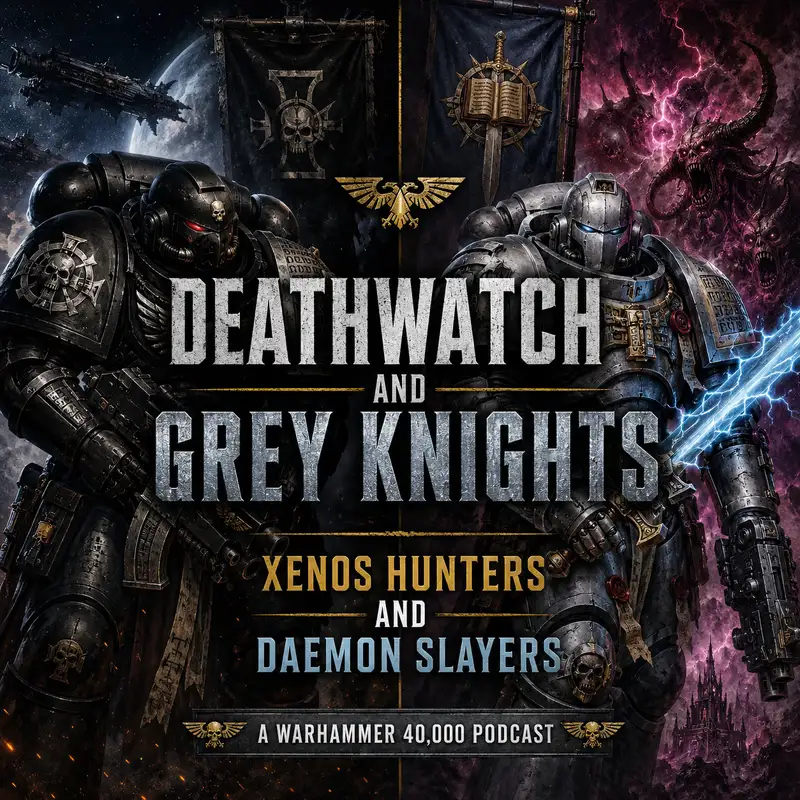
Deathwatch and Grey Knights: Xenos Hunters and Daemon Slayers
There are wars the Imperium celebrates with cathedral bells and victory parades. Then there are wars fought by warriors who arrive without heraldry, kill something that should not exist, and leave behind a battlefield officially described as an industrial accident. The Deathwatch and the Grey Knights belong to that second kind of war. Both are Space Marines. Both serve beside the Inquisition. Both appear when ordinary military force is no longer enough. Yet they are not interchangeable. One hunts enemies from beyond humanity. The other hunts enemies from beyond reality.
That distinction sounds tidy only from a safe distance. The Inquisition divides its work into great branches called Ordos. The Ordo Xenos confronts alien civilisations, organisms, technologies, and infiltrators. The Ordo Malleus confronts daemons and the influence of the Warp. Their associated Space Marine forces are called Chambers Militant, which is the formal Imperial way of saying that investigation has ended and someone exceptionally dangerous must now enter the room. The Deathwatch serves the Ordo Xenos. The Grey Knights serve the Ordo Malleus. Their separate existence answers a basic question. Why does the Imperium need two hidden armies of elite Space Marines? Because a xenos is a creature. A daemon is a violation.
Alien enemies may be ancient, brilliant, incomprehensible, or capable of eating a planet down to the bedrock, but they still operate within the material universe. They have bodies, command systems, supply chains, instincts, technologies, and weaknesses. Even the strangest xenos can be observed. It can be tracked. Its weapons can be tested. Its habits can be learned. There is usually something solid to shoot, though the Tyranids occasionally make the quantity of shooting seem discouraging.
Daemons obey a different order of existence. They are creatures of the Warp, shaped by emotion, thought, symbolism, and the power of the Chaos Gods. A daemon can be cut apart, blasted to fragments, or crushed beneath a tank, yet physical destruction may only banish it from realspace. The conditions that allowed it to manifest can remain. The cult may survive. The ritual may continue. The wound in reality may still be open. A soldier fighting a daemon is therefore not merely trying to kill an enemy. He is trying to deny an idea the right to possess flesh.
The Deathwatch arose from a lesson learned during one of the Imperium’s greatest disasters. In the thirty-second millennium, the War of the Beast brought the Imperium close to destruction beneath an Ork empire of terrifying scale and organisation. The crisis revealed that mass armies and conventional Space Marine deployments could not always reach the decisive point. Small groups of experienced warriors were needed to strike command centres, destroy vital assets, and confront threats too specialised for ordinary formations. From that need came the model that became the Deathwatch: veteran Space Marines drawn from many Chapters, united for a focused mission against the alien.
A normal Space Marine Chapter is a culture as much as a military organisation. Its warriors share gene-seed, rituals, heroes, grudges, doctrines, and often several thousand years of certainty that their own way of war is the sensible one. The Deathwatch deliberately breaks that certainty apart. A kill team may bring together an Ultramarine trained to value ordered doctrine, a Space Wolf who trusts instinct and aggression, a Raven Guard expert in concealment, an Imperial Fist who treats withdrawal as a personal insult, and a Blood Angel carrying burdens he will not discuss. They are all Space Marines. That does not mean they agree on how to open a door.
Their armour is repainted black for the Long Vigil. The silvered Deathwatch insignia marks their new duty, while one shoulder still bears the colours and symbol of the Chapter that made them. This is not a small detail. A Deathwatch warrior does not cease to be a son of his Chapter. He carries its honour into a brotherhood assembled from strangers. Service may last for a mission, for decades, or for far longer. Some eventually return home with knowledge they are sworn not to share freely. Others remain with the Watch until death, necessity, or an Inquisitor’s definition of mission completion finally releases them. The last of these may take some time.
The genius of the Deathwatch is not that it gathers the strongest warriors. The Imperium has no shortage of warriors who believe they qualify. Its real strength is that it gathers experience. Every member brings memories of enemies his Chapter has faced before. One may understand Ork command behaviour. Another may recognise the signs of a Genestealer Cult. Another may know how Aeldari forces manipulate distance and timing. Another may have survived a Necron weapon that removed the man beside him so thoroughly that even the scorch mark seemed uncertain. The kill team becomes a living archive, armed with bolters and a low tolerance for field research delays.
This matters because the word xenos conceals an almost useless range of possibilities. Orks become more dangerous as their wars gather momentum. Tyranids adapt biologically and consume the resources required to resist them. Genestealer Cults infiltrate a society before the fleet arrives, turning families and local faith into weapons. Necrons combine impossible technology with the political habits of an empire that refuses to admit it died. Aeldari warhosts may act according to futures no human commander can see. Drukhari raiders seek terror and captives rather than territory. One universal anti-alien plan would therefore be convenient, simple, and fatal.
Deathwatch kill teams are built around the threat. Their weapons, armour, specialists, and method of insertion can be selected for a particular enemy. They use specialised ammunition, rare devices, and carefully gathered intelligence. Their Watch Fortresses are not merely barracks. They are arsenals, archives, laboratories, prisons, and listening posts placed near regions where alien threats are expected to emerge. From these hidden strongholds, the Deathwatch studies migrations, disappearances, intercepted signals, biological samples, ruined colonies, and technologies that more orthodox Imperial authorities would prefer to destroy before anyone learned anything useful.
That creates the central contradiction of the Deathwatch. The Imperium teaches that the alien is unclean and must be rejected. The Deathwatch protects the Imperium by examining the alien more closely than almost anyone else dares. Its warriors learn foreign anatomy, strategy, language, weaponry, and psychology. In extreme cases, alien devices may be contained, tested, or turned against their makers. This does not make the Deathwatch tolerant. It makes them informed, which in the Imperium is often considered a more alarming condition.
Knowledge also introduces danger. To understand an enemy is to spend time near its ideas. Some xenos technologies tempt the Adeptus Mechanicus. Some alien societies expose uncomfortable weaknesses in Imperial claims. Some enemies are not mindless beasts but civilisations with histories, loyalties, and reasons of their own. The Deathwatch is not asked to admire those reasons. It is asked to know enough to destroy the threat. That is a narrow path, watched closely by Inquisitors who are themselves famous for disagreeing over how narrow a path should be.
The Deathwatch therefore fights like a hunter. It identifies the species, studies the pattern, isolates the critical weakness, and strikes before the wider threat can react. A kill team may assassinate a leader, destroy a spawning site, recover an artefact, sabotage a portal, or expose an infiltrated government. Its members are not usually sent to win a conventional war by themselves. They are sent to remove the reason the conventional war is being lost.
The Grey Knights begin from the opposite assumption. Against daemons, knowledge is necessary, but knowledge itself may be infectious. A name can be a weapon. A symbol can be a doorway. A book can corrupt the person assigned to burn it. The warrior sent against such an enemy cannot merely be experienced. He must be remade so completely that his mind, body, armour, weapons, and very identity become parts of the same defence.
The origins of the Grey Knights lie in the final catastrophe of the Horus Heresy. As the Emperor’s realm collapsed into civil war and Chaos revealed itself openly, Malcador the Sigillite gathered individuals capable of continuing a secret struggle after the Heresy. The surviving accounts are layered with concealment and later legend. Even so, the broad shape is clear. A new brotherhood was prepared on Titan, the moon of Saturn, hidden from the wider war. It would emerge as a Chapter created for one purpose: to fight the daemonic enemy that ordinary armies were not built to face.
They became Chapter Six Hundred and Sixty-Six, though the number is less important than the secrecy surrounding it. Unlike the Deathwatch, the Grey Knights are not veterans temporarily gathered from existing Chapters. They are a permanent and separate brotherhood. Their recruits are chosen for psychic potential, strength of will, and the ability to survive trials designed to break almost anyone subjected to them. Every Grey Knight is a psyker. In another Imperial institution, that fact would require chains, guards, and several forms signed by nervous officials. On Titan, it is the minimum entry requirement.
Psychic power is dangerous because it reaches into the Warp, the same realm from which daemons emerge. The Grey Knights answer that danger through relentless conditioning, ritual discipline, implanted wards, collective training, and an identity built around resistance. Their Chapter claims a genetic legacy drawn from the Emperor himself. Whether every outsider would understand that claim literally is almost beside the point. The Grey Knights understand themselves as weapons forged from the Emperor’s authority, and that belief is reinforced through every part of their existence.
Their silver armour is called Aegis armour. It is engraved and layered with protective sigils, consecrations, and psychically active defences. Their Nemesis force weapons are attuned to their wielders, allowing psychic power to travel through blade, hammer, or halberd. Wrist-mounted storm bolters give them firepower without occupying the hands needed for those weapons. Their strike forces often arrive by teleportation, appearing close to the heart of an incursion before the enemy can strengthen its hold on reality. They do not simply charge into the impossible. They arrive carrying an extensively prepared argument about why the impossible is not welcome.
Their greatest weapon, however, is unity. A Deathwatch kill team gains strength from difference. A Grey Knight formation gains strength from minds trained to act together. Their psychic abilities reinforce wards, disrupt manifestations, shield their brothers, and turn disciplined will into force. Against a daemon, conviction is not merely morale. It has battlefield effect. A Grey Knight does not fight only with muscle and ammunition. He fights with a soul trained to remain closed when something ancient begins speaking from inside his thoughts.
This is why ordinary Space Marines, formidable as they are, cannot simply replace them. A company of Space Marines can destroy a cult army. It can bombard a corrupted fortress and kill possessed warriors by the hundred. Yet if it does not understand the ritual structure of the incursion, the true nature of the possessing entities, or the means by which the Warp is bleeding into realspace, it may win every visible engagement and still lose the war. Grey Knights are trained to locate the point where physical battle and metaphysical corruption meet.
Their victories are often acts of banishment rather than simple destruction. The daemon must be weakened, named, bound, denied, or driven back through the breach that sustains it. The cult’s symbols may have to be shattered in a particular sequence. A possessed relic may have to be contained rather than merely struck with something heavy. The incursion’s mortal servants may need to be destroyed before the greater entity can be confronted. This is warfare conducted partly through fire and steel, and partly through ritual logic. It resembles an exorcism performed by armoured giants who have sensibly brought artillery.
Secrecy follows them because knowledge of Chaos is not neutral. The Imperium fears that witnesses may become carriers of corruption, targets for daemonic influence, or founders of the next cult. Records can spread forbidden names. Survivors can repeat what they saw. Even victory can leave contamination behind. For much of Imperial history, those who fought beside the Grey Knights risked memory alteration, imprisonment, or death once the battle ended. The policy was brutal, but it followed the cold reasoning of quarantine. When the disease can speak, remember, and promise revenge, the witness may be part of the battlefield.
That logic produced one of the darkest episodes associated with the Grey Knights. During the First War for Armageddon, they helped confront and banish Angron, the Daemon Primarch of the World Eaters, after a vast incursion of Khorne’s forces. The military victory was extraordinary and terribly costly. The aftermath became something else. Imperial authorities attempted to contain knowledge of the invasion by purging or imprisoning survivors. The Space Wolves resisted, refusing to accept the destruction of loyal soldiers and civilians who had already endured the war. The resulting conflict became known to the Grey Knights as the Months of Shame.
The episode matters because it prevents the Grey Knights from becoming simple silver heroes. They face enemies that can corrupt worlds, and they serve an institution that often answers risk with extermination. Some Grey Knights have shown restraint, judgement, or unease. Others have carried out orders whose logic is defensible only if one accepts that human lives are variables in a containment equation. The Space Wolves saw betrayed survivors. The Inquisition saw possible vectors. Both understood part of the truth, and people died in the space between those understandings.
Both organisations are associated with the Inquisition, but neither is merely a collection of obedient bodyguards. Watch Masters command fortresses, preserve traditions, and make strategic decisions shaped by centuries of war. Grey Knight Grand Masters possess knowledge that few Inquisitors can match and authority born from an older, darker mandate. Cooperation can be close, but friction is inevitable. An Inquisitor thinks in terms of a case, a conspiracy, or a threat to be contained. A Space Marine commander thinks in terms of honour, mission, and the survival of his warriors. Add secrecy, unlimited authority, and weapons capable of destroying cities, and professional disagreements can become energetic.
On the battlefield, the difference between the two forces can be stated through the questions they ask. The Deathwatch asks: What is the enemy? How does it reproduce, command, travel, communicate, and kill? Which organ, leader, machine, or belief holds the larger threat together? The Grey Knights ask: What has entered reality? What summoned it? What name binds it? Which mind, relic, place, or ritual anchors it here? How much of the surrounding world has already become part of the incursion?
The Deathwatch studies variation. The Grey Knights enforce purity. The Deathwatch combines warriors whose differences create options. The Grey Knights strips away difference until a brotherhood can act with one psychic purpose. Deathwatch veterans often preserve the visible symbol of their parent Chapter and may eventually return to it. Grey Knights surrender their former lives so completely that even their names become weapons and safeguards. One organisation turns many traditions outward against the alien. The other turns a single, relentless discipline inward against corruption.
They also embody two different forms of secrecy. The Deathwatch hides methods, targets, discoveries, and dangerous technology. Its existence is not wholly unknown, but much of its work is concealed because forewarning the enemy would be unhelpful. The Grey Knights historically concealed their very existence because awareness of the daemonic threat was treated as a danger in itself. The Deathwatch protects intelligence. The Grey Knights protects reality from what intelligence may invite.
In the Era Indomitus, both missions have become harder to contain. The Great Rift has spread warp storms, possession, and daemonic incursions across a divided Imperium. The Grey Knights can no longer appear at every breach, and secrecy becomes difficult when the sky itself is torn open. At the same time, Tyranid invasions, awakening Necron dynasties, Ork empires, Genestealer uprisings, and countless lesser xenos threats force the Deathwatch to guard too many frontiers with too few warriors. Elite forces are useful because they can reach decisive points. They are less useful when every point becomes decisive at once.
That pressure reveals the final truth about both organisations. Neither exists because the Imperium is strong. They exist because it is too vast, too slow, and too fractured to respond cleanly to specialised threats. The Deathwatch is an admission that hatred without understanding is poor strategy. The Grey Knights is an admission that courage and firepower cannot solve every war. Each is a correction applied after catastrophe, maintained in secrecy because the wider Imperium would rather believe its normal institutions are sufficient.
The Deathwatch stands at the edge of known space, learning the shape of enemies humanity insists are beneath understanding. The Grey Knights enters places where thought has become predatory and refuses to let fear open the door wider. One survives by studying what is alien. The other survives by denying what is intimate, whispered, and already inside the mind.
They are xenos hunters and daemon slayers, but those names describe only the final act. Before the Deathwatch fires, it must understand. Before a Grey Knight strikes, he must remain himself. Their wars are different because their enemies threaten humanity in different ways. The alien may conquer the Imperium, consume it, replace it, or inherit its ruins. The daemon offers something more dangerous. It offers to make humanity a willing participant.
So the black-armoured kill team and the silver brotherhood keep separate vigils. One watches the darkness between the stars. The other watches the darkness that answers when mortals stare too long into themselves. Both defend humanity by approaching the thing they were created to hate, close enough to learn how it kills, and close enough to risk becoming part of the answer.