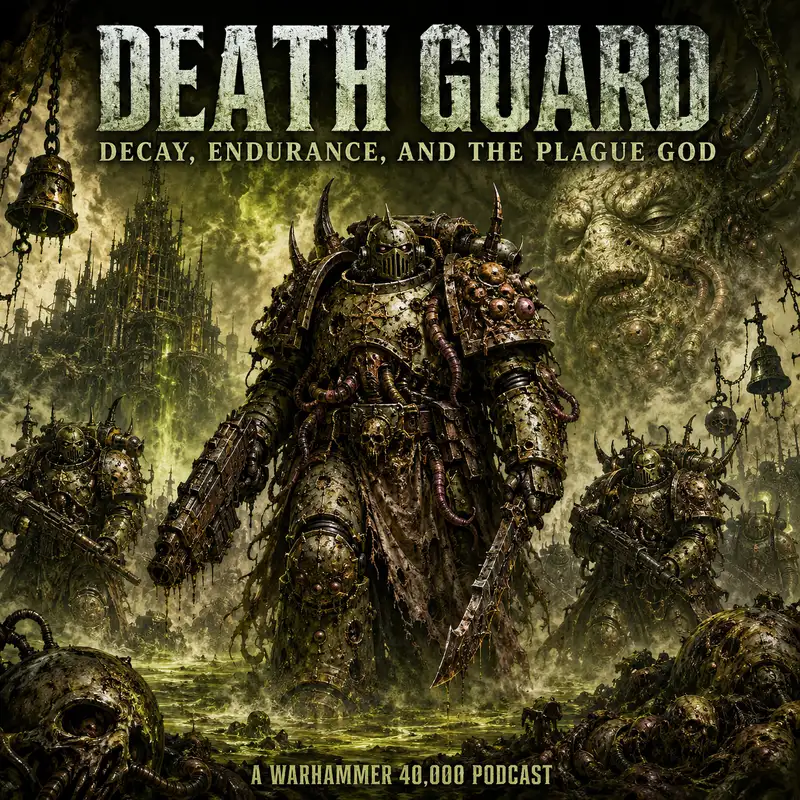
Death Guard: Decay, Endurance, and the Plague God
The first sign of the Death Guard is often not gunfire. It is corrosion. Seals fail inside bunkers that passed inspection that morning. Water develops an oily skin. Medicae scanners return impossible readings, then stop working altogether. Flies gather where no living insect should be able to survive. Somewhere beyond the defensive line, bells begin to toll through the fog.
Then the figures appear.
They do not charge. They do not need to. Vast warriors in ruined power armour walk through artillery bursts with the patience of men crossing bad weather. Bolter fire punches holes through swollen flesh. Limbs hang at angles that should end a battle. Still they advance, carrying rusted blades, plague weapons, and the certainty that the battlefield already belongs to them. The defenders are not merely fighting soldiers. They are fighting the collapse of the world around those soldiers.
That is the central horror of the Death Guard. They were once created to endure conditions that would destroy other armies. Their strength was discipline, stubbornness, and the refusal to stop. Ten thousand years later, those virtues remain. What changed was their purpose. Endurance became submission. Survival became contagion. A Legion that once prided itself on resisting every poison now serves the god of plague.
Long before Mortarion joined them, the warriors of the fourteenth Legion were known as the Dusk Raiders. They had been raised on Terra during the wars that created the Imperium, with many of their earliest recruits drawn from the hard military cultures of Old Albia. Their preferred method was direct and unadorned. They attacked at the fall of night, when changing light confused sentries and made distances difficult to judge. Their grey armour bore dark red markings on the right arm, a reminder that they acted as the Emperor’s hand of judgment.
The Dusk Raiders were not elegant. They excelled at close-range firefights, attritional assaults, and the kind of campaigns in which victory belonged to whoever could remain functional longest. They could honour a surrender when one was offered. Once the chance had passed, they were implacable. Even before meeting their primarch, the Legion had learned to treat persistence as both a method of war and a measure of character.
Mortarion came from a world that made such ideas look almost gentle.
Barbarus was a planet of poisoned mountains, drowned valleys, and perpetual gloom. Human settlements survived in the lowlands beneath layers of toxic mist. Above them ruled beings described in surviving accounts as inhuman psychic overlords. They commanded armies of the dead and descended from their fortresses to raid the people below. Whether every detail of Barbarus was understood correctly by later Imperial historians is uncertain. The records were restricted even during the Great Crusade. What is clear is that its population lived beneath masters who combined sorcery, terror, and environmental control.
The infant primarch was discovered by the greatest of those rulers, a being called Necare. Necare raised him as a weapon and named him Mortarion. The young primarch grew stronger than any human, yet even he could not breathe the most poisonous air near the highest peaks. He learned war from a monster, then turned against the world that monster had built.
Mortarion descended into the valleys and found the human population. He taught them to fight. Crude breathing equipment allowed his followers to climb farther into the poisonous heights. Villages became an army. One fortress after another fell. The resistance fighters called themselves the Death Guard, because on Barbarus the name was less a boast than a job description.
This was the foundation of Mortarion’s character. He hated tyrants because he had been raised by one. He hated sorcery because sorcerers had ruled his world. He respected ordinary people who endured suffering without complaint. He trusted harsh conditions to reveal worth, which is an appealing belief when hardship has made you strong and a dangerous one when you begin imposing hardship on everyone else.
The Emperor arrived before Mortarion could kill Necare. According to the best-known account, Mortarion accepted a challenge to face his adoptive father alone. He climbed into air even his primarch body could not withstand. His strength failed near the summit. The Emperor intervened, slew Necare, and saved Mortarion’s life.
To the Imperium, this was rescue. To Mortarion, it was humiliation. The Emperor had completed the liberation of Barbarus in a moment and claimed the victory Mortarion had spent years pursuing. Worse, he had done so with power Mortarion could not fully understand and already distrusted. The man who hated sorcerous overlords was expected to kneel before a radiant stranger of impossible strength. The political presentation was magnificent. The family relationship required somewhat more work.
Mortarion accepted command of the fourteenth Legion and renamed it the Death Guard after the army of Barbarus. He filled its ranks with recruits from his home world and remade its culture around endurance, simplicity, and relentless advance. Ornament was treated with suspicion. Comfort was weakness. A warrior should be able to fight with limited support, in poisoned air, across ruined ground, and under weapons that made conventional armies reconsider their career choices.
The Death Guard became specialists in the ugliest work of the Great Crusade. They favoured heavy infantry, close-range firepower, methodical advances, and weapons that contaminated whatever they struck. They could cross chemical wastelands and fight amid radiation, toxins, and industrial ruin. Mortarion did not need a brilliant manoeuvre if he could survive every response until the enemy ran out of answers.
There was courage in this doctrine. There was also a narrowing of the moral imagination. The Death Guard admired those who endured, but they often treated suffering as proof of worth rather than a condition to be relieved. Mortarion had liberated the people of Barbarus, yet he carried the values of Barbarus into the stars. He opposed tyrants while becoming increasingly certain that only his judgment could distinguish liberation from destruction.
Horus understood the grievance beneath that certainty. When the Warmaster rebelled against the Emperor, Mortarion joined him. He did not begin as a cheerful worshipper of Chaos. He believed the Emperor had become the kind of distant, psychic tyrant he had always hated. Horus presented rebellion as a war against hypocrisy and hidden domination.
The irony was already severe. Mortarion rejected the Emperor because he feared sorcery, then allied with a rebellion increasingly sustained by it. He opposed masters who demanded submission, then placed his Legion beneath Horus. He believed he was choosing freedom, but Chaos is exceptionally patient with people who think they are using it for practical reasons.
The first great proof of betrayal came at Isstvan Three. Horus and the rebel primarchs sent elements of their own Legions to the planet’s surface, including warriors whose loyalty to the Emperor remained suspect. The world was then bombarded in an attempt to kill them all. Among the Death Guard loyalists was Battle Captain Nathaniel Garro. His eventual escape aboard the frigate Eisenstein helped carry warning of Horus’s treachery toward Terra.
Garro matters because he breaks the easy explanation. The Death Guard were not doomed simply because they were stubborn, or because Mortarion had been raised on Barbarus. Members of the same Legion faced the same history and chose differently. Endurance could support loyalty as easily as corruption. The Legion’s fall required decisions, betrayals, and a leader who allowed resentment to become a substitute for judgment.
The most important betrayer within the Death Guard was Calas Typhon, later known as Typhus. He had fought beside Mortarion since Barbarus and rose to become the Legion’s First Captain. He was also a powerful psyker whose relationship with the warp ran directly against Mortarion’s stated beliefs. The primarch who distrusted witches placed enormous confidence in one standing at his right hand.
Typhon’s loyalty was never truly to Mortarion. He saw Nurgle not as a last resort, but as a destination. During the Heresy he encouraged the Legion’s movement toward corruption while Mortarion continued insisting that he remained master of his own course. Mortarion even began studying forbidden powers in the belief that understanding them would let him control or defeat them. It is a recurring hazard in the far future. The warp rarely objects when someone approaches it with excellent reasons.
As the traitor forces prepared to assault Terra, the Death Guard fleet entered the warp. Typhon accused the fleet’s Navigators of loyalty to the Emperor and arranged their deaths. He then claimed his own psychic abilities could guide the ships. Instead, the fleet became trapped, unable to reach Terra or return safely to realspace.
Then the plague began.
It spread through ships built to survive void war and through bodies engineered to resist disease. Human crew members collapsed first, but the Space Marines followed. Fevers burned without consuming their victims. Flesh split, swelled, and rotted, yet death would not come. The Death Guard could endure the pain. That was precisely the problem. Their legendary resilience allowed the torment to continue.
Weapons could not end it. Medicine could not name it. Mortarion could not lead his sons out of it. The Legion had encountered an enemy that turned its defining strength against it. Every warrior who refused to die became another living monument to failure.
Mortarion confronted Typhon, but the trap had already closed. Typhon had delivered the Legion to Nurgle, and Nurgle offered a bargain. Mortarion could continue resisting while his sons suffered without end, or he could submit and accept the Plague God’s protection.
The choice echoed the summit of Barbarus. Once again Mortarion was choking in poison he could not overcome. Once again a greater power offered salvation at the price of dependence. On Barbarus, the Emperor had saved him without permission. In the warp, Mortarion asked Nurgle to save his Legion.
He surrendered.
The pain changed. The disease remained, but it became blessing rather than affliction in the minds and bodies of those claimed by Nurgle. Ruined organs continued to function. Armour fused with flesh. Infection became strength. Typhon was transformed into Typhus, host of the Destroyer Hive and Herald of Nurgle. Mortarion became a daemon primarch, no longer merely the master of the Death Guard but a favoured son of the god he had once refused to acknowledge.
The Legion survived by becoming the plague that was killing it.
This is why Nurgle is more disturbing than a simple god of disease. He is also associated with despair, entropy, and the cycle in which living things rot so that new life can feed upon them. His domains are filled with growth as well as death. Fungus blooms. Maggots feed. Swamps bubble with fecund life. Nothing remains clean, separate, or still.
Nurgle presents himself as a grandfather, generous and affectionate. His followers speak of gifts. His daemons can appear jolly, even welcoming. That warmth is part of the trap. Nurgle offers relief from fear by making fear pointless. He offers relief from pain by changing what pain means. He offers belonging by ensuring that everyone shares the same corruption.
For someone who believes nothing can improve, surrender may feel like peace. That is the emotional heart of Nurgle’s power. Rage demands action. Ambition demands effort. Excess demands more. Nurgle asks only that the exhausted stop resisting.
The offer is not kindness. It destroys consent and calls the result acceptance. A plague victim does not become free because the disease teaches him to love his symptoms. Nurgle’s affection is possession with a smile.
Not every Death Guard warrior expresses that faith in the same way. Some are zealous and eager to spread disease. Others remain dour, disciplined, and almost resentful. Some count infections, casualties, or the slow movements of corrupted time. Some remember the Great Crusade with bitterness. Others have surrendered so completely that they regard decay as revelation.
This variety matters because the Death Guard are not mindless corpses. Many are veterans of the ancient Legions, with memories stretching back to the Horus Heresy. They can plan campaigns, command fleets, maintain rivalries, and pursue grudges that have lasted ten thousand years. Their bodies may resemble walking disasters, but their military experience remains intact.
On the battlefield, they still fight according to the logic Mortarion taught them. Their advance is slow, but deliberate. Artillery breaks strongpoints. Plague weapons contaminate survivors and terrain. Daemon engines crawl or drone through the haze. Poxwalkers, victims transformed into shambling carriers, spread panic and infection ahead of the main force. Plague Marines follow through conditions that would destroy the troops sent to stop them.
Their greatest weapon is often not the casualty caused immediately. It is the damage that continues after the shooting ends. Water systems become vectors. Medical stations become crowded, then compromised. Supply crews refuse contaminated cargo. Commanders cannot tell whether a fever is natural, engineered, or supernatural. A single infected position may remain dangerous after the Death Guard have moved on.
This makes their style of war strategically corrosive. A fast enemy can be outmanoeuvred. A powerful enemy can be concentrated against. The Death Guard change the environment in which every decision is made. They turn time, terrain, and the bodies of the defenders into additional fronts.
Their armour tells the same story. Once-clean plate is split by horns, tentacles, swollen tissue, and corroded machinery. Rust does not cause the weapon to fail because the rust itself has become part of the weapon. Gaps that should expose vulnerable flesh reveal bodies too altered to die properly. Bells and censers hang beside ammunition and grenades. The sacred and the septic have become difficult to separate.
They are extraordinarily difficult to kill, but not invincible. Their resilience comes from a mixture of Space Marine physiology, deadened pain, supernatural corruption, and bodies that no longer obey ordinary limits. Enough force can still destroy them. The White Scars proved that during the Siege of Terra when Jaghatai Khan led the assault to retake the Lion’s Gate spaceport. The Khan faced Mortarion and brought down his daemonic brother at terrible cost, banishing him back into the warp.
That victory did not cure the Legion. The Death Guard survived the failure of Horus and withdrew into the Eye of Terror. Mortarion claimed a daemon world known as the Plague Planet and reshaped it in the image of Barbarus. The liberator of the poisoned valleys became the ruler of another poisoned world, surrounded by the same imagery of mist, mountain, and suffering that had formed him.
Typhus refused to remain there. He became the Traveller, carrying Nurgle’s contagions across the galaxy aboard the Terminus Est. His relationship with Mortarion is marked by rivalry and contempt as much as loyalty. Typhus sees himself as the more active servant of Nurgle. Mortarion remains the primarch, but Typhus was the missionary who delivered the Legion to its god.
The Death Guard retain more cohesion than many Traitor Legions, though they are divided into Plague Companies, hosts, and warbands with their own leaders and favoured diseases. Mortarion’s authority persists, but it is not absolute in the simple military sense. Every servant of Chaos exists inside overlapping loyalties, rivalries, divine demands, and personal obsessions. Even an army dedicated to inevitable decay can maintain an impressive amount of internal disagreement.
In the Era Indomitus, the Death Guard emerged in force during the wars that followed the opening of the Great Rift. Mortarion’s campaigns against Ultramar showed what a plague Legion could do to a functioning interstellar realm. The target was not only armies. It was harvests, hospitals, transport routes, civilian confidence, and the belief that order could be restored.
That conflict also returned Mortarion to an old family argument. Roboute Guilliman represented structure, reason, administration, and the attempt to rebuild. Mortarion brought contamination, grievance, and the promise that all systems eventually fail. Their war was fought with fleets and primarchs, but also with two answers to the same question. When civilisation is collapsing, do you repair it, or declare collapse the natural state of things?
The Death Guard answer by making decay inevitable, then calling inevitability wisdom.
Their tragedy is not that they became weak. They remain disciplined, dangerous, and terribly hard to destroy. Their tragedy is that strength lost its direction. Mortarion taught his sons to endure every hardship, but never taught them when endurance should end, what it should protect, or how suffering might be transformed into something better. When Nurgle offered them endless survival, they lacked any purpose stronger than survival itself.
Decay, endurance, and the Plague God are therefore not three separate parts of the Death Guard. They are one continuous path. Endurance without hope becomes acceptance. Acceptance without freedom becomes submission. Submission to Nurgle turns decay from an enemy into an identity.
The bells in the fog announce more than an approaching army. They announce men who survived poison, betrayal, civil war, and ten thousand years of corruption, yet lost the reason they once wanted to survive. The Death Guard endure because almost nothing remains within them that death can take, and nothing is more dangerous than endurance that has forgotten what it was meant to save.