Death, Burial, Saints, and the Afterlife
The dead are never entirely permitted to leave the Imperium. Some are sealed beneath cathedral floors, surrounded by candles and the names of their ancestors. Some are burned in communal furnaces before the next work shift begins. Some are reduced to bones, divided into relics, and carried back into battle. Some are processed into food because a hive city containing billions cannot afford to become sentimental about available protein. A very rare few return with light in their eyes and the authority of the Emperor upon them. In a civilisation built around sacrifice, death is not merely the end of life. It is a religious event, a political resource, an administrative problem, and occasionally a temporary inconvenience.
There is no single Imperial funeral. The Imperium spans void stations, feudal kingdoms, forge worlds, nomadic societies, and hives so vast that the inhabitants may never see the sky. The Ecclesiarchy does not erase every local custom. It absorbs them. A world that once prayed to a sun god may be taught that the sun was always a symbol of the Emperor. Ancestor spirits become honoured servants who now stand in his light. A ritual of burial beneath the household hearth may survive, provided the family understands that every soul and every flame ultimately belongs to Terra. The details can vary almost without limit. The permitted conclusion does not. Humanity serves the Emperor in life, and the faithful hope to join him after death.
That hope matters because Imperial life gives people abundant reasons to fear the alternative. Disease can empty a hab-block. Industrial accidents can consume an entire shift. A tithe ship may carry a regiment away from its home world and never return a single body. War, famine, mutation, plague, and simple exhaustion are not interruptions to the Imperial system. They are part of its normal operation. The promise of an afterlife therefore performs essential work. It tells the labourer that suffering has been witnessed. It tells the soldier that an anonymous death on an unnamed moon is not meaningless. It tells the bereaved that separation is temporary. It also tells everyone still alive that obedience can turn death into victory, a useful doctrine for a state that is never short of dead people.
For the wealthy, death may be treated with the same elaborate inequality that governs life. Noble families build crypts, mausoleums, and private chapels. Bodies may be embalmed, preserved in stasis, enclosed within carved sarcophagi, or displayed beneath devotional images that present the deceased as considerably more pious than surviving witnesses remember. Genealogies are recited because lineage is power. A tomb is a political statement in stone, proof that a family has served long enough to own part of the past. On shrine worlds and old civilised worlds, the dead may lie beneath kilometres of chapels, ossuaries, and memorial vaults. The living walk above them, governed by ancestors who no longer need to attend meetings and are therefore difficult to argue with.
The poor receive what their world can spare. That may be a simple grave, a shroud, a cremation, a communal ossuary, or nothing recoverable at all. In the lower levels of a hive, space itself is valuable. A grave occupies room that could hold a pipe, a generator, or another family. Bodies may be reclaimed by guilds, rendered into chemical stock, or processed into corpse-starch. Necromunda makes this practice especially plain, with corpse harvesters gathering the dead for the grinder plants that feed the hives. It would be a mistake to treat every Imperial meal as recycled citizenry, but it would also be unwise to ask too many questions about a ration block whose label has been printed over three times. The official blessing generally concentrates on gratitude rather than ingredients.
Even where bodies are recycled, ritual does not necessarily disappear. A priest may speak the final catechism before the corpse cart departs. A family may keep a name tablet, a lock of hair, an identity tag, or a pinch of ash. The body can be surrendered while memory is retained. This distinction is important. Imperial faith does not always require an intact corpse, because the Imperium routinely destroys bodies with artillery, plasma, fire, vacuum, acid, and weapons whose effects are best described by specialists standing at a considerable distance. What matters is that the death is placed within a sacred story. The individual served. The Emperor saw. The soul has gone where the body cannot follow.
On the battlefield, even that small dignity may be difficult to provide. Astra Militarum regiments fight far from home under conditions that make careful burial impossible. When time and security allow, the dead may be gathered, identified, blessed, and buried or burned. When they do not, trenches become graves, ruined buildings become tombs, and battlefields are left to weather, scavengers, and the next bombardment. Some names survive in regimental rolls or the memories of comrades. Many do not. The Departmento Munitorum records casualties because armies require accounting, although Imperial accounting has never been a dependable form of immortality. A soldier may be listed as dead, missing, transferred, or all three, sometimes in that order.
The contrast reaches its grandest scale on Holy Terra. There, the Bell of Lost Souls is said to toll when a great hero of the Imperium dies. Its voice rolls across the Throneworld, announcing that someone important has passed into glory. For every hero honoured by that thunder, uncounted millions die without a bell, a marker, or a clerk who spells their name correctly. Yet the distinction does not necessarily weaken Imperial faith. It reinforces the hierarchy. The hero becomes a symbol for all the unnamed dead. His or her public death is expanded until it can contain the sacrifice of armies. The Imperium rarely possesses enough truth to honour everyone individually, so it constructs a monument large enough to speak for the multitude.
This is where burial becomes remembrance, and remembrance becomes power. The Ecclesiarchy does not merely comfort the grieving. It decides which deaths should be repeated in sermons, carved into cathedrals, painted onto banners, and carried from world to world. Martyrdom is particularly valuable. A martyr proves that faith can endure pain, fear, and apparent defeat. The martyr’s death can transform a failed defence into a moral victory, a massacre into a pilgrimage site, or a lost war into a reason to begin another one. None of this means the faith is necessarily false. The courage may have been real. The sacrifice may have saved lives. The miracle may have happened. It means that the Imperium understands something every empire eventually learns. The dead cannot object to the uses made of their memory.
Relics give that memory a physical form. A saint’s bones, clothing, weapon, blood, armour, or personal possessions may become objects of veneration. Fragments are enclosed in reliquaries and borne through processions. Great relics draw pilgrims across interstellar distances. Lesser ones accompany soldiers into battle, where the presence of a martyr’s finger bone may steady a line more effectively than a speech from an officer. The Orders Pronatus of the Adepta Sororitas seek out and safeguard sacred treasures, while priests, confessors, and relic bearers place them before the faithful. In a rational universe, this might be symbolism alone. The galaxy has never shown much interest in remaining rational. Faith, emotion, and the Warp interact, and objects saturated by belief may become centres of effects that witnesses call miracles.
Authenticity is another matter. The Imperium contains countless shrines, innumerable martyrs, unreliable archives, broken supply routes, and officials with varying relationships to honesty. Not every relic can be genuine. Some are mistaken. Some are duplicated through innocent error. Some are promoted because a cardinal requires a pilgrimage to rescue a failing local economy. A sufficiently celebrated saint may possess enough alleged bones to assemble several complete skeletons, each one certified with impressive seals. Yet fraud does not make every relic powerless. If millions believe that an object represents sacrifice, their devotion may invest it with significance regardless of its original owner. In the Imperium, belief can survive bad provenance. It has survived worse.
A saint is more than a famous dead person. Imperial saints are models of service whose lives and deaths are understood as evidence of the Emperor’s favour. Some were warriors. Some were missionaries, rulers, healers, or reformers. Many were martyrs. Their cults may begin locally, among survivors who witnessed an act of courage or an apparent miracle. Stories spread. Pilgrims arrive. Clergy investigate, endorse, reshape, or suppress the devotion. Recognition is never wholly separate from politics, because a saint can legitimise a crusade, unite a divided population, or threaten authorities who would prefer the faithful to admire someone less inconvenient. Sainthood is therefore both a religious judgement and a struggle over who controls memory.
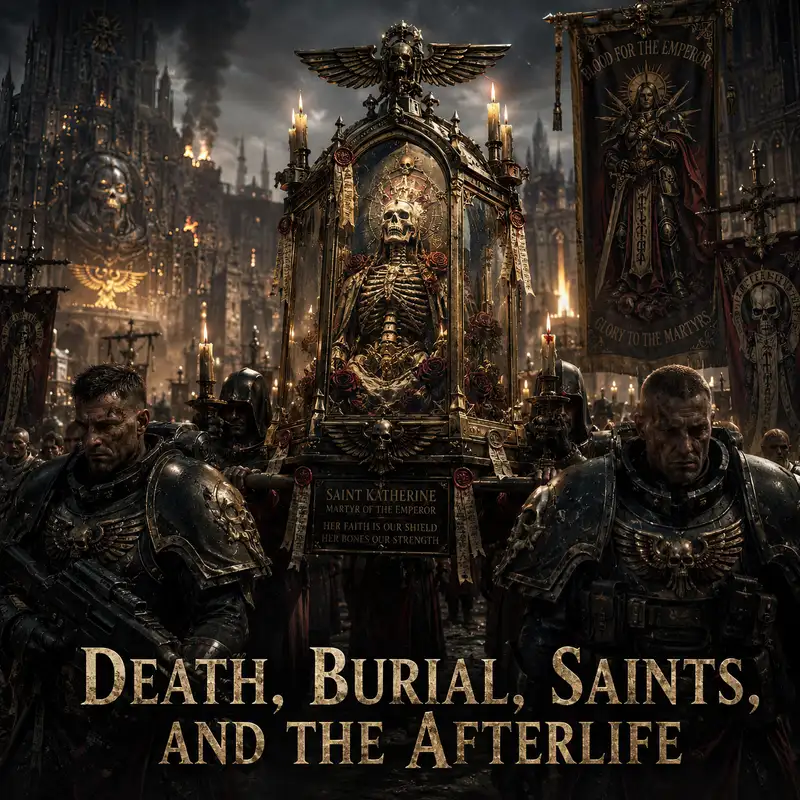
The six founding figures associated with the great Orders of the Adepta Sororitas show how thoroughly personal memory can become institutional structure. Alicia Dominica and her companions helped bring down Goge Vandire during the Age of Apostasy, after an encounter within the Imperial Palace whose exact nature remains unknown. Their legacy shaped the Orders Majoris, and their example became inseparable from the identity of the Sisters of Battle. Saint Katherine’s remains are carried in the Triumph of Saint Katherine, a funerary procession guarded by six relic bearers. The procession does not hide death. It places a skeleton at the centre of military devotion and marches it toward the enemy. The message is direct. Katherine died, but her authority did not. Her body no longer fights, yet armies fight differently because it is present.
That procession captures the Imperial understanding of holiness. A saint is not safely retired into the past. A saint remains operational. Bones inspire courage. A tomb becomes a strategic destination. A feast day becomes a tool for organising society. A shrine becomes a fortress because enemies understand its value. Pilgrim routes move wealth, people, rumours, disease, and occasionally entire wars. The Imperium’s sacred geography is built from places where someone died, appeared, bled, spoke, or was believed to have performed a miracle. Death creates locations that must be defended, recovered, or avenged. The line between cemetery and battlefield becomes very thin. In some cases it is marked only by which direction the procession is moving.
Then there are the Living Saints, whose existence turns doctrine into a much more difficult question. Saint Celestine is the best-known example. She has been slain and returned, appearing amid war in radiance and flame, inspiring the faithful and destroying the enemies of the Imperium. To believers, she is a direct instrument of the Emperor’s will. To a sceptical observer within the setting, she might appear to be a uniquely powerful psychic manifestation shaped by Imperial faith. Those explanations are not necessarily opposites. The Emperor is a psychic presence of immense power, the Warp responds to thought and emotion, and Celestine’s miracles produce real consequences. Calling something a miracle does not make it unreal. Calling it a Warp phenomenon does not explain it away.
Accounts that follow Celestine beyond death portray resurrection not as effortless reward, but as ordeal. She must struggle through a realm shaped by memory, guilt, identity, and temptation before returning to life. This experience cannot be treated as a simple map of the afterlife. Celestine is exceptional, bound to forces most humans never encounter. Still, her repeated return suggests that death in the Imperium is not always a sealed door. For a chosen soul, or perhaps a soul capable of choosing again, it can be a battlefield. The fact that she returns does not prove that every faithful citizen waits in peace beside the Emperor. It proves only that at least one saint has work left to do, which is a very Imperial form of salvation.
The official promise is simpler. The faithful are told that they will join the Emperor, rest in his light, or continue to serve him beyond mortal life. The wording changes from world to world. Some imagine a court of honoured ancestors. Some expect reunion with fallen comrades. Some believe they will stand as spiritual soldiers in the Emperor’s final war. The Ecclesiarchy can accommodate many images so long as they reinforce loyalty, courage, and the supremacy of the Master of Mankind. A miner does not need a precise theological model of the soul. He needs to believe that the darkness beneath the earth is not the last darkness he will see.
The known nature of the Warp makes that promise uncertain. Human souls enter the Immaterium at death, but they do not all remain coherent. Most ordinary souls appear to fade quickly into its vast psychic turbulence. Stronger souls, especially those of psykers, may persist longer and attract dangerous attention. Daemons hunt, consume, imitate, and corrupt. The Warp is formed from emotion and thought, but it is not a gentle archive of human personality. It is a storm in which identity can dissolve. This is why claims about the afterlife must be treated carefully. The records establish no universal fate. They offer fragments, visions, miracles, hauntings, and testimony from highly unusual witnesses.
The Emperor may protect some souls. There are moments when his light appears to resist daemonic power, when the faithful experience intervention, and when saints return bearing signs that something answered them. There are also innumerable deaths in which no rescue is visible. Whether the Emperor cannot save everyone, chooses not to, or acts through means mortals fail to recognise is a theological question the Imperium answers with certainty and the setting leaves deliberately unsettled. The distinction matters. Imperial citizens believe in an ordered afterlife because they need one. The audience sees enough evidence to suspect that their faith touches something real, but not enough to conclude that the promised peace is guaranteed.
At the centre of the entire religion sits the Emperor himself, enthroned between life and death. His ruined body remains upon the Golden Throne. His mind reaches across the Warp through the Astronomican and through powers that have become more visible as the galaxy has darkened. To the Imperium, he is a god who sacrificed himself and still rules. To the institutions around him, he is also the indispensable component of systems they barely understand. The boundary between corpse, sovereign, beacon, prisoner, and deity has been blurred for ten thousand years. It is hardly surprising that the civilisation built around him cannot regard death as a simple ending. Its god is a body that should have died and a presence that refuses to disappear.
Space Marines embody the same refusal in a more practical form. When an Astartes is mortally wounded but still capable of survival, his remains may be sealed within the life-support sarcophagus of a Dreadnought. He becomes an armoured war machine, awakened for battle and counsel, then returned to long sleep as the centuries pass. This is not resurrection and not truly death, but it is close enough to trouble ordinary definitions. A Chapter may revere such a warrior as an ancient link to its past. The person survives, though altered by pain, isolation, and time. The Imperium calls this continued service. The Dreadnought may have other words for it, particularly after being awakened to discover that everyone he knew has been dead for eight hundred years.
Even when a Space Marine dies completely, his body remains important. Apothecaries recover the progenoid glands that carry the Chapter’s gene-seed, allowing future generations to be created. Armour, weapons, and bones may become relics. Names are entered into rolls of honour, and Chapter-specific rites return the dead to flame, stone, earth, ice, or crypt according to tradition. Here again, burial is not merely farewell. It preserves continuity. A fallen battle-brother contributes biologically, materially, and spiritually to those who follow. The individual is gone, but part of the Chapter’s future is literally removed from his body before the enemy can take it. There are few clearer examples of the Imperial conviction that nothing useful should be allowed to stop serving merely because it has died.
All these practices reveal the same underlying truth. The Imperium cannot prevent death, so it governs death. It names acceptable forms of mourning. It decides which bodies become relics and which become rations. It turns heroes into saints, saints into institutions, and institutions into reasons for further sacrifice. This can be cynical, sincere, or both at once. A priest may genuinely comfort a widow while repeating doctrine that helps recruit the widow’s surviving children. A pilgrim may be exploited by a shrine that nevertheless contains a relic capable of driving back a daemon. A martyr’s story may be altered by propaganda without erasing the courage of the person who died.
So what awaits the faithful after death? The honest answer is that no living Imperial authority can prove the full shape of it. The Creed promises the Emperor’s light. The Warp offers dissolution, predation, and rare impossible returns. Saints suggest that devotion can preserve identity and purpose, but their very rarity warns against assuming the same fate for everyone. Burial rites protect the living from despair. Relics make memory tangible. Martyrdom converts loss into obligation. Each practice stands between humanity and the terrifying possibility that a life of suffering may end without explanation.
In the final image, Saint Katherine’s bones move through the smoke of battle while living warriors gather around them. Somewhere far below a hive, an unknown labourer’s body enters a furnace and a priest speaks his name once before the machinery closes. On Terra, a bell tolls for a hero. Across the galaxy, families light candles for people whose graves they will never see. The Imperium offers them no reliable peace, only a promise that service, memory, and faith can carry something beyond the grave. In a universe where belief can wound daemons and the dead sometimes rise, that promise is neither wholly true nor safely false. It is the narrow bridge on which humanity walks into the dark.