Daemons: Ideas Given Claws and Teeth
The artillery stops because there is nothing left in front of the guns that looks alive. Then the smoke begins moving against the wind.
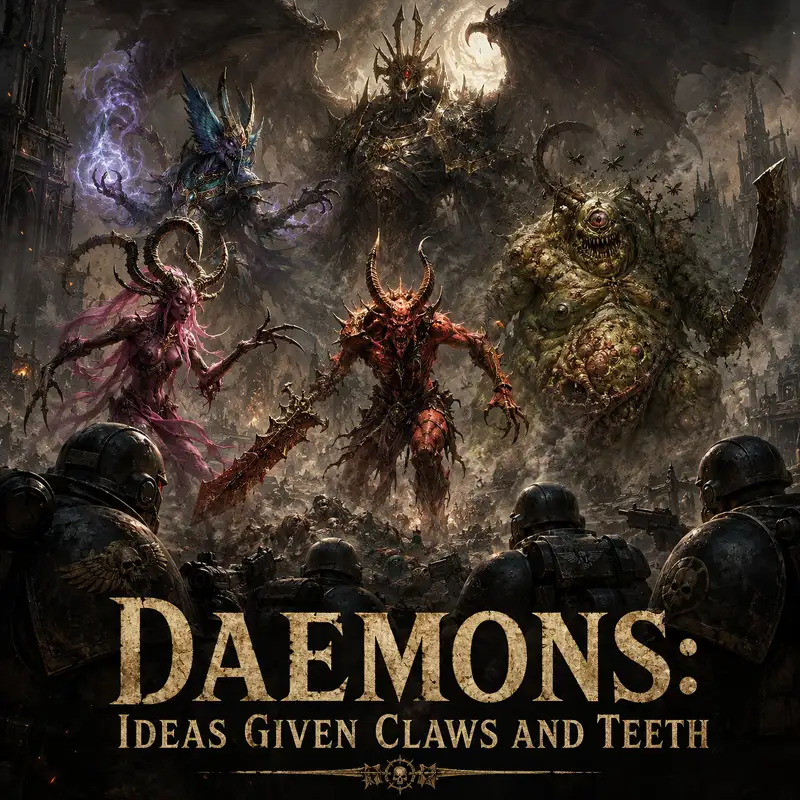
Shapes gather inside it. Some are lean and horned, carrying blades that seem too bright for the ruined world around them. Others crawl on swollen limbs beneath clouds of flies. A few wear beauty like a weapon, every movement graceful until the eye notices the claws. Behind them comes something larger, a silhouette with wings, armour, and a face that seems familiar for reasons no one can explain. The soldiers facing them know these creatures can be shot, cut, burned, and driven back. They also know that none of those facts make the creatures entirely real.
That is the first problem with daemons. They arrive in the material universe wearing bodies, but they are not truly creatures of flesh. They speak, plan, hate, bargain, remember insults, and sometimes display more personality than the mortals who summoned them. Yet beneath the horns and swords, the laughter and the rot, a daemon is something closer to an emotion that has learned how to hunt.
The Warp is often described as another dimension, though that phrase makes it sound far more orderly than it is. It is the immaterium, a realm shaped by psychic energy, emotion, memory, desire, fear, and belief. Every thinking species leaves an impression upon it. A moment of rage does not simply vanish when the heart slows. A lifetime of ambition does not end at the edge of the skull. The psychic echo of sentient life pours into the Warp, where similar impulses gather, reinforce one another, and form patterns.
Over unimaginable spans of time, those patterns can become vast. Rage feeds rage. Despair calls to despair. Hope twists into ambition, then into schemes, then into the belief that everything can still be changed if one more risk is taken. Desire becomes obsession. The wish to excel becomes the inability to stop. These currents do not remain passive. In the Warp, powerful patterns can acquire awareness. Awareness develops appetite. Appetite becomes will.
The Chaos Gods are the greatest examples, storms of emotion and concept so enormous that mortals can perceive only fragments of them. Khorne is not simply an angry person magnified to cosmic size. He is wrath, violence, martial pride, hatred, bloodshed, and the endless demand that conflict be settled through force. Tzeentch is change, ambition, manipulation, hope, sorcery, and the refusal to accept the world as it is. Nurgle is decay, despair, endurance, resignation, fecundity, and the strange comfort of surrender. Slaanesh is excess, desire, perfection, sensation, obsession, and the hunger that grows stronger each time it is fed.
A daemon of one of these powers is often described as a fragment of its god. That is accurate, but only if we allow the word fragment to do some unusual work. A Bloodletter is part of Khorne, but it is not merely a finger clipped from a larger body. A Great Unclean One is part of Nurgle, but it can possess a name, memories, rivals, preferences, and a sense of humour that is best appreciated from another solar system. A Lord of Change may pursue plans that appear entirely personal, though those plans still express the nature of Tzeentch. A Keeper of Secrets can cultivate grudges and ambitions of its own while remaining inseparable from the power that formed it.
The relationship resembles a flame throwing off sparks, except the sparks can argue, scheme, and occasionally believe they ought to be the fire. Daemons may compete for favour. They may hate one another. They can be punished, reshaped, promoted, diminished, or cast aside by their patron. Some rise to command hosts. Others are consumed or reabsorbed. Their individuality is real enough to matter, but never so complete that they escape the nature from which they were made.
That limitation explains why daemons can be cunning without being free in the mortal sense. A daemon of Khorne may choose where to attack, whom to challenge, and how to pursue glory, but it cannot become a sincere advocate of patient diplomacy. A daemon of Tzeentch may tell the truth, but usually because the truth will change something, deceive someone, or serve a more elaborate design. A daemon of Nurgle may show affection, yet that affection is inseparable from decay and surrender. A daemon of Slaanesh may admire discipline, artistry, or devotion, but it will pull those virtues toward compulsion and excess.
They are not actors wearing the masks of their gods. The mask is the face.
This is why the forms taken by daemons matter. Their bodies are not products of natural evolution. They are symbols given temporary anatomy. Bloodletters are lean, red killers because they embody direct slaughter, martial aggression, and the reduction of argument to a blade. Plaguebearers carry swollen bodies, single staring eyes, and the marks of disease because they represent corruption made patient and inevitable. Horrors of Tzeentch are unstable, colourful, divided things because change itself refuses to remain in one shape. Daemonettes combine allure, speed, grace, and mutilating claws because desire in the service of Slaanesh must invite before it consumes.
These appearances are not always perfectly consistent. The Warp does not respect anatomy, and mortal minds help interpret what they see. A daemon may appear differently to different witnesses. Symbols can change across cultures. A creature understood by one civilisation as a horned warrior might be perceived by another through entirely different mythic language. Even so, daemons return to recognisable themes because their forms express what they are. Their bodies are arguments.
Greater daemons make the same argument with more force. A Bloodthirster is not merely a larger Bloodletter. It is war elevated into a commanding presence, an engine of challenge, dominance, and slaughter. A Lord of Change embodies sorcery, foresight, manipulation, and the cruel instability of knowledge. A Great Unclean One presents decay not as a sudden catastrophe but as a vast, almost affectionate inevitability. A Keeper of Secrets turns beauty, skill, temptation, and terror into one impossible presence. To stand before one is not simply to face a powerful enemy. It is to be placed inside the emotional world of its patron.
Their power is therefore psychological as well as physical. A daemon does not need to kill every defender if it can make the defenders become more like the force that created it. Rage answers Khorne. Desperate hope feeds Tzeentch. Resignation welcomes Nurgle. Obsession opens the way to Slaanesh. The victim may resist the daemon and still strengthen the current behind it. A soldier who meets horror with disciplined courage can deny that process. A commander who answers every setback with greater cruelty may believe he is fighting Chaos while marching to its rhythm.
The Imperium understands enough of this to be terrified and not enough to be safe. Its institutions often treat knowledge of daemons as contamination. Entire populations may be censored, quarantined, mind-wiped, or destroyed after exposure. Such measures are brutal, but the fear behind them is not entirely irrational. Knowledge can provide vocabulary. Vocabulary can provide shape. Shape can become invitation.
The Imperial response, as usual, is to solve a metaphysical problem with secrecy, ammunition, and several layers of authority that do not trust one another.
Yet daemons cannot simply walk into the material universe whenever they please. The Warp is their native medium. Realspace has rules they do not naturally possess. Matter remains matter. Time generally moves in one direction, a habit the Warp regards as provincial. Distance is measurable. Bodies require continuity. A daemon attempting to manifest in realspace must impose its symbolic form upon a realm that resists it.
This requires an opening. A psyker may become that opening. So may a ritual, a mass sacrifice, a corrupted relic, a warp storm, a breach in a Gellar field, or a place where violence and suffering have weakened the boundary between realities. The details vary, but the principle remains the same. The daemon needs energy, meaning, and access.
Ritual is especially important because ritual gives structure to the impossible. Symbols, names, numbers, sacrifices, gestures, and repeated acts create a pattern that the Warp can follow. The participants may believe they are commanding a daemon through precise formulae. Sometimes they are correct for several minutes, which is usually long enough to become overconfident. More often, the ritual does not force a daemon into obedience so much as construct a doorway shaped exactly like its interests.
Summoning is therefore a negotiation conducted with something that understands desire better than the summoner understands himself. A cultist may ask for revenge. The daemon hears rage, humiliation, and the willingness to sacrifice others. A noble may ask for beauty that never fades. The daemon hears fear of decline, hunger for admiration, and an opening wide enough to crawl through. A dying soldier may ask only for the strength to endure. Nurgle has built empires from requests no larger than that.
Possession offers another route. Instead of building a temporary body from warp energy, a daemon inhabits a mortal host. The host provides flesh, senses, and a foothold in reality. The daemon provides power and a rapid collapse of every boundary the victim believed was permanent. Possession can be forced, invited, accidental, or disguised as communion. It may begin with whispers, dreams, compulsions, or sudden abilities. By the time the victim recognises the bargain, the negotiator may already be using his mouth.
Possessed bodies are not always stable. The daemon reshapes flesh according to its nature. Limbs lengthen. Faces split. Armour merges with skin. Wounds become mouths or eyes. The result is not random mutation. It is the pressure of symbolic identity forcing itself through biological material. Flesh is being made to confess what now lives inside it.
A daemon may also bind itself to a weapon, machine, statue, or other object. Daemon engines are among the most brutal expressions of this practice, combining industrial construction with a captive or willing warp entity. The machine gains malice, appetite, and a degree of autonomy. The daemon gains armour, weapons, and a body that can remain useful even when reality is being stubborn. The result is theology with tracks, claws, and inadequate safety procedures.
Once manifested, daemons can be harmed by ordinary weapons. This sometimes seems contradictory. If they are ideas, why does a bolter shell matter? Because manifestation is commitment. To enter realspace, the daemon must accept a form. That form can be disrupted. Enough physical damage can break the pattern holding it in place, sever its connection to the Warp, and banish it.
Banishment is not usually death. The daemon’s real existence remains in the immaterium. Its material body collapses, burns, dissolves, or is pulled back into unreality. The creature may be unable to return for years, centuries, or longer, depending on the circumstances. From a mortal perspective, that is often good enough. From the daemon’s perspective, it is a humiliating interruption followed by an eternity in which to remember the person responsible.
Certain forces can do more than ordinary weapons. Psychic power can attack the structure that sustains a daemon. Sacred symbols may matter when backed by genuine belief, ritual authority, or psychic resonance. A daemon’s true name can provide leverage because the name describes more than a label. It touches the pattern of the entity itself. Nulls and pariahs create another danger, suppressing the Warp around them and making manifestation difficult or painful. Rare weapons and beings associated with the Emperor possess the capacity to inflict wounds that daemons fear in a way they do not fear simple destruction of the body.
Even here, certainty is dangerous. Imperial accounts are inconsistent, religious claims are often political, and daemons lie as naturally as mortals breathe. A ritual that banished one entity may fail against another. A true name may be incomplete, deliberately planted, or no longer sufficient after the daemon has changed. Faith can be a shield, but faith without discipline can become fanaticism, and fanaticism is not automatically hostile to Chaos. The Warp is not impressed by good intentions.
The Grey Knights were created for this war. They are Space Marines trained, conditioned, armed, and organised to confront daemonic threats directly. Their methods combine military force, psychic discipline, sacred ritual, specialised knowledge, and secrecy. They do not fight daemons as though they were merely another alien army. They attack the breach, the summoning structure, the cult, the possessed, the symbols, and the creature at the centre of it all. Killing the visible monster is only one part of closing the wound.
The Ordo Malleus of the Inquisition approaches the same danger from a wider angle. Its agents hunt cults, investigate corruption, contain knowledge, and make decisions whose moral cost can be difficult to separate from the horror they oppose. A daemonic incursion may require the destruction of a single coven. It may require the cleansing of a city. It may require the death of everyone who saw too much. The Inquisition’s problem is that daemons are contagious through belief and memory, while the Inquisition itself operates through fear and absolute authority. The cure can begin to resemble the disease.
This resemblance is not accidental. Daemons are dangerous because they do not merely invade from outside. They emerge from qualities already present within sentient life. Khorne does not invent anger. Tzeentch does not invent hope or ambition. Nurgle does not invent fear of death. Slaanesh does not invent desire. Chaos takes these experiences, strips away proportion, and returns them as absolutes.
That is why moral simplicity offers poor protection. A righteous warrior can fall to Khorne because righteousness can become hatred. A reformer can fall to Tzeentch because the belief that the world must change can justify manipulation. A healer can fall to Nurgle because compassion exhausted by endless suffering may become surrender. An artist can fall to Slaanesh because devotion to beauty can become contempt for every limit. The first step does not need to look evil. It only needs to become the only step the person is willing to take.
Daemons also reveal something uncomfortable about identity in the Warhammer universe. Mortals often imagine themselves as self-contained beings, their emotions private and their choices entirely their own. The Warp makes privacy porous. Inner life has consequences beyond the individual. A civilisation built on rage, repression, ambition, fear, and excess does not merely suffer politically. It alters the metaphysical environment in which it exists.
The Imperium is therefore both victim and contributor. Its wars feed Khorne. Its labyrinthine schemes and impossible hopes feed Tzeentch. Its suffering populations, taught to endure without expectation of relief, feed Nurgle. Its obsession with purity, glory, martyrdom, and perfect obedience can become material for Slaanesh. The Imperium fights Chaos with institutions that often reproduce the emotions Chaos consumes. It survives partly because those institutions also produce loyalty, discipline, sacrifice, and faith. The distinction is never comfortable.
Not all warp-born entities fit neatly beneath one of the four great gods. The immaterium contains independent daemons, lesser powers, and creatures whose origins or loyalties remain uncertain. Some are associated with Chaos Undivided. Others are localised horrors or expressions of forces too diffuse or obscure to become one of the great powers. The Imperial word daemon is broad because the Imperium prefers categories that can be stamped on a death warrant.
There is also a crucial difference between a daemon and a Daemon Prince. A daemon is born of the Warp. A Daemon Prince begins as a mortal. Through devotion, achievement, favour, and corruption, that mortal is elevated into an immortal servant of Chaos. The transformation preserves some continuity of personality, ambition, and memory, though it also binds the new prince more deeply to the patron that granted the reward. Ascension is presented to followers as victory over mortality. It is also the final surrender of the self to a power that can revoke, reshape, or discard what it has made.
This helps explain why daemons can feel so personal. They know temptation because they are made from the material of temptation. They understand shame, pride, grief, hunger, and fear not by studying them from outside, but because those emotions are part of their substance. When a daemon speaks to a mortal, it may sound impossibly perceptive. It sees the cracks because it is made from the pressure inside them.
That does not mean every promise is false. Chaos is more dangerous than a simple liar. A daemon may grant strength. It may reveal hidden knowledge. It may cure pain, defeat an enemy, preserve a dying body, or raise a supplicant above ordinary humanity. The gift can be real. The trap lies in what the gift teaches the recipient to need next.
The claws and teeth come later.
This is the answer to the apparent contradiction at the heart of daemons. They are ideas, but not abstractions. They are emotions made persistent, symbols made hungry, and patterns of thought given enough psychic force to look back at those who created them. Their bodies can be broken because, for a time, they have agreed to become bodies. Their minds can be cunning because emotion in the Warp does not remain simple. Their individuality can be genuine because a fragment of a god can still develop a name. Their freedom is limited because no fragment can cease to express the force from which it came.
A daemon is not frightening merely because it can cross a battlefield and kill. Many things in the forty-first millennium can do that, and several are issued with forms in triplicate. A daemon is frightening because it turns the inner life of a civilisation into terrain. It makes fear into a road, rage into a gate, despair into shelter, and desire into a chain.
When the smoke moves against the wind and the first figure steps through, the invasion has not begun. The invasion began earlier, in the thoughts that shaped the doorway and in the choices that made those thoughts stronger. The claws and teeth are only the moment the idea becomes visible.