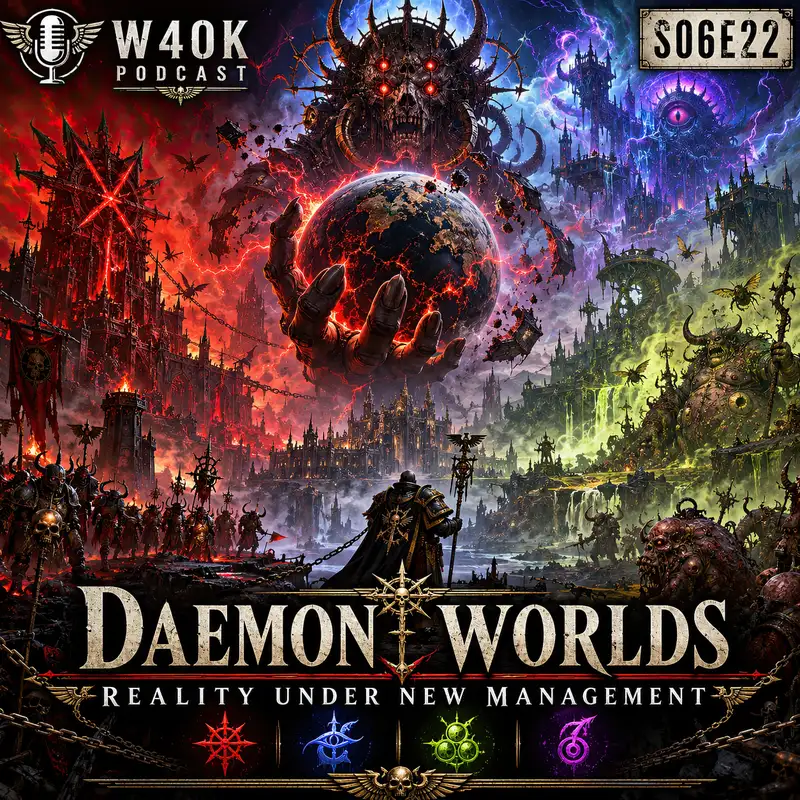
Daemon Worlds: Reality Under New Management
A planet becomes a daemon world when the map stops being a promise. The planet is still there, but presence has acquired a new definition. The coordinates may still exist. A fleet may arrive at the expected star, detect a familiar mass, and even recognise the ruins of cities that once paid Imperial tithes. Yet the oceans may climb into the sky. A road may return a traveller to the gate they left three days before. The dead may continue their duties because no one has informed them that death is now compulsory. Somewhere beyond the clouds, something vast is dreaming, and the landscape has begun to share its opinions. This is not simply a conquered world. An invading army can seize a capital, replace a governor, and raise new banners. On a daemon world, the conqueror has replaced the terms under which a capital, a governor, and a banner are allowed to exist.
The difference begins with the warp. Realspace is the material universe of distance, mass, energy, and cause followed by effect. The warp is a parallel realm shaped by thought, emotion, memory, and desire. It is the sea through which Imperial ships travel, the source from which psykers draw power, and the native domain of daemons. Those daemons are not animals that evolved on distant planets. They are warp entities given identity and appetite, often formed from the power of the Chaos Gods. In ordinary realspace, they require breaches, rituals, hosts, or intense psychic disturbance to remain manifest. Reality resists them. A daemon world is what happens when that resistance weakens so far that the distinction between the material and the immaterial becomes uncertain.
Such a transformation can begin in several ways. A world may be caught within a vast warp storm, as countless planets were swallowed by the Eye of Terror or exposed by the opening of the Great Rift. A daemonic invasion may widen its own breach until the planet is saturated with warp power. Cults may prepare the ground through sacrifice, sorcery, and mass corruption. A powerful artefact or ritual may tear open a wound that no conventional engineering can close. The process is not always immediate. There can be a period in which crops fail, nightmares spread, machines behave as though offended, and familiar places acquire impossible dimensions. Administrators may continue submitting reports during this phase. The Imperium has considerable experience in documenting catastrophes several hours after they have become irreversible.
Not every planet ruled by Chaos is a daemon world. Traitor armies hold fortresses, mining worlds, shipyards, and occupied populations in ordinary space. Those places may be brutal, corrupted, and thick with cult activity while gravity remains reasonably professional. A true daemon world has crossed a deeper threshold. Warp energy is no longer merely present upon it. The warp has entered the planet’s structure, weather, geography, and passage of time. Daemons can manifest more easily because the world resembles their native realm. Mortal assumptions become unreliable. The local environment may reflect the nature of a Chaos God, the will of a Daemon Prince, or the competing influence of several powers. It is territory in the military sense, but it is also personality made geological.
That last point explains why daemon worlds are rarely random collections of horrors. They possess a kind of symbolic consistency, even when they lack physical consistency. A realm shaped by Khorne may turn conflict into climate. Fortresses rise above plains scarred by endless battle, rivers run red, and every social order is tested through domination and bloodshed. The important feature is not the decorative use of brass. It is that peace itself becomes unstable. Grudges find weapons. Rivals meet despite distance. Victories create the conditions for further war. The world does not merely contain violence. It encourages violence as its most natural form of movement, government, worship, and conversation.
A world shaped by Tzeentch follows a different logic. Architecture may alter between one glance and the next. Roads lead toward possibilities rather than destinations. Prophecy changes the actions taken to prevent it, which may be precisely what fulfils it. Sorcerers build towers over libraries whose contents rewrite themselves, while mutants and daemons inhabit ecosystems that make sense only for as long as no one explains them. Change is not an occasional disaster there. It is the stable condition. Even identity becomes provisional. A servant may rise into a wizard, collapse into a spawn, return as an ancestor, or discover that all three outcomes have been arguing about which one occurred first.
Nurgle’s domains are often described through rot, disease, and filth, but decay is only half of their meaning. They present corruption as a cycle of life. Forests bloom from corpses. Insects thrive in poisoned air. Ruined flesh becomes habitat. The inhabitants may regard infection as inheritance and endurance as proof of favour. This is what makes a Nurgle daemon world more disturbing than a dead planet. It is active, fertile, and horribly sustainable. Slaanesh, by contrast, shapes realms around appetite, sensation, pride, and the pursuit of an experience that can never remain sufficient. Beauty becomes painful through excess. Perfection becomes a machine for producing dissatisfaction. Every pleasure creates a sharper hunger, and every achievement reveals a finer standard by which the achiever has failed.
These patterns can overlap because Chaos is not a tidy administrative arrangement. The four great powers wage the Great Game against one another without conclusion, and their servants carry those rivalries into every realm they can reach. A daemon world may be claimed by one power, contested by another, or ruled by an undivided prince whose alliances last exactly as long as they remain useful. Borders can move because armies advance, but they can also move because the mood of the ruling entity changes. A fortress conquered yesterday may be older than the force that captured it. A valley can remember a battle that has not yet taken place. Military intelligence officers prefer enemies whose terrain does not submit counterreports.
At the centre of many daemon worlds stands a Daemon Prince. These beings were once mortal champions who earned, received, or were trapped within the gift of ascension. Their new forms grant immense power and a lasting existence in the warp, but they remain bound to the economy of Chaos. They seek favour, wage wars, cultivate worship, and defend their standing against rivals. A world granted to such a prince can become an extension of that being’s history and obsessions. Mountains resemble old enemies. Cities reproduce the architecture of a lost home. Populations reenact victories, failures, or rituals whose meaning may be known only to their ruler. The prince appears to possess a kingdom. One interpretation is that the kingdom also possesses the prince, preserving every ambition and wound forever.
Mortarion’s Plague Planet offers the clearest example of that cruel reflection. After the Horus Heresy, the Daemon Primarch of the Death Guard established his realm within the Eye of Terror. He shaped it in the image of Barbarus, the poisonous world on which he had been raised. Toxic clouds smother its heights. Diseased populations endure beneath fortress keeps, while the Death Guard gather in strongholds and launch plague fleets into the galaxy. Mortarion had hated the tyrants of Barbarus, especially the monstrous ruler who raised him from the mountain mists. Yet on his daemon world, Mortarion occupies the highest place above a suffering population. He escaped his old master, served another, and rebuilt the structure of his childhood with himself at the summit.
Medrengard reveals Perturabo with equal honesty. The Daemon Primarch of the Iron Warriors rules a world transformed into a fortress of impossible scale, with towers, dungeons, manufactories, and defensive works driven into the landscape. It is not a palace designed for ease. It is siegecraft without an exterior. The Iron Warriors have spent millennia fortifying a realm already held by the beings who built it, because for them security is less a condition than an argument conducted in armour plate. Medrengard serves as a base, arsenal, prison, proving ground, and monument to Perturabo’s conviction that every relationship eventually becomes a contest between wall and weapon. Even his sanctuary is prepared to withstand betrayal.
Sortiarius, the Planet of the Sorcerers, reflects the Thousand Sons’ mixture of scholarship, loss, and transformation. Magnus carried the remnants of his Legion there after the destruction of Prospero. Its skies, continents, towers, and living things are steeped in sorcery. Mutants, beastmen, cultists, thrall wizards, and wandering warbands exist beneath the rule of sorcerers whose ambitions can reshape their surroundings. Later, Magnus brought Sortiarius from the Eye of Terror into realspace near ruined Prospero. That act made the world more than a refuge. It became a declaration that the Thousand Sons could place their nightmare beside the grave of their former civilisation. Their new home preserves the memory of what was lost, but memory on a daemon world is not an archive. It is material waiting to be revised.
Sicarus, the stronghold of the Word Bearers, expresses a different form of corruption. The Legion that once raised monuments to the Emperor now rules from a daemon world of devotion to the powers it calls the Primordial Truth. Cathedrals, rituals, councils, and hierarchies matter there because the Word Bearers did not abandon faith when they betrayed the Imperium. They changed its object and removed its limits. On Sicarus, religion is government, military doctrine, social order, and a technology for opening reality. The result is not the absence of discipline. It is disciplined damnation, maintained by warriors and priests who consider the existence of daemons proof that worship is rational. Their evidence is genuine. Their conclusion remains catastrophic.
Daemon worlds are not populated only by immortal monsters and famous traitors. Mortals live upon them, sometimes in enormous numbers. Some are captives taken during raids. Some are descendants of earlier slaves or colonists. Others are cultists who came willingly and discovered that arrival was the final decision they would be permitted. They farm whatever passes for food, crew manufactories, maintain warships, carry ammunition, serve in armies, and provide the endless labour on which even supernatural empires depend. Chaos can suspend the laws of nature, but someone still has to load the transport. These populations may mutate across generations, develop local religions, or organise into tribes and petty kingdoms beneath the attention of their daemonic masters.
Life there is not necessarily continuous misery in the way an Imperial observer would describe it. That would be simpler. Many inhabitants accept the world’s values because those values define survival. A diseased body may be honoured on a plague world. A successful killer may gain status in a realm of Khorne. Psychic mutation may offer opportunity on Sortiarius, at least until opportunity grows additional mouths. Worship is reinforced not only by priests but by visible cause and effect. A prayer may change the weather. A sacrifice may open a road. A god’s displeasure may become a season. On an Imperial world, faith promises that the universe has moral order. On a daemon world, faith can make the local order physically true.
Time adds another layer of captivity. Within warp-saturated regions, hours in one place may correspond to years elsewhere. A warband can depart its stronghold believing it has been gone for weeks and return to find generations of servants awaiting judgment. Another force may fight for centuries without ageing as expected, then emerge into a galaxy that has forgotten the war’s beginning. This distortion helps explain how the veterans of the Long War experience history. Ten thousand years have passed since the Horus Heresy in the Imperial calendar, but not every traitor has lived those years in sequence. A daemon world can preserve hatred by denying it the ordinary erosion of time.
For Chaos armies, these worlds offer enormous advantages. Daemons can exist there without the same struggle required in stable realspace. Sorcerers draw upon abundant warp power. Warbands can hide within storms that confound Imperial navigation. Fortresses may defend themselves through illusion, mutation, or hostile geography. Shipyards and forges can bind daemons into engines and weapons. Ritual sites can project corruption far beyond the surface. Yet a daemon world is not a perfectly reliable headquarters. Rival gods interfere. Local rulers feud. Time distorts planning. Supply lines vanish into storms. The ground may be loyal, but it is loyal to an intelligence with priorities of its own. No competent commander enjoys discovering that the eastern front has become a mouth.
Attacking such a world is therefore a campaign against more than an enemy army. Orbital charts may become false. Auspex readings contradict one another. Weapons fail because physical law is weakened, while daemons return unless the conditions sustaining them are broken. Soldiers face fear, temptation, mutation, and psychic assault in addition to conventional fire. The Grey Knights specialise in confronting daemonic incursions, but even they do not treat a consumed planet as a routine objective. An invasion must often target rituals, artefacts, sorcerers, or breaches that anchor the warp’s influence. Killing the visible monsters is necessary. It may not be decisive. The battlefield itself is producing replacements.
The Imperium’s preferred answer is often destruction before the transformation is complete. During the Plague Wars, the garden world of Iax was corrupted as Mortarion’s forces attempted to turn it into a daemon world called Pestiliax. Imperial resistance prevented the intended victory, but the contamination had gone too far for restoration. Exterminatus followed. This is the bleak arithmetic behind many Imperial decisions. A living population may still be present. Loyal defenders may still be fighting. The world may retain beauty, history, and strategic value. None of that matters if the planet is becoming a permanent gate through which the warp can enter realspace. Mercy becomes indistinguishable from quarantine conducted with cyclonic weapons.
Complete daemon worlds can sometimes be destroyed, though rarely without extraordinary force. Davin became a centre of Chaos power during the Horus Heresy and the epicentre of the Ruinstorm that divided much of the galaxy. Sanguinius, Lion El’Jonson, and Roboute Guilliman eventually brought about its destruction, ending its influence and opening the route toward Terra. The event demonstrates that these worlds are not invulnerable. It also establishes the scale of the remedy. When three Primarchs are involved, the situation has moved beyond a request for additional infantry.
Other daemon worlds can move, vanish, or be repurposed. Wyrmwood, created by Vashtorr as a twisted echo of lost Caliban, served as a weapon and workshop during the Arks of Omen campaign. When Vashtorr completed the device he sought, the world was swallowed into a maelstrom, leaving a wound in reality. Sortiarius was translated from the Eye into material space. These are planets, but treating them as fixed astronomical objects can be misleading. Their mass may be real. Their location may be negotiable. A daemon world is less like territory marked on a chart and more like a hostile realm that happens, for the moment, to be wearing a planet.
This is why the phrase reality under new management is more than a joke. Chaos does not merely replace one ruler with another. It abolishes the separation between ruler and realm. On an Imperial world, tyranny must use laws, armies, prisons, and propaganda to shape human behaviour. On a daemon world, tyranny can become weather. Ideology enters biology. Memory becomes architecture. Appetite determines distance. The strongest will does not simply command the population. It edits the conditions under which the population thinks, travels, ages, suffers, and hopes.
A daemon world is therefore Chaos in its most complete political form. It is a society in which power no longer needs to pretend that truth exists outside power. The landscape confirms the ruler. The heavens repeat the doctrine. The dead remain available for further service. Yet these realms also reveal the weakness within every promise of Chaos. The prince who sought freedom becomes the fixed centre of an obsession. The warrior who wanted victory receives an endless war. The seeker who demanded knowledge inhabits a world where certainty cannot survive. The survivor who feared death is preserved inside decay. Chaos grants desire by removing every boundary that once gave desire meaning.
From orbit, such a world may still have continents, storms, lights, and the faint geometry of civilisation. A navigator may still assign it coordinates. An Inquisitor may still enter its name into a sealed record before ordering the record burned. None of those acts make the place ordinary again. The decisive change occurred when the warp ceased to be an intruder and became the authority by which the planet understood itself. The new management does not sit in a distant palace. It is present in the road that changes direction, the wound that learns to speak, the sunrise that remembers your fear, and the soil beneath your boots that has already chosen a side.