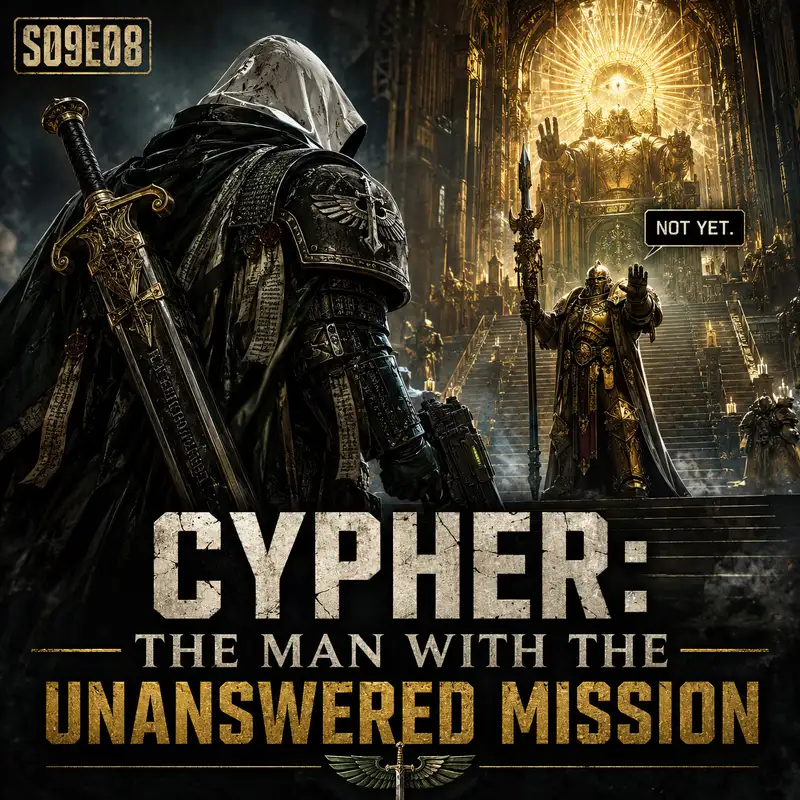
Cypher: The Man With the Unanswered Mission
At the edge of the Emperor's throne room, Cypher finally stopped running. Behind him lay a trail through the Imperial Palace marked by dead pursuers, broken security systems, and companions who had followed him into the most heavily guarded fortress in human history. Ahead waited the Golden Throne. Across his back rested the great sword he never drew. A wounded Custodian barred the final approach, not with an army or a fortress wall, but with a message that seemed to come from the Master of Mankind himself. Not yet. Cypher listened. Then the most hunted warrior of the Dark Angels turned away from the destination he had pursued for thousands of years. That is the central mystery of Cypher. We do not know exactly what he intends to do, but we now know that he believes the moment has not arrived.
Even his name is a disguise. Cypher was originally a title within the knightly Order of ancient Caliban, the forest world that became home to Lion El'Jonson and the Dark Angels Legion. The Lord Cypher guarded the Order's histories, rituals, and hidden knowledge. He was not merely an archivist with better armour. He preserved the meaning of the institution, advised its leaders on tradition, and carried secrets that ordinary knights were never meant to hear. The office mattered because Caliban's warriors understood that customs decay, records vanish, and proud organisations eventually forget why they were created. In a rare display of institutional foresight, they appointed one man to remember. Ten thousand years later, someone still bears that title. Whether he also bears the same loyalties is another question entirely.
Caliban was a world built for secrets. Its human settlements survived behind stone walls while monstrous beasts hunted beneath forests saturated with the influence of the warp. The Order fought those creatures and gradually became the strongest of the planet's knightly brotherhoods. Lion El'Jonson rose to command it, aided by Luther, the older warrior who had found and raised him. When the Emperor arrived, the Lion was reunited with the First Legion, and Caliban's knights were absorbed into a military machine stretching across the stars. Some became Space Marines. Others, including Luther, were enhanced but could never become full Astartes. The old brotherhood survived inside the new Legion, but it did not survive unchanged. Caliban had been invited into the Imperium. It soon discovered that an invitation from the Imperium generally arrives with compliance requirements and orbital fire support.
The Lion left Caliban to prosecute the Great Crusade, while Luther and many Calibanite warriors were sent home. Officially, they were to train recruits and strengthen the Legion. In practice, the assignment carried the taste of exile. Caliban's forests were cleared, its resources consumed, and its people reorganised to feed a war whose purpose was decided on distant worlds. Resentment grew around Luther, but resentment alone does not explain the disaster that followed. Some on Caliban wanted independence. Some remained loyal to the Imperium. Some were loyal to Luther. Some believed they were protecting their home from both the Emperor and Horus. Others were touched or corrupted by the powers beneath Caliban's soil. The lines were never as clean as the later Dark Angels preferred to remember them. Civil wars rarely provide the courtesy of arranging everyone into honest uniforms.
During the Horus Heresy, the office of Lord Cypher passed through violence and conspiracy. One bearer of the title opposed the growing corruption on Caliban and worked in the shadows, even aiding agents loyal to the Emperor. He was eventually killed, and the gifted Librarian Zahariel was raised to the office by Luther. This matters because Zahariel is one of the strongest candidates for the identity of the Cypher who walks the forty-first millennium. He knew Caliban's deepest secrets, possessed unusual psychic abilities, joined the rebellion, and held the title before the planet's destruction. There are clues linking the later Cypher to knowledge Zahariel possessed. There is no final confirmation. The title may have changed hands again, and Cypher's own accounts are designed to make certainty feel like a trap with excellent lighting.
When the Lion returned to Caliban after the Heresy, the planet fired upon his fleet. The Dark Angels answered with invasion and bombardment. Lion El'Jonson confronted Luther while loyalists and rebels tore their home apart around them. The surviving accounts disagree in detail, and the participants had powerful reasons to shape the story afterward. What remained was catastrophe. Caliban broke. The fortress that would become the Rock survived, but much of the world was consumed. Many of Luther's followers were pulled into the warp and scattered across both space and time. These warriors became known as the Fallen. Some emerged centuries later, others millennia later, and they did not share one ideology. A few served Chaos. Some remained renegades. Some regretted their choices. Some insisted that they had been betrayed first.
The surviving Dark Angels turned the Fall of Caliban into the secret around which their Chapter would be built. They called themselves and their successors the Unforgiven, and they dedicated hidden elements of their brotherhood to hunting the Fallen. The Ravenwing found the quarry. The Deathwing captured it. Interrogator-Chaplains extracted confession and repentance, often through methods that made the distinction between justice and vengeance largely administrative. Most Dark Angels knew little or nothing of this mission. Knowledge was restricted through layers of the Inner Circle, ensuring that every promotion brought a warrior closer to the truth and further from the possibility of discussing it sensibly. Cypher became the most important target because he seemed to connect every part of the secret. He knew what happened. He carried relics of Caliban. Most irritatingly, he refused to be caught on schedule.
Cypher's appearance is almost a declaration that concealment has become theatre. He wears ancient power armour beneath robes and carries a bolt pistol and plasma pistol, weapons he uses with extraordinary speed and precision. He can move through a battle as if he has already seen the angles of fire, striking commanders, disabling pursuit, and escaping before the enemy understands why he was there. Across his back hangs a long sword, too important to abandon and apparently too important to draw. That combination defines him. The pistols solve the immediate problem. The sword represents the problem that has waited ten thousand years. Many warriors carry relic blades to advertise lineage or authority. Cypher carries one as a sealed order. Everyone can see it. No one knows when it will be opened.
Cypher's record after Caliban refuses to settle into a loyalist or traitor pattern. He has appeared beside renegades and Chaos Space Marines, stirred rebellions, killed Imperial officials, and left worlds burning behind him. He has also destroyed servants of Chaos, aided Imperial forces, preserved Dark Angels relics, and intervened against enemies of humanity. Sometimes his arrival draws the Fallen together. Sometimes it draws the Unforgiven into a pursuit that serves his purpose. Cypher does not need to defeat the Dark Angels. He needs only to appear where their fear of exposure is stronger than their judgment. A rumour of white robes can redirect elite formations and turn a campaign into a private hunt. He knows the one order they cannot ignore because he embodies the shame they cannot admit.
The sword deepens that control. It is widely believed to be the Lion Sword, the weapon once carried by Lion El'Jonson. During the Heresy, that blade was broken by Roboute Guilliman during a furious confrontation over the Lion's conduct in Imperium Secundus. It was later reforged and eventually vanished in the ruin of Caliban. The weapon on Cypher's back has never been conclusively identified. If it is the Lion Sword, he carries the lost authority of his primarch. He might intend to return it, present it as evidence, seek absolution, or draw it for an act no Dark Angel could forgive. Reports across the centuries also suggested that Cypher was moving toward Terra. That destination turned the sword from a relic into a threat aimed directly at the Golden Throne.
His opportunity came during the Terran Crusade, after the fall of Cadia and the rebirth of Roboute Guilliman. The resurrected primarch attempted to reach Terra through a galaxy convulsed by warp storms, but his expedition was captured within a Blackstone fortress controlled by the Red Corsairs and the daemon Kairos Fateweaver. Cypher appeared with the Harlequin Sylandri Veilwalker and offered release. His price was passage to Terra and an audience at the Golden Throne. Guilliman agreed because his alternatives were imprisonment, death, or trusting a hooded stranger carrying what might have been his brother's lost sword. Cypher freed the captives, guided them toward the webway, and later fought beside the Imperium against Magnus the Red on Luna. Every victory brought Guilliman home and brought Cypher closer to the door.
At the threshold of the throne room, Guilliman broke the agreement. The primarch had watched Cypher fight for him, but he had also seen the sword. Allowing an unknown Fallen Angel, armed with a relic connected to the Lion, into the presence of the Emperor would have been an act of faith bordering on negligence. Guilliman ordered the Custodes to arrest Cypher and his companions. Cypher reacted with anger and briefly reached for his weapons, then surrendered. That restraint is important. He had not crossed the galaxy merely to die in a hopeless exchange of fire outside the final chamber. Either he believed another path would open, or he knew that the correct moment still lay ahead. The Imperium placed him in the Dark Cells beneath the Palace, a prison designed for things that history is safer forgetting.
Then Terra began to break. The Great Rift opened, daemons assaulted the throne world, and systems that had endured for ages failed under pressure. A clandestine force of Dark Angels entered the Imperial Palace to seize Cypher before anyone could discover the Chapter's shame. Their operation involved murder, sabotage, and a confidence in their own discretion that might generously be described as traditional. In damaging the prison's systems, they helped trigger the release they had come to prevent. Cypher and several Fallen escaped into the Palace while the Custodes, Imperial assassins, and Dark Angels hunted them through a fortress already fighting a war. The Imperial response was layered, lethal, and occasionally aimed at itself. Cypher could hardly have arranged a more appropriate environment.
He recovered his wargear and moved through the Palace with a small band of Fallen. They disrupted communications, misdirected pursuers, and entered forgotten passages beneath the Imperial sanctum. One by one, the escape became something more costly than freedom. Cypher had routes by which he might have fled, yet he continued inward. He revealed that his objective was not simply to escape Terra. He still intended to reach the Throne. That choice strips away one comfortable interpretation. The audience he demanded from Guilliman had not been a bargaining trick. Imprisonment, pursuit, and the collapse of Imperial security had not changed the mission. Whatever Cypher wanted, it remained on the other side of the Palace.
The last approach carried him along the Path of Martyrs and toward the Bridge of Ascension. His pursuers were close. His companions had paid for every stage of the advance. There, the wounded Custodian Hekkarron confronted him. Hekkarron had received a vision that appeared to come from the Emperor, and the message was only two words. Not yet. Cypher accepted it and withdrew. The surviving account comes through a story told from Cypher's unreliable perspective, so caution is necessary. Yet the event is presented as the decisive interruption of his advance. He did not test the Custodian's strength. He did not insist upon the bargain Guilliman had broken. He did not draw the sword. He obeyed a command whose wording implied delay rather than refusal.
Those two words changed the shape of the mystery. If Cypher's only goal were to murder the Emperor for Chaos, obedience makes little sense. If he had merely wanted absolution, he had reached the place where he could demand it and still turned back. The message suggests that his mission may be connected to a future condition, a crisis, or a choice that has not yet matured. It also suggests that Cypher recognises an authority beyond himself. That authority may be the Emperor, fate, Caliban, the Watchers in the Dark, or some combination that the surviving records cannot untangle. The evidence does not prove that Cypher is loyal. It does show that his purpose is governed by timing, and that he was willing to abandon immediate success rather than act at the wrong moment.
The return of Lion El'Jonson makes that delay even more significant. The Lion has encountered Fallen who did not embrace Chaos and has accepted some back into his service. These warriors reveal what the Dark Angels' secret history tried to erase. The Fallen were never one uniform body of damned traitors. Each made different choices under conditions of rebellion, deception, and corruption. The Lion now judges at least some of them as individuals, something his sons spent millennia avoiding because individual judgment is untidy and difficult to ritualise. Cypher has not yet received a public verdict from his primarch. The man who carries the Lion's possible sword remains outside the reconciliation the Lion has begun, and his mission still points beyond the Lion toward Terra.
The assassination theory remains powerful because the imagery is almost too precise. A hidden warrior approaches the immobilised Emperor while carrying a primarch's blade he refuses to draw anywhere else. Some believe killing the Emperor's physical body could free or transform his presence in the warp. Others fear it would extinguish the Astronomican, open the webway breach beneath the Palace, and doom humanity. Cypher has confirmed none of this. The absolution theory is safer but also incomplete. He may intend to present the sword, confess the truth of Caliban, and seek judgment. Yet he has shown little interest in the ritual repentance demanded by the Dark Angels. He may not want forgiveness for one man. He may want a verdict on the Lion, Luther, the Fallen, and the Chapter that built its identity around a buried civil war.
Another possibility is that Cypher serves a purpose without belonging to the institution he assists. His choices have repeatedly preserved the Imperium at critical moments, while his attacks have exposed its hypocrisy and damaged its servants. He behaves like someone defending a mission rather than a government. The old Lord Cypher guarded the Order, but the Order was more than its current commander. Its traditions were meant to outlive individuals and survive collapse. The modern Cypher may regard Caliban, the Lion's deeper legacy, or humanity's survival as the thing worth protecting. That would allow him to fight beside traitors against one enemy and beside loyalists against another. Loyalty to a mission can look like treason to every organisation that stands in its way.
Cypher's greatest weapon is therefore not either pistol, nor even the sword. It is uncertainty disciplined into strategy. Enemies cannot predict him because they do not know what victory means to him. Allies cannot own him because he never offers enough truth to create trust. The Dark Angels cannot ignore him because he embodies the history they buried. Guilliman could use his help but could not risk granting his request. The Custodes could imprison him but could not prevent the Palace itself from becoming his road. Even the listener is drawn into the same pursuit, collecting clues and hoping that the next appearance will finally settle the matter. Cypher survives partly because everyone approaches him carrying an answer they already want.
That does not make the mystery empty. We know more than Cypher's legend first appears to offer. He bears an ancient title associated with memory and hidden duty. He is connected to the Fallen but not confined by their divisions. He carries a sword linked, at least by strong rumour, to Lion El'Jonson. He has repeatedly aided and attacked both loyalists and traitors. He demanded access to the Golden Throne, crossed the Palace to reach it, and turned away when told that the time had not come. These facts do not reveal the final act, but they define its shape. Cypher is not wandering without purpose. He is waiting while moving, advancing toward a moment whose conditions only he may understand.
The unanswered mission is therefore more precise than a simple question of whether Cypher is good or evil. He appears to be carrying the unfinished judgment of Caliban. The Dark Angels want that judgment reduced to confession. The Fallen want it turned into vindication, revenge, or release. The Lion has begun to judge his scattered sons one by one. The Emperor, if the message on the Bridge of Ascension was truly his, has postponed whatever Cypher came to do. Cypher has already reached the door once, and he did not fail there, because failure would have ended the journey. He received an order to continue carrying the burden. Somewhere beyond the wars of the Imperium and the return of the Lion, there is a moment for which the title, the sword, and the long pursuit have been preserved. The guns remain ready. The sword remains sheathed. The last judgment of the First Legion is still on its way.