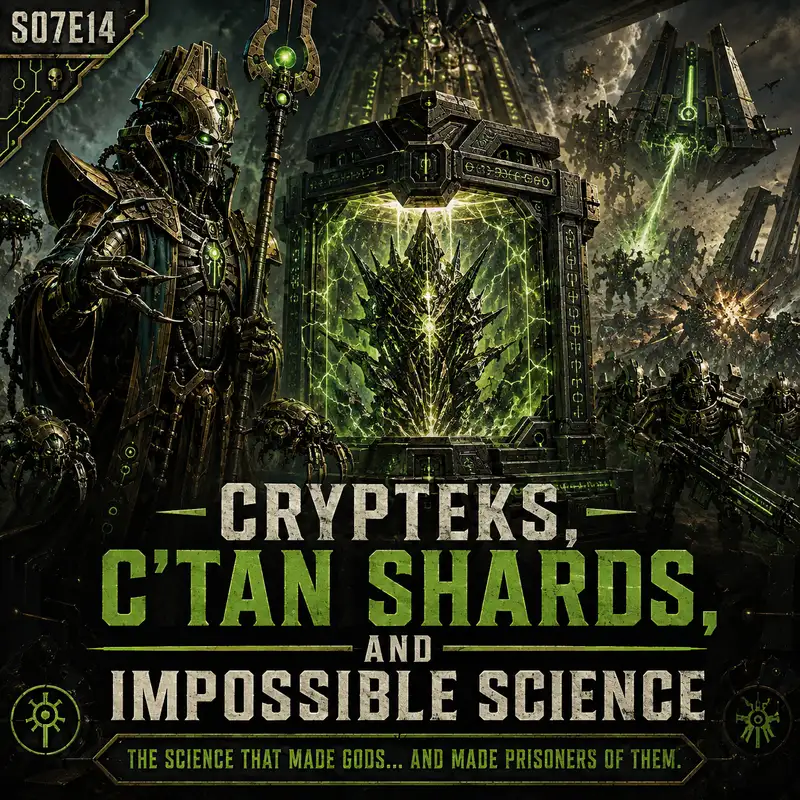
Crypteks, C’tan Shards, and Impossible Science
The deepest chamber of a Necron tomb world is not always a throne room, an armoury, or a crypt. Sometimes it is a prison. Behind walls folded through dimensions no human instrument can measure, something waits inside a cage smaller than a coffin and larger than reason. It remembers feeding upon stars. It remembers the taste of souls. It remembers the metal beings standing outside the seal, because those beings once called it a god. A Cryptek approaches the vault carrying instruments that look like ceremonial staffs, skeletal insects, and pieces of frozen lightning. An enemy army is breaking through the tomb complex above. The dynasty requires a weapon. The Cryptek begins to open the cage.
That image captures the central contradiction of Necron science. The Necrons possess machines that can bend time, strip matter apart, cross dimensions, extinguish suns, and imprison fragments of cosmic beings. Yet much of that power is controlled by damaged minds, guarded by jealous specialists, and built upon the greatest betrayal in their history. Their science is not merely advanced. To younger civilisations, it appears impossible. The Crypteks are its custodians, interpreters, and occasionally its reckless improvisers. The C'tan shards are its most terrible proof. Together they reveal a civilisation that conquered almost every physical limitation while remaining trapped by one decision it cannot reverse.
A Cryptek is often described as a Necron scientist, but the word is too small. Crypteks are engineers, physicians, astronomers, weapons designers, dimensional theorists, and court advisers. They maintain tomb worlds, command Canoptek constructs, restore damaged bodies, awaken dormant systems, and explain to Necron nobles why a plan involving an unstable singularity is technically possible and politically unwise. Their authority does not usually come from royal blood. It comes from knowledge. In a society built upon hierarchy and command protocols, that makes them useful, dangerous, and difficult to replace.
They are not priests in the manner of the Adeptus Mechanicus. A Cryptek may surround a device with ritual, symbols, and elaborate procedure, but those actions are generally the habits of a specialist working with forces understood through calculation rather than worship. The distinction can be hard for an Imperial observer to appreciate. A staff gestures, a tank ages into dust, and the local tech-priest has only a few seconds to decide whether the correct report says science, sorcery, or extremely discouraging battlefield conditions. The Cryptek does not require the Warp to make reality misbehave. Reality is already complicated enough.
That tradition began before the Necrons existed. The biological Necrontyr were a short-lived people whose bodies were burdened by disease and whose empire was divided by dynastic rivalry. Their science became extraordinary, but it did not cure the condition that defined their civilisation. They could cross the stars, build weapons of terrifying precision, and challenge powers older than their species, yet they could not escape their own mortality. Their war against the Old Ones sharpened that frustration into hatred. The Old Ones possessed long lives and mastery over paths through the Warp. To the Necrontyr, this was not merely an advantage. It was an insult written into the structure of the universe.
Then the Necrontyr encountered the C'tan. These entities had fed upon the energies of stars, vast and alien intelligences without bodies in any familiar sense. The Necrontyr fashioned living-metal forms called necrodermis so the star gods could act within the material universe. The bargain that followed promised victory, unity, and immortality. It delivered all three in the manner of a contract written by a predator. The process of biotransference transferred Necrontyr minds into bodies of living metal. The C'tan supplied the essential knowledge, and the Cryptek Illuminor Szeras made the process possible on a civilisation-wide scale.
The furnaces of biotransference ended the weakness of flesh, but they also ended the Necrontyr. Their souls were consumed by the C'tan. Most common citizens emerged as Necron Warriors with little personality or independent will. Soldiers of higher status retained more capability, while nobles and specialists preserved varying degrees of memory, intellect, and selfhood. Even among them, the result was not true continuity. Memory had gaps. Emotion became distant or distorted. Identity survived as an echo running inside an immortal machine. The great cure worked perfectly, provided one ignored the patient.
The Necrons became the armies the C'tan required for the War in Heaven. They fought with bodies that repaired themselves and weapons that treated solid matter as a temporary inconvenience. Worlds died. Species vanished. The Old Ones were broken, and the galaxy was scarred by powers that would shape everything that came later. Then Szarekh, the Silent King, understood the scale of the deception. The precise history is clouded by age, myth, and conflicting records, but the outcome is clear. The Necrons turned upon the star gods they had served.
Destroying a C'tan outright was possible only at a cost the Necrons learned to fear. For most of the star gods, they chose another solution. They shattered them into fragments and imprisoned those fragments in tesseract labyrinths and vaults. This was vengeance expressed as engineering. The beings that had consumed the Necrontyr souls were reduced to captive weapons, bound by the very species they had transformed. It was also a decision with an admirably Necron sense of proportion. Faced with treacherous gods, they did not abandon theology. They broke theology into manageable pieces and issued it to selected units.
A C'tan shard is not a dead relic or a simple power cell. It is a portion of a star god's essence, carrying power, hunger, and aspects of the original being's identity. A shard may be vastly weaker than the complete entity, but weakness is relative. It can twist physical laws, drain life, reshape matter, hurl impossible energies, and tear machines apart through command of the forces beneath their construction. The cage does not make the prisoner harmless. It merely determines the direction in which the catastrophe is pointed.
This is why a dynasty does not release a shard casually. Crypteks maintain layers of control, using blackstone, dimensional bindings, Canoptek restraints, and command systems designed to force obedience. Tesseract technology allows a space to be folded and contained in ways that mock ordinary geometry. A labyrinth small enough to carry can hold something that should not fit inside any ordinary volume. A Tesseract Vault turns that principle into a mobile prison and weapons platform. The shard within is unleashed only through controlled apertures and imposed commands, at least in theory. Necron history contains many examples of theory discovering that it has enemies.
The motives for using such a weapon are practical and deeply personal. A C'tan shard can destroy threats that would overwhelm conventional phalanxes. It can humble enemy war engines, unravel fortifications, and transform a losing battle into an extinction event. Releasing it also reenacts the Necrons' victory over their former masters. Every command given to a shard is an assertion that the slave has become the jailer. Yet the hatred runs both ways. The C'tan remember betrayal, even when their memories are fragmented. A dynasty may own the cage. It does not own the loyalty of what waits inside.
The Crypteks who manage these forces belong to specialised disciplines. Technomancers are masters of repair, restoration, and the systems that sustain Necron armies. They direct Canoptek servants, reinforce reanimation protocols, and manipulate living metal as though tending a body whose anatomy extends across an entire tomb complex. To an organic physician, healing means supporting life. To a Technomancer, it may mean replacing a ruined torso, retrieving a damaged consciousness, and returning the repaired warrior to the firing line before the enemy has finished celebrating. Necron medicine has little interest in bedside manner because the bed is usually a resurrection chamber.
Chronomancers treat time as terrain. Their devices can slow enemies, accelerate allies, anticipate converging possibilities, and weaponise entropy. The most famous is Orikan the Diviner, an astromancer whose calculations read the movements of stars and the tides of events. Accounts of his abilities include predictions of extraordinary accuracy and the use of chronomancy to adjust outcomes that did not cooperate with those predictions. Whether every claim made about Orikan should be trusted is another question. A prophet with access to the past enjoys a considerable advantage in debates over accuracy.
The practical military value of chronomancy is immense. A commander usually asks where the enemy will be. A Chronomancer can ask when the enemy will be vulnerable, how long an incoming shot should take to arrive, or whether a crucial second can be stretched until a phalanx has completed its advance. This is not unrestricted mastery. Necron temporal devices have limits, risks, and dependencies. Still, even local control over time can make conventional tactics feel obsolete. Fortifications depend upon distance, weapons depend upon sequence, and command depends upon events happening in the expected order. Chronomancy attacks that expectation.
Plasmancers specialise in destructive energy. They channel stellar forces, electromagnetic storms, and searing discharges through bodies and weapons designed to survive what they conduct. Their science turns the violence of suns into something that can be directed across a battlefield. Psychomancers work upon a different target. They study fear, perception, and the mechanisms by which a mind interprets reality. Their phantasms and terror effects can break the courage of beings who believe themselves immune to panic. What appears to be supernatural dread may instead be the precise manipulation of senses, instincts, and neural responses. The victim is unlikely to appreciate the distinction.
These named orders are only the most visible parts of a much broader tradition. Necron lore describes Crypteks concerned with dimensions, matter, stars, gravity, transmutation, and other fields for which human language has inadequate categories. They form conclaves, train apprentices, exchange favours, and guard proprietary knowledge. Their devices, often called Cryptek arcana, are not mass-produced equipment in the human sense. Many are singular instruments, inherited techniques, or private applications of ancient principles. A Cryptek's greatest security system may simply be refusing to explain how anything works.
On campaign, Crypteks often work through small technical circles rather than grand laboratories. An apprenticed specialist may carry part of the master's knowledge, while Plasmacytes and other Canoptek constructs regulate energy, accelerate repairs, or protect the Cryptek's work. Immortals and Deathmarks provide the blunt instruments of security. The result is not a conventional command squad. It is a mobile research institution with guns. Such circles retrieve relics, sabotage enemy systems, survey dimensional faults, and test devices under conditions that a more cautious civilisation might call active combat. For the Cryptek, the battlefield is both workplace and experiment, and the enemy is frequently promoted to test material without being consulted.
That secrecy gives Crypteks political power. A Phaeron may command armies and claim worlds, but a dynasty that alienates its technical specialists can awaken to discover that its portals no longer open, its resurrection systems have developed opinions, and its captive star god is making an unfamiliar noise. Crypteks serve royal courts, but service does not always mean obedience. They pursue research, rivalries, and ambitions that may continue for millions of years. To an immortal mind, a professional grudge can become an institution.
Illuminor Szeras represents the grandeur and horror of that ambition. He helped make biotransference possible, and he has never treated its consequences as a reason to stop experimenting. Szeras studies living beings, souls, energy, and the boundaries between physical form and consciousness. His work is driven by the belief that still greater states of existence can be engineered. Organic captives become material for investigation. Necron bodies become prototypes. The catastrophe of biotransference becomes, in his view, an early and imperfect result rather than a warning. Some scientists learn from failure. Szeras learns that the next laboratory requires stronger restraints.
His presence also exposes a painful divide within Necron thought. Some Necrons seek a return to bodies of flesh, hoping that their lost condition can somehow be restored. Others consider organic life weak, temporary, and beneath them. Crypteks stand at the centre of that dispute because they possess the only knowledge that might change the answer. Yet even their greatest achievements have not restored what the C'tan consumed. They can rebuild a body from living metal, transfer a mind, edit memory, suspend time, and contain a fragment of a god. They cannot manufacture the missing soul with the same confidence.
That limitation helps explain why Necron science feels different from human technology. The Imperium preserves machines through ritual because much of its understanding has been lost. Necron systems are also ancient and often damaged, but their masters still grasp principles that humanity has never discovered. They manipulate the material universe at levels where mass, energy, time, and dimension become tools. Blackstone can influence the relationship between realspace and the Warp. Dolmen gates and dimensional pathways bypass ordinary travel. Gauss weapons disassemble targets layer by layer. None of this means every Necron can build such devices, or that every tomb world retains the necessary expertise.
The scale of Necron achievement can be difficult to describe without sounding like an unreliable Imperial interrogation record. Their arsenals include weapons that discharge particles across impossible distances, projectors that force matter through dimensions, and devices that model stellar events with dangerous fidelity. Some of these machines can be used only under strict conditions because their effects continue long after the battle is won. That restraint is important. Necrons do not always avoid using their greatest technologies because they are unable to activate them. Sometimes they understand the consequences better than the younger species demanding a demonstration. A weapon that destroys the enemy and destabilises a region of the galaxy may be effective, but it creates an awkward maintenance problem.
Age has imposed its own attrition. Sixty million years of slumber damaged memory cores, command systems, bodies, and entire planetary complexes. Some Crypteks awakened impaired. Others found that vital colleagues, archives, or manufacturing systems had failed. A device may still function even when nobody alive, if that term can be applied generously, can reproduce it. This creates a civilisation surrounded by wonders that are simultaneously tools, heirlooms, and endangered species. The Necrons can appear omnipotent from the outside while arguing internally over which irreplaceable component a rival dynasty stole before the stars had familiar names.
The C'tan shards embody the greatest danger in that inheritance. Fragments can possess different strengths and personalities. Some retain recognisable aspects of famous star gods. The Nightbringer carries the image and hunger of death. The Deceiver remains associated with manipulation and falsehood. Shards of the Void Dragon exert terrifying power over machines and matter. Other fragments are less clearly identified, sometimes described as transcendent shards whose identities have blurred through combination or damage. Each is a weapon, but each is also a surviving will. If bindings fail, the battlefield does not gain a neutral hazard. It gains an ancient enemy with immediate priorities.
A shard may also seek greater power. C'tan fragments can consume energy, prey upon living beings, and in some accounts absorb other shards. That possibility makes every containment failure more than a local emergency. The Necrons did not destroy the star gods' desire to become whole. They divided that desire among prisons. Crypteks charged with guarding those prisons must therefore understand both the machinery and the prisoner. A lock designed only against force may fail against deception. A command protocol may be obeyed in wording and betrayed in result. The Deceiver, in particular, did not earn its reputation by respecting the spirit of an agreement.
Return to the tomb chamber. The enemy has reached the inner galleries. Necron Warriors rise and fall beneath heavy fire, repairing themselves more slowly than they are destroyed. The Cryptek completes the sequence. Geometric seals rotate through angles that do not exist. Canoptek restraints tighten. A shape unfolds from a space too small to contain it, wearing living metal like a memory of flesh. The air changes. Weapons fail. Stone becomes light. For a few moments, the attackers confront not an army but a law of nature that has been taught resentment.
The enemy may be annihilated. The tomb may be saved. Then comes the more delicate operation: forcing the shard back into confinement before it decides that victory has cancelled the arrangement. This is the true character of impossible Necron science. It is powerful, precise, and never entirely separate from the civilisation's ancient wounds. Crypteks can command time, repair immortals, and place gods in cages, but every triumph carries the shape of the bargain that created them.
The C'tan shards are trophies of rebellion, engines of war, and reminders that the Necrons once surrendered everything for immortality. The Crypteks are the keepers of a science vast enough to bind those trophies, yet not vast enough to restore what was taken. Their greatest machines prove that reality can be mastered. Their existence proves that mastery is not the same as wisdom. Deep beneath the tomb world, the prison closes again, and an immortal civilisation continues guarding the gods it defeated because it still cannot escape the price of having trusted them.