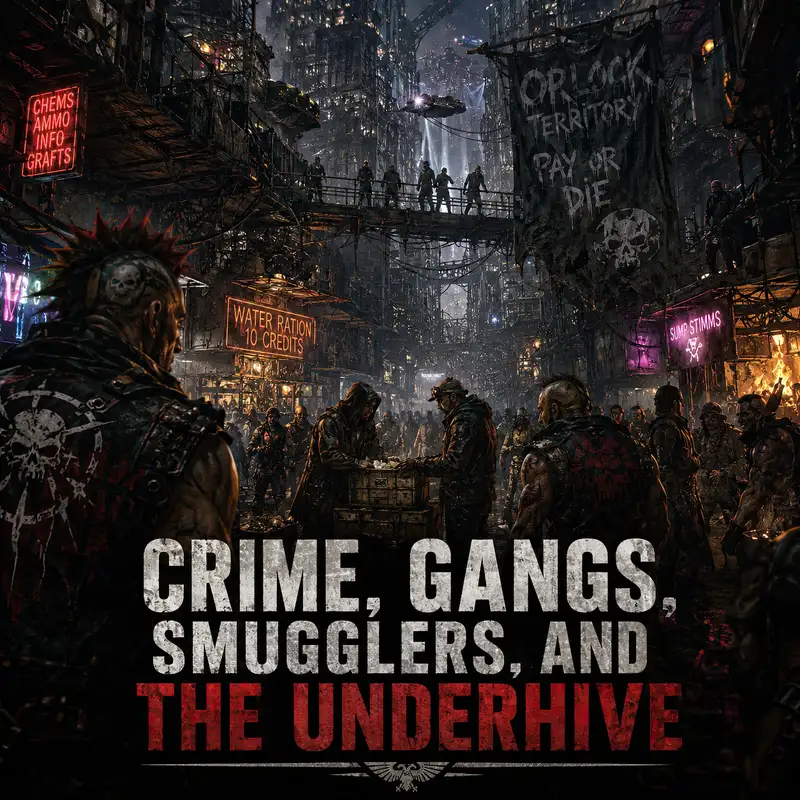
Crime, Gangs, Smugglers, and the Underhive
The shot that begins a gang war in a hive city may be fired over a crate of clean water. Not a relic, not a throne, not a secret capable of toppling the Imperium. Just water that does not taste of metal, fungus, or the last three generations of industrial runoff. The crate arrives on a cargo lift with the wrong seal. A clerk looks away because someone has paid him to look away. A runner carries the delivery into a market where every doorway belongs to somebody. Then another gang decides that the route, the cargo, or the insult should have been theirs. By the time the shooting ends, six people are dead, the water has vanished, and the local authorities have recorded the incident as a minor disruption to trade.
That small story explains more about crime in the Imperium than any law book. Imperial society is built upon commands, permissions, monopolies, and shortages. Almost everything belongs to someone above you. The air may be metered. The water may be rationed. The machinery may be sacred. Movement between districts may require a work token, a house mark, a guild licence, or the goodwill of a guard who has not eaten since the previous shift. Under those conditions, crime is not an intrusion into an orderly system. It is one of the ways the system moves.
A hive city is not merely a city with very tall buildings. It is a mountain of habitation and industry, accumulated over thousands of years. New districts are built above old ones. Factories are expanded, sealed, abandoned, rediscovered, and built over again. Transit shafts become tombs. Hab blocks become foundations for manufactorums whose overseers no longer know what lies beneath them. At the summit are the spires of nobles, governors, and the immensely wealthy. Below them lies the crowded body of the hive, where labour, production, commerce, and sanctioned life continue beneath varying degrees of supervision. Deeper still is the underhive.
The underhive is not one clearly marked district. No courteous sign announces that civilisation ends at the next stairwell. It is the collective name for the neglected, decaying, and only partly controlled lower regions of a hive. Some underhive settlements are busy trading towns with markets, drinking holes, workshops, and local rulers. Others are clusters of habs clinging to a functioning generator or a rare source of water. Beyond them lie the Badzones, where structural collapse, toxic leaks, hostile creatures, mutant enclaves, plague, and ancient machinery make human violence only one item on a rather ambitious list of hazards.
Necromunda provides the clearest picture of this world, although not every hive follows its exact pattern. Hive Primus contains organised Clan Houses, merchant guilds, Palanite Enforcers, gangs, outlaws, bounty hunters, settlements, and criminal empires layered through the same vast structure. In the upper hive, the Clan Houses behave like industrial nations. In the underhive, their gangs fight over workshops, tunnels, trade routes, mineral seams, chemical pools, forgotten technology, and the right to collect payment from anyone passing through. The difference between politics and gang warfare is often altitude.
Imperial law also changes with altitude, although officials would object to the wording. The Adeptus Arbites enforces the great laws of the Imperium. Its concern is rebellion, sedition, interference with the tithe, attacks upon Imperial institutions, and crimes that threaten authority on a planetary scale. It does not normally investigate every stabbing in a sump-side tavern. Ordinary law is left to planetary rulers, local courts, house guards, militia, enforcers, and whatever passes for civic government. On Necromunda, the Palanite Enforcers serve Lord Helmawr’s order. Their task is not to create justice in an abstract sense. Their task is to keep the hive functioning according to his interests.
This distinction matters. A gang can murder rivals, extort shopkeepers, rig pit fights, steal cargo, and sell illegal chems for years without attracting the full attention of Imperial power. Interrupt a major production line, threaten a guild convoy, shelter a dangerous psyker, spread a forbidden cult, or obstruct the tithe, and the response changes. The Imperium can tolerate a remarkable amount of private misery. It becomes much less relaxed when misery affects the paperwork.
The underhive is therefore not lawless. It contains too many laws. There is the law of the planetary governor. There are guild contracts, house claims, settlement customs, gang territories, religious prohibitions, family obligations, blood debts, and the immediate ruling of whoever currently controls the only bridge. These systems overlap without agreeing. A trader may possess a valid guild licence and still owe passage money to three gangs. A local chief may recognise a marriage, a debt, or a claim that the hive authorities do not. A smuggler may be condemned by an Enforcer, protected by a noble, employed by a guild factor, and welcomed by an entire settlement before breakfast.
Settlements survive because someone maintains the machinery. A water still must be guarded. A fungus farm must be kept free of vermin. A generator needs fuel, parts, and somebody willing to crawl inside it while it is still warm. Roads and tunnels must be watched. Markets need rules, even if the rules are simple enough to be explained by pointing at the armed people on the balcony. In many places, gangs provide these services. They collect protection money, but they may also provide actual protection. They punish thieves, escort caravans, settle disputes, and keep worse predators away.
This does not make them benevolent. It makes them governments with smaller offices and less convincing stationery. A gang’s authority rests on reputation, kinship, weapons, and its ability to reward loyalty. It may defend a settlement because the settlement is home. It may defend it because frightened merchants pay reliably. Usually both motives are present. The underhive is rarely generous enough to let morality and self-interest travel separately.
Many gangs are extensions of larger social structures. Necromunda’s Clan House gangs are the most famous examples. House Orlock’s fighters emerge from a culture of mines, transport, road crews, and hard bargaining. Escher gangs reflect a house built upon chemical mastery, pharmaceuticals, and a fiercely independent female society. Goliath gangs come from furnace districts and a brutal industrial culture shaped by engineered strength. Van Saar gangs carry advanced technology that gives them an edge while exposing them to its hidden cost. Cawdor gangs gather faith, poverty, scavenging, and zeal into movements that can be both communal and terrifying. Delaque gangs trade in secrecy, information, and influence, which means they are often accused of knowing things they have not yet had time to learn.
These gangs are not random collections of armed delinquents. They recruit from families, workplaces, neighbourhoods, house traditions, and existing rivalries. A young ganger may join for food, status, revenge, protection, or because everyone they have ever trusted wears the same colours. Gang membership provides a name in a world that treats most labourers as replaceable units. It offers comrades, weapons, access to trade, and the possibility of becoming someone whose death will at least be noticed.
It also binds the ganger to feuds older than they are. Territory in the underhive is not simply floor space. It may contain a pump, a lift, a toll gate, a workshop, a route to the ash wastes, or a door into an abandoned zone rich in salvage. Losing that territory can starve a community. Holding it can make a gang powerful enough to challenge its parent house or attract the attention of enemies from above. A painted symbol on a wall is therefore both identity and warning. It says who lives here, who collects here, and who will come looking if blood is spilled.
Gang warfare often serves the interests of people who never enter the underhive. Clan Houses and nobles can use gangs as proxies, testing rivals, sabotaging production, seizing resources, or settling disputes without risking open conflict in more valuable districts. Authorities may permit this because contained violence is safer than a house war spreading through the hive city. The dead are mostly people whose names were never going to reach the spire. From above, that can look like efficient administration.
The gangs understand this arrangement, even if they cannot escape it. A gang leader may rule several settlements and still be disposable to a house master. A celebrated champion may win territory, only to learn that the prize has been promised to a guild. The underhive rewards ambition, but it also places a ceiling above it. Sometimes literally. The rare ganger who rises too far may be recruited, bought, married into a useful connection, or killed before success becomes independence.
Beneath the house gangs are outcasts, hive scum, escaped workers, deserters, mutants, failed guilders, rogue psykers, disgraced officials, and people whose original crime was surviving someone important. They form crews of their own or hire themselves to whoever can pay. Some become bounty hunters, although the distinction between bounty hunter and professional kidnapper depends heavily upon whether the paperwork survives the gunfight. Others become dome runners, guides who know which tunnels are passable and which echoes mean the tunnel is about to become much shorter.
Around them grows an entire service economy. Rogue doctors treat wounds that cannot be explained at a licensed clinic. Armourers rebuild weapons from mismatched parts. Lookouts watch the approaches to gang strongholds. Chem dealers sell courage, pleasure, endurance, and death in containers that are occasionally labelled correctly. Pit fighters, gamblers, information brokers, corpse collectors, slavers, preachers, cooks, mechanics, and traders all find work. Crime is not a single profession. It is an ecosystem.
Smuggling is its circulatory system.
A hive survives by moving impossible quantities of material. Food, fuel, ammunition, machinery, bodies, chemicals, data, and manufactured goods travel through lifts, rail lines, conveyor systems, cargo shafts, gates, docks, and roads. Official trade is controlled by licences, guild monopolies, tariffs, quotas, inspections, and noble privilege. Every restriction creates a price difference. Every price difference creates an opportunity. The smuggler lives in that gap.
Some smugglers move necessities. A settlement cut off from an official water allocation may pay for stolen purification tablets. Workers whose ration allotment has been delayed may buy food taken from a guild warehouse. A rogue doctor may need antibiotics or replacement organs that cannot be obtained legally because the patients do not officially exist. To the authorities, these goods are contraband. To the people receiving them, they are Tuesday.
Other smugglers carry luxuries and vices. Spire fashions, rare alcohol, exotic meats, narcotics, gambling devices, forbidden entertainments, and off-world curiosities move downward. Underhive chems, fighting beasts, archeotech, stolen weapons, and valuable biological specimens move upward. The wealthy condemn the criminal market while purchasing its most exclusive products through servants who know not to ask why a noble requires a living sump creature after midnight.
The most dangerous cargoes are not always the most valuable. Unsanctioned weapons can arm a revolt. Stolen industrial chemicals can poison a district. A hidden psyker may draw the attention of things far worse than the Enforcers. Xenos artifacts, corrupted relics, and forbidden texts can turn a profitable route into an Inquisitorial matter. At that point, everyone involved discovers that the Imperium has different categories of illegality, and some are enforced with orbital assets.
A successful smuggling network requires more than a fast vehicle and a confident expression. It needs dockworkers, clerks, pilots, guards, warehouse crews, counterfeiters, guides, and officials willing to certify that the crate contains exactly what the crate does not contain. It needs safe houses and alternate routes. It needs people who can move between social layers without attracting attention. A great smuggler is therefore not merely a transporter. They are an organiser of trust among people who have excellent reasons to trust no one.
Routes through the underhive can be more valuable than the cargo. An abandoned maintenance shaft may bypass a guild checkpoint. A half-flooded tunnel may connect two markets without crossing gang territory. A hidden gate may lead into the ash wastes, where nomads, outlaws, and independent haulers can receive goods far from official ports. On Necromunda, places such as Dust Falls and Port Mad Dog prosper because they sit between worlds. Gangs, Guilders, criminals, and sanctioned traders meet there because isolation is bad for business and hypocrisy is usually negotiable.
The merchant guilds occupy an especially interesting position. They are sanctioned powers with control over essential goods and transport. Their monopolies help create the conditions that make smuggling profitable. Their agents may demand crackdowns on illegal trade while quietly purchasing contraband, hiring gangs, or arranging private deliveries. The Enforcers may raid one market to demonstrate authority and ignore another because its payments arrive on time. Corruption is certainly present, but corruption alone does not explain the system. Selective enforcement is often policy.
A planetary ruler does not need every crime prevented. The ruler needs production maintained, taxes collected, rivals controlled, and unrest kept below the level that attracts outside intervention. Gangs can help. They absorb angry young people, police districts too poor to justify official resources, and fight one another instead of uniting against the hive’s rulers. Smugglers keep neglected settlements alive and supply desires that official markets cannot satisfy. Crime becomes a pressure valve, dangerous but useful.
That usefulness has limits. When a gang grows too strong, refuses its obligations, attacks strategic infrastructure, or allies with a wider rebellion, it stops being tolerated disorder and becomes a political threat. Enforcer precincts mobilise. Bounties appear. Rival gangs receive sudden assistance from unnamed patrons. If the threat involves heresy, xenos infiltration, or sedition, the Arbites, the Inquisition, or military forces may intervene. The same settlement that was ignored for generations can be purged in a day because somebody above has changed the category under which it is filed.
This is one reason criminal organisations often imitate respectable institutions. They keep records, collect dues, enforce borders, conduct diplomacy, and perform rituals of loyalty. They have ranks, uniforms, banners, sacred stories, and punishments for betrayal. The Imperium calls them gangs because it denies their authority. The people living under that authority may find the distinction less obvious. If a gang controls the water, guards the road, settles disputes, and takes a portion of every transaction, it is already performing many of the functions of a state. It simply lacks a seal recognised by someone with larger guns.
The resemblance runs deeper. The Imperium itself demands tithes, restricts movement, monopolises violence, punishes forbidden belief, and expects obedience in exchange for protection that may or may not arrive. Underhive gangs reproduce that pattern on a human scale. Their territories are smaller, their weapons less impressive, and their speeches usually shorter. The structure is familiar because the gang has learned power from the civilisation above it.
None of this should make underhive criminals romantic heroes. Many are predators. They enslave captives, sell the desperate, terrorise families, and kill for reputation. A protection payment can be the difference between survival and hunger. A gang war can destroy the pump both sides intended to control. Smugglers may save a settlement with medicine one week and sell its children the next. Scarcity explains cruelty. It does not excuse it.
Nor should every gang be treated as secretly noble resistance. Most do not seek to overthrow the Imperium. They seek territory, profit, safety, vengeance, status, or another day of life. Even rebels may reproduce the same hierarchies once they gain control. The underhive does not automatically create freedom. It creates distance from formal authority, and distance gives both communities and monsters room to grow.
The physical dangers of the underhive reinforce this harsh order. A gang may be brutal, but it knows where the floor is sound. A crime boss may be greedy, but their guards keep raiders away from the market. Outside controlled territory are tunnels filled with toxic gas, failed machinery, plague victims, sump predators, mutant warbands, and cults waiting for the right darkness. In such a place, predictable extortion can feel safer than ungoverned freedom. The gang takes ten credits. The thing beyond the barricade takes the arm holding them.
This is why the underhive remains both feared and necessary. It receives what the upper hive discards: broken machines, industrial waste, unwanted people, dangerous secrets, and the consequences of decisions made far above. Yet it also returns value. Salvage, labour, chemicals, information, recruits, illicit pleasures, and forgotten technology rise from below. The hive despises the underhive while feeding upon it, much as the Imperium condemns crime while depending on the informal systems crime provides.
So what does crime mean in a civilisation like this? It does not mean the absence of order. It means violating the claim of whichever power has been recognised as lawful. A gang taking payment at a bridge is extortion until a guild hires it. A shipment is contraband until a noble signs the right document. A killer is scum until an official bounty names the victim. The acts may remain the same. What changes is sponsorship.
Far below the spire, the cargo lift descends again. Its gears grind through levels abandoned before the current governor’s ancestors were born. Inside is another crate with another false seal. It may contain water, weapons, medicine, chems, or something that should never have been brought onto the planet. A clerk has been paid. A gang has been warned. An Enforcer patrol has been sent elsewhere. The underhive is not waiting in chaos. It is waiting according to arrangements of its own, and everyone involved knows exactly who must be paid before the doors open.