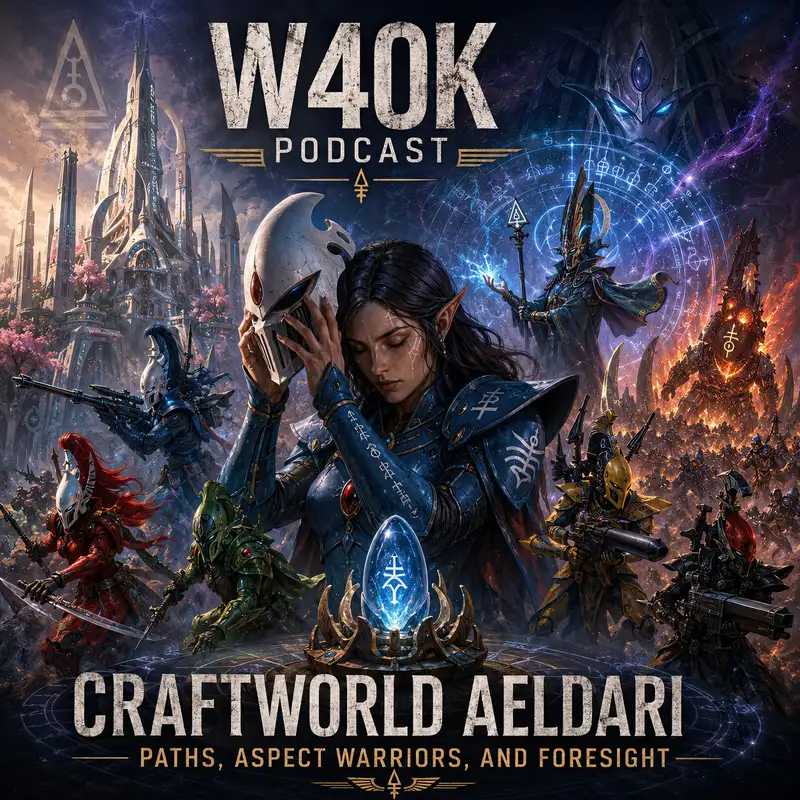
Craftworld Aeldari: Paths, Aspect Warriors, and Foresight
The battle ends when an Aeldari warrior removes her helmet. Until that moment, she has fought behind what her people call the war mask, a disciplined state of mind that allows her to kill without letting every scream, every wound, and every surge of fury become part of her ordinary self. The mask is not a piece of armour. It is a boundary. If she can set it aside, she may leave the shrine, return to her former life, and one day follow an entirely different calling. If she cannot, then the victory has cost more than blood. She has become trapped upon the Path of the Warrior, and the weapon has begun to consume the hand that holds it.
That danger explains almost everything about the Craftworld Aeldari. Their civilisation is not built upon freedom, despite their speed, elegance, and extraordinary power. It is built upon restraint. Every Path, every ritual, every spirit stone, every shrine, and every warning spoken by a Farseer exists because the Aeldari know exactly what happens when their desires are allowed to grow without limits. They do not merely remember the destruction of their empire. They carry its predator inside their own souls.
Long before humanity spread across the stars, the Aeldari ruled a vast dominion. Their technology had advanced beyond ordinary scarcity. Machines performed much of the labour. The Webway allowed travel through a hidden dimension without relying entirely upon the tides of the Warp. Their psychic abilities shaped matter, art, and experience with a subtlety that younger species could barely understand. For a time, this looked like triumph. Then purpose decayed into appetite. Sensation became obsession. Obsession became culture. Across generations, the psychic pressure of Aeldari excess gathered in the Warp until it achieved consciousness.
The birth of Slaanesh destroyed the old Aeldari empire in a single catastrophe remembered as the Fall. Worlds vanished. Souls were devoured. The heart of their civilisation became the Eye of Terror, a wound in reality filled with the remains of what they had made and what had made them. The craftworlds survived because they were already far from the centre. Many had once been immense trading vessels, travelling between distant regions of the empire. As the old order collapsed, they became lifeboats carrying refugees, traditions, relics, and the unbearable knowledge that the disaster had not come from an outside invader. The Aeldari had defeated themselves with considerable efficiency.
The survivors could not simply rebuild the world they had lost. Their enemy was now bound to them. When an Aeldari dies, Slaanesh waits for the soul. Craftworlders protect themselves with spirit stones, psycho-reactive gems worn throughout life. At death, the stone captures the departing spirit before it can be consumed. That soul may later be joined to the infinity circuit, the psychic network running through the wraithbone of the craftworld. The dead remain present, not as ghosts wandering corridors, but as memory, counsel, ancestry, and sometimes power.
This gives every craftworld the character of a city, a ship, and a tomb. Its living population walks beneath graceful towers grown from wraithbone by Bonesingers. Its dead move through the infinity circuit beneath them. Its halls may contain gardens, theatres, shrines, workshops, chambers of meditation, and gateways into the Webway. To an Imperial observer, it can look impossibly serene. That serenity is maintained by an entire civilisation practising emotional containment because failure has a god attached to it.
The Path is their answer. An Aeldari commits to a discipline and enters it fully. The calling might involve craftsmanship, art, scholarship, seafaring, command, psychic study, or war. The precise names and traditions vary among craftworlds, but the purpose remains consistent. The Path gives intensity a direction. An Aeldari does not dabble. The same capacity for obsession that once helped destroy the empire is focused into a controlled pursuit, bounded by ritual and social expectation.
This does not mean the Craftworld Aeldari live without passion. Quite the opposite. Their emotions are deeper and more dangerous than those of most humans. The Path permits them to experience that intensity without allowing it to spread into every part of the self. An artist may devote years to a single mode of expression, then leave it behind. A warrior may master a form of combat, then set down the armour and become something else. The ideal is movement. Each Path teaches discipline, but no Path is supposed to become the whole person.
The danger is becoming lost. Some Aeldari reach such complete identification with a Path that they can no longer leave it. A seer who becomes trapped will eventually become a Farseer. A warrior who becomes trapped becomes an Exarch. Mastery and imprisonment are therefore separated by a very narrow line. Human societies often reward a person for becoming entirely consumed by a profession. The craftworlds recognise this as a medical, spiritual, and occasionally military emergency.
Even rebellion has a place in this system. Those who reject craftworld discipline may take the Path of the Outcast. Rangers wander beyond the safety of their home, travelling through alien territories, exploring lost worlds, gathering intelligence, and experiencing freedoms denied by the Path system. Some become Corsairs and embrace a more dangerous life among the stars. Their independence can be valuable, but it weakens the protections created by craftworld society. Freedom is possible. It merely comes with the attention of She Who Thirsts, which rather spoils the romance of leaving home.
No two craftworlds apply these principles in exactly the same way. Alaitoc is known for strict devotion to the Paths, which may help explain why so many of its people eventually become Outcasts. Biel-Tan places unusual emphasis on the warrior tradition and dreams of restoring Aeldari power through the defence and reclamation of maiden worlds. Ulthwé has spent ages near the Eye of Terror, producing many powerful psykers and relying heavily upon its Seer Council. Saim-Hann preserves strong clan traditions and a fiercely independent culture expressed in swift jetbike warfare. Iyanden, devastated by Tyranid invasion, has been forced to call upon its dead in numbers that other craftworlds find deeply troubling.
These differences matter because the Craftworld Aeldari are not a single, harmonious people following one perfect plan. They share the trauma of the Fall and the need for discipline, but they disagree over what survival requires. Some look backward toward restoration. Some place their faith in prophecy. Some protect scattered Aeldari worlds. Some cooperate with younger species when necessity demands it, then depart before anyone mistakes necessity for friendship. Their foresight does not remove politics. It gives politics more futures to argue about.
The Path of the Warrior is the most visible expression of craftworld discipline because it turns psychological control into battlefield doctrine. Its founder was Asurmen, the first of the great Phoenix Lords. In the chaos after the Fall, he established the warrior tradition that would be divided into Aspect Shrines. Each shrine embodies one facet of Khaela Mensha Khaine, the Aeldari god of war. Khaine is not presented as a gentle protector. He represents violence in its many forms, and the Aspects isolate those forms so that an Aeldari can use them without surrendering to all of them at once.
An Aspect Warrior is therefore not simply an elite soldier. The warrior enters a temple, learns its rituals, wears its armour, and masters a narrowly defined expression of battle. The shrine provides technique, identity, symbolism, and the mental structure of the war mask. This is why Aspect Warriors look and fight so differently from one another. Each shrine answers a particular battlefield problem and a particular emotional danger.
Dire Avengers represent the disciplined warrior, advancing with shuriken weapons and holding the line with a flexibility rare among the more specialised shrines. Howling Banshees turn terror, speed, and the shock of close assault into a precise weapon. Their masks amplify their cries into a psychic and sonic attack that can overwhelm an enemy before the blade arrives. Striking Scorpions embody the hidden hunter, using infiltration, heavy armour, and sudden violence at close range. Fire Dragons direct destructive fury against tanks, fortifications, and other hardened targets, approaching dangers that sensible troops would prefer to address from another continent.
Dark Reapers express Khaine as the destroyer, delivering disciplined long-range fire with a grim focus upon death. Swooping Hawks transform aerial movement into harassment and sudden attack. Shining Spears carry the tradition of the mounted hunter into battle on jetbikes. Warp Spiders use jump generators to pass briefly through the Warp, appearing where the enemy is weakest while accepting a risk that would make most craftworlders profoundly uncomfortable. The manoeuvre is fast, elegant, and occasionally fatal. Even among the Aeldari, some assignments are written by people who will remain safely elsewhere.
The shrines are specialised because Aeldari warfare depends upon combination. One Aspect identifies, isolates, or fixes a target. Another destroys it. Grav-tanks and jetbikes move warriors across the battlefield with astonishing speed. Rangers mark leaders and weak points. Guardians, drawn from the craftworld’s civilian population, defend key ground and provide numbers that the elite shrines cannot. Warlocks shield the advance or cripple resistance. An Autarch, having walked several warrior traditions before following the Path of Command, understands how the Aspects fit together.
This produces warhosts that favour precision over endurance. Aeldari weapons are advanced, their vehicles are swift, and their warriors can act with a coordination that appears supernatural even before a Farseer becomes involved. Yet they are not built for a prolonged exchange of losses. Every dead Aeldari is a blow to a people already living near extinction. A human commander may spend regiments to gain time. An Aeldari commander may begin a war specifically to prevent the future in which such an exchange becomes necessary.
The Exarch stands at the centre of each shrine. This is an Aeldari who can no longer remove the war mask and can no longer leave the Path of the Warrior. The Exarch becomes teacher, priest, guardian, and living embodiment of the shrine. The title carries honour, but the condition is tragic. The individual has achieved perfect concentration by losing the ability to become anything else.
When an Exarch dies, the relationship between warrior, armour, and shrine does not simply end. The souls and memories of previous Exarchs may persist within the shrine’s armour, forming a continuity that reaches across generations. The current wearer becomes part of something older than a single life. The Phoenix Lords carry this principle to its most extreme form. Asurmen, Jain Zar, Maugan Ra, Fuegan, Baharroth, and the other legendary founders are not merely ancient champions who have survived by ordinary means. Their identities endure through their armour and those who take it up, accumulating experience across death and renewal.
This makes the Phoenix Lords inspiring and deeply unsettling. They are proof that an Aeldari soul can resist final destruction. They are also proof that identity can become inseparable from function. A Phoenix Lord does not retire. There is no later career in sculpture, diplomacy, or quiet horticulture. The Path has become eternal. The saviours of the craftworlds are those most completely consumed by the discipline created to prevent consumption.
When war threatens the craftworld itself, restraint can become even more difficult. At the heart of each craftworld rests an Avatar of Khaine, a living shard of the shattered war god. Awakened through ritual and sacrifice, the Avatar marches as molten iron and divine fury, drawing the warhost behind it. Its presence reveals the bargain beneath craftworld warfare. The Aeldari survive by dividing their dangerous emotions into controlled forms, but in extremity they still call upon the same rage they spend their lives containing.
They also call upon the dead. Spiritseers can guide souls from the infinity circuit into wraithbone bodies such as Wraithguard and Wraithlords. These constructs are powerful and resilient, but awakening the dead for war is never merely a convenient reinforcement policy. The spirits may perceive the living world as distant and dreamlike. They require guidance. Craftworld Iyanden’s reliance upon wraith warriors after its losses to Hive Fleet Kraken is therefore both military necessity and cultural wound. The dead defend the living because too few living remain.
Above all of this stand the seers. Every Aeldari possesses psychic potential, but those on the Path of the Seer learn to approach the Warp through disciplined symbols, runes, and ritual. These protections matter. Raw psychic power is dangerous for any species. For the Aeldari, it is exercised beneath the notice of a Chaos God with a personal claim upon them.
A Farseer is a seer who has become lost upon the Path. With experience, such figures learn to read the skeins of fate, tracing possible futures as branching threads. They may identify a small event that leads, centuries later, to the destruction of a craftworld. They may direct a warhost against an enemy that has not yet understood it is part of the conflict. They may preserve an apparently unimportant individual because one future depends upon that person’s survival. To outsiders, this can look like omniscience. It is not.
The future seen by a Farseer is not a single road waiting to be travelled. It is a shifting field of possibility. Every decision changes the pattern. Other psykers interfere. Chaos distorts perception. Enemies act unexpectedly. A vision may be accurate but misunderstood. A disaster prevented in one place may be displaced into another. The farther a seer looks, the more branches must be judged and the more uncertain the route becomes.
This is why Aeldari foresight produces ruthless decisions rather than perfect victories. A Farseer may choose the future in which a human world dies because the alternative leads an enemy fleet toward a craftworld. From the Imperial perspective, this is monstrous manipulation. From the Aeldari perspective, it may be the least destructive path available to a species that cannot replace its losses. Both judgments can be true. Foresight does not make a decision moral. It only makes ignorance a less convincing defence.
Nor are the Aeldari united in their interpretations. Seers can disagree because they have followed different threads or assigned different value to the outcomes. A vision may show survival without showing what survival becomes. The greatest danger is not always failing to see the future. It may be seeing enough of it to become certain. Once prophecy hardens into confidence, every action taken to prevent disaster can help create the conditions for it.
The Fall itself hangs over this problem. The Aeldari were a psychic civilisation of immense knowledge, yet knowledge did not save them from appetite, arrogance, and denial. Modern craftworlders have responded by making discipline the foundation of daily life. Their Farseers search the future for threats. Their Paths contain obsession. Their Aspect Shrines contain violence. Their spirit stones contain the dead. Their craftworlds contain the remains of a people who once believed nothing could contain them.
That is why their wars are so often fought before anyone else understands the cause. An Aeldari force may strike a convoy, assassinate a commander, destroy an excavation, or divert an invasion, then vanish through the Webway. The immediate action can appear arbitrary. Its true objective may lie years away. Sometimes the intervention saves billions who will never know it. Sometimes it condemns them. The official Imperial report usually settles the matter by calling it treachery, which is convenient because it avoids the more difficult task of admitting that the attackers may have been responding to consequences the Imperium could not yet perceive.
For all their foresight, the Craftworld Aeldari remain a dying people. Their numbers are limited. Their old empire is gone. Their gods are dead, shattered, hidden, or uncertain. Slaanesh still waits beyond every failed spirit stone. New powers crowd the galaxy, many of them too numerous, too brutal, or too hungry to be guided away forever. The Great Rift has made the future more violent and less stable. Even the most gifted seer cannot transform survival into safety.
Yet the craftworlds continue. They move between stars like immense vessels carrying both a civilisation and its funeral archive. Children are born beneath the presence of ancestors in the infinity circuit. Artists create works for a culture that may not endure. Rangers return from distant worlds. Guardians leave ordinary lives to defend halls built before human history. Aspect Warriors enter their shrines, put on the war mask, and become a carefully measured fragment of a broken god.
The central achievement of the Craftworld Aeldari is not that they escaped the Fall. Escape was only the first moment. Their achievement is that they built a civilisation around the knowledge of what they could become. The Paths are not proof of serenity. They are evidence of fear, wisdom, and continuous effort. Aspect Warriors are not merely elegant killers. They are violence placed inside ritual boundaries. Farseers are not masters of destiny. They are prisoners of responsibility, choosing among futures that often differ only in who must be mourned.
Their tragedy is that every protection carries the shape of a prison. The Path can preserve the self, or consume it. The war mask can protect the soul, or become the only face left. Foresight can save a craftworld, or justify horrors committed in its name. The dead can shelter the living, or be summoned back because the living are running out.
So the Craftworld Aeldari survive neither through perfection nor through prophecy alone. They survive by narrowing possibility, one choice at a time, because limitless possibility once destroyed them. Somewhere in a quiet shrine, after the firing has stopped, a warrior lifts her hands to her helmet and discovers whether she can still remove the mask.