Could You Survive the Imperium?
The first thing likely to kill you in the Imperium would not be an Ork, a daemon, or a warrior in power armour. It would be the morning shift.
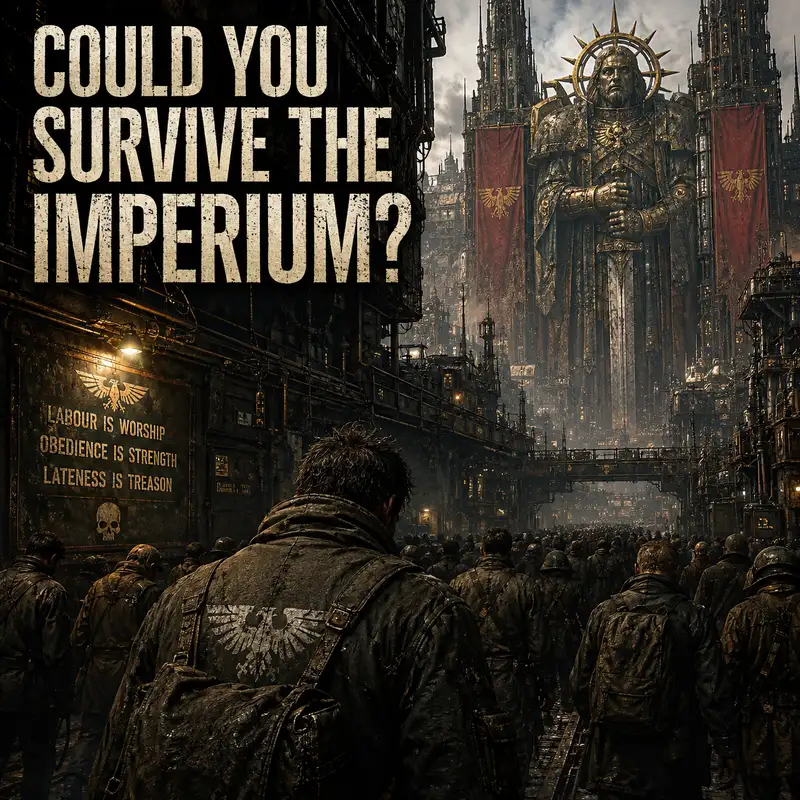
You wake in darkness because the habitation block has no windows. A siren sounds beyond the wall. The air tastes of hot metal, disinfectant, and old machinery. Your room contains a narrow bunk, a devotional image, and a locker. The door opens after your identity token confirms that you are scheduled to work. Thousands of people are already moving toward the transit platform. No one runs. Running attracts attention. Above the crowd, a cracked loudspeaker reminds everyone that labour is worship, obedience is strength, and lateness will be investigated.
Could you survive this place?
The honest answer is yes. That is what makes the Imperium so disturbing.
The Imperium cannot exist if every citizen dies young while being eaten by something with too many teeth. Its armies, fleets, factories, farms, temples, and offices depend upon uncounted human beings who work, raise children, grow old, and die without ever seeing an alien. Most will never meet a Space Marine. Many will never leave the district where they were born. Their lives may be harsh, narrow, and controlled, but they are still lives. The Imperium is not one continuous battlefield. It is a civilisation that has made war the background condition of almost everything else.
That does not mean your chances are good. It means survival depends on more than whether you can fire a lasgun.
There is no truly average Imperial world. Humanity occupies a million or more planets, moons, stations, and artificial habitats. One may possess cities, universities, manufactories, and tolerable weather. Another may be ruled by hereditary nobles while peasants work the soil. A forge world can cover continents in machinery. A death world can treat the local food chain as an escalating series of assassination attempts. A shrine world may live from pilgrims. A void station may contain families whose ancestors never stood beneath an open sky.
Before judging your chances, you need to know where you arrive, who you appear to be, and whether anyone expects you to be there.
That last part matters most.
The Imperium is obsessed with categories. Citizen or vagrant. Worker or deserter. Sanctioned or forbidden. Human or mutant. Faithful or suspect. A modern person deposited into an Imperial city would possess no recognised family, guild, work assignment, ration entitlement, or identity record. You might know more about germs than the person beside you, but that person knows which seal belongs on a transit permit and which prayer starts a machine. Only one of those skills prevents arrest before breakfast.
Your first task would not be finding a weapon. It would be finding a place in the paperwork.
From a distance, the Imperium looks like the most centralised tyranny imaginable. The Emperor is master of humanity, and Imperial institutions demand soldiers, psykers, resources, taxes, and obedience. At ground level, most worlds are governed by local rulers, councils, dynasties, guilds, priesthoods, or military regimes. The Imperium usually cares less about how a governor rules than whether the governor remains loyal, suppresses forbidden threats, and pays the tithe.
That offers a narrow opportunity. The central government is too vast and slow to examine every face. If you can enter a community, obtain work, and acquire plausible documents, you may disappear into the population. The bureaucracy that can condemn a city because a form was misplaced can also fail to notice one additional labourer for the same reason. Imperial administration is not merciful, but enormity creates shadows.
You would need to learn quickly. Do not announce that you come from Earth. The name Terra is sacred, and an unexplained connection to it would make you interesting in the wrong way. Do not debate whether the Emperor is divine. Do not correct a priest, mock a ritual, touch unfamiliar machinery, or ask why the skull in the wall is wired into the door controls. The answer may be ceremonial. It may be technical. It may also look at you.
Modern habits would help. Literacy, numeracy, first aid, hygiene, and the ability to follow procedures could make you useful. A calm person who can learn a process, repair simple equipment, keep records, or clean a wound has a better chance than someone who expects courage to solve everything. Yet questioning authority, demanding transparency, assuming personal rights, and treating doctrine as open to debate can turn a difficult afternoon into a brief legal proceeding.
Suppose you arrive in a hive city. Billions of human beings may be stacked inside a mountain of metal, stone, industry, and accumulated history. The upper levels hold filtered air, palaces, and nobles who consider sunlight a private amenity. Far below, workers live among manufactories, markets, chapels, and hab blocks. Lower still lies the underhive, where toxic ruins, criminal territories, and forgotten machinery form another city beneath the first.
Your chances depend almost entirely on the level.
In the spire, material survival may be easy. Political survival is not. A noble household offers clean water, good food, medicine, education, and protection. It also offers rivals, inheritance disputes, assassins, and relatives who have spent centuries refining the social uses of poison. You might live longer than a factory worker, provided you understand that every dinner is also reconnaissance.
In the working levels, life is harder but more predictable. You labour long hours, breathe repeatedly filtered air, eat processed rations, and obey shift bells, quotas, local enforcers, guild rules, and your neighbours. Accidents are common. Illness can become fatal if treatment is unavailable. Still, people form families, friendships, congregations, and networks of exchange. Human beings have always built community in bad conditions. The Imperium has had ten thousand years to provide bad conditions, and humanity remains stubbornly sociable.
The underhive is worse. Official protection weakens while gang violence, contaminated water, unstable structures, and predatory creatures increase. You need allies immediately. A stranger without a gang, clan, trade, or reputation is not an independent adventurer. A stranger is unclaimed property carrying shoes. Survival remains possible, but the nearest authority may be a gang leader with a hereditary feud and a practical approach to taxation.
Perhaps you would prefer an agri world. Open fields. Fresh air. Honest work beneath a real sun.
Sometimes that would be wise. Some agricultural worlds are fertile and stable. A farm worker in a peaceful region might live a recognisable life, though church calendars, tithe quotas, and orbital freighters remind everyone who owns the harvest.
Others are industrial systems built to feed populations they will never see. Continents may be devoted to a narrow range of crops or livestock. Work can mean vast processing plants, chemical exposure, relentless schedules, and quotas tied to distant armies and hive cities. When the Imperium says a world is important, this rarely means the people living there will be consulted.
A feudal world might be safer if you possess practical skills and accept the hierarchy. A frontier world might offer freedom by Imperial standards, which is rather like being offered a spacious cell. It can also mean raiders, poor medicine, hostile wildlife, and help that is years away. On a death world, if the weather, plants, animals, microbes, and geology are all trying to kill you, local culture will probably regard your concern as weakness.
A forge world may be the worst ordinary destination. The Adeptus Mechanicus turns entire planets into industrial complexes producing weapons, vehicles, armour, and machinery. Its priesthood values knowledge, but not necessarily your access to it. Workers can spend their lives maintaining one stage of a process whose final purpose they never learn.
Your technical knowledge might earn you a place, but only if presented carefully. Telling a Tech-Priest that you have found a better way to operate a sacred machine is hazardous. Reporting a failing coolant line through the proper ritual channel may earn you another shift. On a forge world, innovation can look like heresy, ignorance like sabotage, and curiosity like theft. The ideal survivor is useful, precise, reverent, and never found alone beside an open control panel.
Then there are servitors. Some are created from vat-grown bodies. Others are made from condemned or selected human beings, their minds reduced and bodies modified for labour, maintenance, administration, or war. A servitor may carry cargo or repeat a message in a voice that once belonged to a person. The lesson is plain. The system can always find a use for you. Continued personhood is not guaranteed.
Medicine can be astonishingly advanced and brutally unequal. The wealthy may receive rejuvenation treatments, replacement organs, and fine augmetics. Soldiers and workers may receive bionics that return them to duty. The poor may receive a bandage, a prayer, and instructions not to bleed on productive equipment. Your knowledge of sanitation helps only if you have clean water, medicine, and permission to use them.
Food, housing, and health are serious dangers, but culture is more likely to expose a modern outsider.
The Imperial Creed is not identical on every world. The Emperor may be worshipped as a king, a sun, a warrior, an ancestor, or a distant protector, provided the Ecclesiarchy can reconcile the tradition with Imperial faith. You cannot memorise one set of ceremonies and feel safe. Watch the people around you. Stand when they stand. Bow when they bow. Learn which saints matter locally. Discover whether a casual phrase is a blessing, an insult, or both.
Sincere faith makes life easier, but careful respect might be enough. The dangerous mistake is assuming religion is merely propaganda. In this universe, souls, daemons, psychic powers, possession, and corruption are real. Imperial teachings may be distorted, politicised, or cruel, yet the darkness they warn against is not imaginary. A sceptic who dismisses every account of witchcraft may last until an impossible voice speaks from a locked room. Someone who believes every accusation may burn the wrong neighbour while the actual cult meets beneath the chapel.
If you are a psyker, the calculation changes completely. Psychic talent makes you vulnerable to forces beyond ordinary perception, and everyone nearby may share the danger. Imperial authorities collect psykers, hold them until the Black Ships arrive, and transport them toward sanctioning, service, sacrifice, or death. A rare few become astropaths, military psykers, or powerful agents. Many do not. An untrained psyker is not simply hiding a talent. They may be hiding a door that something else can open.
Mutation is nearly as dangerous, though responses vary. Some stable human offshoots are recognised as abhumans and allowed to serve. Other mutations are treated as contamination or corruption. A harmless difference ignored on one world may provoke execution on another. The safest mutation is the one no official, neighbour, priest, physician, or frightened crowd discovers.
Even if you avoid all of that, the tithe remains.
With few exceptions, Imperial worlds provide soldiers for the Astra Militarum. Regiments are raised, equipped according to local means, and sent across the galaxy. Selection might be an honour, a punishment, or simply the day your number appears. You could join disciplined professionals, desperate conscripts, or something between. Guardsmen can be skilled, courageous, and effective. They are also ordinary humans sent against enemies for whom an ordinary human is a convenient unit of measurement.
Could you survive military service? Certainly. Veterans exist. Some regiments return home, receive settlement rights, or continue fighting for years. Yet modern knowledge would not make you a master strategist. You must learn unfamiliar weapons, alien threats, Imperial doctrine, and officers who may value the objective more than the unit. The best skill remains the same: become competent, dependable, and insufficiently notable to receive a glorious assignment.
Glory is dangerous in the Imperium. Heroes receive difficult tasks because they have demonstrated an unfortunate ability to complete them.
If your regiment travels through the warp, survival depends upon people and machines you may never see. Navigators guide vessels through a dimension where distance, time, and sanity behave badly. Gellar fields protect the ship from what lies outside. Crews maintain ancient systems through inherited expertise, ritual, and exhausting labour. A successful voyage may still deliver you late, early, or to a war whose original participants are dead. Imperial transport works in the same broad sense that a bridge works after ten thousand years of repairs, prayers, and strict rules against examining the foundations.
The great external threats are terrifying, but rare in the daily lives of most citizens. If a Tyranid hive fleet reaches your world, preparation may consist of choosing where to stand during the end. If Orks invade, survival depends on defence, evacuation, and luck. If Drukhari take you alive, death may become the optimistic outcome. If Necrons awaken beneath your city, the property market will suffer briefly. These are not problems an individual solves through sensible planning.
Chaos is different because it begins at human scale. It approaches through despair, ambition, fear, resentment, the promise of power, or the need for relief. A brutal overseer, a pointless war, a dying child, or a lifetime of humiliation can make any promise sound reasonable. The Imperium’s cruelty creates conditions in which corruption flourishes, then answers corruption with greater cruelty. Recognising the cycle does not make you immune. No one is too rational to be tempted when the tempter knows the rationalisation they need.
Genestealer Cults also offer belonging, family, purpose, and hope while preparing a world for consumption. To an isolated worker, a cult may appear kinder than the official order. Often it is, until the sky fills with organisms that regard kindness as an inefficient digestive step. Many Imperial nightmares wear familiar faces before revealing their true shape.
Your best defence is community. Not abstract loyalty to a million-world empire, but people who know your name. Family that notices when you are missing. Coworkers who warn you before an inspection. A priest who believes you are awkward rather than heretical. A supervisor who values your repairs. Even a gang that considers you useful. The lone outsider is fragile. An accepted member of a group has witnesses, obligations, and protection.
You also need restraint. Do not investigate chanting beneath the hab block. Report it through an intermediary and remain somewhere well lit. Do not accept medicine from a smiling stranger whose family share the same forehead. Do not volunteer for off-world service because the poster contains a clean uniform and an attractive horizon. Do not steal from the Mechanicus, insult the local saint, or become the most intelligent person in a room containing an Inquisitor.
A modern visitor’s greatest weakness may be expecting to become important. We are used to stories following exceptional people. More likely, you would spend twelve hours sorting components whose purpose you never learn, then return home worried that the heating unit is making a doctrinally questionable noise. The galaxy would not explain itself. It would issue an assignment.
So, could you survive?
If you appeared without identity, language, local knowledge, or allies, your first days would be dangerous. If you landed in an underhive, war zone, death world, penal colony, or the wrong district of a forge world, luck might matter more than intelligence. If you were born into a stable community on a peaceful civilised world, worked at a necessary trade, observed local faith, avoided political attention, and escaped conscription, your prospects could be surprisingly ordinary. You might marry, raise children, complain about prices, attend festivals, fear the tax collector, and grow old beneath statues of wars you barely understand.
The Imperium is not equally lethal to everyone. Rank, birthplace, wealth, health, genetics, occupation, and timing shape a life more than courage. A noble may live for centuries with rejuvenation treatments. A labourer may die young in an accident. A farmer may enjoy decades of peace until the tithe exceeds what the land can produce. A Guardsman may survive monsters and artillery only to be executed for retreating without orders. There is no honest universal percentage. The Imperium is too large, unequal, and badly recorded for that comfort.
Your chances improve once you understand one fact. The Imperium does not spend every moment trying to kill its citizens. It spends every moment trying to use them. Death is acceptable when it serves production, faith, order, or war, but a living worker returns tomorrow. A trained clerk is expensive to replace. A healthy family produces another generation. Its people survive not because the Imperium cherishes them, but because civilisation cannot consume everyone at once.
That leaves a price. To survive, you would have to change. You would learn when not to speak. You would perform rituals you did not understand and perhaps come to depend upon them. You would accept dangers that once seemed intolerable because everyone around you accepted them. You would measure safety by a ration card, the mood of an overseer, and whether the chapel bells sounded the normal alarm. You might remember another way to live, but privacy itself would become a discipline.
You could survive the Imperium. Millions upon millions do, every day, with courage that receives no medals and endurance that appears in no chronicle. They keep machines running, children fed, ships supplied, and cities alive beneath a government that sees them mainly as numbers in a tithe ledger. Their survival is real. So is the cost.
The Imperium does not require you to die. It requires you to become useful, obedient, and ordinary enough that no one important ever learns your name. You might live a full life beneath its shadow, but only after learning that survival and freedom are not the same thing.