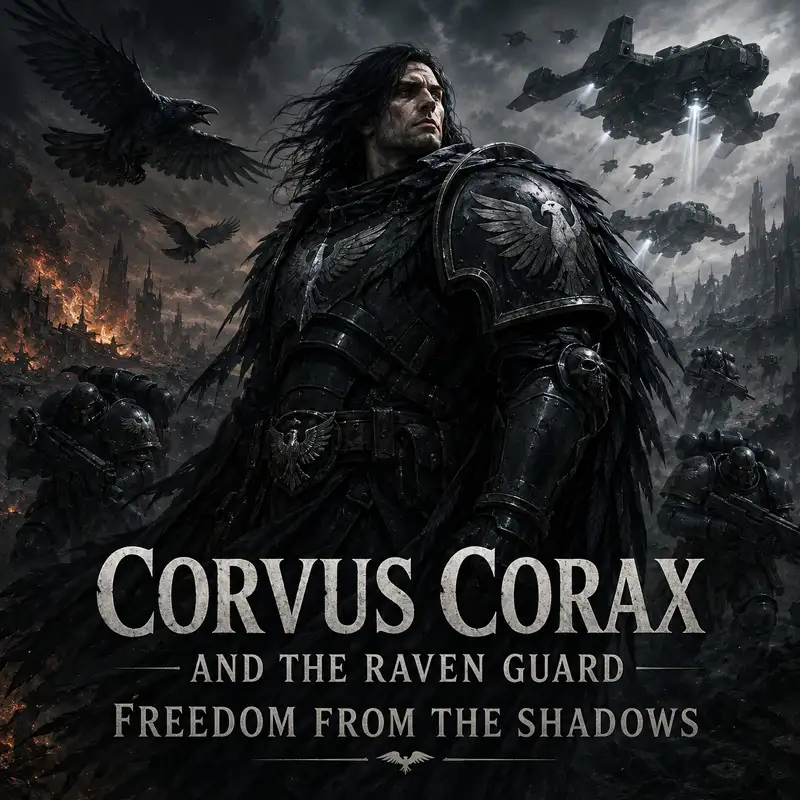
Corvus Corax and the Raven Guard: Freedom From the Shadows
On the ninety-eighth day after the Dropsite Massacre, Corvus Corax had roughly three thousand sons left and nowhere worth hiding. The poisoned plains of Isstvan Five lay ahead. Behind them came the World Eaters, tens of thousands strong, with Angron roaring for his brother to turn and fight. Corax had spent months refusing that invitation. At last, he ordered the Raven Guard to halt. It appeared that the master of escape had reached the place where escape ended.
That moment reveals more about Corax than any list of victories. He was a Primarch built for sudden violence, yet he distrusted glorious last stands. He wore darkness as a weapon, but he had not been raised to worship darkness. He had been raised by prisoners who wanted to see the sky without permission. For Corax and the Raven Guard, stealth was never merely a way to approach an enemy. It was the method by which the weak could deny the strong a fair fight. Their promise was freedom delivered from the shadows. Their tragedy was that Corax never fully escaped the shadows within himself.
His story began on Lycaeus, a prison moon orbiting the industrial world of Kiavahr. The rulers of Kiavahr fed their factories with ore extracted by convicts, political enemies, failed workers, and anyone else the tech guilds found convenient to remove. Lycaeus was not simply a mine with cells attached. It was an economic system built on people who could be exhausted, replaced, and forgotten. The arrangement was efficient, provided one did not ask the workers for an opinion.
Corax was found there as a child, pale and black-haired, growing with the impossible speed of a Primarch. The prisoners concealed him from their overseers. They taught him demolition, combat, machinery, politics, and the patient reading of a guard who believed himself safe. They did not raise him as a prince. They raised him as the answer to a practical problem. How do people with no army defeat a ruling class that controls the weapons, the communications, the food, and the airlocks?
The answer was not a heroic charge. Corax organised cells, trained leaders, hid weapons, sabotaged systems, and stretched the garrison with strikes and unrest. He understood that rebellion succeeds before the shooting begins or it usually does not succeed at all. Every stolen charge, concealed meeting, and false alarm altered the balance. When the uprising finally came, it seemed sudden only to the guards. To the prisoners, it was the visible end of a war already fought in silence.
Lycaeus was liberated, but Kiavahr remained above it, powerful, armed, and determined to restore the old order. Corax answered with atomic mining charges. The rulers of Kiavahr collapsed. Millions died so that billions might be freed. The survivors renamed Lycaeus as Deliverance and called Corax their deliverer. It was a victory, but not an innocent one. The first great freedom Corax won was purchased with lives he could not return, and that knowledge became part of him.
The Emperor arrived soon afterward. The surviving accounts do not preserve the private conversation between father and son, which is probably just as well. Conversations between the Emperor and his children had a tendency to become historical disasters with excellent ceremonial lighting. Corax accepted command of the Nineteenth Legion and joined the Great Crusade. He appears to have believed that the Imperium could do on a galactic scale what he had done on Lycaeus: overthrow tyrants, unite humanity, and prevent isolated worlds from falling into slavery or extinction.
That belief was never entirely false, but neither was it entirely honest. The Great Crusade liberated some worlds and conquered others. Compliance did not become freedom merely because the banners were larger. Corax was now a revolutionary serving an empire, a former prisoner commanding genetically engineered armies, and an enemy of oppression whose duty required him to impose the Emperor’s will. He carried the contradiction everywhere, usually in silence.
The Legion he inherited made the problem immediate. Before Corax, the Nineteenth had recruited heavily from the Xeric tribes of Terra, cultures associated with slaving and ruthless warfare. The Legion had fought beside Horus and the Luna Wolves as assassins, suppressors, and hunters of resistance. They were already skilled at infiltration, but their stealth served terror. They did not merely remove enemy commanders. They made populations understand what would happen if obedience failed.
Corax recognised too much of Kiavahr in them. He did not discard their skill. He changed its purpose. Under him, the Raven Guard emphasised reconnaissance, sabotage, decapitation strikes, rapid assaults, and the destruction of critical military systems. The aim was to collapse resistance before a prolonged war consumed cities and civilians. He removed or banished officers whose methods he considered cruel and elevated warriors who understood restraint. In a galaxy where several Legions treated civilian casualties as scenery, this qualified as a moral distinction.
It did not make Corax morally simple. His treatment of the old Terran Legionaries could be severe and perhaps self-serving. Many had served under Horus for decades. Some embraced customs and warrior lodges Corax distrusted. Others represented a past he wanted erased. Those who could not accept his reforms were sent into distant predation fleets and remote campaigns. Corax had learned to overthrow ruling classes, but he had not learned to forgive those who resembled them.
The conflict came into the open at Gate Forty-Two. Horus ordered the Raven Guard to make a frontal assault against heavily defended positions. Corax proposed feints and manoeuvre instead, drawing defenders away so allied Legions could strike the weakened centre. Perturabo accused him of cowardice. Corax submitted, then committed many Terran-dominated formations whose commanders had supported Horus’s plan. The gate fell. Thousands of Raven Guard died, and the decisive glory went elsewhere.
Afterward, Corax removed his Legion from Horus’s command and swore not to serve beside him again. The episode vindicated Corax’s tactical judgment, but it also exposed his capacity for cold political calculation. He had obeyed a wasteful order while allowing it to consume many of the sons he least trusted. Whether he intended their destruction in full remains uncertain, but the outcome strengthened his control over the Legion. The liberator had used a battlefield to settle an internal struggle. Freedom, in Corax’s hands, could have sharp boundaries.
The Raven Guard that emerged from these reforms was not an army of men crouching behind convenient crates. Their warfare began with information. They mapped command networks, supply lines, sensor coverage, transport routes, and the loyalties of local populations. Scouts and infiltrators moved ahead of the main force. Saboteurs blinded communications. Aircraft and strike cruisers approached under specialised concealment systems. Then, at the chosen moment, black-armoured warriors descended on the few targets that held the enemy system together.
A Raven Guard victory might look strangely small. One landing field was seized. One governor vanished. One generator failed. One artillery command post stopped answering. Hours later, an army that had seemed intact could no longer move, see, or obey. The killing blow came only after the enemy had been divided into manageable pieces. Other Legions proved courage by standing in the open under fire. The Raven Guard considered that an unnecessarily public way to confirm the enemy’s marksmanship.
Corax possessed an ability that made the Legion’s character almost supernatural. He could slip from awareness, not merely hiding his body but making observers fail to notice him. Some of his sons inherited a lesser echo of this gift. Yet the true foundation of Raven Guard warfare was discipline rather than magic. Silence had to be maintained. Timing had to be exact. A warrior who attacked early could expose an entire operation. Independence was encouraged, but vanity was fatal.
This separated Corax from Konrad Curze, the Primarch of the Night Lords. The two looked disturbingly alike and both understood fear, darkness, and sudden violence. Curze used terror to make populations submit. Corax tried to strike the people who created the terror. Curze wanted witnesses. Corax preferred survivors who had never seen the blow fall. The difference was not that one understood darkness and the other did not. The difference was whom they believed darkness should serve.
During the Great Crusade, that distinction gave the Raven Guard a reputation for limiting unnecessary destruction. It also allowed Corax to believe that his wars remained connected to the revolution on Deliverance. Sometimes they were. The Legion broke slave regimes, destroyed predatory rulers, and ended wars with precision. At other times, they merely forced a more efficient compliance. A targeted conquest is still a conquest. Corax could reduce the suffering produced by the Imperial project, but he could not turn that project into consent.
When Horus rebelled, Corax remained loyal. His distrust of the Warmaster and his earlier removal of many Terran officers had reduced the influence of the warrior lodges that helped corruption spread through other Legions. Yet loyalty drew the Raven Guard into the trap at Isstvan Five. Alongside the Iron Hands and Salamanders, they descended against Horus’s entrenched forces. Corax and Vulkan urged caution, but Ferrus Manus demanded an overwhelming assault. The plan was brutal, direct, and almost exactly the kind Corax had spent his life trying to avoid.
The first attack cost heavily, but the Loyalists fought forward until fresh Legions arrived behind them. Those reinforcements were supposed to relieve the exhausted attackers. Instead, the Iron Warriors, Night Lords, Word Bearers, and Alpha Legion opened fire on their supposed brothers. The retreat route became a killing ground. Formations disintegrated under crossfire. Officers could not tell which signals were genuine. The Raven Guard, masters of preparation, had entered a battle whose most important decisions had been made by the enemy long before they landed.
In the chaos, Corax fought Lorgar of the Word Bearers and came close to killing him. Konrad Curze intervened, confronting Corax with the brother he might have become had hatred replaced purpose. Corax withdrew. It was not the heroic ending the Traitors wanted, but it preserved the one commander who might still save the Legion. Ferrus Manus sought a decisive reckoning and died. Vulkan disappeared in fire. Corax survived, burdened by the knowledge that survival could feel very much like failure.
For ninety-eight days, the remnants of the Raven Guard fought across Isstvan Five. They attacked isolated Traitor units, scavenged ammunition, moved through poisoned ravines, and refused the final battle Angron wanted. Corax turned a massacre into a guerrilla campaign. Every ambush proved that Horus’s victory was incomplete. Every vanished patrol forced the Traitors to spend more troops hunting fewer survivors. The Legion had lost almost everything except its method of war, and that method kept it alive.
Near the end, with about three thousand Raven Guard trapped against the salt plains, Corax prepared to stand. Rescue arrived at the last possible moment. A force from Deliverance, moved in part by the strange dreams of the Imperial commander Marcus Valerius, descended through the burning sky and pulled the survivors away from Angron’s charge. Whether this was providence, psychic intervention, or an almost impossible coincidence remains unsettled. The Imperium records many miracles. A surprising number involve aircraft arriving after the situation has become completely unreasonable.
Corax escaped Isstvan, but he could not accept what his survival had cost. He went to Terra and sought help from the Emperor. What he received was access to genetic knowledge connected to the creation of the Primarchs. With it, Corax hoped to rebuild the Raven Guard at extraordinary speed. The project was desperate but not irrational. The Imperium was collapsing, the Traitors possessed whole Legions, and Corax had only a few thousand warriors. Patience had won his first revolution. Now time itself was the enemy.
The first results were astonishing. New Space Marines could be created rapidly, and the warriors called Raptors appeared stronger and quicker to mature than ordinary recruits. Corax seemed to have found a way to undo Isstvan. Then the Alpha Legion, already concealed among the survivors, sabotaged the work. The process became corrupted. Later recruits emerged hideously altered, their bodies still powerful but unstable and increasingly monstrous. The Raven Guard had been attacked through the very shadows they trusted.
The disaster was more than a military loss. Corax had promised these recruits transformation, purpose, and brotherhood. Instead, his urgency had placed them inside an experiment his enemy could poison. He continued to use those capable of fighting, and many remained loyal despite what had been done to them. Their appearance did not make them traitors. Their tragedy lay in remaining faithful while Corax increasingly treated their condition as evidence of his own failure.
The Raven Guard continued the war in smaller forces. They struck Traitor supply lines, liberated prison colonies, fostered uprisings, destroyed war production, and attacked command centres far behind the main front. Corax even led operations to rescue other Loyalists, including the battered Space Wolves. These campaigns did not reverse Isstvan or place the Raven Guard at the centre of the war. They did something more suited to Corax. They denied Horus secure possession of what he had conquered.
A force does not need to hold the centre of a map to shape a war. It can make occupation expensive, movement dangerous, and local rulers uncertain. The Raven Guard became a persistent threat rather than a decisive army. They lacked the numbers to smash the rebellion head-on, so they attacked its confidence. On worlds declared for Horus, officials learned that allegiance offered no protection from a blade emerging in a locked room.
Yet victory did not free Corax from guilt. After the Heresy, as the old Legions were divided into Chapters, he faced the remaining mutated Raptors. He chose to end their lives himself, granting them the Emperor’s peace one by one. The act can be read as mercy, execution, or both. They were victims of enemy sabotage, but Corax treated their existence as a debt he alone must settle. He had once freed prisoners from masters who regarded damaged lives as disposable. Now he stood as judge over sons damaged in his service.
He withdrew into the Ravenspire for a year. When he emerged, he left Deliverance and entered the Eye of Terror, seeking vengeance or absolution among the worlds of the Traitor Legions. His last recorded word was, “Nevermore.” The phrase suited the raven imagery, but it also sounded like a sentence passed upon himself. Corax did not leave as a triumphant liberator. He left as a man who believed punishment remained unfinished.
A later account places him deep within the Eye, hunting the Word Bearers. There he appears less like an armoured Primarch and more like living darkness, a storm of shadow and black wings capable of tearing through the servants of Chaos. He confronts the transformed Lorgar and drives him back. Whether Corax had been changed by the Warp, had mastered it without surrendering, or had revealed something that had always existed within a Primarch is not settled. The surviving tale does not make the distinction comfortable.
That image completes the contradiction. Lorgar embraced the Warp and became a daemon prince. Corax entered the same realm as a hunter, yet he no longer appeared entirely human. He had spent his life using shadows without wishing to belong to them. In the Eye of Terror, the weapon and the wielder became difficult to separate. He may still have been loyal. He may still have been himself. Warhammer’s universe is generous enough to allow both statements while making neither reassuring.
The Raven Guard who endured into the forty-first millennium preserved the clearer parts of his legacy. They favour reconnaissance, infiltration, sabotage, rapid aerial assault, and independent companies capable of acting far from central command. Their gene-seed carries lasting damage, and their numbers have often been difficult to replace. Their culture remains reserved, but not empty. Even their art descends from the prisoners of Lycaeus, who made small beautiful things that could be hidden from overseers. Secrecy, for them, once protected more than military plans. It protected the human spirit.
That is why the Raven Guard are more than Space Marines painted black and instructed to stand somewhere dim. Their doctrine contains a political memory. They remember the mine, the cell, the overseer, and the moment when an oppressed population discovered that the master’s fortress could be entered. They prefer to break the structure of domination rather than grind through everyone trapped inside it. By Imperial standards, this is compassion. By ordinary standards, it remains heavily armed compassion delivered from orbit.
Corax’s answer to oppression was never sunlight. It was preparation, concealment, and one precise act that made the prison doors open. That answer freed Deliverance, reshaped a Legion, and preserved three thousand sons on a world designed to kill them. It also allowed him to hide difficult truths from himself: that the Imperium could resemble Kiavahr, that unwanted sons could be sent away, and that mercy could become execution when guilt held the blade.
Freedom from the shadows, then, does not mean Corax escaped darkness. It means he tried to make darkness serve freedom rather than fear. Sometimes he succeeded. Sometimes the distinction collapsed beneath the weight of empire, war, and his own judgment. The Raven Guard inherited both halves of that legacy: the patience to strike an oppressor where he is weakest, and the melancholy knowledge that a liberator can carry the prison with him long after its walls are gone.
On Lycaeus, Corax taught slaves to disappear from the sight of their masters until the hour came to rise. In the Eye of Terror, he became the thing that disappeared, still hunting brothers who had chosen chains and called them revelation. The deliverer entered the final shadow not because he had abandoned freedom, but because he could no longer imagine earning it for himself.