Commorragh: A City Built From Cruelty
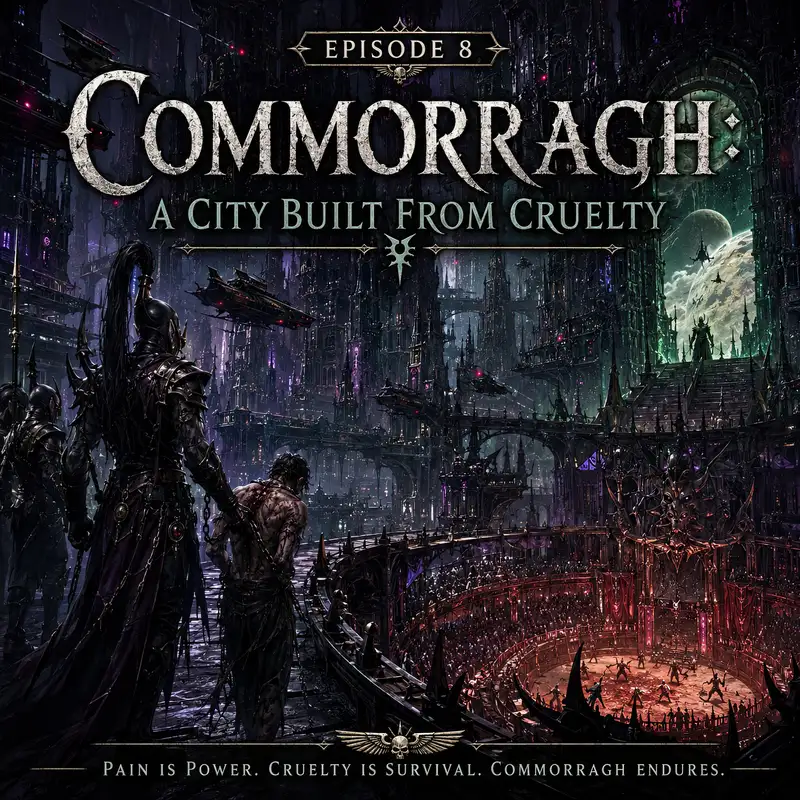
A prisoner entering Commorragh sees the city before understanding it. There is no horizon, only black towers descending beneath black towers, bridges crossing distances that should not fit inside any sane geometry, and aircraft moving like knives through a sky that is not truly a sky. Somewhere far below, an arena roars. Somewhere above, a gate opens onto a world whose inhabitants have not yet learned that they are prey. The newcomer may think the screams are a symptom of disorder. They are not. In the Dark City, suffering is organized, traded, displayed, refined, and consumed. Commorragh is not merely a place where cruel people happen to live. It is a civilization whose politics, economy, medicine, entertainment, and survival all depend upon cruelty continuing without interruption.
Calling Commorragh a city is convenient in the same way that calling a battleship a boat is convenient. It is technically useful and deeply misleading. Commorragh lies within the Webway, the ancient network of hidden passages that runs outside ordinary space and avoids the full violence of the Warp. It is not one continuous urban mass occupying one location. It is a collection of districts, ports, estates, fortresses, arenas, laboratories, and conquered sub-realms joined by portals and secret routes. Two towers that appear to stand beside one another may be separated by impossible distances. A doorway can lead to a domain whose nearest point in realspace lies thousands of light years away. Geography in Commorragh is a matter of access, and access belongs to whoever can keep it.
The city began long before the birth of the Drukhari. During the height of the ancient Aeldari empire, Commorragh was one of the greatest ports in the Webway. Its gates connected distant regions of the empire, making it commercially valuable and strategically indispensable. Because no single political faction could be trusted with so important a junction, the port enjoyed unusual independence. That autonomy had consequences. Wealthy nobles, private cults, criminals, and those wishing to pursue appetites best kept beyond public inspection gathered there. Commorragh became a place where influence could purchase distance from law. As the wider Aeldari civilization sank into arrogance and excess, the port did not resist the decline. It specialized in it.
Then came the Fall. The psychic corruption of the Aeldari empire reached the point at which it gave birth to Slaanesh, the Chaos God that now hungers for every Aeldari soul. Worlds died. The heart of the old empire became the Eye of Terror. Aeldari in the Webway were shielded from the first, overwhelming catastrophe, and many within Commorragh survived. Survival, however, was not freedom. Slaanesh still exerted a constant pull upon them, draining vitality and spirit by degrees. The inhabitants of the Dark City discovered that the anguish of other beings could replenish what was being taken. Fear, pain, and despair restored their strength. A Drukhari who fed well could recover youth and vigor. One who did not would wither beneath the Thirst.
That is the fact around which Commorragh was rebuilt. Cruelty became more than pleasure, although pleasure remained part of it. Cruelty became nourishment. The Drukhari did not adopt the disciplined Paths of the craftworlds, nor did they bind their souls within spirit stones. They continued many of the habits that had helped destroy the old empire, while forcing other beings to pay the spiritual cost. Their victims suffer so that the Drukhari can remain themselves for another day. This does not excuse what they do. It explains why sadism became stable enough to support institutions. A civilization can survive almost any moral contradiction once that contradiction supplies food, status, security, and the reasonable expectation of waking up tomorrow.
Commorragh reflects that bargain in its architecture. Needle-like spires climb into darkness while other structures hang inverted above them. Districts are linked by narrow bridges, dimensional gates, and transit routes guarded as jealously as fortresses. The city is illuminated by the Illmaea, ancient suns stolen from realspace and imprisoned within Webway sub-realms. Their caged radiance provides power and a harsh imitation of daylight, though much of Commorragh remains deliberately shadowed. The result is grandeur without warmth. The technology involved is more advanced than nearly anything the Imperium can understand, yet it serves a society that often uses its genius to design a sharper hook. Progress, in the Dark City, has never suffered from excessive concern about the customer.
There is no dependable civic law in the Imperial sense. There are commands, arrangements, debts, privileges, and territories, all backed by the credible threat of violence. The strong survive, but strength in Commorragh means more than skill with a blade. It means belonging to an organization, controlling a portal, owning information, purchasing the favor of a Haemonculus, or making an enemy disappear without encouraging every other enemy to attack at once. Open anarchy would destroy the city, so the Drukhari have built something more sophisticated. They have created order through overlapping systems of fear. Every resident knows that betrayal is possible. Every successful ruler works to ensure that betrayal remains more dangerous for the traitor than for the intended victim.
The Kabals are the most visible political and military powers. Each is ruled by an Archon who has reached the summit through ability, inheritance, assassination, or some particularly elegant combination of all three. A Kabal controls territory, maintains warriors and aircraft, gathers intelligence, and organizes raids into realspace. For an ordinary Drukhari, membership offers protection and opportunity. The protection is conditional, the opportunity is usually lethal, and resignation can be difficult to arrange, but the alternative is isolation. A Kabal is part private army, part criminal cartel, part aristocratic court. Its warriors compete for advancement while watching those beneath them for ambition and those above them for weakness. Loyalty exists, though it is commonly rented by the hour.
The Wych Cults provide another pillar of the city. Their arenas transform killing into public spectacle. Wyches train for lifetimes to fight with speed, precision, and theatrical control, drawing out a contest so that an audience can savor every reversal. Captured soldiers, alien beasts, rival gladiators, and unfortunate curiosities are thrown before the crowds. The violence is entertainment, but it is also communal feeding. The terror and pain generated in a great arena invigorate those who witness it. A skilled Succubus therefore becomes more than an athlete or celebrity. She is a political figure whose performances can sustain followers, embarrass rivals, and turn slaughter into public legitimacy. In Commorragh, bread and circuses have been reduced to one item, and the bread screams.
The Haemonculus Covens hold a different kind of power. Haemonculi are flesh-sculptors, surgeons, torturers, philosophers, and scientists who regard the body as temporary material. Their laboratories contain creations assembled from living captives, altered servants, and mechanisms designed to harvest agony with clinical precision. They can rebuild favored clients from surprisingly little remaining tissue, provided suitable arrangements were made beforehand. This makes them indispensable to powerful Archons who expect assassination as a routine occupational hazard. It also gives the Covens leverage over nearly everyone. A ruler may command thousands of warriors, but the individual who keeps a fragment of that ruler’s flesh in a resurrection vault possesses a persuasive form of insurance.
For the wealthy, death can become an inconvenience. For everyone else, it remains extremely final. This difference shapes the city’s appetite for risk. An Archon who can be restored by a Haemonculus may gamble warriors, territory, and even personal survival on an ambitious scheme. A lowborn Kabalite cannot expect the same service unless someone important finds value in preserving them. Commorragh therefore combines extreme social mobility with extreme social cruelty. Advancement is possible. Vect himself is remembered as rising from the lowest levels of society. That possibility keeps ambition alive, even though every rung of the ladder is sharpened and several are attached to traps.
Below the great Kabals, Cults, and Covens lies a shifting population of gangs, mercenaries, artisans, traders, Hellions, Scourges, alien visitors, predators, and outcasts. Some districts have markets where weapons, poisons, information, slaves, and stolen relics change hands. Others belong to creatures that even the Drukhari approach cautiously. Mandrakes move through shadows connected to the strange realm of Aelindrach. Ur-Ghuls hunt in the deepest darkness. Entire neighborhoods can be controlled by a local power whose name means nothing beyond three streets and one portal, yet within that boundary its word is life or death. Commorragh is vast enough to contain countless smaller tyrannies, each dreaming of becoming a larger one.
At the bottom are the captives. Realspace raids supply the Dark City with labor, experimental subjects, gladiators, servants, and above all sources of suffering. The Drukhari do not usually raid because they need land. They raid because they need people. Their forces emerge through Webway gates, strike vulnerable settlements, overwhelm resistance with speed, and withdraw before a conventional response can gather. Those killed immediately may be the fortunate ones. Survivors are taken through portals and distributed according to status, usefulness, novelty, and the preferences of their owners. It is an interstellar supply chain built around kidnapping, with remarkably little paperwork and a rather severe customer-retention policy.
The Webway makes this predatory economy possible. Commorragh can reach distant regions without crossing the intervening void, and its raiders can attack places that appear strategically unrelated. An Imperial commander may fortify the routes leading toward a valuable world and discover that the enemy has ignored the routes entirely. The Drukhari do not need to hold a system or defeat its fleet in a prolonged campaign. They need an opening, a target, and a path home. Their aircraft and skimmers favor speed because the objective is not honorable battle. It is controlled harvest. Prolonged warfare gives an opponent time to adapt. A successful raid ends before the victim fully understands what kind of war has begun.
This is why cruelty in Commorragh is inseparable from refinement. The Drukhari are not mindless berserkers. They are heirs to an ancient civilization with extraordinary senses, long lives, sophisticated tastes, and technology that can reshape flesh and space. Their horror comes from the deliberate use of those gifts. Pain becomes an art because ordinary suffering eventually ceases to impress an audience that has witnessed everything. Weapons are designed not merely to kill but to produce distinctive effects. Arena performances are judged by elegance. Haemonculi pursue new transformations as creative achievements. An Archon’s revenge must communicate intelligence as well as power. Simple brutality is common. Memorable brutality is social capital.
At the center of this system stands Asdrubael Vect, Supreme Overlord of Commorragh and master of the Kabal of the Black Heart. Vect does not govern through a civil service or a public code. He governs by understanding the city better than anyone else and by demonstrating that no rival can safely unite against him. Accounts of his rise describe a masterful manipulation of an Imperial assault. Space Marines entered Commorragh seeking their captured brethren and devastated much of the old nobility. Vect emerged from the destruction stronger, replacing aristocratic houses with the Kabal system and placing himself above it. Whether every detail unfolded precisely as he intended is difficult to prove. In Commorragh, surviving a catastrophe is often presented as evidence that one arranged it.
Vect’s achievement is not the elimination of conflict. It is the management of conflict. He allows Kabals to feud because competition removes weak leaders and prevents stable coalitions. He permits ambition because a city without ambition would stop raiding, innovating, and feeding. Yet he punishes anyone whose success threatens the structure that keeps him supreme. His reprisals are designed as lessons for an audience. A rival may lose more than life. Their fortress can vanish, their followers can be reassigned, and their name can become dangerous to remember. Vect’s rule is therefore both personal and environmental. He has shaped Commorragh so that the instincts driving every ambitious Drukhari also tend to preserve the system he dominates.
The city itself can be used as a weapon. Portals can close without warning. Routes can be redirected. A district can be isolated from its allies or exposed to its enemies. Because Commorragh is assembled from connected realms rather than built upon a single planet, territory can sometimes be severed from the whole. This makes the Dark City extraordinarily difficult to invade. An enemy cannot simply locate its star, establish orbit, and begin a siege. There is no normal approach. Any attacker must enter through paths the Drukhari know far better, then fight within a geography that can change around them. The defender does not always need to defeat an invading force. Sometimes it is enough to lock the door and remove the room.
That advantage also reveals Commorragh’s greatest weakness. The Webway protects the Drukhari from the full force of the Warp, but it is not invulnerable. Breaches can become daemonic incursions, and psychic disturbances threaten the entire city. Drukhari society therefore suppresses the open use of psychic power. Their ancestors possessed immense psychic potential, yet the people of Commorragh avoid exercising it because drawing upon the Warp risks attracting the very hunger from which they hide. Their civilization depends on ancient systems they can exploit but cannot always safely replace. They inhabit one of the most advanced cities in existence while living beside sealed doors that must never be opened.
In the closing years of the forty-first millennium, that danger became immediate. Events surrounding Yvraine and the partial awakening of Ynnead, the Aeldari god of the dead, triggered a catastrophic Dysjunction within Commorragh. The barriers between realms failed. Daemons entered. Khaine’s Gate, long feared as a weak point in the city’s defenses, became the center of a spreading disaster. Vect responded as Commorragh always responds: decisively, ruthlessly, and with other people placed nearest the danger. Forces were committed to contain the breach, and infected sub-realms were cut away, creating the region known as the Chasm of Woe. Entire populations were sacrificed so the greater city might endure.
The Dysjunction exposed the lie beneath Commorragh’s confidence. The Drukhari often present themselves as the true heirs of the ancient Aeldari, too sophisticated for craftworld restraint and too proud to fear extinction. Yet their city is a refuge under permanent siege. Every raid admits that they need outsiders. Every arena admits that they are being drained. Every resurrection admits that death is waiting. Every prohibition on psychic power admits that Slaanesh remains close enough to hear. Their arrogance is genuine, but so is the terror beneath it. Commorragh is loud because silence might leave its inhabitants alone with the sound of their own souls being taken.
Life there is not continuous panic. No society could function that way for millennia. The Drukhari form alliances, pursue crafts, collect art, attend spectacles, bargain, celebrate victories, and maintain relationships that may even contain forms of affection. The difference is that none of these bonds exist outside the city’s incentives. Trust must survive a culture in which betrayal can bring advancement and suffering provides literal renewal. A Drukhari may care for a companion while still preparing for that companion’s treachery. They may admire a leader while planning to replace them. They may keep a promise because a reputation for keeping selected promises makes later deception more effective. Their society is not without rules. It is full of rules that punish innocence.
This also explains why Commorragh does not collapse under the weight of its own treachery. Most residents benefit from preserving the larger system even while attacking one another within it. Kabals require gates, markets, and raiding routes. Wych Cults require audiences and captives. Haemonculi require patrons and materials. Vect requires rivals strong enough to keep the city productive but divided enough to remain controllable. Everyone requires the Webway’s protection, and nearly every Drukhari requires the suffering brought back from realspace. They can despise one another without wanting the machinery to stop. The city survives because self-interest is distributed more widely than loyalty.
For the same reason, reform is almost unimaginable. Asking the Drukhari to abandon cruelty is not merely asking them to become kinder. It is asking them to surrender the method by which they resist spiritual consumption, dismantle the institutions that provide status and security, and trust an alternative that their rulers would treat as a threat. The rise of the Ynnari offers one possible escape from Slaanesh through Ynnead, which is precisely why it provokes such violent opposition in Commorragh. A genuine alternative would not simply change private behavior. It would make Kabals, arenas, slave raids, and perhaps Vect himself less necessary. Few regimes welcome a cure for the disease that justifies their power.
Commorragh becomes clearer when placed beside the craftworlds. Both societies descend from the same catastrophe and live under the same threat. The craftworld Aeldari answer with discipline, psychic restraint, spirit stones, and Paths designed to prevent obsession from consuming the individual. The Drukhari answer by embracing appetite while directing its cost outward. One civilization fears losing control of the self. The other makes control of everyone else the foundation of the self. Neither escaped the Fall. They carry different pieces of it into the future, each convinced that the other has chosen a form of death.
So Commorragh was built from cruelty in more than a poetic sense. Its towers may be metal, crystal, bone, or stranger materials, and its energy may come from captive suns, but its civilization rests upon harvested anguish. Cruelty feeds its people, structures its hierarchies, supplies its medicine, animates its entertainment, equips its armies, and rewards its rulers. It converts the suffering of outsiders into additional years of Drukhari life. The Dark City endures because it has turned damnation into an economy and terror into public infrastructure. Far above some nameless captive, another portal opens, another raid departs, and Commorragh continues to live by ensuring that someone else does not.