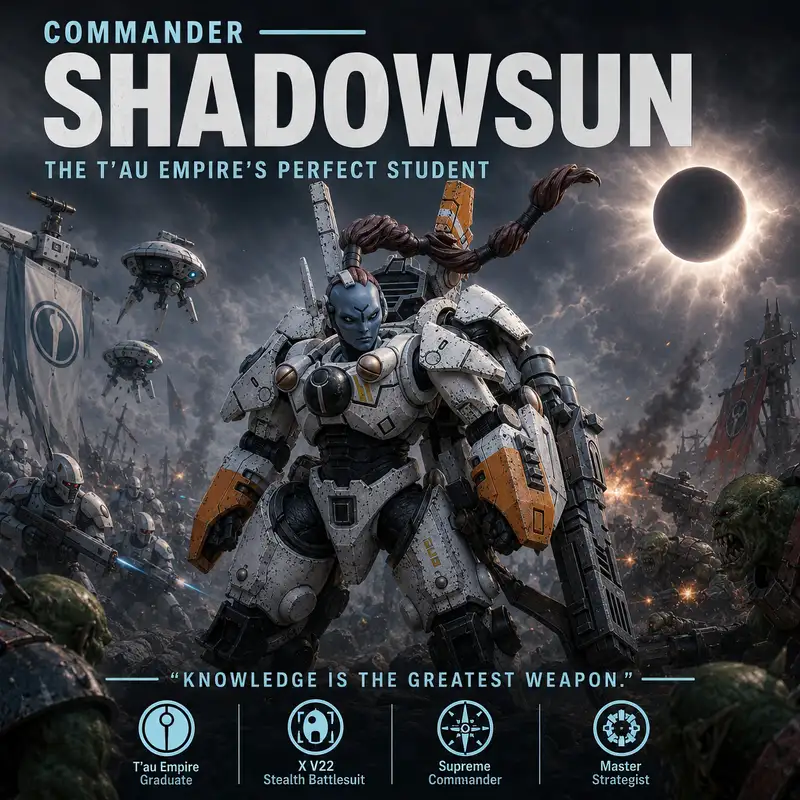
Commander Shadowsun: The T’au Empire’s Perfect Student
The Orks on K'resh had every reason to believe the battlefield belonged to them. They had numbers, noise, momentum, and the uncomplicated confidence of warriors who considered planning a suspiciously quiet activity. Then the sun vanished. An eclipse crossed the world, and in the deepening shadow a T'au commander moved forces into position, struck the Ork horde from concealment, and turned darkness into a weapon. The victory gave O'Shaserra the name by which the galaxy would remember her: Shadowsun.
That battle captures the image the T'au Empire prefers. Shadowsun is calm where others are reckless, disciplined where others are proud, and patient where others demand immediate glory. She is the master of Kauyon, the way of the Patient Hunter, and the most celebrated living pupil of Commander Puretide. Yet calling her the perfect student raises a more difficult question. Is she perfect because she follows the lesson exactly, or because she eventually learns when the lesson is no longer enough?
The T'au are a young power surrounded by civilizations older, larger, and considerably less interested in being impressed. Their answer is not to imitate the Imperium's scale, because they cannot. They rely on cooperation among castes, rapid technological refinement, and the belief that rational organization can overcome inherited brutality. Shadowsun is the military expression of that confidence. She does not command the largest armies in the galaxy. She tries to make size irrelevant.
Puretide occupies an unusual place in T'au history. He was not merely a successful general. He became the model against which later Fire Caste commanders were measured, the old master whose campaigns seemed to contain an answer for every military problem. The T'au even preserved fragments of his strategic mind through technology, because apparently venerating a dead commander is perfectly rational once the process involves enough circuitry. His teachings became doctrine, memory, and state property.
Among Puretide's most famous students were three very different warriors. One was the commander later called Farsight, brilliant, aggressive, and drawn toward the decisive violence of Mont'ka, the Killing Blow. Another was Kais, associated with the lonely path of the individual warrior. The third was the young O'Shaserra. They trained together in the bitter conditions of Mount Kan'ji, where survival was part of the examination and failure had more serious consequences than an unfavorable note from the instructor.
The three students did not simply learn maneuvers. They absorbed different answers to the same question: how should a commander create victory? Farsight sought the crucial point and struck it before the enemy could recover. Kais turned himself into a weapon that required little from anyone else. Shadowsun learned to shape the battlefield until the enemy's choices became illusions. She would allow the prey to advance, encourage confidence, conceal the true danger, and close the trap only when escape had become impossible.
Puretide's deeper teaching was broader than a choice between two named doctrines. Mont'ka and Kauyon were tools, not rival religions, and a commander who understood only one response could eventually be predicted. Later generations preferred cleaner categories. Farsight became the Killing Blow, Shadowsun the Patient Hunter, and Kais the Lone Warrior. Institutions enjoy turning complicated teachers into tidy examination subjects. Battlefields are less accommodating.
Kauyon is often reduced to waiting in ambush, but that misses its scale. It is a metastrategy, a way of organizing an entire campaign around control. The patient hunter does not merely hide behind a convenient rock. She decides what the enemy will see, what the enemy will fear, which route appears safe, and which target seems too valuable to ignore. The enemy is permitted to make decisions, provided every useful decision leads toward the same killing ground.
This suited Shadowsun because her greatest talent was not personal marksmanship, although she possessed plenty of that. It was coordination. Reconnaissance teams, aircraft, battlesuits, armored formations, orbital assets, local allies, and carefully timed reserves could all become parts of one design. Her victories were rarely about one heroic charge. They were about many separate elements acting as though a single mind had placed them exactly where they needed to be.
Her preferred battlesuit expressed the same philosophy. Rather than encasing herself in the heaviest armor available, Shadowsun fought in an advanced X V twenty-two stealth battlesuit. Its systems allowed her to approach unseen, reposition rapidly, and strike hard targets with fusion weapons at dangerously intimate range. Her drones extended her awareness and protection. The whole arrangement was elegant, precise, and dependent upon not being where the enemy expected. It was also a reminder that stealth ceases to be theoretical when you are close enough to melt a tank.
The campaign on K'resh showed how naturally she understood that kind of war. She did not defeat the Orks by matching their appetite for a direct fight. She used timing, terrain, and the eclipse itself to remove their advantages. The name Shadowsun was more than a battlefield honor. It described a commander who could turn absence into presence, concealment into pressure, and the enemy's own certainty into the opening she required.
Her career also reveals something less heroic about the T'au Empire. T'au lives are brief compared with those of many human leaders, and Puretide's finest students were too valuable to lose to ordinary aging. Shadowsun was placed in cryogenic stasis and awakened when the Empire needed her. From the Ethereals' perspective this was efficient stewardship of a strategic asset. From hers, it meant surrendering the normal flow of life and emerging into futures shaped by people who had continued living without her.
Even the private questions surrounding her family became entangled with service. Accounts of Shadowsun's life repeatedly place duty against personal continuity, asking whether the child of a distinguished line belongs to that family or to the Greater Good. The official answer is rarely in doubt. The Greater Good claims every talent eventually, and it had claimed hers more completely than most. Perfection, in this system, begins with availability.
That made her the ideal answer to the disaster of Farsight. He had been Puretide's dazzling pupil and one of the Empire's greatest heroes. He had also broken from Ethereal authority, founded enclaves beyond their control, and become the example whispered whenever commanders showed too much independence. Shadowsun had fought beside him and understood his gifts. She also became the loyal counterimage the Empire needed.
When news of Farsight's separation became undeniable, Shadowsun destroyed a statue raised in his honor. The act was theatrical, angry, and politically useful. It announced that Puretide's legacy did not belong to the rebel. The Empire still possessed a disciple who would combine military genius with obedience. Farsight could be rewritten as the student ruined by pride, while Shadowsun became the student who remained faithful.
Ethereal Supreme Aun'Va elevated her to lead the Third Sphere Expansion. This was not simply a military appointment. It was a public restoration of confidence. The T'au had suffered reverses, the Damocles Gulf remained dangerous, and Farsight's shadow lingered over the Fire Caste. Shadowsun was awakened, presented as Puretide's true heir, and given the task of proving that the Empire could expand without repeating the rebel's path.
She proved exceptionally good at it. The Third Sphere pushed outward through the eastern reaches, establishing colonies and bringing new worlds under T'au control. Some populations were persuaded, some were absorbed through political pressure, and some were defeated. The Greater Good prefers a clean distinction between willing unity and regrettable force. Frontier warfare tends to smudge the paperwork.
Expansion also required more than Fire Caste victories. Water Caste diplomats offered terms, Earth Caste engineers made conquered worlds productive, Air Caste fleets connected new holdings, and auxiliary peoples added abilities the T'au lacked. Shadowsun's task was to make these parts support one another under combat pressure. Her army was therefore a small model of the Empire's promise: different strengths coordinated toward one purpose. Its darker implication was equally clear. Those who rejected that purpose would be coordinated against.
Shadowsun's campaigns worked because she understood that the T'au did not need to fight like the Imperium. Imperial commanders could pour regiments into a fortress line and call the resulting graveyard endurance. Shadowsun preferred information, mobility, air power, localized superiority, and attacks against the system holding an army together. She did not need to destroy every enemy unit. She needed to make resistance disconnected, blind, and increasingly pointless.
At Agrellan, later renamed Mu'gulath Bay by the victors, those methods produced one of the T'au Empire's greatest triumphs over humanity. Imperial defenders faced an enemy that refused to provide the straightforward battle they understood. T'au forces struck, withdrew, redirected, isolated strongpoints, and exploited the gaps between Imperial formations. The campaign became a demonstration of modern combined arms against an institution that often considered communications failure a traditional feature of command.
Victory made Shadowsun more than a general. She became an icon of expansion, the Spearhead of the Greater Good, proof that T'au technology and doctrine could defeat the ancient Imperium. That image was valuable because the Empire's wars are fought in the realm of belief as well as territory. Every conquered world had to be shown that resistance was futile, but cooperation remained generously available.
Then Kor'sarro Khan of the White Scars began hunting her. The White Scars understood speed, misdirection, and the value of refusing an enemy's preferred engagement. They were not the static Imperial soldiers Shadowsun had learned to disassemble. Khan attacked her command structure, inflicted severe losses, and made the campaign personal. The patient hunter discovered that she could also be bait.
Shadowsun reacted with anger. She pursued, overreached, and entered an Imperial trap. Members of her retinue died to preserve her life, and the commander celebrated for making enemies obey emotion had been manipulated through her own. The defeat did not erase her genius. It exposed the person beneath it. Beneath the discipline was pride, grief, and a temper made more dangerous by the belief that she had mastered it.
This is the most important failure in her career because it prevents her from becoming a diagram with a name. Puretide's doctrine did not fail at Mu'gulath Bay. Shadowsun failed to follow the part of it that required command of herself. A perfect student can recognize an enemy's weakness. A mature commander must also recognize when the enemy has found hers.
She recovered by returning to the larger campaign. The Prefectia offensive restored T'au momentum and again displayed her ability to coordinate complex operations. Yet the Imperium used that struggle as cover for a renewed strike against Mu'gulath Bay. The hunters were now setting traps for one another across whole systems. No plan remained private for long, and every apparent objective concealed another.
The second battle for Mu'gulath Bay ended with devastation. Imperial forces returned in strength, assassins struck at T'au leadership, and Aun'Va was killed. The Empire concealed his death behind a technological imitation, maintaining the public voice of the Ethereal Supreme after the person was gone. It was a grimly efficient solution to a political emergency, and one Puretide might have appreciated if military deception had extended to pretending one's ruler was still alive.
Shadowsun survived partly because a separate assassination attempt wounded her and removed her from the world's final destruction. Farsight also returned during the fighting and aided the defense, placing the old students of Puretide on the same battlefield despite the division between them. Their reunion did not repair the Empire, but it revealed that history had not reduced them to the simple roles assigned by propaganda.
Afterward, Shadowsun learned that the Ethereal Council intended to use her against Farsight. Rather than obediently closing the trap, she secretly warned him. The act did not make her a rebel. She did not abandon the Greater Good or declare war on the Ethereals. She made a judgment that loyalty to the Empire did not require blind compliance with every order issued in its name.
That choice marks the beginning of a different kind of perfection. The young student had demonstrated loyalty by destroying Farsight's statue. The older commander preserved him when authority demanded his capture. She had not adopted his cause, but neither would she pretend that official condemnation erased what she knew of him. Experience had complicated the lesson, and she allowed it to remain complicated.
The opening of the Great Rift confronted the T'au with problems Puretide could never have fully anticipated. The Startide Nexus carried the Fifth Sphere Expansion into distant regions, where Shadowsun was again awakened to command. There she found survivors of the lost Fourth Sphere, T'au who had crossed the warp and returned traumatized, secretive, and violently suspicious of the Empire's alien auxiliaries.
Their conduct threatened the idea they claimed to defend. Fourth Sphere commanders committed atrocities against humans and other client species, treating allies as contamination rather than partners in the Greater Good. Shadowsun opposed that brutality and helped discipline those responsible. For a commander raised inside a hierarchy of castes and carefully managed truths, this required more than tactical skill. It required recognizing that T'au forces themselves could become the danger.
Then the Death Guard arrived. They brought diseased warships, corrupted Space Marines, daemons, and a form of warfare that mocked every clean assumption in the T'au military mind. Their bodies endured wounds that should have stopped them. Their ships violated ordinary expectations of engineering. Their plagues were both biological and supernatural. A rail weapon can solve many disagreements, but it struggles to persuade an infection blessed by a god.
Shadowsun attempted to apply Kauyon. She gathered intelligence, calculated losses, redirected fleets, and searched for the point at which the enemy could be induced to overextend. The difficulty was that the Death Guard did not behave like rational prey. They could accept ruinous damage, carry corruption through space, and draw strength from forces the T'au had barely begun to understand. The battlefield itself no longer obeyed the rules on which her control depended.
Her isolation made the crisis worse. Shadowsun had learned to carry responsibility without revealing uncertainty. She trusted her drones more easily than most people and kept subordinates at a distance. That composure helped sustain an empire-wide symbol, but it narrowed the circle from which she could learn. Puretide had taught her to control the field. He had not taught her how to surrender control without collapsing.
The final test of the perfect student was therefore not a more elaborate ambush. It was adaptation. Briefly removed from command, Shadowsun assembled a small force of auxiliaries, including peoples whose beliefs and perceptions did not fit comfortably inside T'au rationalism. She boarded the Death Guard battleship Nephylum and entered a war where faith, psychic force, disease, and material reality had become inseparable.
Surviving that confrontation required her to accept help she could not fully explain. Accounts differ in how the strange power associated with the Greater Good should be understood, and the T'au themselves do not possess a settled answer. What matters for Shadowsun is that she could no longer dismiss the experience simply because it violated doctrine. She acted, trusted others, and returned with her certainty damaged but her command restored.
This did not transform her into a mystic, nor did it make the T'au suddenly comfortable with the warp. Shadowsun remained a military rationalist leading an expansionist empire. She still believed in coordinated purpose, disciplined force, and the Greater Good. The change was narrower and more significant. She understood that reality was under no obligation to respect the boundaries of her education.
That is why Shadowsun deserves to be called Puretide's perfect student, although not for the reason the Ethereals would prefer. She mastered Kauyon, preserved discipline under enormous pressure, and turned doctrine into victories across generations. She also failed, became angry, was deceived, questioned orders, trusted forbidden possibilities, and learned from consequences that no training simulation could provide.
Farsight answered the limits of T'au authority by leaving it. Shadowsun remained inside and forced herself to work through its contradictions. That path is less dramatic than open rebellion and perhaps more exhausting. She must serve as the Empire's symbol while seeing the machinery behind the symbol, defend unity while confronting crimes committed in its name, and obey a hierarchy without surrendering the judgment that makes her valuable.
Puretide's lesser student would have copied his solutions. Shadowsun absorbed his method. Observe without vanity. Shape the enemy's choices. Preserve strength for the decisive moment. Change position when the field changes. The last principle is the one that matters most, because a patient hunter who refuses to move is not patient. She is merely waiting to be found.
Shadowsun began as the pupil who could disappear beneath an eclipsed sun and make an army vanish with her. She became the commander who survived the disappearance of certainty itself. Her perfection does not lie in never departing from the master's path. It lies in carrying his discipline beyond the point where his map ends, and continuing into the dark without pretending the darkness is empty.