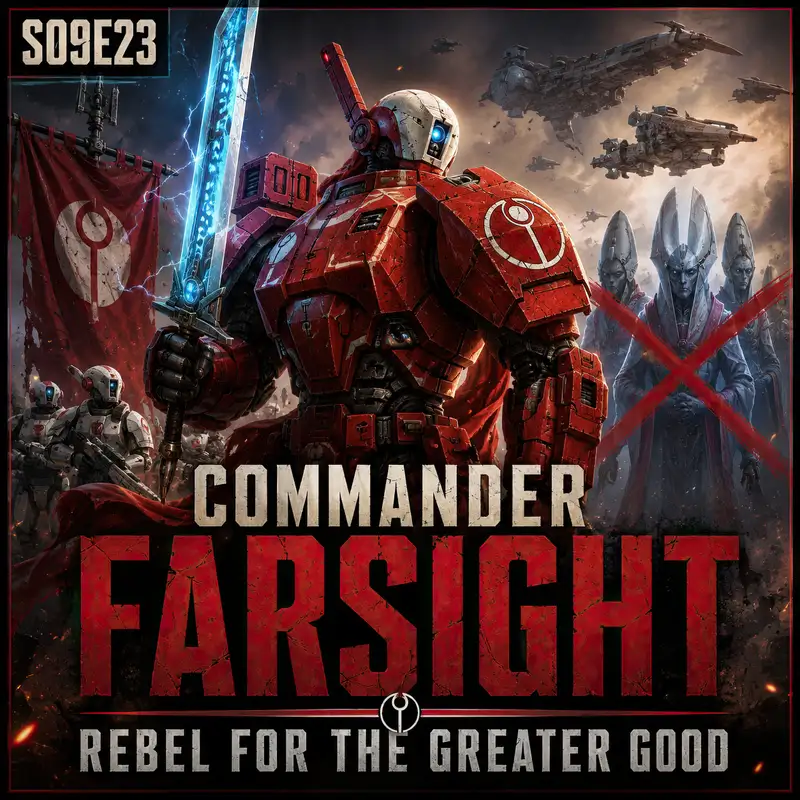
Commander Farsight: Rebel for the Greater Good
The strangest thing about Commander Farsight is not that he rebelled. It is that he never stopped believing. The T’au Empire calls him the Great Traitor, the warrior who renounced the Greater Good and led worlds beyond Ethereal authority. Yet whenever T’au lives face destruction, Farsight returns. He breaks the empire’s laws, rejects its rulers, and then fights to preserve the people they claim to serve. That contradiction is the heart of his story.
On the dead world of Arthas Moloch, that contradiction first took shape. Farsight’s expedition had pursued Orks into ruins older than T’au civilisation. There, a portal opened and creatures came through that fit no sensible category of enemy. They were violence, mutation, and nightmare given bodies. The Ethereals accompanying the expedition died. Farsight survived, carrying a strange talisman and an ancient sword large enough for his battlesuit to wield.
The sword became the Dawn Blade. The dead became evidence. The silence of the Ethereals became suspicion. Farsight left Arthas Moloch knowing that the universe was not the orderly place described by T’au teaching, and believing that his leaders had concealed that fact. The question was no longer whether he could obey. It was whether the Greater Good belonged to the T’au people, or to the Ethereals who claimed the sole right to define it.
That distinction matters because the T’au Empire is held together by more than force. Its castes are taught that each life has purpose within a common design. The Earth, Air, Water, and Fire Castes build, travel, negotiate, and defend. Above them stand the Ethereals, whose guidance ended the ancient T’au wars and gave their civilisation a shared direction. For most T’au, service to the Greater Good and obedience to the Ethereals are not separate ideas.
Farsight began as an exceptional product of that system. Born among the hot-blooded warriors of Vior’la, the young Shoh mastered doctrine with an appetite that impressed some instructors and alarmed others. He memorised the Code of Fire, studied communications not intended for him, and displayed the confidence of a gifted student who had not met a problem immune to confidence. His teachers placed him where failure would be educational and survival surprising.
He survived, rose through the Fire Caste, learned to pilot battlesuits, and came under Commander Puretide, the greatest T’au strategist of his age. Puretide also trained Shadowsun and Kais. Each absorbed a different part of the master’s art. Shadowsun became associated with Kauyon, the Patient Hunter, drawing an enemy into a prepared killing ground. Farsight embraced Mont’ka, the Killing Blow, concentrating speed and violence at the decisive point.
Mont’ka is not simple aggression. In its proper form, it is a chosen strike against the one target whose destruction unravels everything around it. Farsight excelled because he could identify that target quickly and commit without hesitation. He was also willing to move closer than many T’au commanders preferred. Against enemies who treated a firing line as an invitation, he concluded that refusing to understand close combat was less a principle than a future casualty report.
His reputation was forged during the Arkunasha War, when Orks threatened a T’au colony across a desert cut by immense canyons. Farsight used the terrain to fragment a much larger enemy, drawing mobs through gullies before destroying them in isolation. The campaign earned him the name by which the galaxy would know him. It also began a lifelong education in Ork warfare. Orks looked crude, but their commanders understood momentum, deception, and the value of being difficult to discourage.
Arkunasha taught Farsight to respect the enemy and distrust rigid assumptions. It also fed the traits that would later endanger him. He took defeat personally and pursued problems beyond the point where a calmer commander might accept containment. He led from the front because he believed command required shared risk, but also because he trusted his own judgment most when events became uncertain. These qualities made him inspiring. They also ensured he would not break with authority quietly.
The Imperium of Man provided the next lesson. During the Damocles Gulf Crusade, Imperial forces crossed into T’au space with fleets, armour, Space Marines, and a tradition that treated negotiation with aliens as a delay before shooting them. The T’au had believed themselves an expanding power. The Imperium revealed how small that power remained. Farsight fought effectively, but the crusade ended when the Imperials withdrew to confront a greater Tyranid threat elsewhere.
For the T’au, survival was presented as victory, because governments often polish an outcome before displaying it. Beneath the celebration lay a problem. The empire had encountered a civilisation vastly older, larger, and more violent than itself. Confidence had been shaken. The Ethereals answered with an expedition beyond the Damocles Gulf, intended to reclaim lost worlds, restore morale, and prove expansion could continue. Farsight, now one of the empire’s greatest heroes, was chosen to command it.
At first, the expedition succeeded. Farsight recovered territories abandoned after the Imperial withdrawal and established holdings beyond the gulf. Then he encountered a massive Ork force. His orders emphasised reconquest and consolidation. Farsight chose pursuit. It was a rational concern, because an Ork empire left intact rarely becomes a quiet neighbour. It was also his first great act of disobedience. He had begun to place experience above instruction, and distance from the Ethereal heartland made that possible.
The Orks punished him for certainty. Their warlord, Grog Ironteef, used stolen technology, asteroid strikes, ambushes, and divided attacks to drag the expedition into costly battles. T’au cities were smashed. Worlds Farsight thought secure came under assault behind him. His hatred deepened because the Orks repeatedly exposed the limits of his planning. An enemy he considered strategically inferior kept behaving with the discourtesy of having strategies of its own.
Farsight withdrew beneath the ocean of Vior’los inside his battlesuit and remained there, considering how to defeat them. When he returned, his methods became more inventive. He used volatile gases, seismic technology, oceans, and even T’au city structures as parts of his battle plan. The campaigns displayed both sides of his genius. He could adapt faster than almost anyone, but often needed catastrophe to force that adaptation.
The pursuit eventually brought him to Arthas Moloch, a dead world marked by ancient ruins and a great pillared dais. As T’au and Orks fought, impossible light rose from the structure. The first creatures to emerge tore into the Orks, which briefly made them appear helpful by the generous standards of the forty-first millennium. Then they attacked the T’au. Fire changed bodies into stone, water, and screaming shapes. Winged horrors followed. Reality itself split.
The T’au had almost no framework for Chaos. Their young empire explained the galaxy through material cause, scientific inquiry, and social order. Farsight’s warriors confronted daemons without understanding the word. They saw hostile entities and effects that violated every expectation. Farsight looked into the opening and witnessed visions of death on a scale he could scarcely process. The master of the decisive strike had found an enemy that could not be reduced to a firing solution.
When he recovered, the battle had worsened. The Ethereals with the expedition were dead, and the authority that normally bound the castes together had vanished in a single night. Farsight chose not to continue the evacuation. He counterattacked. Within the ruins he found an alien talisman and the weapon later called the Dawn Blade. With them, he was able to resist the creatures and close the portal. The victory saved his forces, but it destroyed the assumptions on which his loyalty had rested.
The revelation was not simply that daemons existed. Farsight came to believe that the Ethereals knew more about the galaxy’s hidden dangers than they had admitted. He reconsidered moments when T’au had obeyed Ethereal commands against reason, self-interest, or even survival. Their influence had always appeared serene and natural. From a distance, and without an Ethereal present, it began to look like control. Whether every suspicion he formed was correct is less important than the conclusion he reached. Obedience could no longer be mistaken for truth.
Farsight did not respond by broadcasting his discoveries across the empire. He feared what the truth might do. T’au history remembered the Mont’au, the age of terror before the Ethereals, when the castes fought one another and the species approached ruin. If he shattered faith in the Ethereals without offering a stable alternative, he might liberate his people directly into civil war. His rebellion therefore began with a restraint that is easy to miss. He would not submit, but he would not burn the empire merely to prove himself right.
Instead, he remained beyond the Damocles Gulf and fortified the worlds his expedition had secured. When ordered to return and account for the dead Ethereals, he refused. Contact failed, hardened into estrangement, and finally became secession. These worlds became the Farsight Enclaves. To the empire, they were proof of treachery. To their inhabitants, they were a frontier society still committed to collective survival, but no longer willing to accept that the Ethereal Caste possessed an unquestionable mandate.
The Enclaves did not abolish every structure of T’au life. The castes remained, and the society that emerged was intensely martial because its borders were under almost continuous attack. Local councils exercised greater independence, while the Fire Caste held enormous influence over common defence. That is not the same thing as a modern democracy, and Farsight is not a blue-skinned revolutionary carrying a convenient constitution. His alternative is more limited. He argues that service can be chosen, authority can be questioned, and worlds can stand without Ethereal command.
The companions known as the Eight embody that alternative. They are not merely a ceremonial bodyguard. They are a compact of unusual warriors, engineers, survivors, and recreated minds held together by trust in one another. An Earth Caste scientist, O’Vesa, pilots a war machine despite the old boundaries between social roles. A recreated intelligence based on Farsight’s former mentor Ob’lotai continues to fight after the original warrior’s death. Others bear wounds, inherit mantles, or arrive as defectors. The group is practical, personal, and difficult to fit into official doctrine.
That personal loyalty is both strength and danger. The Enclaves can make decisions without waiting for distant Ethereals, and their commanders understand the enemies along their frontier. Yet much depends upon Farsight himself. His legend gives the Enclaves unity, while his unusual lifespan makes that legend permanent. T’au lives are brief by human standards. Farsight has endured for centuries. The empire suggests deception, succession, or forbidden technology. The actual explanation is hidden in the weapon he took from Arthas Moloch.
The Dawn Blade is fashioned from chronophagic, or time-devouring, material. When it kills, the remaining natural span of the victim’s life is added to its wielder. Farsight does not fully understand this. He sees an ancient weapon of extraordinary sharpness and carries it as the instrument that saved his expedition. The blade quietly turns every victory into stolen time. It does not need to whisper like a daemon to become a curse. Farsight fights to protect his people, and the act of killing ensures he outlives them.
After establishing the Enclaves, he withdrew from rule. Haunted by Arthas Moloch and uncertain of his own corruption, Farsight abandoned his battlesuit and sword and entered voluntary exile in the wilderness of Vior’los. This is important. A simple warlord does not normally create a state, hand authority to others, and then attempt to disappear. Farsight feared becoming another unquestionable ruler. He also believed he had seen too much and carried something dangerous within him. For years, he sought an ending that the Dawn Blade had already denied him.
That exile ended when Tyranids came to Vior’los. Accounts have differed over the identity of the attacking hive fleet, but the essential event is clear. Farsight’s adopted home faced consumption. He returned to a society that had turned his old battlesuit into a museum relic and found that his legend had outlived his absence. He took up command not because the Enclaves had begged for a monarch, but because their people were dying. A young rebel called Torchstar helped save him and eventually joined the Eight.
The struggle also brought Farsight into direct confrontation with Aun’Va, the Ethereal leader who had done much to define him as a traitor. The encounter revealed an empire willing to remove Farsight from images of victories he helped win, as though careful editing could persuade history to cooperate. Yet another Ethereal, Aun’Shi, aided him. That distinction prevents the story from becoming too easy. Farsight’s enemy is not every Ethereal as an individual. It is the claim that their authority must never be questioned.
Farsight later returned again during the Second Agrellan Campaign at Mu’gulath Bay, where Imperial forces threatened the T’au under Commander Shadowsun. He could have watched his former empire suffer. Instead, he brought the strength of the Enclaves to its defence. Shadowsun was ordered to capture him even after his intervention. She quietly gave him the warning needed to escape. The two former students of Puretide remained divided by loyalty, but not emptied of respect. Their relationship is the T’au civil conflict reduced to two commanders who still understand each other.
Shadowsun represents service through the established order. Farsight represents service in defiance of it. Neither is foolish, and neither possesses the whole truth. Shadowsun knows that unity allows a small empire to survive among predators. Farsight knows that unity enforced through secrecy can preserve the state while betraying its purpose. The Ethereals cannot forgive him because he demonstrates that T’au can cooperate without them. He is more dangerous as a functioning alternative than he would ever have been as a dead dissident.
His rebellion therefore remains morally complicated. The Enclaves are freer from Ethereal control, but they are also frontier fortresses shaped by permanent war. Their culture admires personal courage, decisive action, and military readiness. Those virtues can defend a community. They can also narrow it. Farsight distrusts distant authority, yet his own judgment carries exceptional weight. He rejects a cult of obedience while standing at the centre of a legend. In the forty-first millennium, even a rebellion against control can become dependent on one extraordinary commander.
His greatest vulnerability is the same quality that made him a master of Mont’ka. Farsight commits. He closes distance. He seeks the decisive enemy and strikes with everything available. Anger can sharpen that instinct until the difference between precision and vengeance disappears. Chaos recognised the opening on Arthas Moloch. Khorne, the power of rage and slaughter, had little interest in T’au philosophy, but considerable interest in a commander who solved problems with a blade and carried centuries of unresolved fury.
During the later War of Dakka, Farsight fought the Ork warlord Nazdreg and was drawn once more toward Arthas Moloch. A Chaos fleet under the Daemon Prince Ughalax also converged on the world, seeking an artefact hidden there. Farsight attempted to turn Orks and Chaos against one another, a sensible plan in a galaxy generous enough to provide two enemies at once. The battle instead became a trap built from old trauma. Members of the Eight fell or were grievously wounded, and the Enclaves were pushed toward destruction.
Farsight appealed for aid and received condemnation from the projected authority of Aun’Va, whose death the empire had concealed behind a holographic continuation. Even by Imperial bureaucratic standards, being denounced by a dead politician maintained as software is an impressive complication. Rage overwhelmed him. At the Great Star Dais, blood and warp energy answered one another. For a terrible moment, Farsight appeared as an enormous axe-bearing figure, armoured in hatred and contempt, exactly the champion Khorne had been trying to create.
The temptation was not merely greater strength. It was the belief that Farsight alone was sufficient. Under the influence of Khorne, he began to regard warriors who could not survive without him as weak and unworthy. That thought broke the spell. It violated the purpose beneath all his violence. He had not rebelled so that the strong could abandon the vulnerable. He had rebelled because leadership that sacrificed people to preserve its own authority was false. Farsight returned to himself and ordered a fighting withdrawal to save those he could.
That moment answers the central question more clearly than any declaration. Farsight is not loyal to the T’au Empire as an institution. He has fought its agents, rejected its commands, and built a rival polity beyond its frontier. He is not obedient to the Ethereals, and he no longer accepts their right to define truth. Yet he remains loyal to the idea that strength exists to protect a community, that different talents should serve a shared future, and that no leader’s prestige is worth more than the lives entrusted to that leader.
He is therefore a rebel for the Greater Good, but not a simple hero of liberation. His Enclaves reveal that the T’au ideal can survive without Ethereal rule. They also reveal how easily that ideal can become militarised, personalised, and trapped in endless emergency. Farsight offers his people choice, but his wars leave them few easy choices to make. He resists tyranny, but carries a sword that steals life and an anger that a god of slaughter continues to watch. Freedom has not made him safe.
The empire remembers him as the warrior who turned away. The evidence suggests something more uncomfortable. Commander Farsight turned away from the rulers because he believed they had turned the Greater Good into an instrument of obedience. Across centuries he has returned to fight for T’au who are ordered to despise him, while the Dawn Blade quietly adds the years of the dead to his own. At the edge of the Damocles Gulf, the Great Traitor still stands guard, unable to stop serving the cause for which he rebelled.