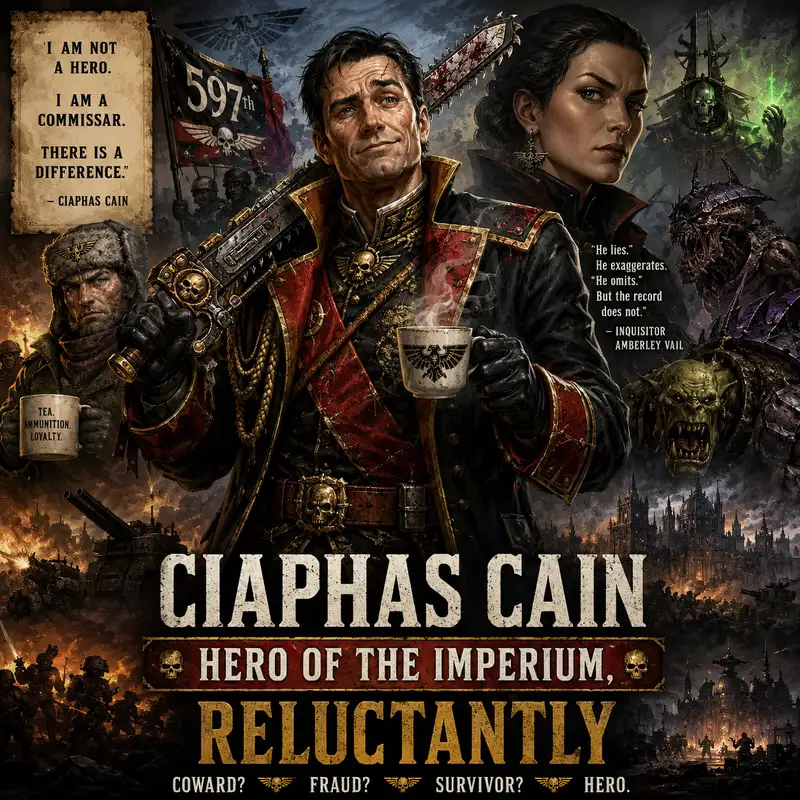
Ciaphas Cain: Hero of the Imperium, Reluctantly
Ciaphas Cain was buried with full military honours, praised as a servant of the Emperor, and left on active duty. The last part was not a miracle. It was paperwork. Cain had been reported dead, missing, buried, or otherwise removed from the Imperial order of battle so many times that the Departmento Munitorum eventually adopted the safest possible regulation. Whatever the evidence, Commissar Cain was to remain officially alive. Somewhere in the ledgers of the Imperium, he may still be drawing pay. It is a fitting end for a man whose public life became too useful to be restrained by facts, including the inconvenient fact of his death.
The official Cain is easy to understand. He is the Hero of the Imperium, a fearless commissar whose presence steadies armies, whose chainsword finds the enemy commander, and whose courage survives Orks, Tyranids, Necrons, heretics, daemons, and Imperial administration. The private Cain is more difficult. In the memoirs attributed to him, he insists that he was a coward, a fraud, and a gifted survivor who spent most of his career looking for the safest assignment available. Both versions are supported by evidence. That is the central problem of Ciaphas Cain. Was he an impostor who accidentally became a hero, or a hero so frightened of the title that he could never accept what he had become?
A commissar is not merely an officer in a dramatic coat. Commissars serve beside the soldiers of the Astra Militarum as guardians of loyalty, discipline, and political reliability. They are expected to inspire courage, detect treachery, advise commanders, and punish failure before it spreads. In the harshest version of the office, inspiration and execution are neighbouring tools. The ideal commissar stands where the fighting is worst and appears entirely certain that victory is inevitable. Cain wore the uniform, carried the weapons, and understood the performance. What separated him from the ideal was that he possessed a perfectly functional sense of danger, and he saw no spiritual virtue in being killed by something avoidable.
His story reaches us through another layer of doubt. Cain's private memoirs were edited by Inquisitor Amberley Vail, an Ordo Xenos operative who knew him professionally and personally. She interrupts his account with corrections, rival reports, historical extracts, and observations sharp enough to cut ceramite. Cain presents himself as self-serving. Amberley sometimes confirms this, sometimes exposes his exaggerations, and sometimes places beside his confession evidence that makes him look better than he wishes. The result is not a clean correction of propaganda. It is an argument between a man's memory, an inquisitor's judgment, and an Imperium that had already decided what it needed him to be.
Cain had been trained in the Schola Progenium, the Imperial system that turns the orphaned children of servants of the state into officers, clerks, storm troopers, priests, Sisters of Battle, and commissars. He learned the duties expected of him, but he also learned how institutions reward appearances. His choice of an early posting showed his priorities. He attached himself to a Valhallan field artillery regiment, reasoning that the guns would normally remain behind the front. This was sensible. It was also his first serious misunderstanding of military life, which has always been inventive about relocating the front to wherever someone believed they were safe.
The companion who followed him through most of his career was Gunner Ferik Jurgen. Jurgen was a Valhallan soldier of unshakable loyalty, limited social grace, questionable hygiene, and a talent for appearing with tea, ammunition, or a meltagun at the precise moment one of them became essential. He was also a blank, a human whose presence disrupted psychic power and produced instinctive discomfort in many people around him. Cain did not understand this at first. He simply knew that Jurgen was useful, dependable, and widely avoided. For a commissar who preferred privacy and survival, this was an unusually efficient combination.
The first great machinery of Cain's legend began turning on Perlia. His transport entered a disastrous battle, and Cain and Jurgen escaped only to crash behind Ork lines. Cain had selected artillery service to avoid close combat. He now found himself separated from the artillery, the army, and any route that did not contain a large number of Orks. His solution was not a grand offensive. He wanted to return to Imperial territory. To accomplish that, he gathered scattered soldiers and civilians, acquired vehicles, imposed enough order to keep the group moving, and fought toward safety. The retreat became an advance because the safest direction happened to run through the enemy.
Later Imperial histories remembered the March of the Liberator. They described Cain rallying the abandoned, striking the Orks where they least expected resistance, and helping to break the campaign. The broad shape was true. Cain had assembled a force, kept it alive, and killed the Ork warlord in personal combat. His own account emphasised every moment of panic, improvisation, and private desire to be somewhere else. Yet fear did not prevent him from reading the battlefield. He found fuel, transport, weapons, and people. He understood that a frightened crowd would die, while an organised column might survive. He gave them the thing he claimed not to possess: confidence.
Perlia established the pattern that would follow him for decades. Cain sought safety, discovered that no safe position existed, and then attacked the danger before it could reach him. This was not the same as charging blindly. He looked for leverage. He deceived stronger enemies, noticed details that more heroic minds dismissed, and withdrew when withdrawal served a purpose. Because his objective was survival, he paid close attention to practical reality. Ammunition mattered. Routes mattered. Morale mattered. So did the lives of the people beside him, because dead soldiers are poor protection and broken units are worse.
That understanding made Cain unusually effective when he joined the regiment that became the Valhallan Five Hundred and Ninety-Seventh. The unit had been formed from the shattered remains of the all-female Two Hundred and Ninety-Sixth and the all-male Three Hundred and First. Loss, pride, and resentment had turned the amalgamation into a prolonged internal feud. Cain arrived as a mess hall riot exposed how badly the situation had deteriorated. A more theatrical commissar might have solved the matter through executions. Cain instead integrated the former regiments at squad level, created training that forced cooperation, and gave the combined unit a new identity. Even its number joined the old formations together.
His motives were not entirely charitable. A regiment at war with itself was dangerous to everyone assigned to it, especially its commissar. Restoring order protected Cain. It also protected the soldiers. That overlap between self-interest and duty is where most of his real character lives. Cain rarely chose virtue in the abstract. He chose workable solutions, and workable solutions often required fairness, restraint, and respect for competent people. Colonel Regina Kasteen and Major Ruput Broklaw could trust his judgment because he did not compete for their command. The troopers could trust him because he did not waste their lives to prove his courage.
This was a different kind of commissarial authority. Cain cultivated approachability, remembered people, listened to specialists, and used his reputation before he used his pistol. Soldiers believed he would share danger with them because, sooner or later, he usually did. They also believed that if Cain appeared worried, the situation must be catastrophic, so he learned to control what his face revealed. His famous composure was partly theatre, but military leadership has always contained theatre. A commander may feel fear and still lend others the shape of confidence. The fact that the confidence is constructed does not make its effects imaginary.
On Gravalax, Cain's social instincts became as important as his skill with a chainsword. The planet seemed to be drifting toward the T'au Empire, while Imperial authorities, local factions, and T'au representatives moved toward a conflict none fully understood. Cain preferred a posting where negotiation might keep him away from battle. Instead, suspicious violence led beneath the political crisis to a Genestealer cult. The apparent contest between two powers had been manipulated by a third force that wanted confusion, division, and time. Cain's willingness to doubt the obvious story helped expose the deeper threat.
Gravalax also brought Amberley Vail into his life and revealed the nature of Jurgen's strange presence. Jurgen's null aura could disrupt psychic influence, which made the otherwise unremarkable gunner extraordinarily valuable against alien and warp-born threats. Cain survived the Genestealer Patriarch with Jurgen's help, but survival alone does not explain what followed. Cain did not discard his aide once the secret was known. He kept Jurgen close for years, trusted him with his life, and repeatedly entered danger rather than abandon him. Cain would have called this practical loyalty. The evidence suggests it became something more durable.
The victory on Gravalax enlarged Cain's reputation, and his reputation became a trap. The Imperium does not reward a hero by allowing him to rest. It places him where morale is failing, where the enemy is strongest, and where a famous face may turn disaster into resistance. Every success therefore increased the chance that Cain would be assigned to a worse crisis. His attempts to appear heroic kept him alive in the moment and endangered him over the long term. He had built an armour of legend, only to discover that Imperial commanders regarded armour as evidence that he could be shot at more often.
The irony would be less convincing if Cain were merely lucky. He was lucky, sometimes absurdly so, but he was also formidable. He became an exceptional swordsman because repeated close combat is a severe instructor. He could shoot accurately, think while terrified, and recognise when an enemy's behaviour did not fit the accepted explanation. On Simia Orichalcae, a campaign against Orks led to the discovery of a Necron threat beneath the ice. On Adumbria, a conventional defence against Chaos concealed a ritual that could transform the entire world. Again and again, Cain found the greater danger because he was searching so urgently for the route away from the smaller one.
His actions on Adumbria nearly earned him punishment. Cain left the expected front in order to disrupt the summoning of a daemon prince. From a narrow view of discipline, he had abandoned his assigned position. From the perspective of anyone hoping the planet would remain part of material reality, his priorities were sound. A court martial followed, encouraged by a fellow commissar who regarded Cain's manner and reputation with deep suspicion. Cain was cleared. The episode captures the difference between regulation and judgment. Cain could manipulate rules, but he also understood that obedience becomes meaningless when it protects the wrong objective.
This does not make him secretly pure. Cain lies, flatters, evades, and calculates. He enjoys comfort, status, good food, drink, and the company of attractive people. He protects his reputation because it gives him influence and because exposure could be fatal. He is capable of using other people's assumptions to place himself in a better position. Yet the Imperium offers many examples of men who want comfort and power and are willing to purchase them with other people's blood. Cain repeatedly refuses that price. Even when his mercy begins as self-preservation, the mercy remains real to the person who is not shot.
His attitude toward the troops is especially revealing. Cain knows that terror can force obedience for a moment, but it cannot create trust. He prefers to prevent panic before it requires punishment. He speaks to soldiers as people, relies on noncommissioned officers, and takes advice from those who understand a problem better than he does. This makes him look less severe than the popular image of a commissar, but it also makes his presence stabilising. The Five Hundred and Ninety-Seventh does not follow Cain because it fears the bolt pistol at its back. It follows because experience has taught the regiment that his instincts offer a reasonable chance of seeing another dawn.
There is dry comedy in the gap between Cain's self-image and the view of those around him. General Jenit Sulla remembers him as an inspiration and writes about war with an enthusiasm Cain finds painful in several senses. Kasteen and Broklaw see a reliable partner. Lord General Zyvan values his counsel. Imperial citizens treat him as a figure from legend. Cain looks at the same record and sees narrow escapes, improvised excuses, and the recurring failure of everyone else to notice how frightened he was. The comedy works because neither side is entirely wrong. Public memory removes the fear. Private memory removes too much of the courage.
Amberley's editorial presence makes that contradiction impossible to settle neatly. She knows Cain's vanity and his evasions. She also knows the record. When he minimises an achievement, her notes can reveal how unlikely his survival actually was, or how many people survived because of his decisions. She does not turn him into a saint. Her affection does not erase her professional suspicion, and her sarcasm does not erase the evidence. The Cain Archive becomes an inquiry into motive. If a man saves a world because he wants to save himself, does the world become less saved?
Jurgen provides the most direct answer. He is useful beyond measure, but usefulness alone cannot explain the bond. Cain worries about him, trusts him, and recognises his virtues when others see only discomfort. Jurgen, in return, treats Cain's heroic identity as a simple fact. He is not impressed by speeches because he rarely needs them. He brings the vehicle, the weapon, or the tea, and stands beside the commissar while creatures from humanity's oldest nightmares approach. Their partnership strips heroism of ceremony. It becomes two men who know the other's limitations and continue forward because neither intends to leave the other behind.
Age did not release Cain from the role. He eventually retired to Perlia and taught at a Schola Progenium, shaping future commissars while hoping, with some justification, that his days of direct combat were over. Then the Thirteenth Black Crusade spread war across the Imperium, and Chaos forces threatened Perlia. Cain was old, officially retired, and surrounded by cadets rather than a veteran regiment. He could no longer claim ignorance of what command would cost. He helped organise the defence anyway. The reluctant hero had returned to the world where his legend began, not because he had stopped fearing death, but because there were people behind him who had not yet learned how to survive it.
By then, Cain's reputation was not merely a disguise he wore. It had shaped his habits, his relationships, and the expectations he placed upon himself. He may have begun by pretending to be brave because appearing brave was safer than admitting fear. Decades of maintaining that appearance made certain choices unavoidable. He could not abandon soldiers who trusted him without destroying the identity that protected him. He could not ignore a hidden threat because he knew what hidden threats did. He could not allow the legend to fail in front of cadets who had built their own courage around it. The mask had become a form of duty.
That is why calling Cain a coward is both accurate and misleading. He feels fear intensely. He anticipates pain, humiliation, and death. He avoids danger when he can, and he resents people who confuse sacrifice with competence. None of that disqualifies him from courage. Courage is not the absence of fear, and in the forty-first millennium, the absence of fear is often a symptom of indoctrination, madness, or possession. Cain's fear keeps him observant. It reminds him that lives have value to the people living them. It makes survival a military objective rather than an embarrassing afterthought.
Calling him a fraud is equally complicated. The propaganda version is false because it removes hesitation, self-interest, chance, Jurgen, Amberley, Kasteen, Broklaw, and the thousands of ordinary people who made his victories possible. Cain accepts praise for a cleaner story than the truth. Yet the legend is not invented from nothing. He does stand in the breach. He does duel enemies that should kill him. He does detect invasions and conspiracies. He does hold frightened formations together. The official portrait lies about why he acts, but not always about what he does.
Ciaphas Cain remains one of the Imperium's most revealing heroes because he makes heroism human enough to examine. His stories allow fear, humour, bureaucracy, friendship, vanity, and exhaustion to exist beside genuine horror. They do not make the galaxy safer. Genestealers still hollow out communities, Necrons still wake beneath inhabited worlds, and Chaos still offers ruin in the language of liberation. Cain simply refuses to meet these things with empty solemnity. He survives them by noticing what is actually happening, finding the people he can trust, and doing the necessary work while complaining privately about the personal inconvenience.
The final judgment depends on what a hero is supposed to be. If heroism requires pure motives, complete fearlessness, and a cheerful desire for martyrdom, Cain fails. So would almost everyone worth following. If heroism is the repeated decision to protect others while afraid, compromised, tired, and fully aware of the cost, then the case is stronger than Cain ever admits. He was reluctant because he understood that the title was dangerous, and because every celebration of his courage concealed the terror that made it meaningful. Ciaphas Cain spent a lifetime trying to escape the Hero of the Imperium, only to discover that the safest road kept leading through the lives he refused to abandon.