Choose Your Path Into Warhammer 40,000
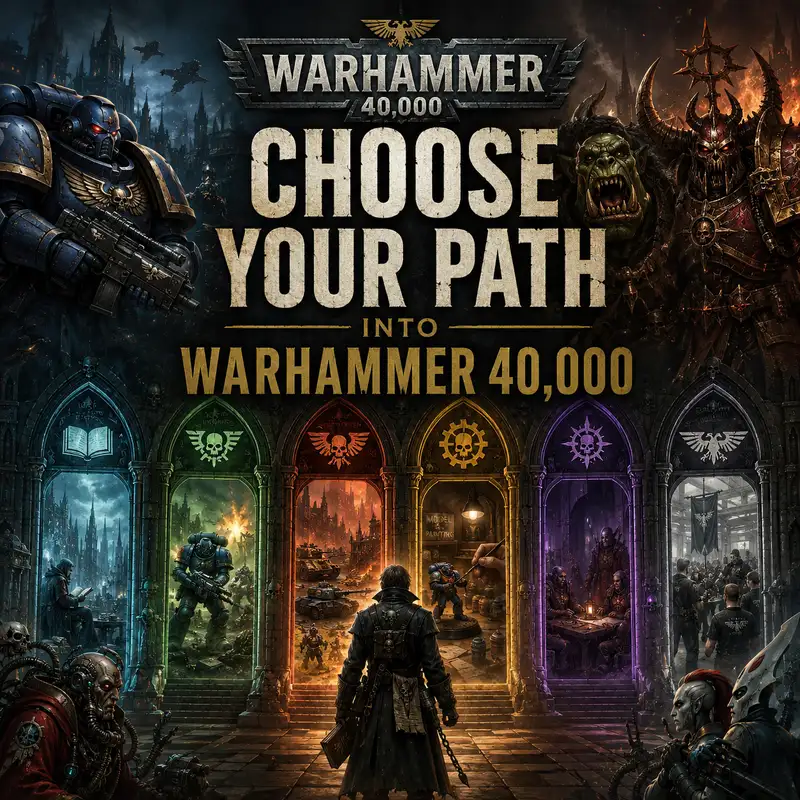
The first mistake most newcomers make is assuming Warhammer forty thousand has a front door. It does not. It has a million doors, most of them made of black iron, several of them on fire, and at least one guarded by a clerk who insists that your entry permit was lost during a crusade three centuries ago. The universe is too large to approach as a single story, because it was never designed to be one. It is a setting filled with wars, empires, mysteries, tragedies, jokes, and contradictions. You do not begin at the beginning. You begin at the point where something catches your attention and refuses to let go.
That may sound unhelpful, especially when the shelves are crowded with novels, rulebooks, miniatures, games, and names that seem to require a minor degree in ecclesiastical bureaucracy. Yet the lack of a single entrance is not a flaw. It is one of the great strengths of Warhammer forty thousand. A person can enter through military history, gothic horror, political intrigue, model painting, competitive gaming, role-playing, video games, or the simple question of why a particular armoured giant has a chainsaw attached to his sword. All of those paths are valid. None of them require you to understand everything first.
The best way to choose a path is to ask what kind of experience you already enjoy. Not what you think a proper fan should enjoy. Not what the loudest person in a hobby shop tells you is essential. What do you actually want from this universe? Do you want a story? A game? A creative project? A social activity? A deep body of lore to explore? A chance to command armies? A quiet evening painting one absurdly detailed shoulder pad? Your answer matters because Warhammer forty thousand is not one hobby. It is several hobbies wearing the same battered armour.
For many people, the easiest entrance is the lore itself. The setting offers an enormous historical canvas. Humanity survives inside the Imperium, a decaying interstellar empire held together by faith, violence, bureaucracy, and institutions that no longer fully understand the civilisation they claim to preserve. The Warp makes faster-than-light travel possible, while also exposing travellers to a realm shaped by emotion and inhabited by predatory powers. Alien empires pursue their own visions of survival. Ancient grudges outlive planets. Every faction has reasons for what it does, even when those reasons lead directly to atrocities.
A lore-first approach works well if you enjoy understanding how worlds fit together. Begin with broad questions rather than obscure details. What is the Imperium? Why are Space Marines different from ordinary soldiers? What is Chaos, and why is it tempting? Why do the Aeldari fear the consequences of their own past? Why do the Necrons remember themselves so imperfectly? Why are the Tyranids frightening in a way that no political enemy can be? Each answer will naturally lead to another question. That is far more manageable than trying to memorise ten thousand years of history as though an examiner will arrive at dawn.
The danger of the lore path is not confusion. It is uncontrolled expansion. One minute you are learning what a bolter is. Three hours later you are comparing disputed accounts of an administrative revolt on a moon that has not appeared in a story since the previous millennium. This is normal. The setting rewards curiosity, but it does not require completion. No one knows all of it. The people who sound as if they do are usually remembering half a paragraph from a book they read twelve years ago, and saying it with admirable confidence.
Podcasts, introductory videos, core setting guides, and faction overviews are useful because they give you a map before you enter the forest. Use them to discover which subjects create a reaction. Perhaps the disciplined tragedy of the Astra Militarum appeals to you. Perhaps the Adeptus Mechanicus offers the right mixture of religion, technology, and people replacing their legs because flesh has developed an unfortunate reputation. Perhaps you are drawn to Orks, who have built an entire civilisation around the idea that a problem becomes simpler when approached at speed and while shouting.
Once a faction or theme interests you, fiction becomes one of the richest paths into the setting. A good novel does something a summary cannot. It shows what the universe feels like from inside. An Imperial citizen does not wake each morning thinking about the complete political structure of the Imperium. They think about their family, their duty, their ration allowance, the sirens outside, and whether the figures in black coats asking questions have already decided the answers. Fiction turns institutions into lived experience.
Character-focused series are often easier starting points than giant event narratives. Stories about an Inquisitor, a regiment, a Space Marine chapter, a rogue trader, or a Chaos warband allow the setting to unfold through a limited viewpoint. The reader learns only what the characters need to know. That is not a weakness. It is how human beings understand large events. A soldier sees the war from the trench. A governor sees it through reports. An Inquisitor sees it through suspicion. The official archive may later claim that everyone acted with complete unity and perfect foresight, because archives also enjoy fiction.
Choose fiction by the experience you want. Inquisition stories offer investigation and moral compromise. Imperial Guard stories keep the scale human, following soldiers who survive through discipline, loyalty, and exhaustion. Space Marine fiction provides grand violence and ritual, though the strongest stories remember that power does not make a character simple. Stories about Chaos work best when corruption appears as a process, showing how pride, grief, ambition, fear, or loyalty can become a road whose destination was hidden at the first step.
The Horus Heresy deserves a warning. It is famous, important, and often treated as the beginning of everything. Chronologically, it occurs roughly ten thousand years before the main setting and explains many of the Imperium’s deepest wounds. Yet it is not necessarily the best first door. The Heresy gains power when you already understand what the Imperium became. Its betrayals are sharper when you recognise the ruins they will leave behind. Starting there is not wrong, especially if tragic primarchs and civil war are what drew you in, but it is like beginning the history of a fallen kingdom with the private arguments of its royal family. Fascinating, certainly. Efficient, perhaps not.
Some people need to see the universe move before they care about its history. For them, video games provide a direct entrance. A good Warhammer game can communicate scale, atmosphere, and faction identity in minutes. Heavy armour changes the way a character occupies a room. Las-fire across a ruined city explains the vulnerability of ordinary soldiers. A Mechanicus temple full of chanting machinery shows the union of ritual and technology more effectively than a page of definitions. Games can make the setting immediate.
Different games reveal different parts of the universe. A Space Marine action game presents the world through speed, violence, and superhuman endurance. A squad-based game such as Darktide brings the player closer to the filth and desperate cooperation of Imperial life. Mechanicus explores tech-priests confronting an older machine civilisation. Rogue Trader opens political, religious, and moral choices at the edges of Imperial authority. Strategy games such as Dawn of War show armies colliding at battlefield scale. Each is a window, not the whole setting, because games must simplify a galaxy that is rarely so courteous.
For others, the true entrance is the tabletop. This path combines strategy, storytelling, collecting, painting, and the peculiar satisfaction of moving a carefully prepared force across a kitchen table while pretending the measuring tape is an instrument of war. The full game can look intimidating because photographs often show large armies and elaborate terrain. You do not need to begin there. A small introductory game, a demo at a local store, a starter set, Combat Patrol, or a skirmish game such as Kill Team can teach the basic rhythm without requiring you to assemble an invasion force.
The first tabletop goal should not be mastery. It should be finishing one small game and understanding why decisions mattered. Learn how units move, attack, survive, and support one another. Let the rules reveal the character of the army. An elite force may have few models and little room for mistakes. A horde may control space through numbers. A mobile army may win by refusing the battle its opponent wants. A durable army may advance with the confidence of an institution that has already completed the casualty forms.
Choose your first faction by attraction rather than efficiency. Rules change. Army strength rises and falls. The unit that dominates discussion today may spend tomorrow guarding a shelf while players wait for a new book. Visual identity, background, and emotional appeal last longer. Ask which force you would still enjoy if it lost. Which models make you want to pick them up? Which philosophy interests you enough to hear its arguments, even when those arguments are appalling? Which army would you be happy to paint slowly?
Space Marines are an obvious starting point because they are central to the setting’s imagery, but they are not mandatory. The Astra Militarum offers ordinary humans facing extraordinary threats. The Adepta Sororitas combines martial devotion with the machinery of faith. Orks offer speed, improvisation, brutality, and a worldview of alarming consistency. The T’au fight through coordinated technology and an ideology whose promises become more complicated at close range. Necrons bring ancient dynasties and rulers who survived death only to discover that survival had terms and conditions. Aeldari, Drukhari, Chaos, Tyranids, and Genestealer Cults each offer a different mixture of tragedy, horror, ambition, and survival. There is no shortage of doors.
Painting can become a path entirely separate from playing. Some people collect miniatures because they enjoy colour, texture, composition, and the transformation of grey plastic into a character. That is enough. You do not need an army list to paint a model. You do not need to know every rule attached to it. You do not need to present evidence that the colour scheme was approved by a long-dead chapter master. The setting is full of lost forces, local traditions, successor chapters, splinter fleets, minor dynasties, and units altered by circumstance. There is room for invention.
Begin with one miniature you genuinely like. Not the one someone says is easiest. Not the one attached to an ambitious plan involving eighty identical infantry. One model. Learn how to prepare it, apply a base coat, place basic colours, add a wash or shade, and finish the base. The first result will not resemble the box art. This is not a moral failure. Box art is produced by highly skilled painters with excellent tools, strong lighting, and the useful advantage of not being you on your first Tuesday evening.
A painted miniature is more than decoration. It creates ownership of the setting. The scratches, heraldry, dust, and colours imply a history. A pristine warrior suggests ritual and discipline. A battered vehicle suggests campaigns survived. A bright accent may identify a unit or honour. Even a mistake can become weathering, which is one of the hobby’s most civilised arrangements. The model becomes your version of the universe, while still belonging to the larger one.
Tabletop role-playing offers another entrance, especially for people who prefer characters to armies. It can place you inside the Imperium as an investigator, soldier, trader, priest, psyker, criminal, or unfortunate citizen standing too close to all of the above. The scale becomes personal. A hive city is no longer a statistic measured in billions. It is a district, a street, a room, and a locked door behind which someone has stopped answering. Most people in this universe are not legendary commanders. They are workers, pilgrims, medics, guards, and functionaries trying to survive systems too large to understand.
The social path matters as much as the medium. A friend who already enjoys the setting can guide you, lend a book, run a demonstration game, or explain why two nearly identical armoured figures are separated by ten thousand years of doctrinal hostility. A local game store can provide tables, events, painting nights, and opponents. Online communities can answer questions and display extraordinary creative work. They can also produce arguments of such intensity that one might assume the fate of a real star system is involved.
Choose communities that make curiosity feel welcome. Expertise is valuable when it helps someone enter. It becomes less valuable when used as a border wall. You are allowed to mispronounce a name, confuse two campaigns, change factions, dislike a popular character, or discover that the part everyone recommended does not interest you. The setting is large enough to survive your preferences. It has survived far worse administrative decisions.
The practical rule for entering any path is to start smaller than your enthusiasm suggests. Warhammer encourages grand visions. A new player sees a display army and imagines a completed crusade force, a shelf of novels, custom terrain, and perhaps a dedicated room with lighting suitable for orbital bombardment. Enthusiasm is useful. Uncontrolled procurement is merely another form of logistics failure. Buy or borrow enough to complete one experience. One novel. One game. One squad. One character. One short campaign. Finish something before expanding.
A good first month might involve listening to broad lore explanations, choosing one faction that interests you, reading one character-focused novel, painting a handful of miniatures, and playing a small demonstration game. Not because this is the official sequence, but because each activity tests a different kind of interest. You may discover that you love the fiction but not the rules. You may enjoy painting and never play. You may become a devoted player who reads only enough lore to know whom to charge. The result is not a failed journey. It is a more accurate map.
Do not wait until you understand the universe before forming opinions. Understanding comes through contact. You will revise your views as you encounter other factions and perspectives. The Imperium may first appear to be humanity’s heroic shield, then reveal itself as a machine that consumes the people it protects. Chaos may first appear to be simple evil, then become more disturbing when you see how it recruits through genuine grievances and corrupted hopes. Xenos factions that begin as enemies may become tragic, admirable, horrifying, or all three.
That changing interpretation is part of the experience. Warhammer forty thousand is built from unreliable records, propaganda, myth, and stories told from limited viewpoints. Contradictions are not always errors waiting to be repaired. Sometimes they show how power controls memory. Sometimes they reflect the scale of a galaxy where no archive can contain the whole truth. Sometimes two writers simply saw the same faction differently. You do not need to resolve every dispute before enjoying the story. You need only recognise that certainty is often one more weapon in the setting.
There are several poor ways to begin. Trying to read everything in chronological order is one. Buying a full army before painting a single model is another. Choosing a faction only because someone says it is strongest is risky. Forcing yourself through a famous series you do not enjoy will not earn you a certificate. Letting online arguments decide what you are permitted to like is perhaps the worst. The Imperium already has enough institutions dedicated to restricting harmless choices.
Choose the path that gives you a reason to return. If a single character captures your imagination, follow that character. If a faction’s visual design makes you stop scrolling, learn its name. If you enjoy strategy, play a small game. If you enjoy making things, paint one model. If you enjoy history, trace one campaign and ask who recorded it. If you enjoy horror, look beneath the promises made by the Warp. If you enjoy comedy, notice how often the galaxy’s institutions respond to failure by creating a larger department.
You may eventually cross into every other path. The reader buys a miniature because a novel made one regiment feel real. The painter learns the lore to choose campaign markings. The gamer begins writing background for a commander who survived an unlikely battle. The role-player starts collecting models for characters who existed only as notes on paper. Warhammer forty thousand is designed for this migration. Each medium changes how the others feel.
The real question is not where Warhammer forty thousand begins. It is where your curiosity begins. The universe does not demand that you arrive through the grandest gate or the most approved route. It asks only that something inside it matters enough for you to take one more step. A battle report, a battered paperback, a digital campaign, a half-painted soldier, or a conversation across a game table can all serve as the first light in a very large darkness.
Your path will not be complete, because no path through this setting can be. It will branch, double back, and disappear into subjects you never expected to care about. That is the point. You are not trying to conquer the whole galaxy. Many better-equipped people have attempted that, and the results remain discouraging. You are choosing one door, opening it, and discovering what waits on the other side.