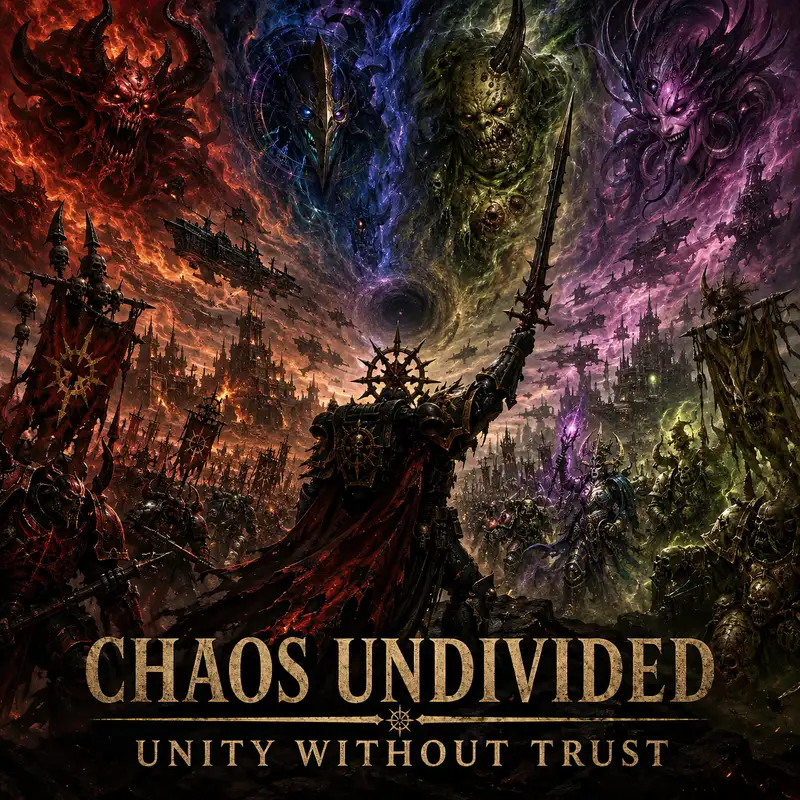
Chaos Undivided: Unity Without Trust
The fleet gathered in the dark beyond the reach of any friendly star. Its ships had not been built to serve together. Some were iron-sided siege vessels, their hulls scarred by ten thousand years of war. Others were shrines to appetite, plague, slaughter, or impossible change. Within them waited warriors who hated one another almost as much as they hated the Imperium. Priests condemned the doctrines preached in neighbouring holds. Sorcerers laid wards against supposed allies. Champions measured the strength of rivals they fully intended to murder once the campaign was won.
Then the order came.
Engines ignited. Warp drives howled. Thousands of vessels turned toward the same target.
No one trusted anyone. It did not matter.
That is the central contradiction of Chaos Undivided. The forces of Chaos are defined by rivalry, ambition, jealousy, and competing visions of existence. Their gods wage the Great Game against one another without end. Their mortal servants imitate them with admirable efficiency and considerably less immortality. Yet, at certain moments, those same forces can unite into armies vast enough to break worlds, shatter empires, and alter the shape of the galaxy.
Chaos Undivided is not a fifth god standing above Khorne, Tzeentch, Nurgle, and Slaanesh. It is not a treaty between them, and it does not mean that their followers have discovered moderation. Moderation is rarely the first accusation levelled at a daemon prince. The term describes several related forms of allegiance. A mortal may worship the whole pantheon. A champion may refuse to surrender himself to any single patron. A warband may contain followers of several gods. An army may march beneath a commander favoured by all four, even though its members remain divided in purpose, belief, and appetite.
These arrangements are not identical, but they share one principle. Unity does not require affection. It requires a reason to postpone the killing.
The four great powers are not merely different personalities occupying neighbouring thrones. Each embodies impulses that can conflict at the deepest level. Khorne exalts direct violence and despises sorcery. Tzeentch feeds upon change, schemes, and the overthrow of settled conditions. Nurgle offers endurance and acceptance, turning decay into a kind of permanence. Slaanesh drives every desire beyond satisfaction and into dependence. Their domains overlap, because mortal emotions are untidy, but overlap does not produce friendship. It produces arguments over ownership.
A warrior may kill from rage, ambition, despair, pride, pleasure, or some mixture of all five. The gods do not calmly divide the proceeds. Each claims the act according to its nature. Each seeks more worshippers, more influence, and more of the emotional current that sustains it. Even when the gods appear to cooperate, the Great Game continues beneath the alliance. Every shared victory is also an opportunity to weaken a rival. Every chosen champion may become another god’s stolen prize.
This is why the easiest form of Chaos unity is temporary. A fortress stands in the way. An Imperial world possesses something worth taking. A rival power has grown too strong. A crusade offers plunder, vengeance, slaves, relics, territory, souls, or access to a greater war. The followers of Chaos do not need to agree on what victory means. They need only agree that the enemy should not possess it.
The Horus Heresy was the first great demonstration of this principle on a galactic scale. Horus did not lead a single religious movement united by common doctrine. The primarchs who followed him carried different resentments, ambitions, wounds, and beliefs. Some sought freedom from the Emperor. Some wanted recognition. Some desired revenge. Some believed rebellion was necessary. Others had already passed beyond necessity into devotion, obsession, or hatred. Their legions were not bound together by trust. They were bound by Horus, by war, and by the knowledge that defeat would leave little room for apology.
Horus provided a common banner, a strategic direction, and the promise that every grievance could be settled after Terra fell. That last part is important. Coalitions survive by postponing questions that cannot be answered without violence. Who would rule the new order? Which legion had sacrificed the most? Whose gods would receive the greatest honour? Which brothers would be rewarded, punished, or quietly removed? These problems did not disappear. They were deferred behind the walls of the Imperial Palace.
As the war continued, corruption deepened and discipline weakened. The traitor host became more powerful in some ways and less coherent in others. Individual legions pursued their own wars. Primarchs became increasingly consumed by personal transformation and divine patronage. Command decisions were distorted by pride, prophecy, madness, and the direct pressure of the warp. By the Siege of Terra, the rebellion had reached the seat of Imperial power, but the alliance carrying it there was already coming apart.
This was not simply poor leadership. It was the natural cost of building unity from forces that reward selfish ambition. Chaos can grant strength, foresight, resilience, and terrible inspiration. It also encourages every champion to believe that he alone understands destiny. A commander must therefore do more than defeat the enemy. He must constantly prevent his own subordinates from deciding that the most useful enemy is standing beside them.
The Word Bearers offer the clearest example of Chaos Undivided as a faith. They do not merely tolerate several gods within one army. They regard the pantheon as parts of a greater truth about reality. The warp is not, in their view, an unfortunate hazard or a weapon to be used cautiously. It is the spiritual foundation of existence, and the gods are powers that must be acknowledged through worship, sacrifice, and obedience.
This gives the Word Bearers a form of unity that many other traitor forces lack. Their Dark Apostles maintain doctrine. Ritual gives shape to ambition. Hierarchy turns personal revelation into authorised revelation, which is useful because an army in which every officer receives private instructions from eternity tends to develop scheduling problems. The legion can coordinate cults, daemonic rites, mortal auxiliaries, and Space Marine warbands because all are placed within a shared religious structure.
Yet even this is not trust in the ordinary sense. Word Bearers have factions, rivalries, competing interpretations, and leaders whose ambitions extend well beyond humble service. They may agree that the gods are real and worthy of worship while disagreeing violently over who has best understood their will. Theology provides a common language. It does not remove the knife from behind the back.
Other forces described as Undivided may be far less devotional. Iron Warriors often approach the warp as another element of siegecraft, dangerous but useful. Night Lords can range from open worshippers to bitter predators who despise the weakness they associate with submission. The Alpha Legion is difficult to describe with certainty because uncertainty is one of its more reliable traditions. Renegades from countless chapters and armies may enter the Eye of Terror without any coherent theology at all. They begin with survival, vengeance, or ambition, and discover that the warp accepts practical men just as readily as true believers.
For such warriors, refusing a single patron may be an assertion of independence. A champion of Khorne may gain enormous power, but that power comes with direction. The same is true of every god. Gifts are never merely gifts. They are changes in desire, identity, and possibility. The servant becomes more capable of expressing the patron’s nature and less capable of becoming anything else.
An Undivided champion may try to take from all four while belonging fully to none. This is dangerous in the way that stealing from four armed kings is dangerous. Success can bring extraordinary power. Failure may bring mutation, abandonment, or the sudden discovery that the gods have a broad and creative understanding of punishment.
Be’lakor stands as the oldest warning. He was raised by the combined favour of the Dark Gods and became the first Daemon Prince. Their shared investment made him mighty, but it also made him the object of their rivalry. Each power sought influence over what all had created. Be’lakor, for his part, possessed enough pride and ambition to resent every master equally. His existence shows the central weakness of Undivided favour. The more powerful the champion becomes, the more each god fears that another has gained the advantage.
The gods can cooperate to elevate a servant, but they cannot stop being themselves. Nor can the servant.
Horus suffered a related fate. The combined power of Chaos made him capable of confronting the Emperor, but that power did not free him. It consumed the space in which his own will had once operated. The Warmaster who began the rebellion as a leader of legions ended it as the vessel through which the gods pursued their war. Chaos Undivided gave him more power than any single patron might have offered, while making the question of who truly commanded increasingly difficult to answer.
Abaddon learned from that failure.
He inherited the broken remains of the Sons of Horus, but he did not attempt to restore the old legion exactly as it had been. The Black Legion became something broader. Warriors from many origins could enter its ranks, abandon old colours, and join a new identity centred on the Long War. The black and gold did not erase former loyalties, but they placed them beneath a greater cause. The Imperium had survived. The Emperor still ruled from Terra. The war had not ended. It had merely become longer, uglier, and less well supplied.
Abaddon is the closest thing the armies of Chaos possess to a supreme commander, but his authority does not rest on universal obedience. Many warlords hate him. Some envy him. Some consider him a rival, a useful ally, or a future victim. The daemon primarchs possess power and prestige he cannot simply command. Cult legions answer first to their own obsessions and patrons. Independent warbands have survived for millennia by avoiding other people’s chains.
Abaddon unites them because he offers what trust cannot.
He offers purpose. The Long War gives veterans of the Heresy and later renegades a shared enemy large enough to contain almost any grievance. Hatred of the Imperium can bridge divisions that no theology could settle. A Khornate champion and a Tzeentchian sorcerer may disagree on nearly every important question, but both can recognise an Imperial fortress as an obstacle.
He offers opportunity. A Black Crusade opens paths to plunder, relics, slaves, recruits, daemon worlds, and victories that no isolated warband could achieve. Joining the Warmaster is not an act of charity. It is an investment. The expected return may be paid in worlds.
He offers legitimacy. Abaddon bears the favour of all four powers without openly surrendering himself to one. He carries symbols of conquest and inheritance, including the Talon of Horus and the daemon blade Drach’nyen. Symbols matter among beings who have spent ten thousand years turning personal grudges into political institutions. They tell ambitious followers that this commander has survived tests that destroyed greater men.
He offers fear. Abaddon’s followers do not merely believe he can reward loyalty. They know he can punish defiance. Chaos armies may be fractious, but they understand strength. A warlord who cannot enforce his commands does not remain a warlord for long. The process of selecting a replacement is usually informal and extremely final.
Most importantly, he offers results. His Black Crusades are often misunderstood as repeated attempts to perform the same attack against the same objective. In reality, they were campaigns within a much longer strategy, each with its own aims, conquests, raids, and consequences. Imperial records gave them names and numbers after the fact, trying to impose order on wars they did not fully understand. Abaddon’s authority grew because he continued to return with victories, weapons, alliances, and deeper damage to the Imperium.
The fall of Cadia demonstrated what this system could achieve. The fortress world had stood as the great gate before the Eye of Terror, a symbol and military obstacle that had resisted Chaos for millennia. The Thirteenth Black Crusade brought together forces that did not become friends merely because they shared a target. They coordinated long enough. Cadia broke, the old barrier failed, and the Great Rift tore across the galaxy.
That outcome did not prove that Chaos had discovered stable government. It proved that stable government was unnecessary for the destruction of a single objective.
This is how unity without trust functions in practice. The commander does not ask whether his followers believe in one another. He asks whether their interests can be aligned for the duration of the campaign. He assigns different forces tasks suited to their nature. The berserkers are given something worth charging. The sorcerers are given problems that cannot be solved by charging, though they may be wise not to phrase it that way. Siege masters break fortifications. Raiders sever supply lines. Priests maintain zeal. Daemons are summoned where reality is weakest and dismissed, when possible, before they develop independent opinions about command.
The coalition is held together through overlapping restraints. Oaths may be enforced by reputation, sorcery, hostage, debt, or fear of divine punishment. Rival warbands may be kept apart until battle begins. Rewards can be distributed before resentment matures into mutiny. A commander may deliberately give competing champions separate objectives, allowing each to believe he is the true instrument of victory. Intelligence is compartmentalised because betrayal becomes less useful when no one possesses the whole plan.
None of this creates loyalty in the noble sense. It creates predictability, which is often more valuable.
A Khorne worshipper may be trusted to seek battle, not because he respects the operational plan, but because the plan has placed battle directly in front of him. A Slaaneshi champion may be trusted to pursue perfection if success offers a stage large enough to satisfy pride. A servant of Nurgle may endure where others would break. A Tzeentchian may follow the plan because he believes he has already improved it in secret. The commander does not require identical motives. He requires motives that point in the same direction.
This is one reason Chaos armies are most dangerous while moving. Momentum conceals disagreement. Every victory validates the leader. Every new target provides fresh rewards. Every Imperial counterattack reminds the coalition why it assembled. Delay is dangerous. Defeat is worse. Once progress stops, warbands begin calculating losses, questioning promises, and noticing how conveniently their rivals have been weakened.
Victory can be dangerous as well. When the fortress falls, the common purpose begins to dissolve. Who takes the relics? Who claims the slaves? Which god receives the sacrifice? Who is named conqueror? Who suffered the fewest losses, and was that because of cowardice or cunning? The enemy that united the host has vanished, leaving thousands of heavily armed philosophers to debate ownership.
Chaos Undivided therefore depends upon controlled incompleteness. The final victory must always remain ahead. Horus promised Terra. Abaddon promises the death of the Imperium and the end of the Emperor’s rule. These goals are vast enough that no single campaign can exhaust them. The war continues, and continuation preserves the coalition.
There is an irony here. The Imperium also survives without much trust. Its institutions are divided by rivalry, secrecy, faith, fear, and overlapping authority. Space Marine chapters, inquisitors, forge worlds, governors, priests, and generals cooperate because threats force them to, not because they agree. The difference is that the Imperium tries to make its arrangements permanent through law, tradition, bureaucracy, and sacred duty. Chaos makes them personal, transactional, and temporary.
The Imperium builds systems that continue after the commander dies. Chaos tends to build commanders who become the system.
That can be a weakness. Remove the leader, disrupt the rewards, expose the deception, or force the coalition into a long defensive war, and unity begins to rot. Personal authority does not transfer cleanly. A successor must prove himself immediately, often while surrounded by colleagues who have been preparing for the vacancy. Chaos has no shortage of ambitious applicants.
It can also be a terrifying strength. A permanent institution accumulates procedure, hesitation, and competing jurisdictions. An Undivided host assembled for one purpose can be brutally direct. It does not need to govern the world it attacks. It does not need to reconcile the beliefs of its soldiers. It does not need to build a future everyone can inhabit. It needs to breach the wall.
This is why Chaos Undivided should not be mistaken for a softer or more balanced form of corruption. The worshipper who honours the whole pantheon has not chosen restraint. He has opened every door. The champion who refuses a single master has not necessarily preserved freedom. He may simply be negotiating with four masters at once. The warlord who unites rival factions has not overcome Chaos. He has learned to use its rivalries as fuel.
The unity is real. So is the hatred beneath it.
A Black Crusade can cross the stars with Khorne’s killers, Tzeentch’s sorcerers, Nurgle’s plague hosts, Slaanesh’s devotees, daemon engines, renegade knights, cultists, traitor legions, and warbands that kneel to no god at all. They can fight beneath one command and break an enemy no single faction could defeat. They can do this while plotting against one another at every level, from the council chamber to the gun deck.
Trust would be comforting. Chaos has found something more practical.
It has leverage, appetite, fear, ambition, and a common enemy.
Chaos Undivided is not peace among monsters. It is the brief and terrible moment when every monster is pointed in the same direction.