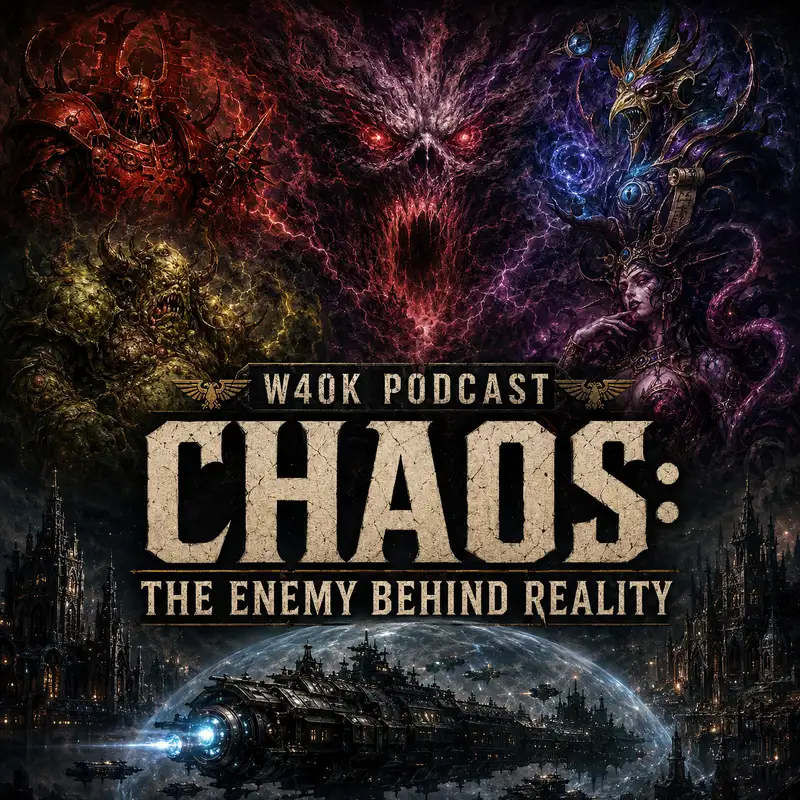
Chaos: The Enemy Behind Reality
The safest thing protecting an Imperial warship is a lie told to reality. The Gellar field wraps the vessel in a bubble of ordinary space, while outside that bubble the laws of matter become suggestions. Distance buckles. Time loses discipline. Thought acquires weight. Hunger can become a voice, and a memory can discover that it has teeth. If the field fails, there may be no enemy boarding through an airlock. The enemy is already touching every wall at once.
That realm is the Warp, also called the Immaterium. It exists alongside the physical universe, but it does not behave like a second stretch of ordinary space. It is a psychic dimension, shaped by the minds and emotions of living beings. Fear, rage, hope, grief, ambition, obsession, and despair leave impressions there. Most are brief and weak. Across an entire galaxy, however, those impressions gather. They form currents, storms, predatory intelligences, and powers so vast that mortals call them gods.
Chaos is not simply another empire hidden beyond the stars. It has no capital that can be surrounded, no single species that can be exterminated, and no border that remains fixed on a map. Nor is Chaos identical to everything in the Warp. The Immaterium is larger and stranger than the four great powers that dominate it. Yet for humanity, the difference is often academic. When the Warp presses back against reality, it usually does so with claws.
This makes Chaos the most intimate enemy in Warhammer forty thousand. Orks arrive in ships. Tyranids descend in swarms. Necrons wake beneath the soil. Chaos can enter through a dream, a grievance, a prayer, or a perfectly reasonable desire pursued beyond every reasonable limit. It is behind reality because the Warp lies beneath the machinery of the Imperium, and because the emotions that feed it lie inside every human being.
The terrible complication is that humanity cannot simply close the door.
The Imperium is spread across distances too great for ordinary travel. Its fleets cross those distances by entering the Warp, where a journey that would take generations in realspace may be completed in weeks or months. Navigators guide ships through that impossible ocean. The Astronomican burns as a psychic beacon, allowing them to find a course through the turbulence. Astropaths transmit messages through the same realm, carrying warnings, orders, pleas, and bureaucratic misunderstandings between distant worlds.
Without the Warp, the Imperium would not function as an empire. Its armies would arrive centuries late, assuming they arrived at all. Its worlds would become isolated islands. Its rulers would lose even the illusion of central control. The Imperium survives by repeatedly entering the domain of its greatest enemy, protected by technology it only partly understands and rituals it would be unwise to skip.
Chaos therefore cannot be understood as an external invader. It is also a consequence of connection. The same realm that allows humanity to cross the galaxy allows nightmares to cross back.
The four great Chaos Gods are the most powerful expressions of this relationship between mortal life and the Warp. They are not merely very large daemons sitting on thrones somewhere beyond a cloud. Each is a vast psychic power formed around recurring emotions, desires, and actions. Each has a personality, a will, servants, rivalries, and purposes. Each also represents a trap, because the road toward damnation rarely begins with someone announcing a sincere interest in damnation.
Khorne is the power of rage, violence, slaughter, and the desire to overcome through force. He is fed by bloodshed whether it is committed by a berserk murderer or a disciplined army. His followers may speak of courage, strength, or martial honour, and those qualities can be part of the temptation. A soldier who hates cowardice may begin by demanding resolve. Then resolve becomes contempt for weakness. Contempt becomes cruelty. Cruelty becomes a need to prove strength through killing. Khorne does not require a complicated theology. He requires the next blow.
This is why Khorne is more dangerous than a simple god of mindless anger. Anger can be justified. Violence can be necessary. The galaxy provides an endless supply of enemies for anyone seeking permission to hate. Khorne takes the moment when force becomes necessary and whispers that force is therefore pure.
Tzeentch is the power of change, ambition, sorcery, conspiracy, and the hope that the future can be made different. His influence appears in schemes within schemes, but reducing him to a clever trickster misses the deeper threat. Tzeentch offers possibility. He appeals to the prisoner who wants freedom, the scholar who wants forbidden knowledge, the ruler who believes one final deception will save a world, and the revolutionary who cannot accept that the present order should endure.
Hope itself is not evil. Neither is change. That is precisely the problem. Tzeentch corrupts through the belief that one can control every consequence if only one possesses enough knowledge. His servants plan, manipulate, and transform until the plan becomes more important than the people it was meant to serve. The future remains open, but only because Tzeentch keeps moving the door.
Nurgle is the power of decay, disease, despair, endurance, and the surrender that follows prolonged suffering. At first glance, he seems the easiest to understand. He is rot with a personality. Yet Nurgle’s followers often display a grotesque cheerfulness, because his gift is not merely disease. It is relief from the fear of disease. He offers acceptance when resistance has become exhausting.
A population trapped by plague may pray for the pain to stop. A soldier surrounded by corpses may decide that death is inevitable. A person who has lost everything may find comfort in the promise that nothing can be taken from someone who has already surrendered. Nurgle turns endurance into stagnation and acceptance into captivity. His affection is real in the way a swamp can be called welcoming. It will hold everyone equally, and it has no intention of letting go.
Slaanesh is the power of excess, obsession, sensation, pride, and the pursuit of perfection without restraint. Slaanesh is often misunderstood as a god of pleasure alone. Pleasure is only one road. The artist seeking an impossible masterpiece, the warrior demanding the perfect victory, the ruler who needs perfect obedience, and the ascetic who takes pride in perfect denial can all walk toward the same destination.
The danger lies in escalation. What once satisfied becomes ordinary. What once seemed extreme becomes necessary. The pursuit narrows until everything outside it appears dull, obstructive, or unworthy. Slaanesh does not merely offer indulgence. Slaanesh offers the intoxicating belief that limits are an insult.
The birth of Slaanesh destroyed the ancient Aeldari civilisation that had fed this power through generations of escalating excess. Their empire did not fall because every individual made the same choice, nor because pleasure alone somehow exploded. It fell because a civilisation with immense psychic potential allowed obsession and self-gratification to become a culture, and that culture created something in the Warp capable of devouring its creators. The resulting catastrophe tore open the Eye of Terror and left the survivors living in the shadow of what their ancestors had made.
Together, the four gods are sometimes called a pantheon, but they are not a stable council. They wage the Great Game against one another without end. Khorne despises sorcery. Tzeentch undermines every settled order. Nurgle embodies stagnation that Tzeentch cannot tolerate. Slaanesh competes with all of them by turning every appetite, including warfare, ambition, and despair, toward excess. Their rivalries prevent Chaos from becoming a single disciplined power. They also ensure that war within the Warp never stops.
This disunity is one reason the galaxy still exists. It is not a comforting reason. Humanity survives partly because its predators are busy trying to eat one another.
Daemons are the servants and expressions of these powers. A daemon is not merely an animal native to another dimension. It is a portion of the Warp that has acquired identity and purpose. Many daemons are fragments of a Chaos God’s power, shaped according to that god’s nature. Others are less easily classified. All are creatures for whom symbolism, emotion, and intention can matter as much as mass or distance.
When a daemon appears in realspace, it must force something unnatural into a universe governed by physical law. That usually requires a weakness. A ritual, a psychic rupture, a massacre, a possessed host, a damaged Gellar field, or a place where the boundary has already worn thin may provide the opening. Once manifested, a daemon can tear through flesh and metal like any physical monster. Yet destroying its body usually banishes it rather than killing it forever. The weapon defeats the appearance. The thing behind the appearance remains.
This is one reason daemonic war feels so different from ordinary combat. Soldiers can hold ground, but the ground may remember what happened on it. A fortress can be sealed, but someone inside may begin hearing instructions in the walls. A commander can win a battle and still lose because the violence required for victory created the conditions for something worse. Ammunition counts remain important. They are simply no longer the whole problem.
Chaos corruption follows the same logic. It is rarely a single instant in which an innocent person becomes a theatrical villain. Sometimes possession is sudden and brutal, but the more common danger is a chain of choices. Each decision appears defensible in isolation. Use forbidden knowledge to defeat a greater threat. Accept one small mutation because it grants strength. Conceal the truth to preserve morale. Sacrifice a few to save many. Then sacrifice many because the first sacrifice must have meant something.
The Warp rewards commitment. Power arrives before the full cost becomes clear. A cultist may receive visions that seem prophetic. A warrior may become stronger. A sorcerer may learn secrets. A plague victim may stop feeling pain. An obsessive may finally produce work beyond normal human ability. By the time the gift reveals its nature, the recipient may depend upon it, defend it, and reinterpret every warning as persecution.
Chaos is persuasive because it does not always lie. It can offer power. It can expose hypocrisy. It can reveal truths suppressed by the Imperium. It can punish oppressors, break chains, and make the helpless dangerous. The deception lies in ownership. The gift does not make the recipient free. It transfers the claim.
The Horus Heresy remains the greatest demonstration of this method. Horus was not chosen because he was a mindless brute. He was the Emperor’s favoured son, a brilliant commander, and the Warmaster entrusted with humanity’s armies. The rebellion that followed did not begin with a simple declaration that evil seemed attractive. It grew through wounded pride, mistrust, manipulation, fear of the Emperor’s intentions, and the conviction that the future had been stolen.
Chaos did not need every grievance to be false. It needed those grievances to become absolute. Horus and the primarchs who followed him were encouraged to treat doubt as proof, ambition as destiny, and compromise as betrayal. Once the conflict began, every atrocity created reasons for the next. Legions that had been built to conquer the galaxy turned their weapons upon one another, and the war ended with the Emperor broken upon the Golden Throne and the Imperium transformed into the kind of civilisation many rebels had claimed to oppose.
The Traitor Legions still carry that history into the present age, though ten thousand years of war and Warp exposure have not preserved unity or clarity. Some serve a particular god. Some follow Chaos in a broader form. Some are driven by hatred of the Imperium, loyalty to an ancient brotherhood, hunger for power, or the simple inability to imagine another life. Their armour and bodies bear the effects of long exposure to the Immaterium. Their warbands fight the Imperium, one another, and occasionally themselves, which at least keeps command meetings lively.
Not every servant of Chaos understands what they serve. A planetary uprising may begin over taxes, famine, forced labour, or a governor whose idea of public service involves a private palace. A hidden cult can attach itself to legitimate anger, offering organisation and strength. By the time symbols change and rituals deepen, the rebellion may have become a doorway.
This does not excuse the Imperium. Its cruelty, inequality, and secrecy create wounds that Chaos can exploit. Yet Chaos is not the cure for those wounds. It is the infection that learns to speak in the patient’s voice.
The Imperium’s response is therefore built on containment as much as conquest. Psykers are identified, controlled, sanctioned, sacrificed, or killed. Ships maintain Gellar fields. Inquisitors investigate cults and daemonic influence. The Grey Knights are trained and conditioned to fight threats that ordinary troops may not be permitted to remember. Wards, relics, faith, ritual, and psychic discipline are used to reinforce the boundary between realspace and the Warp.
These measures are sometimes effective. They are also brutal. An Imperial commander facing possible corruption may destroy a city to save a planet, or destroy a planet to prevent a wider breach. Officials suppress knowledge because awareness can attract attention, inspire imitation, or provide cults with exactly the instructions they require. The policy has a certain severe logic. It also ensures that when the truth finally arrives, most citizens meet it without preparation.
Ignorance can deny Chaos a path. Ignorance can also make the first persuasive liar sound like the only honest person in the room.
Faith serves as another defense, although its relationship with the Warp is complicated. Belief has power in a universe where thought can shape the Immaterium. The conviction of a priest, a battle-sister, or an ordinary soldier may resist terror and corruption. Miracles are reported, though Imperial accounts are rarely neutral and the exact mechanisms remain uncertain. What is clear is that identity, discipline, loyalty, and shared purpose can help a mind hold its shape when Chaos attempts to rewrite it.
The reverse is also true. Faith without humility can become fanaticism. Discipline can become cruelty. Loyalty can become refusal to see betrayal. Every defense has a shadow, and Chaos is patient enough to wait for people to mistake the shadow for the virtue.
For most of Imperial history, the Warp remained hidden behind a damaged but recognisable boundary. Storms erupted. Worlds vanished. The Eye of Terror burned as a vast wound in space, but much of the galaxy could still pretend that realspace was the normal condition and Chaos was an intrusion.
The opening of the Great Rift ended that comfort.
When Cadia fell and the ancient structures that helped restrain the Warp were broken, a tear of impossible scale spread across the galaxy. Warp storms swallowed routes, isolated systems, and divided the Imperium. On one side, the light of the Astronomican became faint or vanished. Daemonic incursions increased. Time itself became unreliable. The enemy behind reality was now visible across the heavens.
The Great Rift did not create Chaos, but it revealed the weakness that had always existed. Reality in Warhammer forty thousand is not a solid wall with monsters on the far side. It is a contested boundary under pressure from the minds of those living within it. The more violent, desperate, ambitious, and obsessive the galaxy becomes, the more turbulent the reflection.
That does not mean every angry thought summons a daemon, or that ordinary emotion is itself a crime. The Imperium often behaves as though fear and repression can sterilise the human soul. They cannot. People must hope, grieve, strive, love, and sometimes fight. The danger appears when an emotion becomes an identity, when identity becomes surrender, and when surrender is mistaken for liberation.
Chaos wins by narrowing the world. Khorne reduces every problem to violence. Tzeentch reduces every relationship to manipulation. Nurgle reduces every struggle to inevitable decay. Slaanesh reduces every value to appetite. Each promises to remove uncertainty. Each removes the part of a person capable of choosing anything else.
This is why Chaos is the enemy behind reality. It is not merely hiding in another dimension. It is woven into the methods by which the Imperium travels, communicates, fights, believes, and survives. It reflects the galaxy’s emotions, then magnifies them until the reflection can reach back through the glass.
A fleet can defeat a Chaos armada. An Inquisitor can break a cult. A Grey Knight can banish a daemon. A world can be cleansed, sealed, and declared safe. None of these victories abolishes the source. The next breach may begin in another sector, another century, or inside the mind of the person writing the declaration of victory.
The war against Chaos therefore has no final front line. It is fought in fortress corridors and on blasted worlds, but also in choices, loyalties, ambitions, and moments of despair. The weapons matter. So do the reasons they are raised.
Every Imperial ship that enters the Warp carries a shield of reality into an ocean shaped by mortal nightmares. Beyond that thin field, the dark is not empty. It is listening. The true horror is not that something alien waits there. It is that the thing waiting has learned humanity’s voice, and knows exactly what humanity wants to hear.