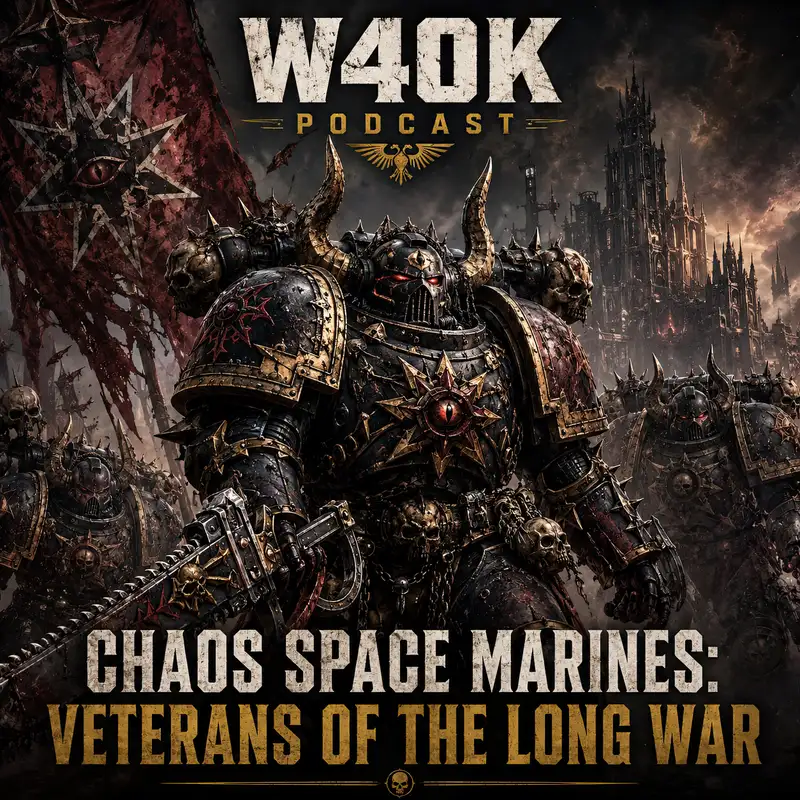
Chaos Space Marines: Veterans of the Long War
One of the most dangerous warriors in the forty-second millennium may remember the Emperor before the Imperium called him a god. He may have marched beneath the same banners as the ancestors of the Space Marines hunting him. He may have fought through the dust of Terra, watched the Warmaster fall, and fled beneath the guns of the victorious loyalists. Ten thousand years later, he is still at war. His armour has changed. His body may no longer be entirely human. His reasons have probably become harder to separate from his hatreds. Yet somewhere beneath the horns, chains, trophies, and whispered promises of the warp remains a soldier who believes the civil war never ended.
That belief is the heart of the Chaos Space Marines. They are often called the Veterans of the Long War, but the phrase means more than age. It describes an identity built from defeat, exile, memory, and revenge. The Long War is their struggle against the Imperium, but it is also the story they tell themselves about why they still matter. To understand these warriors, the important question is not simply why they betrayed the Emperor. It is why, after everything they lost and everything Chaos took from them, they continue to fight a war whose first commander has been dead for millennia.
The answer begins before there were Chaos Space Marines at all. During the Great Crusade, the Emperor created vast Legions of genetically transformed warriors and placed them under the command of the primarchs. These Legions were not small brotherhoods guarding isolated regions. They were conquering armies, each with its own culture, methods, rivalries, and wounds. They brought human worlds into compliance, crushed alien empires, and helped build the Imperium through a combination of military brilliance and violence on an industrial scale.
The warriors who later became traitors were part of that achievement. They had not spent their early lives hiding in the warp and decorating every available surface with spikes. They had been the Emperor’s angels of war. Then Horus rebelled. The reasons were never identical across the Traitor Legions. Some followed their primarchs out of loyalty. Some carried old grievances against the Emperor or the Imperium. Some believed the new political order would discard the warriors who had built it. The Word Bearers embraced Chaos as a religious truth. The Iron Warriors brought bitterness hardened by years of thankless siege warfare. The Night Lords already ruled through terror and had little reason to trust the justice of the empire judging them. Others were drawn by ambition, pride, desperation, or the simple fact that refusing a primarch’s command was rarely a safe career choice.
Chaos exploited every fracture. It offered vindication to the resentful, power to the ambitious, certainty to the devout, sensation to the empty, and survival to those who had run out of alternatives. Corruption worked through choices, compromises, rituals, necessities, and self-deception. Many traitors believed they were using the powers of the warp as weapons. The powers of the warp have always appreciated that kind of confidence.
The Horus Heresy became a civil war on a scale the Imperium never truly recovered from. Legions were shattered. Worlds burned. Primarchs killed one another or became things no longer bound by mortal life. At last, the traitor assault reached Terra. Horus’s armies broke into the Imperial Palace while the Emperor confronted his favored son aboard the Warmaster’s flagship. Horus died. The Emperor was mortally wounded and placed upon the Golden Throne. The rebellion had failed at the moment it seemed closest to victory.
For the traitors, the retreat from Terra was more than a military withdrawal. It was the collapse of the future they had gambled everything to create. The loyalists pursued them during the campaigns remembered as the Scouring, driving the defeated Legions away from the Imperium and toward the Eye of Terror. That vast wound in reality became their sanctuary because Imperial forces could not easily follow. It also became their prison.
Inside the Eye, ordinary rules weakened. Space, time, flesh, and thought could all become unstable. A ship might experience years while centuries passed beyond the warp storm, or return to realspace and discover that history had moved on without it. Some Heresy veterans have therefore lived through much less than ten thousand years by their own reckoning. Others have endured ages of warfare, ritual, and mutation that no reliable calendar could measure. They are survivors from an ancient war carried forward through broken time.
The Eye did not preserve the Traitor Legions as disciplined armies waiting patiently for another campaign. Their primarchs were dead, absent, transformed, or concerned with purposes far beyond ordinary command. Rivalries that had been dangerous during the Heresy became murderous in defeat. Resources dwindled. Commanders fought over ships, fortresses, slaves, weapons, and gene-seed. The Legions fractured into warbands led by champions powerful enough to demand obedience and ruthless enough to keep it.
This is why Chaos Space Marines are not one unified army. A warband may contain a handful of raiders aboard a failing cruiser, or enough warriors, cultists, engines, and allied daemons to threaten a sector. Some still preserve the colors and traditions of a Traitor Legion. Others combine warriors from several bloodlines under a new name. Some follow a single Chaos God. Some bargain with all four. Some insist they serve none of them, even while their armour grows teeth and their dreams answer back.
Their daily existence is less romantic than their titles suggest. Power armour requires repair. Bolters need ammunition. Ships need fuel, parts, navigators, and crews. New warriors require gene-seed, surgery, training, and candidates strong enough to survive the process. Chaos can produce miracles, but it has never shown much interest in dependable logistics. Warbands raid Imperial worlds not only for glory or sacrifice, but for food, machinery, captives, weapons, and biological material. Eternity contains a surprising amount of maintenance.
The need to replace losses is important because not every Chaos Space Marine fought in the Horus Heresy. Some are recruits created by the Traitor Legions or their warbands. Others are loyal Space Marines who turned renegade centuries or even weeks ago. They may have rejected Imperial authority, fallen under a curse, embraced forbidden power, or simply made one desperate compromise too many. Among the servants of Chaos, an ancient veteran can stand beside a warrior who remembers the Imperium only as the enemy.
This creates a harsh hierarchy. Those who fought in the Heresy often regard themselves as the true heirs of the old Legions. They remember the primarchs in life. They saw the Imperial Palace before it became the center of a religion. They can look upon modern loyalist Chapters and see descendants wearing fragments of traditions the veterans once knew in full. To a newly fallen renegade, the Long War may be a cause. To an old Legionary, it is memory.
That memory is one of their greatest weapons. A genuine veteran of the Long War may possess centuries of combat experience. He has fought humans, aliens, daemons, and other Space Marines across battlefields that no longer appear on Imperial charts. He knows how Astartes think because he was trained in the same military tradition. He may remember the origins of doctrines that loyal Chapters now treat as sacred inheritance. When such a warrior faces a young Space Marine, the contest is not merely strength against strength. It is living experience against carefully preserved legend.
Age, however, does not guarantee wisdom. Ten thousand years of hatred can refine tactical skill while destroying judgment. Veterans become trapped by old rivalries. They pursue vendettas whose original causes have been buried beneath layers of retaliation. They may underestimate later generations, dismiss new threats, or assume that surviving the past proves they deserve to rule the future. Chaos adds another cost. The gods reward their champions, but every gift carries a claim. A warrior devoted to Khorne may gain terrible strength while losing the ability to imagine any answer that does not involve slaughter. A servant of Tzeentch may pursue knowledge and transformation until identity itself becomes uncertain. Nurgle offers endurance, belonging, and relief from suffering, though the form of that relief is unlikely to reassure anyone nearby. Slaanesh promises perfection and sensation, then steadily moves satisfaction beyond reach.
Even those who worship Chaos Undivided are not safely outside this system. They may seek to balance the gods, exploit them, or avoid permanent submission to any single power. Abaddon the Despoiler is the greatest example. He accepts the favor of the Ruinous Powers but refuses to become a daemon prince, preserving his material existence and, as he sees it, his independence. Whether any mortal can accept so much from Chaos without becoming its instrument is exactly the sort of question Chaos prefers to leave unanswered.
Abaddon had been First Captain of the Sons of Horus and one of the Warmaster’s most formidable lieutenants. After the defeat, he did not simply repaint the old Legion and continue as if nothing had happened. Horus had failed, and the Sons of Horus carried the shame of that failure. Abaddon eventually forged the Black Legion as a new brotherhood, drawing warriors from different origins into a cause centered on victory rather than loyalty to a dead primarch.
The Black Legion matters because it offers an answer to the fragmentation of the traitors. Its warriors do not need to forget where they came from, but they are expected to place Abaddon’s war above the feuds of the old Legions. The Black Legion is therefore not merely the Sons of Horus under another name. It is an attempt to create something stronger from the ruins, united by hatred of the Imperium and by the promise that the defeat at Terra can still be reversed.
That unity is never complete. Abaddon is the closest thing the Chaos Space Marines possess to a supreme commander, but he does not control every warband at all times. He must bargain, threaten, inspire, and demonstrate strength. Daemon primarchs pursue their own designs. Legion lords guard their independence. Champions of the gods cooperate when the prize is large enough and remember their grievances as soon as it is divided. Organizing the forces of Chaos is rather like commanding an alliance in which every participant believes betrayal is both inevitable and a respectable opening move.
The Black Crusades were Abaddon’s great efforts to carry the Long War beyond the Eye of Terror. Imperial accounts often reduced the first twelve to failed invasions, because Abaddon did not conquer Terra and eventually withdrew. That interpretation was too simple. The crusades struck different targets, gathered weapons, tested defenses, broke strongholds, and weakened the systems surrounding the Cadian Gate. They were not one campaign repeated twelve times without anyone considering a revised plan.
The thirteenth Black Crusade brought the strategy to its terrible conclusion. Cadia had guarded the most stable route out of the Eye for thousands of years. Its soldiers and fortresses stood between the traitor hosts and the wider Imperium. Abaddon’s forces finally broke the world, and Cadia’s destruction helped unleash the Great Rift across the galaxy. The Imperium was split. Entire regions were cut off from Terra. The Long War ceased to be a threat contained behind a gate and became a vast offensive across a wounded reality.
Yet Abaddon’s vision is only one version of the Long War. Each Traitor Legion carries its own interpretation of what was lost and what vengeance should look like. The Iron Warriors turn resentment into siegecraft, reducing fortresses and empires through brutal calculation. The Word Bearers wage a holy war for the truth of Chaos, viewing the Imperium’s worship of the Emperor as both blasphemy and bitter confirmation that faith was always the galaxy’s real power.
The Night Lords often fight through terror, punishment, and predation. Their warbands may share a hatred of the Imperium without sharing a coherent plan for replacing it. The Alpha Legion is even less easily defined. Its cells, commanders, and hidden agendas make certainty dangerous. Some appear committed to Chaos. Others claim purposes rooted in the Heresy’s oldest deceptions. The surviving evidence rarely offers the courtesy of a clear answer.
The four Legions most closely bound to individual gods have become distinct horrors. The World Eaters are broken into warbands driven by the Butcher’s Nails and the demands of Khorne. The Death Guard endure beneath Nurgle’s corruption, carrying plague as weapon, sacrament, and condition of existence. The Thousand Sons combine sorcery, ambition, and tragedy, many of their warriors reduced to souls sealed inside empty armour. The Emperor’s Children pursue Slaanesh through sensation, artistry, cruelty, and an appetite for perfection that can never be satisfied.
These differences matter because Chaos does not erase personality. It magnifies, twists, and weaponizes it. The Iron Warriors remain recognizably shaped by grievance and siege warfare. The Word Bearers still seek meaning through faith. The Night Lords carry the logic of terror beyond any boundary that might once have restrained it. Chaos takes what is already present and gives it room to become monstrous.
This is also why the traitors cannot be explained as victims with no responsibility for their actions. Many were manipulated. Many were lied to. Some entered the rebellion before they understood the powers behind it. None of that erases what they chose afterward. Across the Long War, they have enslaved populations, destroyed worlds, offered souls to the warp, and made suffering into military practice. Their grievances can be understood without being accepted as excuses.
The tragedy is that many veterans still describe themselves as liberators. They remember an Emperor who rejected public worship, yet now rules an Imperium that prays to him. They remember promises of human progress, yet see a civilization governed by fear, dogma, and decay. From their perspective, the Imperium proves that the Great Crusade’s ideals were always false or that the loyalists betrayed them after the war.
There is truth inside that accusation. The modern Imperium is cruel, superstitious, and often incapable of distinguishing preservation from slow collapse. The Emperor has become the center of the religion he once opposed. The Space Marines who defend his realm serve institutions their Legion ancestors might barely recognize. The Chaos veterans can identify these contradictions because some of them were present when the original promises were made.
Their conclusion does not follow from the evidence. The Imperium’s corruption does not make the servants of Chaos righteous. A warrior does not become free by replacing one master with four gods who feed upon mortal emotion. The Long War offers rebellion without liberation. It tears down a monstrous order while building realms that are usually worse. Chaos can reveal hypocrisy with perfect clarity and still provide the most catastrophic possible remedy.
For the Imperium, a Chaos Space Marine is a heretic, a monster, and a warning. For a veteran of the Long War, the modern Imperium is an occupied inheritance. Its worlds were conquered by his generation. Its institutions rest upon victories he helped win. Its loyal Space Marines bear gene-lines related to warriors he once called brothers. Every battle is therefore both present war and ancient family murder.
That intimacy separates the Long War from an ordinary conflict. The traitors do not simply want territory. Many want vindication. They want the Imperium to admit that Horus’s rebellion exposed a lie, that their sacrifices were stolen, or that history chose the wrong victors. Since empires do not usually surrender to arguments made with chainaxes, this desire for recognition becomes another reason the war cannot end.
The war also protects them from a more difficult question. If the Imperium vanished tomorrow, what would the veterans become? Some would build kingdoms. Some would pursue ascension. Some would continue fighting each other. A few might discover that revenge had consumed every purpose they once possessed. The Long War gives structure to lives otherwise ruled by appetite, rivalry, and the demands of the gods. Hatred is not merely their weapon. It is their remaining home.
That is what makes the title Veteran of the Long War both a boast and a sentence. It honors survival, skill, and direct connection to the greatest civil war in human history. It also reveals a warrior unable to leave that war behind. He has crossed ten thousand years without reaching the future. He still measures every victory against Terra and every enemy against brothers who chose the other side.
Chaos Space Marines remain dangerous because they are not relics. They recruit, adapt, raid, bargain, invent, and return. Their ancient experience is joined by new hatred. Their warbands can be divided, but they can also gather behind commanders powerful enough to turn resentment into strategy. They carry the weapons of the old Legions, the mutations of the warp, and a knowledge of the Imperium’s weaknesses earned from having helped create it.
They continue fighting because the Long War explains their suffering, justifies their crimes, and promises that defeat can still be transformed into victory. It tells them that exile was not failure, corruption was not surrender, and ten thousand years of bloodshed have not been wasted. To abandon the war would mean confronting the possibility that Horus died for nothing, that Chaos used them, and that everything they became was built upon a choice they can no longer undo.
So the oldest of them marches on. The Imperium has changed beyond recognition. The Emperor he opposed has become a god. The brothers he hated are dust, and their distant descendants now carry the quarrel. Still, when the guns open and the battle lines close, the veteran hears the echo of the Imperial Palace. He is not fighting to recover the past. He is fighting because the past is the only part of him that Chaos has not yet devoured.