Chaos Knights and the Traitor Titan Legions
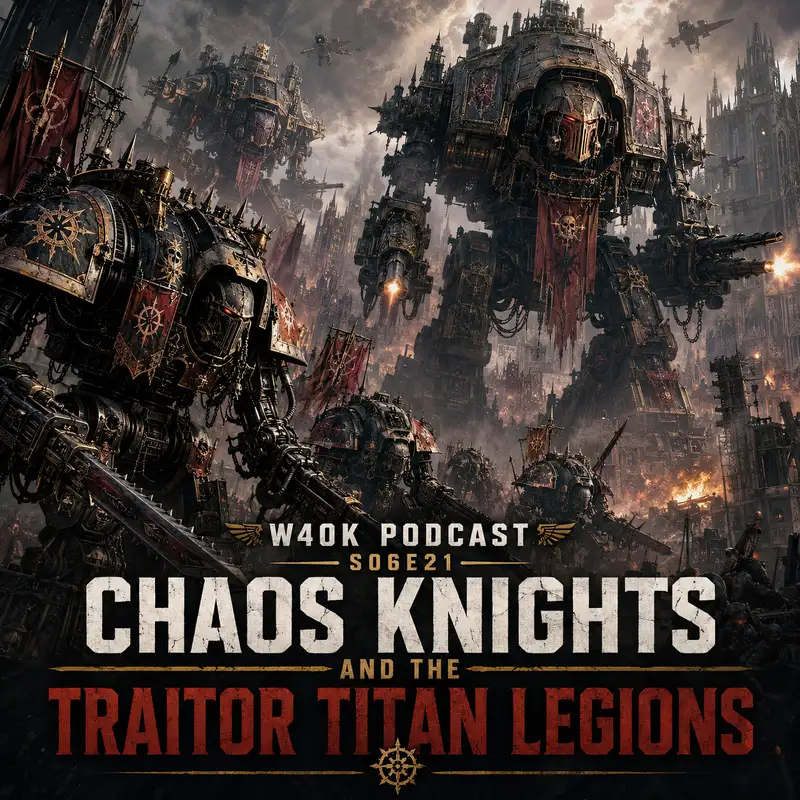
The first warning was not a battle cry or a flash on the horizon. It was the ground itself, shuddering beneath fortifications already battered by months of siege. At Terra, the traitor god-engines of Legio Mortis advanced toward the Imperial Palace beneath banners that had once represented the disciplined might of Mars. Around their feet moved Knight suits, smaller only by comparison, each carrying a fallen noble whose ancestors had sworn that honour would outlast death. The defenders were not simply watching large machines approach. They were watching old institutions return as monsters.
Chaos Knights and Traitor Titan Legions are often grouped together because both arrive as towering armoured walkers covered in guns, heraldry, chains, and enough spikes to make maintenance a devotional act. Yet they are not the same kind of force. A Chaos Knight is usually a personal war engine, bound to one pilot and one corrupted aristocratic tradition. A traitor Titan belongs to a military priesthood, crewed by many minds and built to serve as a walking engine of strategic destruction. One is fallen knighthood. The other is a fallen god-machine. Their shared horror lies in what Chaos does to the bonds that once controlled them.
A Knight suit is enormous by human standards, capable of crushing infantry beneath its feet, tearing open armoured vehicles, and duelling monsters that would halt an ordinary army. A Titan stands on another level. Even the swift Warhound is a dedicated god-engine, while the larger Reaver, Warlord, Warmaster, and Imperator classes are weapons around which entire campaigns may be planned. Titans break fortress lines, kill other Titans, and turn districts into firing solutions. The distinction is not merely height. Knights are battlefield nobles. Titans are pieces of military infrastructure that have learned to walk.
The roots of the Knight households reach back into humanity’s lost technological past. Many Knight worlds were isolated during Old Night, when interstellar civilisation collapsed and distant colonies had to survive without help. Their armoured suits became protectors, hunting engines, symbols of authority, and eventually the foundation of feudal societies. Families that controlled Knights controlled security, land, and political power. Over generations, practical command became hereditary privilege. The machine that defended the settlement became the throne from which the settlement was ruled. Human history has produced stranger governments, though usually with fewer thermal cannons.
At the centre of this system is the Throne Mechanicum, the neural interface that binds a noble pilot to the Knight. It does more than translate thought into movement. Within it linger impressions of previous pilots, ancestral personalities, inherited instincts, and the accumulated character of the machine itself. A new pilot does not enter an empty cockpit. The noble joins a conversation that began centuries before birth. Loyal households describe this as continuity, duty, and the wisdom of ancestors. It can also become a mechanism by which pride, grievance, and cruelty are passed down with unusual efficiency.
That inheritance helps explain why a Knight household can fall as a household. Chaos does not always need to corrupt every pilot separately. It can enter through the values that already hold the family together. Honour becomes obsession with status. Duty becomes unquestioning obedience. Independence becomes contempt for every lesser life. Martial pride becomes the belief that destruction proves nobility. Once these ideas take root in the Throne Mechanicum, each new pilot may inherit more than a war engine. The pilot may inherit a chorus of corrupted ancestors insisting that betrayal is loyalty and tyranny is tradition.
Some households turned during the Horus Heresy, when Warmaster Horus split the Imperium and the Mechanicum in two. Others fell long afterward. A few cannot honestly be called traitors because they never accepted Imperial rule in the first place. House Herpetrax, for example, emerged from a culture that had resisted would-be emperors throughout Old Night. When the Imperium finally found its world, the household saw no compelling reason to exchange its own brutal customs for obedience to a distant corpse on Terra. From the Imperial perspective, this was heresy. From the household’s perspective, it was consistency.
House Devine offers the darker and more intimate example. Long before the Heresy reached its homeworld of Molech, corruption had already spread beneath the surface of the household. The nobles maintained the appearance of loyalty until Horus attacked the world in search of the hidden power beneath it. At the decisive moment, House Devine turned its weapons on supposed allies. Knights that should have reinforced the defence instead helped tear it apart from within. The betrayal worked because the victims still believed the old heraldry meant what it had meant the day before.
This is one reason Chaos Knights remain so effective as instruments of terror. Their shapes are recognisable. Their banners resemble the symbols of protection and authority that human populations have been trained to obey. A Knight approaching an Imperial settlement may look, for a few precious moments, like salvation. Then the war horn sounds, the weapons turn, and the population discovers that familiarity can be more frightening than the alien. Chaos rarely invents from nothing when it can corrupt something people already trust.
Not every fallen Knight serves a great household. Some become Dreadblades, solitary engines whose pilots have abandoned, murdered, or outlived their former kin. A Dreadblade may fight beside Chaos Space Marines, follow a daemon prince, sell its strength to a warlord, or pursue a private feud across generations. Independence does not make such a pilot free. The Knight’s machine spirit, the voices in the Throne, daemonic influence, and the pilot’s own obsessions form a court from which there may be no appeal. The noble has escaped family authority only to carry the family ghosts inside the cockpit.
The smallest Chaos Knight engines are commonly called War Dogs, though small is doing strenuous work in that sentence. They hunt ahead of larger Knights, harry armoured columns, seize ground, and bring down prey through speed and numbers. Some households treat their pilots as lesser nobles. Others treat them as expendable retainers, rivals, or animals barely held in check. Larger Knights provide the crushing centre of the attack, armed for close assault, long-range destruction, psychic corruption, or some unpleasant combination of all three. Together they fight less like a conventional armoured brigade and more like a predatory court on the move.
The physical corruption of a Chaos Knight varies. Some retain much of their original form, with defaced heraldry and forbidden weapons revealing the change in allegiance. Others become fused with daemonic entities, warp-grown organs, living cables, impossible mouths, or armour that heals like wounded flesh. The pilot may still command the machine. The machine may command the pilot. A daemon may be manipulating both. In many cases, the distinction has ceased to be useful, which is normally the point at which an Imperial investigation becomes both very interested and very brief.
Traitor Titan Legions begin from a different tradition. The Titan Legions, or Legios, were created and maintained by the Mechanicum and later the Adeptus Mechanicus. Each Legio developed its own forge world, heraldry, battle honours, rivalries, rituals, and preferred methods of war. A Titan was never simply issued to a driver. It was served by a princeps, moderati, tech-priests, servitors, maintenance crews, security forces, and the industrial population required to keep a god-engine alive. A Legio was an army, a religious order, and a mobile expression of its forge world’s power.
The princeps commands through the Manifold, a neural communion that allows human thought to inhabit the Titan’s immense body. The princeps feels through auspex arrays, balances through stabilising systems, and directs weapons with an immediacy no bank of ordinary controls could provide. This connection also exposes the princeps to the Titan’s machine spirit, which may possess a will as forceful as that of its commander. Even loyal princeps struggle to remain themselves while joined to a consciousness built for dominance and destruction. Commanding a Titan is partly an act of leadership and partly a permanent argument with a mechanical predator.
When the Mechanicum split during the Horus Heresy, the Titan Legions split with it. Fabricator General Kelbor-Hal sided with Horus, and many Legios followed their forge masters, their political loyalties, or their own ambitions into rebellion. Others remained loyal to the Emperor. The result was not merely a transfer of equipment from one side to another. Ancient rivalries became open war. Forge world disputes became campaigns of annihilation. Titan crews who had once recognised one another as members of the same sacred order now calculated how many reactor breaches would be required to kill their former kin.
Legio Mortis became the most infamous of the traitor formations. Known as the Death’s Heads, it was one of the ancient Martian Legions and stood at the centre of the Warmaster’s Titan forces. Its engines fought through the great battles that opened the road to Terra, then marched against the Imperial Palace itself. Mortis did not represent a mob of captured machines. It represented the authority of Mars turned against the Imperium, complete with discipline, command structure, sacred history, and a deep conviction that its betrayal was justified.
Other Legios followed different paths. Legio Fureans brought a reputation for savage aggression. Legio Krytos had long specialised in breaking enemy god-engines and reducing resistant worlds. The twin formations of Legio Vulcanum pursued forbidden methods of replicating the qualities of notable Titan machine spirits. Some Legios were driven by loyalty to Horus or to traitor forge lords. Some sought freedom from restraint. Some used the civil war to settle grudges older than the Imperium. Chaos did not erase their identities. It gave those identities permission to become absolute.
This is an important point because not every traitor Titan became a fully mutated daemon engine on the first day of rebellion. At the beginning, many were recognisable military machines crewed by people who had chosen the Warmaster’s side. Corruption deepened over time. Warp exposure, forbidden modification, daemonic pacts, and the gradual collapse of technical restraint changed both engines and crews. Some Titans remained outwardly mechanical for long periods. Others grew weapons no forge had installed, leaked corrosive fluids, developed predatory appetites, or carried entities that treated the original machine spirit as either a partner or prey.
A corrupted Titan magnifies the already dangerous relationship between princeps and machine. The princeps may enter the Manifold expecting to command and instead find a presence waiting within. The Titan may remember old victories, old injuries, and old enemies with inhuman clarity. Daemonic influence can turn those memories into hunger. The crew may continue performing rituals because the rituals still appear to work, even as the meaning changes beneath them. Incense becomes offering. Maintenance becomes sacrifice. Activation becomes invocation. The line between engineering and worship was never especially wide in the Mechanicum. Chaos merely removes the guardrail.
The campaign at Beta-Garmon showed what happens when these forces are gathered in numbers large enough to shape history. Horus needed the strategic cluster cleared before the final advance on Terra. Loyalist commanders committed vast armies and numerous Titan Legions to stop him. The traitors answered with Legio Mortis and other Legios, supported by renegade Knight households. The resulting struggle became remembered as the Titandeath, a sequence of battles in which god-engines destroyed one another at a rate that even the Imperium could not easily replace.
Knights mattered in that war because Titan battles are not fought by Titans alone. A god-engine has immense firepower, but it can be flanked, isolated, blinded, or overwhelmed. Knight banners screen the larger machines, hunt vulnerable enemies, exploit breaches, and attack targets too dispersed for a Titan’s main weapons. Infantry, tanks, aircraft, and artillery fight beneath them, often with the uncomfortable awareness that a duel between Warlords may erase both sides without consulting anyone at ground level. A Titan maniple is a combined-arms formation whose largest members happen to resemble moving cathedrals.
The traitor victory at Beta-Garmon was costly, but it opened the path to Terra. There, the Titan war became part of the siege’s final pressure against the Palace. Legio Mortis advanced against loyal engines including its ancient rival, Legio Ignatum. The corrupted Imperator Titan Dies Irae became one of the most feared machines in the assault, helping the traitor forces break deeper into the defences. By this stage, the war was no longer simply about competing claims to Imperial rule. The Warp had entered the engines, the battlefield, and the logic of the siege itself.
Even death did not always end a Titan’s service. During the fighting around Terra, the traitors used warp power to animate ruined Loyalist engines from Beta-Garmon, turning dead god-machines against former comrades. The act captured the nature of the conflict with almost excessive precision. The shells of honoured defenders were made to rise under hostile spirits, their history retained only as an additional insult. The Imperium had always called Titans god-machines as an expression of reverence. Chaos treated the title as a technical objective.
After Horus fell, the surviving traitor Legions and households did not simply vanish. Many withdrew toward the Eye of Terror or other warp-tainted regions. There they found shelter among dark forge worlds, heretek enclaves, Chaos Space Marine domains, and the shifting territories of the Dark Gods. Time within the Warp did not pass cleanly. Some crews experienced centuries while the Imperium endured millennia. Others emerged after what felt like a short campaign to discover that ten thousand years had turned their names into curses.
Maintaining a Titan across that span is difficult even for the Adeptus Mechanicus, with its forge worlds, priesthoods, and supply systems. Traitor Legios solve the problem through a mixture of preserved expertise, scavenging, cannibalisation, slave labour, dark industry, sorcery, and bargains that sensible engineers would reject before the screaming began. A damaged engine may be rebuilt with parts from a defeated rival. A failing system may be replaced by a bound entity. A dead princeps may remain connected because removal would be inconvenient. Chaos logistics are still logistics, only with a less reassuring definition of spare parts.
Full Titan deployments therefore remain rare and strategically significant. A warlord who can call upon even a small maniple possesses the power to crack fortresses, dominate open battlefields, and force an enemy to commit its heaviest assets. Chaos Knights are more numerous and more flexible. They can raid, pursue private wars, reinforce a Chaos Space Marine invasion, or rule conquered territory through fear. A lance of Knights can devastate an army. A Titan Legio can change the question from whether a city will fall to whether there will be enough city left to occupy.
The relationship between Knights and Titans is not always one of simple command. Some Knight households are bound by old oaths to a Legio or forge world. House Vextrix followed Legio Mortis into rebellion and fought beside it at Beta-Garmon. Other households cooperate for advantage, prestige, or access to the Dark Mechanicum’s workshops. Proud nobles may resent being treated as escorts by Titan princeps. Titan crews may view Knights as useful, temperamental auxiliaries. Both sides remember rank, lineage, and insult. Chaos can unite them against a common enemy without making any of them pleasant company.
On the battlefield, their psychological effect begins before the first shot. Imperial soldiers know that ordinary courage has limits when the enemy can step over defensive walls. Vox traffic fills with war horns, machine howls, corrupted binharic signals, and the amplified proclamations of nobles who have spent centuries addressing everyone else as prey. Shadows pass over infantry formations. Tanks that seemed formidable moments earlier become cover of doubtful quality. The purpose is not only to kill. It is to make resistance feel unreasonable.
Yet these machines are not invincible. Knights can be trapped, outmanoeuvred, or brought down by concentrated fire. Titans can lose void shields, suffer reactor damage, and die with enough violence to destroy nearby allies. Their pride creates weaknesses. A fallen noble may pursue a duel rather than the mission. A princeps may let the Titan’s aggression override tactical judgment. Rival commanders may compete for glory when cooperation is needed. The same identities that make these forces terrifying also make them predictable. Honour corrupted into vanity remains vanity, and a god-engine convinced of its own divinity may neglect the existence of mines.
The deeper danger is what these forces prove about Chaos. Corruption does not require a person or institution to abandon every former value. It can preserve the structure while reversing the purpose. Knightly duty survives, but it becomes duty to a murderous house. Reverence for the machine survives, but the object of reverence begins answering in a daemon’s voice. Loyalty to a Legio survives, but it justifies war against everything the Legio once defended. The banners remain. The rituals remain. The oaths remain. Their meanings rot from within.
That is the clearest difference between the two great families of traitor war engine. Chaos Knights are fallen aristocracies made mobile, each pilot carrying inherited pride, ancestral memory, and personal hunger into battle. Traitor Titan Legions are fallen institutions of the Machine Cult, entire priesthoods and military traditions wrapped around engines built to kill cities. Knights make war as corrupted nobles. Titans make war as corrupted gods. Together they show that the most dangerous weapon is not always the machine itself, but the ancient bond that teaches its servants why they are entitled to use it.
Their size is what the victim sees first. Their history is what makes them endure. Long after Horus died, the households still remembered their grievances, the Legios still carried their old colours, and the machines still bore the impressions of those who had commanded them before. When their footfalls return from the smoke, the sound is not merely armour crossing a battlefield. It is the past refusing burial, armed heavily enough to make the argument.