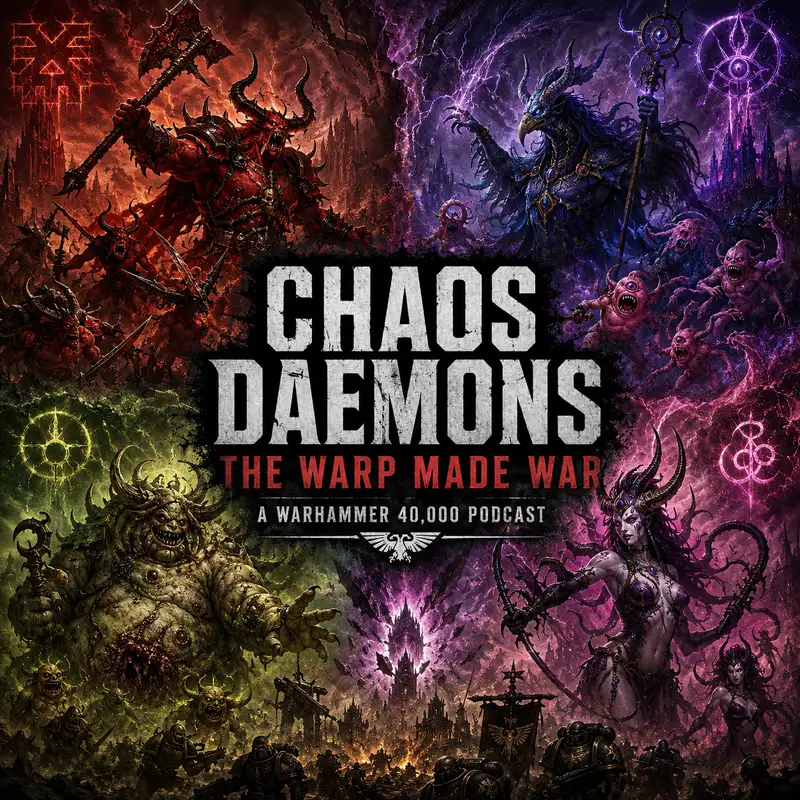
Chaos Daemons: The Warp Made War
An ordinary army needs roads, ammunition, food, officers, and enough surviving troops to keep moving. A daemonic army needs terror, hatred, broken laws of nature, and an open wound in reality. Once those conditions exist, the enemy does not march onto the battlefield. It condenses out of nightmare.
That is what makes Chaos Daemons different from nearly every other foe in Warhammer forty thousand. They are not aliens from a distant star, and they are not merely corrupted mortals wearing monstrous shapes. They are beings of the Warp, the immaterial realm through which starships travel and psychic power flows. The Warp is responsive to thought and emotion. Across ages of fear, rage, ambition, despair, obsession, and desire, the psychic lives of mortal species have given its currents pattern. Those patterns became powers. Those powers became gods. Their hungers, rivalries, and impulses became servants with claws, blades, mouths, and names.
A daemon is therefore both a creature and an idea. It can think, deceive, remember, bargain, hate, and pursue ambitions of its own. Yet it is also made from the substance and nature of Chaos. A Bloodletter of Khorne does not merely enjoy violence. Violence is the principle from which it has been formed. A Plaguebearer of Nurgle does not simply carry disease. It is decay, endurance, misery, and corrupted life given a body that reality can briefly tolerate.
Briefly is the important word.
Realspace has rules. Matter remains where it is placed. Time proceeds with reasonable discipline. A door generally stays a door instead of becoming a childhood regret with hinges. The Warp has no such courtesy. Distance, identity, memory, and cause can flow into one another. Daemons belong to that environment. To enter the material universe, they require a breach between realms and enough Warp energy to sustain them.
That breach may be opened by a psyker who loses control, a cult performing a ritual, a starship whose protective field fails, or a storm in the Immaterium pressing against reality until the barrier thins. Mass slaughter can help. So can terror, despair, obsession, and prolonged corruption. The exact conditions vary, because Chaos is not an engineering discipline, despite the best efforts of several deeply optimistic sorcerers.
Once daemons begin to manifest, their presence makes further manifestation easier. The battlefield changes around them. Light behaves incorrectly. Metal sweats. Voices speak from sealed rooms. Wounds refuse to close. Statues turn their heads. Soldiers remember crimes they never committed, then discover evidence that they did. The Warp does not merely send troops through the breach. It brings part of its own environment with them.
This turns morale into something more than a military concern. Against most enemies, fear damages discipline. Against daemons, fear may also strengthen the conditions that allow the enemy to remain. Panic can become terrain. Despair can become weather. A massacre is no longer only a tactical defeat. It may be the next wave of reinforcements.
The forces of Chaos are usually described through the four great gods, but these gods are not calm rulers sitting above neatly organised departments. They are vast concentrations of psychic meaning, forever struggling against one another in the Great Game. Their wars in the Warp are endless and often more important to them than any mortal campaign. A planet may believe it is facing the final battle for its existence, while the daemons involved regard the invasion as a useful interruption in a much older family dispute. The family is immortal, immensely powerful within its own realm, and incapable of sharing a room.
Khorne is the god of rage, bloodshed, martial fury, and the urge to answer conflict with greater conflict. His daemons are the most direct expression of war as appetite. Bloodletters advance with hell-forged blades. Flesh Hounds hunt sorcerers and fleeing prey. Bloodcrushers ride brutal Juggernauts into enemy lines. Above them tower Bloodthirsters, greater daemons built for slaughter on a scale that makes armoured vehicles seem like inconvenient furniture.
There is a terrible clarity to Khorne’s hosts. They do not need to convince a city that murder is wise. They need only find the anger already present and give it momentum. A defensive war becomes revenge. Revenge becomes extermination. Discipline becomes pride, then pride becomes the refusal to retreat, even when retreat is the only sane choice. Khorne does not require every fighter to worship him. Blood spilled in hatred serves well enough.
This does not make his daemons simple. Bloodthirsters are commanders as well as monsters, and the hierarchies of Khorne’s realm are shaped by victory, strength, and favour. Some are savage engines of destruction. Others possess a ruthless martial intelligence. What they share is purpose. A Khornate incursion tends to move toward the point where resistance is strongest, because resistance promises the most worthy violence. The sensible military solution may be to deny them battle. Sensible military solutions have a difficult career in the forty-first millennium.
Tzeentch embodies change, ambition, sorcery, hope, manipulation, and the belief that the future can be mastered. His daemons are contradiction made animate. Pink Horrors caper and hurl unnatural flame, then split into Blue Horrors when destroyed, as though death were merely an administrative error. Flamers move like living fires. Screamers hunt through the air and the Warp. Lords of Change stand above them, towering sorcerers whose schemes can extend across generations.
The danger of Tzeentch is not simply that his servants wield psychic power. It is that they attack certainty. Orders arrive before they are issued. Maps redraw themselves. A commander receives a warning from a trusted officer who died years earlier. Every choice appears anticipated, including the choice to act unpredictably. Tzeentch offers the promise that knowledge will create control, then ensures that every new piece of knowledge reveals three more uncertainties.
His daemons often seem more individual than lesser creatures of the other gods, but individuality does not mean freedom. A Lord of Change may manipulate empires and still discover that its rebellion was another movement in its master’s design. Perhaps it was. Perhaps Tzeentch merely claims that afterward. In the realm of the Architect of Fate, the distinction is not especially comforting.
Nurgle is the god of decay, disease, despair, endurance, and the cycle by which living things rot and feed new life. His daemons are not merely diseased soldiers. They embody surrender to inevitability. Plaguebearers trudge forward while counting afflictions with the solemn patience of exhausted clerks. Nurglings swarm around them in obscene good humour. Beasts of Nurgle seek affection with the enthusiasm of enormous, lethal animals that have never been informed what skin is for. Great Unclean Ones loom over the host as swollen figures of ruin, often displaying a grotesque warmth toward the creatures beneath them.
That warmth is part of the horror. Nurgle offers relief from fear by making suffering permanent and therefore familiar. The infected soldier no longer has to dread disease once disease has become identity. The besieged population no longer has to struggle once hope has been abandoned. His daemons can appear almost jovial because despair has already done the work. They are not rushing toward death. They are welcoming everyone into a condition where death, life, rot, and affection have become indistinguishable.
A Nurgle incursion changes the rhythm of war. Ammunition spoils. Water thickens. Medicae facilities become centres of transmission. Corpses swell and rise. Soldiers who survive the first assault may carry the second inside them. The defenders face a cruel calculation. Mercy may spread infection. Quarantine may require abandoning the innocent. Every delay gives the plague more time, and time is one resource Nurgle possesses in generous supply.
Slaanesh is the god of excess, obsession, sensation, perfection, pride, and desire without limit. Reducing Slaanesh to pleasure misses the central danger. The first step may be admiration, discipline, love, artistic ambition, or the wish to become better. The corruption begins when enough is no longer possible.
Daemonettes are swift, graceful killers whose beauty and horror refuse to remain separate. Fiends overwhelm the senses and the body. Seekers race ahead with predatory speed. Keepers of Secrets are greater daemons of intelligence, seduction, and exquisite violence. They do not merely attack the flesh. They identify what the victim wants most, then turn that desire into a weapon.
A Slaaneshi assault may arrive as a spectacle before it becomes a massacre. Sound becomes physically painful. Colour carries emotion. Warriors become fascinated by the enemy they are trying to kill. The proud seek a perfect duel. The curious move closer for one better look. The disciplined discover that discipline itself can become obsession. Slaanesh wins not by erasing identity, but by narrowing it until one appetite consumes everything else.
The four hosts look different because they are formed from different psychic truths, but they share a deeper nature. Daemons are often described as fragments of their patron gods, splinters of immense power given identity and purpose. They can compete, plot, and even defy commands, yet they remain bound to the essence from which they came. A daemon of Khorne cannot decide that peace is preferable after a period of reflection. Reflection is already suspect, and peace has very little blood in it.
Not every daemon fits neatly beneath one god. There are unaligned Warp entities, lesser powers, and creatures whose nature remains uncertain. There are also Daemon Princes, who began as mortals and were transformed through the favour of Chaos. This distinction matters. A Bloodthirster is a being of the Warp manifesting in physical form. A Daemon Prince carries the history of a mortal life into immortality, though how much of that former person remains is often difficult to judge.
The most famous example is Be’lakor, the first Daemon Prince, elevated by the combined powers of the Chaos Gods and later cursed by their rivalry and suspicion. He is not simply a larger daemon with a more impressive title. He is ambition preserved across ages, forever seeking independence from masters who granted him power precisely because they expected obedience. His existence shows the central bargain of Chaos. Ascension can make a mortal almost impossible to kill, but it rarely makes that mortal free.
Killing daemons is complicated because the body on the battlefield is not their complete existence. Destroying that body usually banishes the daemon back into the Warp. The creature may be absent for years, centuries, or some interval that has little meaning outside material time. It may return bearing a grudge with remarkable clarity. Daemons are very patient about revenge, partly because patience is easier when causality is optional.
Permanent destruction is possible in some circumstances, but it is rare and requires exceptional powers, weapons, or conditions. For most soldiers, victory means breaking the manifestation, closing the breach, and surviving long enough for reality to become solid again. This can feel unsatisfactory. The enemy is not dead. It has merely been denied access.
Yet banishment is not trivial. Daemons exist through hierarchy and favour. Failure can bring punishment from a patron god or a rival. Names matter. Symbols matter. Rituals matter. A daemon’s true name can offer power over it because identity in the Warp is not merely a label. It is structure. Learning such a name is dangerous, using it is worse, and assuming the daemon has supplied the correct one is a splendid way to make a brief career in forbidden scholarship.
Weapons also behave differently against them. A las-bolt or shell can disrupt a manifested body, especially when enough force is applied, but symbolism and conviction may matter alongside physics. Sacred relics, psychic force, wards, and acts of faith can wound entities that should not possess flesh in the first place. This does not mean belief automatically wins. The Warp is shaped by emotion, but it is not obligated to reward confidence. Many doomed defenders have been extremely certain.
The Imperium’s specialist response includes the Grey Knights, the Ordo Malleus, sanctioned psykers, exorcists, nulls, and weapons preserved for threats most citizens are not supposed to understand. Their methods combine military force with knowledge of ritual, corruption, and the Warp. They do not merely ask where the enemy is strongest. They ask what opened the breach, what sustains it, which symbols anchor it, whose mind is compromised, and whether the apparent commander is the real threat or a distraction wearing several tons of horns.
Possession is one of the daemons’ most intimate methods of entry. Instead of forcing a complete body through a breach, a daemon inhabits or overwhelms a mortal host. The result can be a puppet, a transformed monster, or a contested mind in which the victim remains aware. Cultists may invite possession as a blessing. Sorcerers may attempt to bind a daemon into another being, a weapon, or a machine. The process is usually described as controlled right up to the point when control becomes a matter for the casualty report.
Daemonic war engines carry this principle into industry. A machine can be fused with a Warp entity until metal, hunger, and malice become one system. Such creations are not merely vehicles with unpleasant decoration. They are prisons, bodies, and weapons at once. Their armour is physical, but the will driving it is not. Destroying the machine may release the thing inside, banish it, or simply make it angrier. Maintenance doctrine is understandably limited.
The Horus Heresy demonstrated what happens when daemonic warfare reaches strategic scale. As the civil war deepened and the barrier between realms weakened, the conflict ceased to be only a rebellion of Space Marine Legions. Daemons entered the war in growing numbers. By the Siege of Terra, reality itself was being assaulted. Time distorted. The dead and the impossible crowded the battlefield. The defenders were not merely holding walls against armies. They were trying to preserve the idea that walls, armies, and time still meant anything.
That history also exposes a recurring error. Mortals often believe they are using daemons as weapons. A ritual summons a creature. A sorcerer gives it a target. A warlord gains an advantage. For a few minutes, the arrangement can resemble command. Yet the daemon has its own purpose, its patron has another, and the emotional consequences of the violence may matter more than the stated objective. The mortal sees a tactical asset. The Warp sees a door that has learned how to open itself.
This is why Chaos Daemons should not be understood as the supporting troops of Chaos Space Marines. Sometimes they fight together, but the relationship is not that of one army lending units to another. Traitor Marines are still material beings with ships, ammunition, rivalries, and memories of mortal history. Daemons are incursions from a realm where those categories are unstable. The Marines may begin the invasion. The daemons may decide what the invasion was truly for.
Their greatest strategic advantage is that the galaxy continually produces the conditions they need. Every war generates rage. Every plague generates despair. Every empire generates ambition. Every culture produces desire, pride, and obsession. The Imperium fights Chaos through repression, sacrifice, faith, and overwhelming violence, all of which can prevent immediate catastrophe. They can also create fresh psychic fuel. Chaos does not need the Imperium to lose every battle. It benefits when the Imperium becomes more like the nightmare it is resisting.
That does not mean resistance is pointless. Daemons can be banished. Cults can be broken. Rituals can be interrupted. Populations can be protected, breaches sealed, and worlds saved. The setting would be much less tragic if courage achieved nothing. The tragedy is that courage must operate inside a system where every victory has a cost, and every human emotion has an echo.
The most effective defence is often clarity. Recognise the nature of the threat. Refuse the bargain that promises an easy weapon, a perfect future, freedom from pain, or the fulfilment of every desire. Maintain discipline without feeding pride. Preserve hope without turning hope into certainty. Fight anger without pretending anger can be erased. These are difficult demands for individuals. For an empire built on fear, dogma, and permanent war, they approach the miraculous.
Chaos Daemons are the Warp made war because they turn the inner life of sentient beings into an external enemy. They are not invaders from somewhere wholly separate. They are the consequences of thought and feeling, accumulated across civilisations, sharpened by gods, and sent back through the wound between realities.
A fortress can close its gates against soldiers. It can track fleets, ration ammunition, and calculate how long the walls will hold. Against daemons, the final line of defence may be the minds of the people standing on those walls. If fear becomes surrender, rage becomes worship, hope becomes obsession, or endurance becomes acceptance of corruption, the enemy is already inside.
That is the bleak answer at the centre of every daemonic incursion. The Warp does not conquer reality only by breaking through from beyond. It waits for reality to become enough like the Warp that the door no longer knows it is closed.