Brothers in Arms: Friendships Among the Primarchs
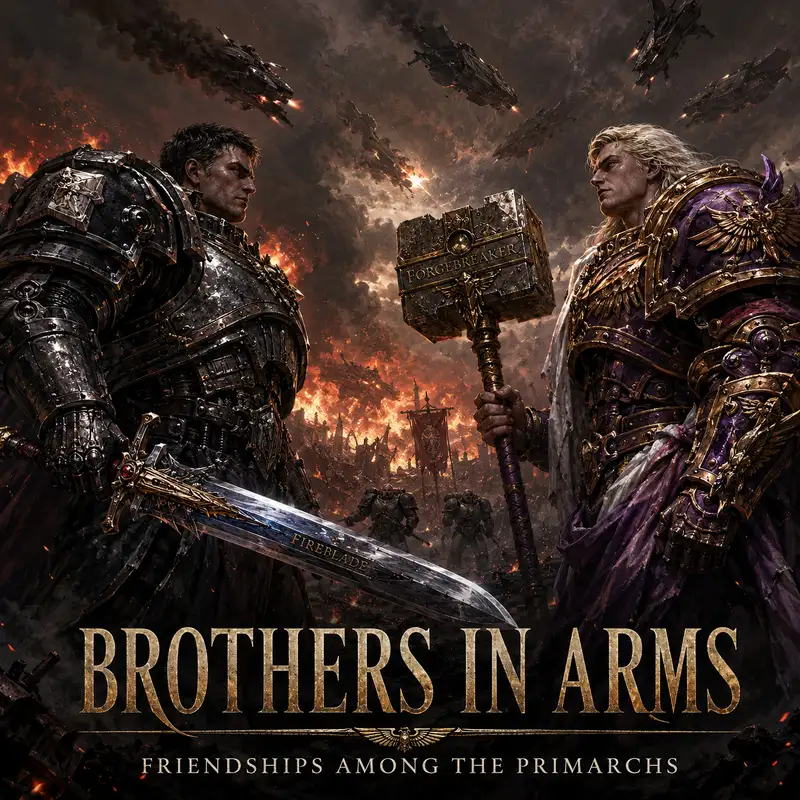
On Isstvan Five, Ferrus Manus came for Fulgrim carrying a sword that Fulgrim had once worn as a gift. Fulgrim met him with a hammer he had forged for Ferrus in happier years. Around them, Legions burned, gunships fell, and the first great loyalist counterattack of the Horus Heresy collapsed into betrayal. Yet the weapons in their hands told an older story. Fireblade and Forgebreaker had been made not as trophies of conquest, but as signs of admiration between two brothers who believed they had found an equal. Before the battle ended, one would kill the other with a third weapon, a blade carrying a darker will.
That duel exposes the central difficulty in speaking about friendship among the Primarchs. These were not ordinary men sharing ordinary loyalties. They were engineered warlords, each commanding a Legion, a fleet, and often an empire of his own. Their private disagreements could redirect crusades. Their jealousies could cost worlds. Their affection could bind hundreds of thousands of warriors together, while a broken confidence might send those same warriors into each other’s guns. When a Primarch called another brother, the word could mean family, rival, ally, political partner, beloved companion, or future target. Sometimes it meant all of them at once.
Most of the Primarchs were brothers who had never shared a childhood. Scattered across the galaxy before they could be raised together, they grew to adulthood on different worlds beneath different skies. One became a knight in a forest haunted by monsters. Another became a slave in an arena. Others were kings, rebels, scholars, hunters, engineers, prophets, or conquerors before the Emperor ever found them. They were reunited not as children learning how to live with one another, but as fully formed rulers being introduced to a family and immediately handed armies. As foundations for domestic harmony go, it was ambitious.
Their bonds therefore had to be made during the Great Crusade. They campaigned together, argued over doctrine, tested one another in war, and discovered the rare relief of meeting someone who could understand what it meant to be a Primarch. Humans could admire them, fear them, or love them, but no human truly shared their scale of experience. Their own Space Marines were sons and subordinates. The Emperor was father, sovereign, and mystery. Only another Primarch could be an equal, which made friendship precious. It also made rejection almost unbearable.
Even friendship was rarely private for them. A shared campaign joined entire military cultures. A compliment from one Primarch could elevate another Legion’s reputation, while an insult might be repeated by generations of gene-sons who had not been present to hear it. The Legions watched their fathers closely and inherited their preferences. When two Primarchs trusted each other, their warriors learned to cooperate. When the fathers quarrelled, the sons often converted wounded pride into doctrine. A family disagreement could therefore survive for ten thousand years, maintained with banners, oaths, and the occasional ceremonial blow to the head.
Ferrus Manus and Fulgrim formed perhaps the clearest friendship of the Great Crusade. On the surface, they seemed badly matched. Ferrus was blunt, severe, and impatient with ornament. Fulgrim cultivated grace, ceremony, and beauty with the devotion of a man who considered an unpolished breastplate a personal insult. Yet both were makers. Both believed that excellence had to be worked into existence through discipline. Both could stand at a forge and judge the labour of the other without flattery. Their friendship grew from recognition rather than similarity.
That recognition took physical form. Ferrus forged Fireblade, a magnificent sword, for Fulgrim. Fulgrim created the thunder hammer Forgebreaker for Ferrus. The exchange mattered because neither Primarch was easily impressed. Each had made something worthy of the other, then surrendered it. In a family crowded with boasts, contests, and carefully measured respect, the gifts were unusually direct. They said that each brother trusted the other to carry a part of his craft into battle.
When Horus rebelled, Fulgrim approached Ferrus because he believed their bond could accomplish what threats could not. He did not send an anonymous envoy or begin with bombardment. He went to the brother who knew him best and tried to draw him into the rebellion. Ferrus refused with absolute fury. Their first confrontation shattered Fireblade and ended with Fulgrim escaping with Forgebreaker. Ferrus then reforged the broken sword. The object once made for friendship became a weapon prepared for judgment.
At Isstvan Five, the old gifts crossed again. Ferrus wielded the remade Fireblade. Fulgrim carried Forgebreaker, the hammer he had once placed in Ferrus’s hands. Ferrus fought with the rage of a betrayed friend, and that rage helped drive him ahead of support into the trap prepared by the Traitor Legions. Fulgrim finally struck him down with the daemon blade taken from the Laer. The precise balance between Fulgrim’s own will and the influence within that weapon is presented differently across the surviving accounts, but the outcome is certain. Ferrus was beheaded, and the closest bond of his life ended beneath a sky full of falling fire.
The consequences reached far beyond two men. The Iron Hands did not simply lose a commander. They lost the father whose strength had defined them, and they saw him fall because anger had overcome calculation. Their grief hardened into a deeper hatred of weakness, flesh, and emotion. Fulgrim’s descent also crossed a threshold. Whatever regret remained in him could not restore Ferrus, and the murder became one of the clearest signs that corruption did not merely change loyalties. It turned intimacy into a weapon.
Horus understood that principle better than any of his brothers. Before the Heresy, he was the social centre of the Primarch family. He had been found early, had spent long years beside the Emperor, and knew how to speak to proud men without making every conversation sound like an order. He praised some, challenged others, and gave distant brothers room to remain distant. His appointment as Warmaster rested on military ability, but also on relationships. The Emperor gave authority over the Great Crusade to the son most capable of persuading the others to follow.
Horus built a different relationship with nearly every brother. Fulgrim admired his brilliance and had served beside him when the Emperor’s Children were still rebuilding. Jaghatai valued that Horus understood his need for freedom of action. Even Angron responded to a brother who recognised his usefulness without pretending the Red Angel was something he was not. This network became one of Horus’s greatest strengths and one of his fatal errors. He knew how to read his brothers, but after his fall he began to confuse being understood with being owned. He assumed old affection would naturally become allegiance.
Among Horus’s closest bonds was his friendship with Sanguinius. The Great Angel was admired by almost everyone, but Horus did more than admire him. Sanguinius offered counsel that Horus respected. He possessed the charisma, martial brilliance, and nobility expected of a leader, yet carried private fears concerning his wings, his visions, and the blood hunger within his Legion. He trusted Horus with knowledge of the Red Thirst, a secret that could have condemned the Blood Angels in an Imperium deeply suspicious of mutation and instability.
That confidence should have been safe. Instead, Horus later used it when he sent the Blood Angels into the daemonic trap at Signus. The attack was designed around the very flaw Sanguinius had revealed in trust. This makes the betrayal more personal than a routine effort to remove a powerful loyalist Legion. Horus did not merely know where Sanguinius was strong. He knew where his brother was afraid, and he aimed the enemy there.
Affection and jealousy appear to have existed together in Horus. He could regard Sanguinius as the finest of the Primarchs and still fear comparison with him. Sanguinius was widely loved, visibly magnificent, and sometimes imagined as the son who might have made a better Warmaster or even a better heir to the Emperor’s vision. Horus’s corruption did not create every insecurity from nothing. It enlarged them, justified them, and taught him to treat a beloved brother as a rival whose continued existence threatened his own place.
Their final encounter aboard the Vengeful Spirit therefore completed a long betrayal. Sanguinius went to face Horus knowing that his visions pointed toward death. Horus faced the brother whose confidence he had exploited and whose destruction he had already attempted at Signus. The Warmaster killed him, and the psychic shock of that death scarred the Blood Angels forever as the Black Rage. A friendship once capable of influencing the Great Crusade ended by transmitting one brother’s last agony through generations of the other’s sons.
Not every friendship among the Primarchs was built around affection expressed so openly. Some grew from shared ideas. Magnus the Red, Jaghatai Khan, and Sanguinius were united by support for the Librarius, the attempt to regulate psychic warriors within the Space Marine Legions. They did not agree on every method. Jaghatai’s people approached the powers of the Warp through tradition, restraint, and hard-earned caution. Magnus believed knowledge could master almost any danger. Sanguinius understood both the value of psychic gifts and the fear they inspired. Their alliance was intellectual, political, and personal.
The friendship between Jaghatai and Magnus mattered because the Khan was not easily drawn close to anyone. Many brothers saw only a barbarian horse lord from a distant world. Magnus recognised a thoughtful ruler beneath the speed and laughter, while Jaghatai recognised the brilliance within Magnus without accepting every claim Magnus made for himself. The Khan could respect a friend without surrendering judgment. That distinction would become critical after the Burning of Prospero.
When contradictory reports reached the White Scars, Jaghatai refused to choose a side merely because Horus or Russ demanded it. He went to Prospero and found ruin. There he confronted an echo of Magnus, his former friend, and heard an appeal to join the rebellion. Jaghatai rejected him. The decision was not proof that the friendship had been false. It was proof that genuine friendship did not require obedience. The Khan mourned what had happened to Magnus, condemned the destruction around him, and still refused to follow his brother into slavery to the Warp.
Magnus also formed a surprising bond with Perturabo. They were utterly different in manner, yet united by the desire to recover knowledge. They explored lost places and campaigned together, each pursuing understanding through his own discipline. Magnus looked toward psychic and philosophical truth. Perturabo trusted engineering, mathematics, and structures that could be measured. For a time, each found in the other a mind capable of keeping pace. Perturabo, often treated as a tool for unpleasant wars, responded strongly when someone valued what he could create rather than merely what he could destroy.
That friendship did not survive the larger failures of the family. Perturabo’s suspicion of the Warp and Magnus’s confidence in his own mastery steadily narrowed the ground they shared. Nikaea deepened the division between those who feared psychic power and those who believed it could be controlled. The Heresy then made every disagreement terminal. Yet their earlier companionship remains important. It shows that even Perturabo, remembered for bitterness and isolation, was not incapable of friendship. He was capable of it, and therefore capable of feeling its loss.
Some Primarch relationships looked less like friendship and more like a prolonged military argument conducted with swords. Leman Russ and Lion El’Jonson became famous for their rivalry during the campaign on Dulan. Russ had sworn to kill the enemy tyrant. The Lion reached the target first and did so himself. Honour, pride, and poor communication then produced a fight between two demigods who were supposedly pacifying the same world. The Imperial war machine survived. The furniture may not have.
The quarrel became legend, but rivalry does not exclude affection. Russ and the Lion understood each other through opposition. Each was a loyal weapon of the Emperor, but each performed that role differently. Russ cultivated the image of the savage while exercising more judgment than many realised. The Lion cultivated perfect control while concealing depths of instinct, secrecy, and wrath. They irritated one another because each could see something familiar beneath the other’s mask.
Their contests created a tradition that endured between the Space Wolves and Dark Angels long after the original reason had become almost ceremonial. What began as wounded pride became ritualised memory. That does not make Russ and the Lion close companions in the manner of Ferrus and Fulgrim, but it does make them recognisably fraternal. They could fight, resent, and still understand that the other belonged within the family. Among Primarchs, a relationship in which both parties struck each other and then continued the campaign counted as encouraging progress.
The Heresy forced other brothers into cooperation that slowly approached trust. Roboute Guilliman, Lion El’Jonson, and Sanguinius gathered in Ultramar while the Ruinstorm cut them off from Terra. Believing the Emperor might be dead and the Imperium lost, Guilliman created Imperium Secundus as a contingency. Sanguinius became its figurehead. The Lion commanded its armies. Guilliman supplied the realm, the institutions, and most of the administrative paperwork, because even at the end of civilisation someone must apparently approve the fleet allocations.
This was not an effortless friendship. The Lion distrusted Guilliman’s motives. Guilliman feared appearing to seize the Emperor’s throne. Sanguinius carried visions of his own death and the burden of being made regent. Konrad Curze moved through their realm like a living accusation, exploiting every disagreement. The three brothers argued over authority, strategy, secrecy, and whether hope justified building a replacement Imperium before they knew Terra’s fate.
Yet the experiment revealed something valuable. None of the three could rule the others by force without destroying the very refuge they were trying to preserve. They had to negotiate, forgive concealments, and accept that loyalty could take different forms. Sanguinius often served as the point of balance, not because he was flawless, but because both Guilliman and the Lion trusted his character more than they trusted each other’s ambitions. Their alliance eventually carried the Blood Angels toward Terra while the Ultramarines and Dark Angels fought to break the traitor position elsewhere.
The darker side of friendship appears in the bond between Lorgar and Angron. At first, they seemed an absurd pairing. Lorgar was a theologian searching for cosmic meaning. Angron was a mutilated survivor whose Butcher’s Nails turned thought and memory into pain unless violence drowned them out. During the Shadow Crusade, irritation slowly became respect as they fought together. Angron even saved Lorgar from being crushed beneath a Titan. For a Primarch who often treated his brothers with contempt, the act carried weight.
Lorgar also saw that the Nails were killing Angron. He recognised the suffering beneath the rage and sought a way to preserve his brother’s life. This can be read as genuine concern. It can also be read as the concern of a zealot who believes he understands salvation better than the person being saved. Lorgar’s answer was not healing, release, or consent. He arranged the slaughter and ritual on Nuceria that transformed Angron into a Daemon Prince of Khorne.
Angron survived, but survival was not necessarily what he wanted. His first family, the gladiators of Nuceria, had chosen to die together rather than return to slavery. The Emperor had denied Angron that death by taking him away. Lorgar later denied him death again, this time binding him eternally to the embodiment of rage and slaughter. Lorgar saved his brother’s existence while completing the destruction of his freedom. It is one of the bleakest friendships in the Heresy because care and violation are almost impossible to separate.
These bonds show why the Horus Heresy cannot be understood as a simple division between loyalists and traitors. It was a civil war fought through a network of personal loyalties. Fulgrim was sent to Ferrus because friendship offered access. Sanguinius was sent to Signus because trust had revealed his fear. The Khan delayed judgment because Horus, Magnus, and Russ were not merely names on dispatches but brothers whose claims had to be weighed. Lorgar changed Angron’s fate because he believed he knew how to save him.
Friendship did not make the Primarchs gentler, but it made them more human. They sought equals who could appreciate their burdens. They wanted admiration that did not feel like worship, counsel that did not sound like obedience, and companionship that was not based on fear. For brief periods during the Great Crusade, some of them found it. They forged weapons together, explored lost ruins, defended shared ideas, laughed after fights, and trusted one another with secrets that could destroy Legions.
The failure was not that these friendships were unreal. Unreal friendships would have mattered less. The tragedy is that the bonds were genuine enough to shape decisions, and fragile enough to be broken by pride, ideology, corruption, and the Emperor’s refusal to build a family before using one as a command structure. The Primarchs had been created to conquer the galaxy together, but no one had taught them how to survive disagreement without turning it into war.
On Isstvan Five, the symbols of friendship remained after the friendship itself had been murdered. Fireblade and Forgebreaker endured as relics and symbols, while Ferrus lay dead and Fulgrim fell further from the brother who had once known him. That is the clearest answer to what friendship meant among the Primarchs. It was real, powerful, and dangerously exposed. They did love one another, and the galaxy learned how much damage a broken bond between demigods could do.