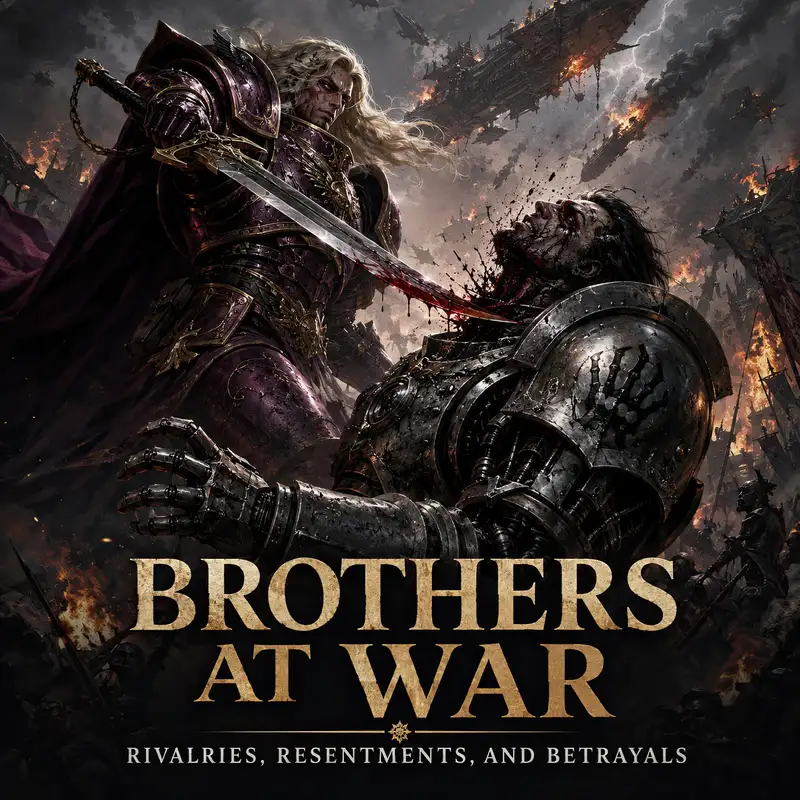
Brothers at War: Rivalries, Resentments, and Betrayals
Ferrus Manus found Fulgrim in the smoke of Isstvan Five, beneath a sky crowded with burning ships and falling ash. Around them, the loyalist assault had become a slaughter. Reinforcements had revealed themselves as traitors, gun lines had turned inward, and three Legions were being crushed inside a trap prepared by men they still called brothers. Yet for Ferrus, the vast betrayal had narrowed to a single face. Fulgrim had warned him, tempted him, and failed to turn him. Now there would be no persuasion. There would only be the two of them, weapons raised, with the friendship of decades buried beneath the dead.
Their duel ended with Ferrus beheaded and Fulgrim standing over the body of the brother he had once admired more than almost any other. It was one of the most personal killings of the Horus Heresy, but it was not an isolated madness. The Heresy was fought by armies numbering in the millions, fleets that darkened systems, and powers older than humanity. Its decisive fault lines were often painfully intimate. A slight remembered. A warning ignored. A humiliation assigned to the wrong culprit. A rivalry allowed to harden until one brother could imagine another not merely as an opponent, but as an obstacle that had always deserved to be destroyed.
The Primarchs called one another brothers, but they had not grown up as a family. They were created together, scattered as infants, and raised on different worlds by different cultures. One became a knight of a death-world forest. Another became a gladiator slave. One learned politics in a stable civilisation. Another learned that justice meant terror delivered before fear could spread. By the time the Emperor gathered them, each was already a ruler, warrior, prophet, or survivor with a complete idea of how the universe worked. The Emperor did not bring children into a household. He brought sovereign personalities into a command structure and informed them that they were related.
That relationship was made more dangerous by comparison. Every Primarch had a Legion, a domain of expertise, and an appetite for achievement. Victories were counted. Compliance records were compared. Some brothers received praise, while others received the campaigns nobody wanted. Horus was elevated above them as Warmaster. Rogal Dorn was recalled to fortify Terra. Guilliman built functioning realms with an ease that made other conquests look wasteful. Sanguinius inspired affection almost without trying, which is a rare and suspicious talent in any military headquarters. The Emperor’s solution to tension was usually another expedition. It kept the fleet moving. It did not make the resentment disappear.
Not every rivalry led to betrayal. Some became a harsh form of affection. The famous feud between Lion El’Jonson and Leman Russ began during the campaign against the tyrant of Dulan. Russ believed he had claimed the right to kill the enemy ruler. The Lion reached the target first and ended the matter himself. Russ struck him in fury, and the two Primarchs fought with the dignity expected of demigod generals, which is to say they battered each other while an entire war waited for them to finish. Russ eventually recognised the absurdity and laughed. The Lion, who had not reached the same philosophical conclusion, knocked him unconscious.
The incident became tradition. The Dark Angels and Space Wolves carried the feud long after its original cause had ceased to matter, sometimes reenacting it through ritual champions rather than open warfare. Beneath the hostility, however, there was recognition. Russ and the Lion could infuriate one another because each saw in the other a strength he could not comfortably dismiss. Their conflict was dangerous, but it remained bounded by loyalty. That distinction matters. Rivalry was not itself the poison. The poison entered when grievance became identity, when a brother needed another brother to be contemptible in order to explain his own pain.
Russ’s clash with Angron showed how quickly two Primarchs could experience the same battle and learn opposite lessons. Russ confronted the World Eaters over Angron’s brutality and the influence of the Butcher’s Nails. The argument became a battle remembered as the Night of the Wolf. Angron fought Russ directly and believed he had proved his superiority by forcing the Wolf King back. Around them, however, the Space Wolves had manoeuvred into position to kill Angron if Russ gave the order. Russ believed the encirclement demonstrated the difference between a warrior and a commander. Angron believed the fact that Russ did not finish the fight proved the lesson hollow.
Neither persuaded the other. Russ saw a brother destroying his own Legion and tried to impose understanding through force. Angron saw one more privileged son lecturing him about honour after the Emperor had abandoned the gladiators who died beside him on Nuceria. The dispute was doctrinal, but the resentment beneath it was personal. Angron did not merely reject Russ’s method of war. He rejected the moral authority of any brother raised with choices he had never possessed. When he later confronted Guilliman on Nuceria, the same wound opened again. Guilliman represented order, inheritance, and the luxury of building. Angron had been given survival and then blamed for what survival made of him.
Corvus Corax’s relationship with Horus revealed a quieter form of rivalry. During the Great Crusade, Horus ordered the Raven Guard into a costly frontal assault at Gate Forty-Two. Corax preferred infiltration and manoeuvre, methods suited to his Legion and intended to avoid needless losses. Horus insisted. The assault succeeded, but the Raven Guard paid heavily, and Corax never forgot that his warriors had been treated as material for another commander’s plan. He withdrew from Horus’s direct command afterward. There was no dramatic oath of vengeance, only damaged trust. Years later, when Horus betrayed the Imperium, Corax did not need to discover that the Warmaster could spend other Legions for his own objectives. He had already seen a lesser version of it.
The most corrosive rivalry was probably the one between Rogal Dorn and Perturabo, because it grew from similarity rather than difference. Both understood fortification, siegecraft, logistics, and the arithmetic of attrition. Both were capable of endurance beyond ordinary reason. Yet Dorn became the trusted defender, the Praetorian recalled to Terra and given the Imperial Palace. Perturabo received grinding campaigns against enemies entrenched in places no sane commander wished to approach. His victories were necessary, technically brilliant, and often appallingly costly. He believed the Imperium valued the result while despising the man and Legion required to achieve it.
Dorn did not create Perturabo’s bitterness, but he became its symbol. Every honour given to the Imperial Fists could be read by Perturabo as a judgment against the Iron Warriors. Every praise of Dorn’s discipline sounded like silence concerning Perturabo’s sacrifice. The tragedy was that Perturabo wanted recognition from the very order he increasingly hated. He did not simply wish to prove that he could break Dorn’s walls. He wanted the breaking of those walls to demonstrate that the Imperium had misunderstood him from the beginning.
At the Siege of Terra, their rivalry became strategy on a planetary scale. Perturabo directed the traitor assault against defences designed and commanded by Dorn. Siege engines, trenches, void shields, orbital attacks, and massed infantry became arguments between two brothers conducted through the deaths of other people. Perturabo’s eventual withdrawal did not resolve the contest. After the Heresy, the Iron Cage drew Dorn and the Imperial Fists into another brutal confrontation, one shaped as much by grief and pride as by military need. Neither brother could grant the other a clean victory, because the conflict was no longer about a fortress. It was about whose life had been the greater insult.
Lorgar’s resentment toward Guilliman began with an act of public humiliation. Lorgar had built the city of Monarchia as an expression of devotion to the Emperor. The Emperor rejected that worship and ordered the Ultramarines to destroy the city. Lorgar and the Word Bearers were forced to kneel in its ruins while their beliefs were condemned. Guilliman carried out the order with controlled obedience. He was not the author of the punishment, and the surviving accounts suggest he took no pleasure in it. To Lorgar, that distinction offered little comfort. Guilliman became the face of the moment when faith, achievement, and filial love were answered with ash.
The retaliation came at Calth. The Word Bearers arrived under the appearance of cooperation and struck the Ultramarines without warning. Ships collided, weapons fired at close range, and the surface became a killing ground. The attack was military sabotage, ritual vengeance, and ideological declaration at once. Lorgar’s sons had waited years to reverse Monarchia. This time, Guilliman would be the brother caught unprepared. This time, the perfect realm would burn. The scale of the operation makes it easy to speak of fleets and casualty figures, but its emotional logic remained brutally simple. Lorgar had been made to kneel, and an entire world was offered to ensure that Guilliman understood the memory.
Guilliman’s reaction is important because it shows the moment a restrained rivalry became hatred. He had spent much of his life treating conflict as a problem to be understood, organised, and solved. Calth confronted him with a brother who had converted humiliation into extermination. Even then, Guilliman’s hatred did not erase his capacity to analyse. He learned from the ambush while fighting through it. That combination made him dangerous. Lorgar had wanted to wound the brother who represented judgment. He succeeded, but he also taught one of the Imperium’s greatest administrators how to wage a war of survival against family.
Konrad Curze experienced betrayal even where others may have intended concern. Curze was tormented by visions of murder, rebellion, and his own death. He confided some of those visions to Fulgrim, apparently believing the confidence would remain private. Fulgrim told Dorn. Dorn confronted Curze, and the confrontation ended with Curze violently attacking him. The sequence contains no simple villain. Fulgrim may have believed the matter too dangerous to keep secret. Dorn may have believed direct challenge was necessary. Curze saw proof that trust was a trap and that his brothers would expose, judge, and restrain him.
That belief fed a pattern already formed on Nostramo. Curze expected betrayal, so he behaved in ways that made betrayal and isolation more likely. His visions gave him knowledge without wisdom. He could see outcomes, but he often treated them as permission rather than warning. Once he concluded that his brothers were hypocrites and the Imperium’s justice was fraudulent, every attempt to reach him could be interpreted as another lie. Betrayal became his explanation for the universe. It also became his preferred method of answering it.
The destruction of Prospero grew from another pair of brothers who had ceased to believe the other could act in good faith. Magnus valued knowledge, psychic power, and the conviction that understanding could master danger. Russ distrusted sorcery and believed some powers corrupted the user before the user recognised the cost. Their contempt had been sharpened by the debate over psychic practice and the judgment at Nikaea. When Magnus broke the Emperor’s prohibition in an attempt to warn Terra of Horus’s treachery, he also shattered the Emperor’s hidden project beneath the Palace and unleashed catastrophe.
The Emperor sent Russ to bring Magnus back to Terra, but Horus exploited the hostility between them and encouraged a more final outcome. The precise chain of orders has been told with variations, yet the result is not in doubt. Russ arrived at Prospero prepared to treat resistance as confirmation of guilt. Magnus, overwhelmed by what he had done, initially refused to defend his world. Communication failed, assumptions hardened, and punishment became annihilation. By the time Magnus chose to fight, the Thousand Sons and Space Wolves were locked inside a disaster that served Horus better than either side.
Prospero demonstrates how betrayal can be engineered without inventing a grievance. Horus did not need to teach Russ to distrust Magnus. He did not need to teach Magnus that his brothers misunderstood him. He needed only to place existing convictions under pressure and remove the chance for correction. One loyal Legion was devastated. Another was weakened and stained by what it had done. Magnus was driven toward the power he had spent years believing he could control. Horus won before either brother understood the battle’s true purpose.
This was the Warmaster’s greatest skill. Horus recognised that the Primarchs did not need equal reasons to rebel. Perturabo wanted acknowledgment and revenge. Lorgar wanted meaning after humiliation. Angron wanted the destruction of a system he had never believed deserved loyalty. Mortarion hated tyranny, psychic corruption, and the helplessness that both awakened in him, even as his choices led him into all three. Fulgrim wanted perfection and became vulnerable to the suggestion that restraint was merely fear wearing ceremonial armour. Horus offered each brother a rebellion shaped like his private grievance.
He also understood where loyal brothers could be turned against one another. Russ could be aimed at Magnus. Suspicion could delay the Lion. Pride could draw Ferrus into an assault before the full trap was understood. The Heresy did not spread because nine Primarchs suddenly adopted one coherent philosophy. It spread because Horus created a coalition of resentments and gave each member permission to believe that his wound was the central injustice of the age. The alliance was unstable from the beginning. That did not prevent it from reaching Terra. Many military coalitions have crossed considerable distances while privately planning to hate one another later.
Ferrus and Fulgrim remain the clearest image of what this process destroyed. They had been genuinely close. Each respected the other’s strength and skill. They crafted magnificent weapons for one another, gifts that carried more intimacy than most Primarchs could comfortably express in words. Their friendship was founded on challenge. Each encountered in the other someone powerful enough to make excellence meaningful. That is why Fulgrim first tried to bring Ferrus into the rebellion. He did not approach him merely as a useful commander. He wanted his closest brother to affirm that the path he had chosen was still a path toward perfection.
Ferrus refused with violence. From that point, both men became trapped by what the other represented. To Ferrus, Fulgrim’s treason was corruption made personal, proof that even the finest metal could conceal weakness. To Fulgrim, Ferrus’s rejection threatened the story he was telling himself about liberation and transcendence. At Isstvan Five, the duel was not simply loyalist against traitor. It was each brother trying to destroy the judgment contained in the other’s existence.
Fulgrim killed Ferrus under the influence of corruption he had willingly allowed close. His horror afterward matters, but it does not erase responsibility. Chaos rarely removes choice at the beginning. It reshapes the choices, rewards surrender, and waits until the victim can no longer identify where desire ended and compulsion began. Fulgrim’s grief showed that some part of him still understood what he had done. The brother he most wanted beside him had become the brother whose continued life he could not endure.
Horus’s betrayal of Sanguinius followed a related pattern, though its purpose was different. Sanguinius was loved across the Legions and possessed the kind of nobility Horus could not dismiss as simple weakness. The Blood Angels were sent into the trap at Signus, where daemonic forces sought to exploit the Legion’s hidden flaw and break or corrupt their Primarch. The plan attacked more than military strength. It attacked Sanguinius at the point where love for his sons became fear for what they might become. Horus understood his brother well enough to know where the blade should enter.
The loyalists were not free of rivalry after the rebellion began. Guilliman, the Lion, and Sanguinius created Imperium Secundus when the Ruinstorm cut them off from Terra and made the Emperor’s fate uncertain. Their arrangement depended on cooperation, but suspicion remained. Guilliman feared the appearance of ambition. The Lion concealed information and pursued Curze with methods that tested the limits of loyalty. Sanguinius accepted a crown he did not truly desire because someone had to hold the fragile alliance together. These brothers did not betray the Emperor, but their inability to trust one another fully cost time, lives, and clarity.
That contrast is essential. Loyal Primarchs also carried pride, anger, and resentment. Russ could be reckless. The Lion could be secretive to the point of self-sabotage. Dorn could become rigid. Guilliman could appear calculating even when acting from duty. Corax could mistake isolation for moral clarity. Loyalty did not make them emotionally healthy. It meant that, when wounded, they continued to recognise a claim greater than the wound. They could fail one another without deciding that failure justified burning the species they had been created to defend.
The traitor Primarchs crossed that line in different ways. Some believed the Imperium had already betrayed its ideals. Some believed the Emperor had betrayed them personally. Some wanted freedom from judgment. Some wanted revenge dressed as justice. Some were corrupted before they understood the price. None of these explanations turns treason into innocence. They reveal why treason could feel, from inside the decision, like the final correction of an old wrong.
The deepest betrayal was therefore not a single murder, ambush, or broken oath. It was the transformation of brotherhood into evidence for hatred. Every difference in upbringing became proof of favouritism. Every command dispute became proof of contempt. Every honour given to one became theft from another. Horus and the powers behind him did not create all these wounds, but they taught the wounded to worship them.
On Isstvan Five, Ferrus Manus charged because betrayal had made patience feel unbearable. Fulgrim raised his blade because his brother’s refusal had become a judgment he could not silence. Around them, Legions died according to plans written by other resentful sons. The Primarchs went to war as commanders of armies, but they destroyed one another as brothers who had never learned how to be a family. Their tragedy was not that they hated without reason. It was that they allowed real injuries, real failures, and real betrayals to become reasons for betraying everything else.