Bolters, Chainswords, Titans, and Exterminatus
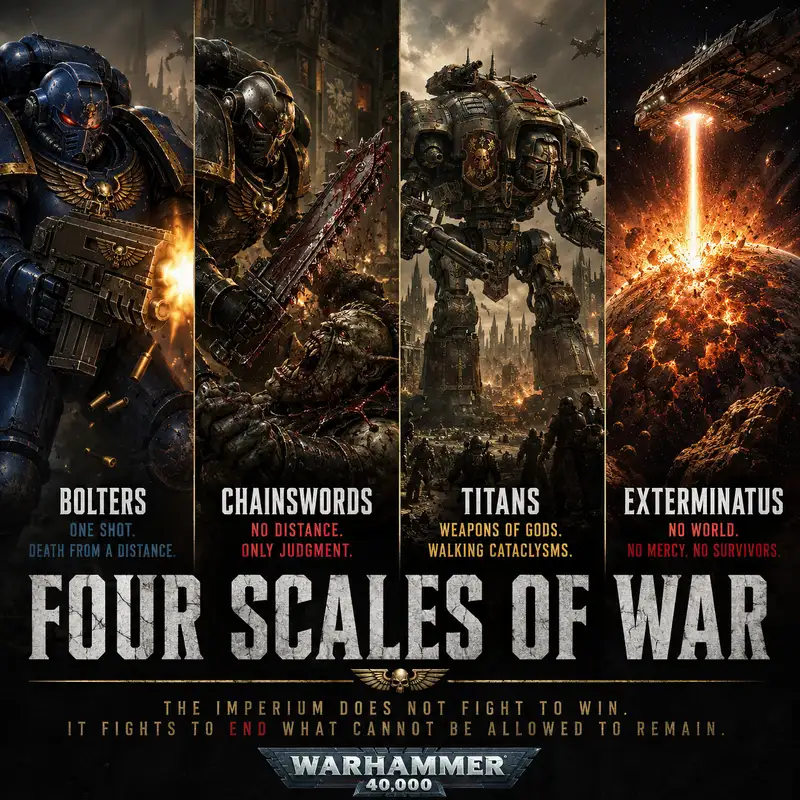
A bolt shell kills one body. A chainsword makes the killing intimate. A Titan turns a city into terrain. Exterminatus removes the world beneath it.
These are not simply four famous weapons from the Imperium of Man. They are four different scales of the same idea. Each begins with a threat that humanity believes it cannot tolerate. Each answers that threat with greater force, greater ceremony, and less room for mercy. Taken together, they explain something fundamental about warfare in the forty-first millennium.
The obvious explanation is that the Imperium likes excessive weapons. This is true in much the same way that a volcano likes heat. It is accurate, but it does not tell us very much. The more interesting question is why these particular weapons have become such powerful symbols. Why does a civilisation capable of crossing the stars still place a sword in a warrior’s hand? Why does it build walking engines and worship them as gods? Why does it sometimes destroy the very worlds it claims to defend?
The answer begins at the scale of a single trigger pull.
A bolter is often described as an enormous gun, which is rather like describing a cathedral as a large shed. The term actually covers a family of weapons, including bolt pistols, boltguns, bolt rifles, heavy bolters, and many specialised variants. What joins them is their ammunition.
A bolt round is not an ordinary bullet. A conventional charge launches it from the weapon, and the projectile’s own propellant then drives it onward. Once it penetrates its target, a mass-reactive fuse detonates the explosive warhead. The round does not merely punch a hole. It enters, then explodes.
That distinction matters in a galaxy filled with targets that refuse to behave like normal human beings. Orks can survive wounds that would drop a soldier. Tyranid organisms may continue attacking after losing parts that most creatures consider essential. Traitor Space Marines wear armour descended from the same traditions as their loyalist enemies. Daemons are not especially impressed by the medical consequences of being shot. Against such opponents, stopping power is not a luxury.
The bolter is therefore a practical response to the creatures of the setting, but it is not a practical weapon for everyone. The standard weapons carried by the Astra Militarum are usually lasguns, not bolters. A lasgun is rugged, comparatively easy to maintain, and supplied by rechargeable power packs. That matters when an army may contain millions of soldiers spread across several worlds.
Bolt ammunition is heavier, more complicated, and more demanding to manufacture. The weapons themselves produce punishing recoil. Human-sized bolt weapons exist, and the warriors of the Adepta Sororitas carry them as symbols of faith and instruments of war, but an Adeptus Astartes boltgun is built for a transhuman soldier wearing powered armour. Giving one to an ordinary recruit would not transform that recruit into a Space Marine. It might instead produce a brief instructional demonstration concerning shoulders.
This is why the bolter tells us more about the Space Marines than a simple list of specifications ever could. The Adeptus Astartes are not line infantry. They are shock troops designed to strike where the enemy is strongest, break command structures, seize critical positions, and turn a local crisis into a decisive collapse. Their signature weapon reflects that mission. It is compact enough to carry into a ship, fortress, trench, or hive city, yet violent enough to tear apart heavily protected targets at close and medium range.
It also has a psychological effect. A lasgun can kill with a flash and a cauterised wound. A bolter announces itself with recoil, smoke, impact, and detonation. The enemy does not merely see comrades fall. It sees them come apart. When Space Marines descend from the sky and open fire, the sound is part of the assault.
The Imperium calls the Space Marines the Angels of Death. Their bolters make the title audible.
Yet the bolter is not a magical answer to every battlefield problem. Magazines empty. Ammunition runs out. Armour can resist it. Tanks require heavier weapons. Some enemies close the distance before the shooter can stop them, while others appear from tunnels, teleport chambers, ruined buildings, or the wrong side of a sealed bulkhead. The galaxy has spent ten thousand years finding ways to turn a firefight into a struggle at arm’s length.
That is where the chainsword begins to make sense.
A chainsword is a powered blade with a moving chain of cutting teeth running around its edge. When it strikes, those teeth bite, tear, and drag through armour and flesh. It does not cut with the clean elegance of a power sword. It worries its way through the target with mechanical violence.
The weapon is not subtle. Subtlety generally leaves the room when the blade has an engine.
Its continued use does not mean that the Imperium has forgotten ranged warfare. It means that ranged warfare has repeatedly failed to keep the enemy at a comfortable distance. Battles take place in the narrow corridors of voidships, inside manufactorums, beneath hive cities, across trench networks, and among ruins where visibility is measured in metres. Tyranids rush firing lines in living waves. Orks regard closing with the enemy as the point of the exercise. Daemons can emerge in places that military planners had previously marked as secure, a word that Imperial history uses with touching optimism.
For a Space Marine, close combat is not a desperate last resort in the same way it would be for an ordinary soldier. Enhanced strength, speed, reflexes, armour, and endurance make the Marine terrifying at close range. A chainsword turns that physical advantage into repeated tearing strikes. It can be swung one-handed, leaving the other hand free for a bolt pistol, shield, or the practical business of throwing an enemy off a wall.
Other Imperial warriors carry chain weapons as well. Guardsmen, officers, Sisters of Battle, and zealots use chainswords of varying sizes. The enormous two-handed eviscerator transforms the same principle into a weapon closer to a portable execution device. At the largest scale, chain weapons can be mounted on Knights and Titans, because the Imperium occasionally encounters a problem so large that it requires a sword with industrial zoning requirements.
The chainsword also carries a meaning beyond efficiency. The Imperium is a civilisation of relics, oaths, saints, duels, martyrdoms, and sacred blades. Its technology may be advanced, but its imagination is medieval. A warrior who kills from a distance may be effective. A warrior who meets the enemy face to face can be presented as courageous, pure, and personally committed to the Emperor’s judgment.
This is one reason melee weapons remain so central to Imperial identity. A sword makes war visible as ritual. The chain mechanism adds the industrial character of the Imperium. It joins the knightly and the mechanical, the heroic image and the slaughterhouse reality.
There is nothing clean about it. Chain teeth can break. Mechanisms require maintenance. Blood, dust, fragments of armour, and less identifiable alien material are all determined to enter places the manufacturer did not intend. The weapon’s reliability depends upon artisans, armourers, sacred oils, replacement parts, and the usual amount of prayer. In the Imperium, maintenance and worship often occupy the same work order.
Bolter and chainsword belong to the individual warrior. They make one Space Marine feel larger than the battle around him. A Titan reverses the relationship. It makes every warrior nearby feel small.
A Titan is not simply a tank made tall. It is a walking fortress, a strategic weapon, a religious object, and a dangerous partnership between a human mind and an ancient machine. The Imperium refers to Titans as god-engines, and the title is not poetic exaggeration to the servants of the Adeptus Mechanicus. They believe these machines possess powerful spirits worthy of reverence.
Imperial Titans are organised within the Collegia Titanica, whose Titan Legions carry their own names, colours, heraldry, traditions, rivalries, and battle honours. They do not arrive on a battlefield as anonymous equipment. Each engine has an identity. Some have fought for centuries or millennia. Their hulls become archives of victories, repairs, vows, and old grudges.
There are several major classes. Warhound Titans are the smallest commonly encountered god-engines, built for speed, scouting, hunting, and flanking attacks. They often operate together, moving with an agility that seems wrong for something so large. Reaver Titans occupy a heavier middle ground, carrying greater firepower and armour while retaining more mobility than the largest engines. Warlord Titans are the towering centrepieces of many Titan Legions, able to mount weapons designed to destroy fortifications, armies, and other Titans. Rarer machines are larger still, approaching the scale of mobile citadels.
Exact measurements vary across surviving accounts, but the important point is not a number. It is the experience of seeing one. A Titan rises above armoured columns and city walls. Its weapons are mounted where buildings would be on a smaller machine. Its footsteps shake structures. Its war horns can be heard across the battlefield. Soldiers do not simply observe a Titan’s arrival. They endure it.
Its weapons match that scale. Volcano cannons hurl energy capable of gutting other god-engines. Plasma weapons release star-hot destruction at the risk of placing enormous strain on the reactor. Missile launchers can erase formations that would occupy an entire conventional commander’s attention. Some Titans carry massive fists, chain weapons, or siege tools for the disconcertingly direct business of killing another walking fortress by hand.
Protection begins with armour, but the defining defence is the void shield. These energy barriers absorb or deflect incoming attacks until sustained fire overwhelms them. Titan warfare therefore has its own rhythm. Shields flare under bombardment. Crews manage heat and reactor strain. Enemy engines manoeuvre for firing angles. Smaller units attempt to strip shields, distract weapons, or reach vulnerable points. Then a decisive shot penetrates, and a machine that appeared immortal begins to die.
This is why Titans do not merely wander forward alone, despite the confidence suggested by their architecture. They require support. Infantry protects their legs and rear approaches. Aircraft watch for attack runs. Armoured forces screen their movement. Specialised troops defend them from enemy soldiers bold enough to climb, sabotage, or swarm. Even a god-engine benefits from having someone check beneath the altar.
A Titan also requires a crew, though the word crew hardly captures the relationship. The senior commander is the princeps. Through a neural interface often called the manifold, the princeps experiences the Titan as an extension of the body. Sensors become sight. Armour becomes skin. Weapons become limbs. Moderati and other specialists control systems, while tech-priests, servitors, and vast maintenance staffs keep the engine functioning.
The machine spirit is not always passive. Titans are old, powerful, and possessed of distinct temperaments. A princeps must direct the engine without being overwhelmed by it. The most aggressive machine spirits may press toward violence. Ancient battle memories can shape reactions. A weak or injured commander risks losing control of the relationship.
For the forces of Chaos, that danger becomes something worse. Traitor Titans may be corrupted until the boundary between machine spirit, crew, and daemon disappears. Armour mutates. Cables resemble nerves. The engine no longer merely carries a crew. It becomes a predatory being. The loyalist Titan is worshipped as a god-machine. The corrupted Titan may answer the worship.
Despite their power, Titans are not common. Moving one requires specialised transport, secure landing zones, enormous stores of fuel and ammunition, and the cooperation of the Mechanicus. Repairing one can consume resources that would equip armies. Deploying an entire maniple of Titans is a statement that the campaign matters on a planetary or sector-wide scale.
It is also a political statement. The Titan Legions belong to the power structure of the Adeptus Mechanicus, not to an ordinary Imperial general’s motor pool. Their participation reflects alliances, obligations, sacred pacts, and strategic priorities. A commander may request a Titan. Requesting is not the same as receiving.
When a Titan finally walks, the effect reaches beyond firepower. Friendly soldiers see proof that the greatest engines of the Imperium have come to stand beside them. Enemies see a cathedral advancing through the smoke. The battle becomes liturgy performed with plasma reactors and city-killing guns.
Yet a Titan still fights for possession of something. A fortress. A hive. A manufactorum. A road. A continent. Its purpose is to destroy the enemy while leaving some version of victory behind.
Exterminatus begins when the Imperium decides that there is no victory worth preserving on the surface.
Exterminatus is often imagined as a single weapon or a large red button hidden beneath an Inquisitor’s desk. It is neither. It is a sentence of planetary death, carried out through whatever means are available and judged sufficient. Only individuals and institutions with exceptional authority can order or execute it, and even within the Imperium the decision can lead to investigation, censure, or vengeance.
The reasons vary. A world may be consumed by daemonic corruption so thoroughly that reconquest would only spread the infection. A Tyranid invasion may be impossible to stop before the hive fleet harvests the planet’s biomass. An alien organism may have transformed the biosphere beyond recovery. A strategic world may be destroyed to deny its resources to an advancing enemy.
The method depends upon the target and the fleet. Virus bombs can release engineered agents that devour organic material, leaving the atmosphere saturated with gases that can then be ignited. Cyclonic torpedoes may scour a world’s surface or penetrate deeply enough to cause catastrophic planetary destruction. Sustained orbital bombardment can burn cities, rupture infrastructure, and sterilise continents. Some methods kill the biosphere. Others break the planet itself.
Exterminatus does not always mean that a world explodes into neat fragments. The Imperium is entirely satisfied with a dead, poisoned sphere, provided the enemy is equally unable to use it.
The process may involve formal declarations, verification, ritual, command authentication, and fleets moving into exact positions. This bureaucracy can appear absurd beside the scale of the act, but the paperwork reveals something important. Exterminatus is not supposed to be a moment of temper. It is an official determination that every life, city, ecosystem, relic, and future generation on the planet has become an acceptable loss.
Few stories reveal the logic more clearly than that of Inquisitor Kryptman and Hive Fleet Leviathan. Kryptman understood that the Tyranids became stronger by consuming inhabited worlds. Every population, ocean, forest, and animal became raw material for the hive fleet. Defeating the Tyranids was not simply a matter of holding territory. Territory itself fed them.
Kryptman’s answer was to deny them that food. He ordered Exterminatus upon worlds in the path of the hive fleet, creating a devastated cordon and condemning billions of Imperial citizens. From a purely strategic perspective, the calculation had a terrible logic. If the worlds would be consumed anyway, destroying them first could slow the Tyranids and reduce what they gained.
The scale of the slaughter led to Kryptman’s exile and notoriety. He later helped direct Leviathan toward the Ork empire of Octarius, hoping that the Tyranids and Orks would destroy one another. Instead, the war created conditions in which both enemies could grow more dangerous. Orks become stronger through conflict. Tyranids adapt through consumption and resistance. The plan did not lack intelligence. It lacked a safe outcome.
Kryptman’s story prevents Exterminatus from becoming a simple symbol of Imperial stupidity. His enemy was real. The danger was existential. Conventional mercy might have fed humanity’s population directly into the fleets that would attack the next world. Yet his answer transformed Imperial citizens into terrain to be cleared in advance of the enemy.
That is the moral mechanism of Exterminatus. The torpedo is only the delivery system. The true weapon is the authority to decide that a world’s people no longer count as people, but as resources, risks, or denied biomass.
There are situations in the setting where planetary destruction may genuinely prevent something worse. A world opened completely to the warp can become a wound through which daemons spread. A mature Tyranid infestation can turn rescue into reinforcement for the hive fleet. The Imperium is surrounded by threats that make ordinary ethical choices feel dangerously inadequate.
The institution of Exterminatus remains horrifying because the same Imperium making that judgment is secretive, authoritarian, divided, and often working from incomplete information. Its records can be wrong. Its commanders can be zealous. Its Inquisitors can disagree about what corruption means and when a population is beyond saving. A necessary power in one crisis becomes an invitation to atrocity in another.
Bolters, chainswords, Titans, and Exterminatus therefore form a ladder, but not merely a ladder of size.
The bolter shows how the Imperium defines an enemy. The target is not expected to surrender after being wounded. It is expected to be destroyed.
The chainsword shows how the Imperium understands violence. Killing is not only a technical act. It is a test of courage, a ritual of judgment, and a personal demonstration of faith.
The Titan shows how the Imperium understands technology. A machine is not simply built, operated, and replaced. It is inherited, named, worshipped, and bound into political and religious authority.
Exterminatus shows how the Imperium understands survival. Humanity may sacrifice soldiers, cities, histories, and entire planets, then call the result preservation because something human remains elsewhere.
Most Imperial soldiers will never carry a bolter. Most battles will never see a Titan. Most threatened worlds will not face Exterminatus. These weapons are iconic not because they are ordinary, but because they reveal the civilisation that created them.
The Imperium fights with relics it barely understands, ceremonies it cannot separate from procedure, and force so extreme that victory can resemble defeat. Its weapons are practical responses to a monstrous galaxy, but they are also expressions of fear, faith, memory, and control.
A bolt shell detonates inside the enemy. A chainsword drags the warrior close enough to feel resistance. A Titan makes war into a moving cathedral. Exterminatus casts judgment from orbit and leaves no one alive to appeal it.
They are four stages of one Imperial decision. Whatever humanity cannot control, it will try to destroy, even when the thing being destroyed is part of humanity itself.