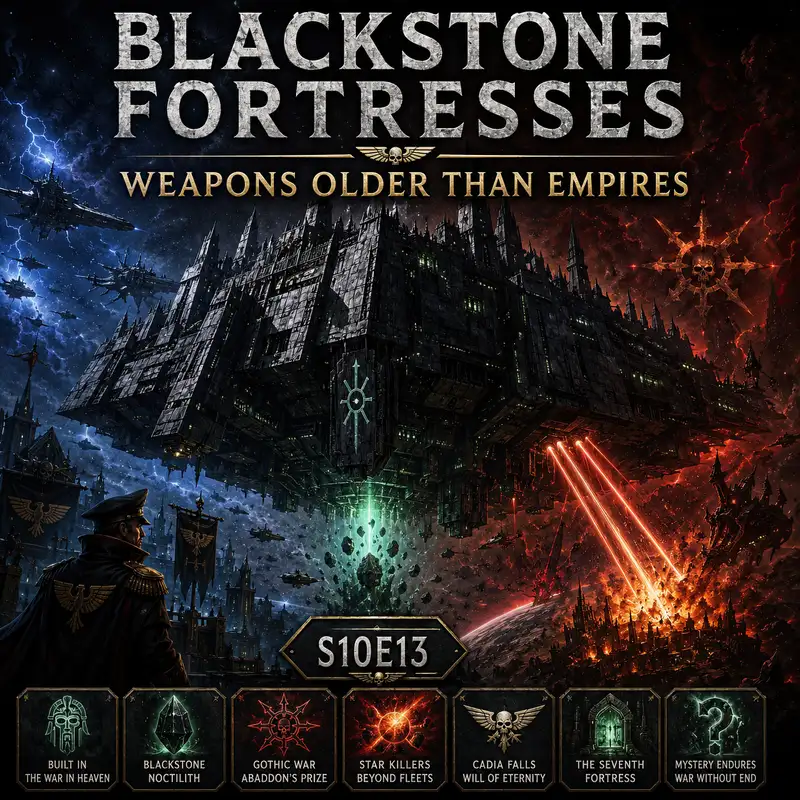
Blackstone Fortresses: Weapons Older Than Empires
Cadia did not die beneath a clean beam of light. It died beneath the falling corpse of a weapon that had already been beaten. High above the fortress world, the ancient station called the Will of Eternity was crippled, its systems failing and its guns silenced. Abaddon the Despoiler looked at that ruined mass and made one final calculation. If the fortress could no longer destroy Cadia as a machine, it could still destroy Cadia as an object. He sent it down.
That is the first thing to understand about a Blackstone Fortress. Even wrecked, it remains a strategic weapon. Even dormant, it is large enough to anchor fleets and dominate systems. Even misunderstood, it can change the fate of the galaxy. The fortresses are not simply old warships with unusually impressive guns. They are surviving pieces of a war so ancient that every modern empire is, by comparison, a temporary camp built among the ruins.
From a distance, a Blackstone Fortress appears as a vast geometric citadel, dark against the void and severe in its symmetry. Its surfaces are formed from blackstone, the substance known to Imperial scholars as noctilith. Within, the structure becomes far less obedient to ordinary description. Corridors shift. Chambers tessellate into new patterns. Gravity, distance, and direction can behave as suggestions rather than rules. The Imperium calls such a thing a fortress because the alternative would be admitting that its filing system has reached the edge of usefulness.
Its scale is difficult to communicate because ordinary comparisons shrink beside it. A battleship is built to move through a battle. A station is built to support the ships that do. A Blackstone Fortress can serve as both, while also containing internal regions large enough to swallow expeditions and lose them without inconvenience. Human additions cling to its exterior like scaffolding on a mountain. Those additions create the dangerous illusion that the whole structure has become familiar simply because part of it now has airlocks and duty rosters.
Noctilith is central to the mystery. Properly arranged, blackstone can suppress the influence of the warp, quieting psychic activity and strengthening the barrier between the material universe and the immaterium. Aligned differently, it can amplify warp energy instead. The same substance can serve as a dam or as a channel. That dual nature explains how Necron pylons can push back the warp while Blackstone Fortresses can draw upon it as ammunition. The material is not loyal to order or Chaos. It responds to design.
The builders are less certain. Aeldari traditions call the fortresses the Talismans of Vaul, linking them to the divine smith of their mythology and to the ancient War in Heaven. Some accounts suggest the Old Ones created them, perhaps with Aeldari participation, as weapons against the C'tan. Other sources place greater responsibility on the Aeldari themselves. These stories do not fit together neatly, and they were never intended as engineering records. Myth remembers purpose more readily than manufacturing tolerances.
The broad outline is still compelling. The C'tan were beings of the material universe, star-born powers whose command of physical reality made ordinary weapons seem provincial. Their great vulnerability lay in the warp, a realm they could not master in the same way. A weapon designed to tear open the boundary between realspace and the immaterium would therefore be more than destructive. It would attack them through the one medium least suited to their nature. The Blackstone Fortresses may have been built as answers to gods of living metal.
If that interpretation is even partly correct, then these structures are tens of millions of years old. They predate the rise of Humanity, the Imperium, the T'au Empire, and the long sleep of many Necron dynasties. They may have fought while Terra's most advanced native military doctrine involved teeth and determined shouting. Their survival is not merely evidence of durable construction. It suggests that their creators expected war to continue across geological time.
Then the War in Heaven ended, or at least changed beyond recognition. The Old Ones disappeared. The Aeldari inherited a wounded galaxy and later destroyed their own civilisation in a catastrophe of appetite and psychic excess. The Necrons withdrew into tomb worlds. The fortresses remained. Some drifted. Some slept. Their original command structures vanished, yet the machines did not decay into harmless monuments. They waited without explaining what they were waiting for.
The Imperium eventually found six of them in the Gothic Sector. Their primary systems appeared dormant, but their scale made them invaluable. The Adeptus Mechanicus reinforced them, attached human docks and weapons, and turned them into major Imperial naval bases. This was practical, bold, and entirely consistent with a civilisation that often survives by bolting familiar machinery onto something incomprehensible. Imperial crews lived and worked inside ancient superweapons without knowing how to awaken the systems that mattered most.
Human records labelled them Blackstone One through Blackstone Six and associated each with the system it guarded. The names were administrative rather than revelatory. A fortress could support fleets, repair ships, store supplies, and command a subsector while its deepest mechanisms remained sealed. Generations of officers treated them as fixed installations because that was how the Imperium used them. A cathedral can be mistaken for a warehouse if every surviving priest has forgotten the doors.
Abaddon did not forget that the doors might open. The Twelfth Black Crusade, remembered as the Gothic War, was not merely a storm of raids across an Imperial sector. Beneath the fleet battles, planetary assaults, and deliberate confusion lay a focused objective. Abaddon wanted the Blackstone Fortresses. He also sought the alien relics called the Hand of Darkness and the Eye of Night, devices associated with activating and controlling the ancient structures. His campaign was archaeology conducted by battleship.
The Gothic War showed the difference between possessing a fortress and commanding one. Imperial ownership had meant docking rights, gun emplacements, and careful Mechanicus rituals around systems no one understood. Abaddon's forces sought access to the original weapon. He captured three of the six fortresses and brought their dormant power to life. How completely he understood the process remains doubtful. He knew enough to make the galaxy pay for the distinction.
A fully awakened Blackstone Fortress could direct warp energy through the boundary of realspace. Its primary weapon was not simply a larger lance battery. It could unleash immaterial force in a way that ignored many ordinary assumptions about armour and void shields. Ships caught in its path could be torn apart by energies for which conventional protection had never been designed. One fortress was catastrophic. Several working together became something closer to an astronomical execution device.
Its design also belongs to a different understanding of warfare. Modern fleets divide tasks among command ships, carriers, repair stations, fortifications, and weapons platforms. A Blackstone Fortress folds those roles into one structure, then adds capabilities that cross the border between physics and sorcery. It can be a base before a campaign, the decisive weapon during it, and the means of escape afterward. Fighting for one is therefore not like capturing a vessel. It is closer to seizing an entire theatre of war and discovering that the theatre has engines.
At Fularis Two, two fortresses demonstrated that power against a world. Their combined attack stripped away the planet's atmosphere and left its surface ruined. There was no need for a prolonged invasion, no patient reduction of orbital defences, and no argument over the surrender terms. The target ceased to be a functioning world. For naval commanders who measured power by the number of capital ships in a battle line, the lesson was unpleasantly simple. The old weapon did not play their game.
The destruction of the Tarantis system went further. Abaddon linked three fortresses and directed their combined power at the system's star. The star was driven into catastrophe, and the system died with it. A planet-killer destroys a world. A weapon that can murder a star erases the battlefield, the supply lines, the population, and the map reference at once. Three Blackstone Fortresses had accomplished what entire crusade fleets could not reliably attempt.
That demonstration also revealed why Abaddon wanted all six. The fortresses were designed to combine their power, forming a network rather than a collection of independent stations. Three could destroy a star. The surviving accounts do not establish what six acting together might have achieved, and speculation quickly becomes theatrical. It is enough to note that Abaddon believed the remaining fortresses were worth a sector-wide war, and the Aeldari were willing to intervene rather than let him complete the set.
The Aeldari understood the danger through a different inheritance. To them, these were not unexplained Imperial stations but Talismans connected to the deepest layer of their civilisation's memory. Their aid during the Gothic War was never simple friendship. The Imperium and the Aeldari remained suspicious partners with incompatible motives and a long history of shooting first for reasons each side considered excellent. Yet both could see that Abaddon controlling the full network was worse than temporary cooperation.
The decisive confrontation came at Schindlegeist. Abaddon brought his captured fortresses into position and began building power for another attack on a star. Imperial forces closed in, but fleets and guns could not simply absorb the discharge. Captain Abridal of the Flame of Purity chose a narrower answer. He drove his ship into the convergence of the fortresses' energy beams. The cruiser was destroyed, but the sacrifice disrupted the attack and dissipated the gathered power.
Abridal's action did not destroy the Blackstone Fortresses. It bought the moment in which the wider battle could be won. With Imperial forces pressing hard, Abaddon withdrew into the warp with two of the three captured structures. The third was recovered apparently abandoned. Then it self-destructed. The three fortresses still held by the Imperium also destroyed themselves. No surviving explanation settles whether this was sabotage, a remote command, an ancient failsafe, or a decision made by systems no human had recognised as capable of deciding.
The result was stark. Four of the original six fortresses in the Gothic Sector were gone, and two had escaped with Abaddon. The Imperium had prevented a greater disaster but lost every Blackstone Fortress it had once claimed. Victory, in this case, meant denying the enemy four ancient superweapons while allowing him to keep two. Imperial history contains many triumphs that become less comfortable when the inventory is read aloud.
One of the surviving fortresses became known as the Will of Eternity. The precise identity of the original Gothic station remains disputed, but its later service is clear enough. Abaddon kept it within the Eye of Terror, where centuries of corruption altered its appearance and systems. It came to look like an artefact of Chaos, yet Chaos had not created it. The distinction matters. Abaddon was not displaying the genius of the Dark Gods. He was chaining their power to a weapon stolen from a far older war.
Control remained difficult. Later accounts describe Abaddon using an artificial being infused with noctilith, Dravura Morkath, to command the Will of Eternity. Another surviving fortress was reportedly subjected to daemonic possession with disastrous effects upon whatever intelligence or governing presence existed within it. These were not obedient ships waiting for a new captain's flag. Every effort to master them carried the possibility that the master had misunderstood which side of the relationship was being tested.
During the Thirteenth Black Crusade, the Will of Eternity came against Cadia. The fortress world guarded the narrow passage beside the Eye of Terror and stood upon an ancient network of pylons that restrained the warp. Cadia was therefore more than a military obstacle. It was a lock upon a cosmic wound. Abaddon's assault brought armies, fleets, daemons, and the accumulated purpose of his earlier crusades against that single point.
The Will of Eternity attacked from orbit, but Imperial forces managed to board and cripple it. Space Wolves and Mechanicum warriors prevented the fortress from completing the destruction for which it had been positioned. Its main systems were largely disabled. By conventional military reasoning, the weapon had been neutralised. Conventional military reasoning then encountered the fact that a Blackstone Fortress remains an object of appalling mass even when its internal mechanisms have been broken.
Abaddon cast the wreck onto Cadia. The impact devastated the world and shattered the pylon network that had helped contain the Eye of Terror. Cadia broke, and the warp surged through the failure. The catastrophe became part of the opening of the Great Rift, the vast wound that divided the Imperium and transformed the strategic geography of the galaxy. The Will of Eternity died, but its final use achieved more than its working guns had managed.
There is a bitter symmetry in that ending. A structure possibly created to weaponise the warp against the C'tan was used by Chaos to destroy the pylons restraining the warp. Blackstone can suppress or amplify immaterial power, depending upon arrangement and purpose. The same ancient science can seal a breach or widen it. The Will of Eternity did both across its long existence, not because the material changed allegiance, but because later hands learned different ways to point it.
Cadia might have been the perfect final chapter for the Blackstone Fortresses. It was not. Far from the old Gothic battlefields, another fortress emerged in the Western Reaches of Segmentum Pacificus. Imperial catalogues called it the Seventh Blackstone Fortress, a name that quietly admitted the first six had never been the complete story. Other reports have since indicated still more examples across the galaxy. Humanity had not discovered a unique set. It had discovered one cluster.
Around the Seventh Fortress gathered the wreckage of those who tried to seize it by force. From that graveyard grew Precipice, a rough station assembled from broken ships and stubborn optimism. Rogue Traders, zealots, mercenaries, Aeldari, Kroot, abhumans, and stranger travellers came to bargain, threaten, and prepare expeditions into the fortress. The arrangement resembled peace only when viewed from a considerable distance, but greed can maintain a ceasefire where diplomacy would feel embarrassed to try.
The explorers entered for different reasons. Janus Draik sought fortune and the restoration of a ruined reputation. Amallyn Shadowguide believed the fortress might contain knowledge capable of helping her shattered craftworld, Biel-Tan. The machine intelligence hiding behind the designation U R zero twenty-five had interests of its own. Each saw the fortress as an opportunity shaped by personal need. The fortress, meanwhile, offered no evidence that it accepted any of their definitions.
Inside, chambers rearranged themselves. Guardian constructs hunted intruders. Hostile creatures, traitor soldiers, cultists, and the servants of Chaos occupied regions they did not truly control. The warship Impaler became fused with the fortress and was gradually absorbed into its structure. Later, deep systems awakened, gravitational forces drew Precipice toward destruction, and defensive weapons prevented easy escape. Whether these responses came from conscious intention, ancient programming, or damaged instinct remains uncertain. The practical difference was limited.
This is what makes the Seventh Fortress so important to understanding the whole class. It behaves not merely as a gun platform but as a landscape, a machine, a vessel, and perhaps an actor. Its corridors are defensive measures. Its geometry is command and control. Its ability to absorb foreign structures suggests that invasion may become digestion. Calling it a fortress is not wrong, but it is like calling an ocean a moat. The description is accurate only at the scale of the observer.
The later discoveries also change the meaning of the Gothic War. Abaddon had fought for six fortresses because those were the six available within reach, not because they were necessarily the only ones ever made. More may still be dormant in uncharted regions, watched by Aeldari seers, surrounded by Necron dynasties, occupied by Chaos warbands, or mistaken for dead celestial bodies. Each one carries technology that no modern faction can confidently reproduce and few can safely command.
The Imperium can mine blackstone, study it, and build devices around fragments of its properties. The Necrons understand noctilith with far greater sophistication, while Chaos has learned to reverse its suppressive qualities and turn it toward warp amplification. None of that makes a Blackstone Fortress ordinary. The complete structure represents an integration of material science, psychic engineering, navigation, weaponry, and autonomous control from an age when the galaxy's wars were fought between powers that treated stars as terrain.
That is why these fortresses remain more dangerous than their armaments alone. A modern empire can capture one without understanding it, awaken one without truly controlling it, or destroy one without knowing what purpose has been interrupted. Every faction approaches with its own certainty. The Imperium sees a bastion, Chaos sees a conduit, the Aeldari see a talisman, and explorers see treasure. The fortress can accommodate all of those beliefs because none of them is large enough to contain the machine.
Blackstone Fortresses are weapons older than empires, but age is not their most unsettling quality. Ruins are comforting when they belong to the past. These do not. They still move, reconfigure, absorb, awaken, and kill. Their makers are gone, their original enemy has returned in fragments, and their surviving orders remain unreadable. Somewhere beyond the mapped routes, another dark geometry may be turning toward a destination chosen before Humanity had a name, still carrying out a war that never received the message to end.