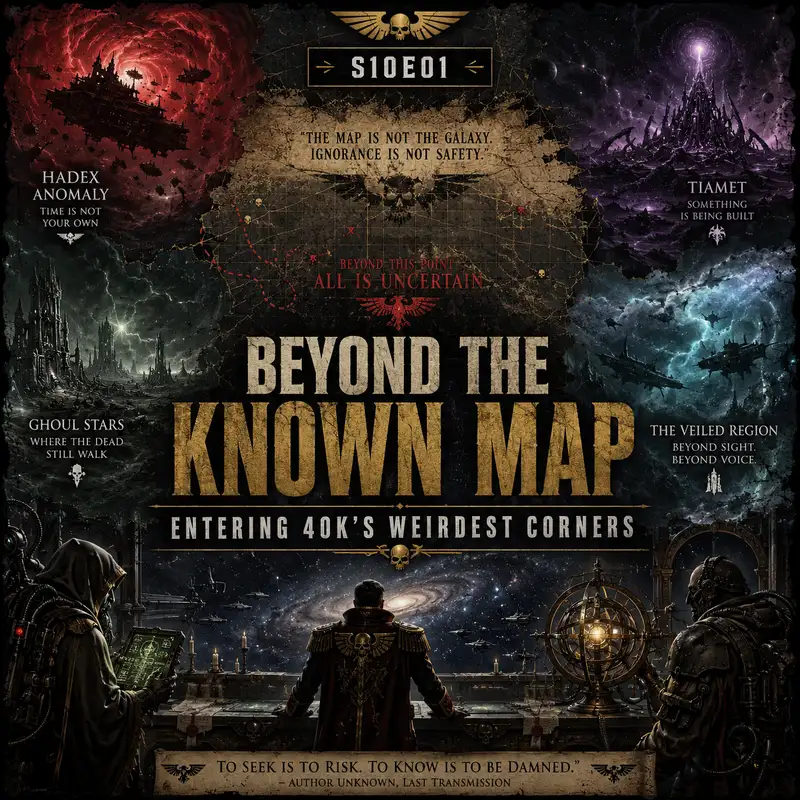
Beyond the Known Map: Entering 40K’s Weirdest Corners
The map does not end at a line. It frays. Trade routes become guesses, astropathic messages return as broken echoes, and stars once marked with confident Imperial symbols fade into warnings written by people who never came home. Beyond that point, the galaxy is not empty. It is simply no longer arranged for human understanding. The Imperium calls such places wilderness space, the halo, the fringe, the outer dark. Those terms sound geographical. They are really admissions of failure.
An Imperial map is less a picture of the galaxy than a statement of intent. It shows worlds that pay tithes, routes that can sometimes be travelled, fortresses that still answer their signals, and enemies important enough to deserve a symbol. The Imperium may claim dominion over a million worlds, but those worlds are scattered like embers across an ocean of night. Between them lie uncounted systems, lost colonies, alien territories, dead civilisations, and regions where the laws of navigation become suggestions. The map looks solid because bureaucracy dislikes drawing uncertainty. Reality is less cooperative.
At the centre of Imperial travel is the Astronomican, the psychic beacon projected from Terra and shaped by the Emperor’s will. Navigators sense its light through the warp and use it as a fixed point in a realm that has no trustworthy distance, direction, or time. It is not a road. It is the lighthouse that makes roads possible. Where its signal weakens, journeys become slower and more dangerous. Where it cannot be perceived, the Imperium’s practical border begins, even if some ancient charter insists otherwise.
That border has never been neat. The extreme eastern reaches of the galaxy lie beyond reliable sight of the Astronomican. Warp storms can isolate a sector that sits comfortably inside an Imperial chart. A stable route may close for centuries, then reopen after everyone who remembered its destination is dead. The Great Rift made this old problem catastrophic. Across much of Imperium Nihilus, the beacon is obscured, communication is shattered, and worlds that were once part of the known realm have become islands in a darkness usually reserved for the edge.
So the strangest corners of Warhammer forty thousand are not always physically distant. Some begin wherever the network breaks. A world can be close in real space and unreachable through the warp. Another can be half a galaxy away yet connected by a rare passage or ancient gate. Distance matters, but access matters more. The Imperial map is therefore built from routes, not kilometres. Lose the route, and a civilisation disappears. Find a route, and a nightmare acquires an address.
People still cross those thresholds. Rogue Traders carry warrants broad enough to turn trespass into policy. Explorator fleets seek lost technology with the focused optimism of people who believe every forbidden ruin contains a recoverable machine. The Inquisition follows rumours that sane officials prefer to misfile. The Deathwatch watches approaches from regions whose inhabitants may not even possess names humanity can pronounce. Exiles, pirates, missionaries, and desperate colonists go as well. Some seek profit. Some seek revelation. A few have merely exhausted the safer ways to die.
One of the clearest thresholds lies near the Calixis Sector, where the passage called the Maw opens toward the Koronus Expanse. The Maw is not a friendly corridor. It is a dangerous route through violent warp phenomena, navigable only under favourable conditions and with knowledge bought by generations of loss. Yet beyond it lies a vast frontier filled with human worlds, alien domains, unexplored systems, and relics from ages the Imperium barely understands. To a Rogue Trader, that is opportunity. To everyone serving under the Rogue Trader, it is often the same thing with worse lighting.
The Koronus Expanse demonstrates how Imperial knowledge advances. First comes a route. Then come charts copied from damaged logs, accounts traded in dockside vaults, and rumours repeated until someone wealthy decides they are coordinates. A discovered world may enter the record as a resource, a threat, a conversion target, or a problem to be revisited by someone else. Its people may have their own history stretching back thousands of years. The first Imperial clerk to survive the journey will nevertheless assign them a category and regard the matter as substantially improved.
The phrase beyond the map can be misleading. Humanity has not reached a clean outer boundary and looked over the edge. The Milky Way is too large, the warp too uneven, and Imperial knowledge too fragmented for that. Known space contains holes, while remote frontiers contain narrow threads of familiarity. A shrine world may maintain a dependable route to Terra while a neighbouring system remains unvisited for five thousand years. The strange corners are therefore scattered through the chart like missing pieces, some enormous and some no larger than a single forbidden system.
Beyond even such frontiers lie the Halo Stars, ancient and thinly scattered across the outer reaches. Their systems are far apart, their habitable worlds rare, and their reputation uniformly poor. Imperial expeditions have vanished there often enough that the disappearances have become part of the region’s identity. The Halo Stars are not frightening because one known enemy controls them. They are frightening because no single explanation accounts for the losses. The void is old, the evidence is incomplete, and the surviving reports do not agree on what they saw.
That distinction matters. The Imperium understands war, even when it is losing. Orks can be fought. Tyranids can be burned. Necron tombs can be marked, avoided, or assaulted with the usual Imperial preference for learning by detonation. The Halo Stars deny that comfort. A ship may find a dead human colony whose architecture predates the Imperium. It may encounter technology that changes those who use it. It may receive a signal from a system absent from every chart. The danger is not merely death. It is discovering that the categories carried from home are too small.
At the extreme northeast lie the Ghoul Stars, also called the Ghost Stars, where dying suns cast cold light over dead worlds. This region contains known dangers, including alien species, isolated human powers, and the Necron Bone Kingdom of Drazak. The Flayed Ones associated with that place are not simply mechanical soldiers. They are Necrons broken by a curse that drives them to drape themselves in the flesh of the living. In most regions, that would be sufficient reason to turn the fleet around. In the Ghoul Stars, it is one item on the navigation brief.
The region’s greater terror is historical. During the Nova Terra Interregnum, something emerged from the Ghoul Stars in the event remembered as the Pale Wasting. The surviving Imperial record is deliberately ruined. Accounts describe a plague born among the stars and nightmare engines capable of destroying whole sectors, but they do not settle whether these were two aspects of one enemy, competing explanations, or language failing under pressure. Multiple Space Marine Chapters were committed. Most were lost. Later authorities preserved fragments, censored others, and left a warning without a usable description.
That is one of the purest expressions of the outer dark. The Pale Wasting is not frightening because its exact form has been revealed. It is frightening because the Imperium encountered something large enough to demand an apocalyptic response and then chose, or was forced, to erase the explanation. Records can be destroyed for many reasons. They may conceal shame, prevent panic, suppress dangerous knowledge, or protect later generations from ideas that behave like weapons. Imperial censorship is often brutal and frequently self-defeating. It is also not always irrational.
The Death Spectres maintain their vigil in the Ghoul Stars because whatever inhabits the region cannot be treated as a solved problem. Other forces pass through or hunt along its margins, including the Carcharodons and the Deathwatch. Their purpose is not necessarily to make the region safe. Safety would require knowledge, settlement, stable routes, and control. Their more realistic task is containment. They stand between the wider Imperium and a frontier from which previous threats have emerged. It is less a border post than a door braced shut from the human side.
The Veiled Region presents a different kind of unknown. It is hidden behind dense nebulae, stellar dust, radiation, and the debris of forming stars. Explorator fleets have barely penetrated it since the Great Crusade. Astropathic communication is unreliable, with messages reflected back as echoes or swallowed by silence. Navigation demands immense resources before an expedition has even discovered anything worth fighting. Imperial law has prohibited settlement there, which has naturally encouraged persistent rumours that human settlements already exist inside.
Unlike the Ghoul Stars, the Veiled Region does not need a single ancient horror to remain mysterious. Ordinary physics does much of the work. Sensors fail. Signals scatter. Stellar matter hides movement. A fleet can cross light years of luminous dust and emerge into clear space with no certainty that the way back remains open. Greenskin pirates, xenos traders, human enclaves, and awakening Necrons have all been associated with the region. The result is not a blank. It is an accumulation of partial truths that no authority can assemble into a reliable whole.
Charting such a place is closer to a military operation than a scientific survey. A fleet needs Navigators, astropaths, fuel, repair capacity, armed escorts, and enough political authority to survive whatever it reports. Every additional ship creates another mouth to supply and another vessel that can bring contamination home. Success may mean returning with a partial route and one intact data vault. Failure may mean silence, which proves nothing except that the expedition is no longer available for questions. The Imperium’s exploration budget is measured in lives, and the invoice is usually classified.
There is a useful lesson here. In Warhammer forty thousand, the unknown is not always the warp. The setting contains genuine cosmic geography that defeats the Imperium without daemons, prophecy, or sorcery. Radiation can kill a crew just as thoroughly as possession. A nebula can conceal an empire. A bad chart can destroy a fleet. This makes the supernatural dangers more effective because they exist beside practical ones. When the alarms begin, the captain must first determine whether reality is breaking or the auspex is simply having a very poor day.
Then there is the Hadex Anomaly in the Jericho Reach, a red wound in space whose behaviour refuses ordinary sequence. It expands and recedes without a dependable rhythm, covering and revealing whole systems. Ghost ships hang near its outskirts as if caught outside normal time. Reports suggest that the anomaly can distort events themselves, not merely clocks, and that it may cast time from elsewhere into the surrounding region. It is classified as a warp phenomenon because the Imperium requires a filing cabinet even when causality has caught fire.
The Jericho Reach is itself connected to the distant Koronus Expanse by an ancient warp gate. That link turns the Imperial idea of location inside out. Armies from one side of the galaxy can enter a frontier near the Eastern Fringe through a passage whose builders and full purpose remain uncertain. The Achilus Crusade uses that connection to wage war across a region beset by Chaos, Tyranids, and expanding T’au power. Strategically, it is a miracle. Logistically, it is a corridor feeding soldiers into three wars and a hole in time. The distinction is mostly ceremonial.
Hadex also shows why exploration in this setting rarely produces clean enlightenment. Scientific observation, religious interpretation, military necessity, and psychic experience arrive at the same phenomenon with incompatible languages. A Magos may describe energy patterns. An Inquisitor may see corruption. A preacher may identify judgement. A Navigator may refuse to look twice. Each could possess part of the truth. None has the luxury of waiting for consensus, because the anomaly may expand over an inhabited system while the committee is still debating terminology.
Farther toward the Eastern Fringe lies Tiamet, where the Tyranids behave in a way that unsettles even those familiar with them. Most hive fleets consume worlds and move onward, converting life into fresh organisms for the next assault. Hive Fleet Tiamet instead holds territory. On Ziaphoria, vast Tyranid bio-structures have grown across the landscape, including a continent-spanning psychic construction of chitin and living neural tissue. Its purpose remains uncertain. Some Imperial observers suspect a beacon. The important fact is simpler. The Tyranids are building something, and they are not finished.
This is weirdness without human motive. The Imperium can imagine why a conqueror wants territory, why a heretic wants power, or why a dynasty wants revenge. Tiamet offers activity without a comprehensible political aim. Genestealer cultists associated with the Choir of the Void have abandoned conquered worlds and travelled toward the system, carrying biomass inward rather than preparing a planet for consumption. Psykers report a growing psychic scream. The pattern is visible, but its meaning is not. Humanity is watching an intelligence work at a scale where the tool, the message, and the organism may be the same thing.
The temptation is to treat all these places as boxes of monsters waiting to be opened. That misses what makes them powerful. The weirdest corners of the galaxy challenge the assumptions that organise the familiar setting. The Imperium is not the measure of civilisation. Real space is not stable everywhere. History does not always survive. An enemy may not want conquest, worship, revenge, or food in any form humans recognise. A region may remain unmapped not because nobody tried, but because mapping it changes too quickly, costs too much, or reveals knowledge that cannot safely be distributed.
They also expose the limits of Imperial power. A crusade can conquer worlds and still fail to understand them. The Mechanicus can recover a device and spend centuries arguing over whether activating it was discovery or sacrilege. The Inquisition can destroy every record of a threat and thereby ensure that the next generation meets it without preparation. The administratum can place a seal on a chart and call the region forbidden. The stars do not notice. Imperial authority is immense, but at the edge it often becomes theatre performed for an audience that has already eaten the cartographer.
The records from these frontiers are unreliable for understandable reasons. Survivors are rare. Astropathic messages arrive damaged. Navigators experience the warp through symbols that cannot be reduced to ordinary coordinates. Institutions alter reports to protect secrets or reputations. Later copyists combine separate disasters. Prophecy enters history, and history is rewritten as doctrine. Contradiction is not a flaw added to the setting from outside. It is what information looks like after crossing impossible distances through hostile dimensions and passing several Imperial offices with competing security classifications.
This uncertainty does not mean that every rumour is equally true. The known facts still matter. The Ghoul Stars are a real region, the Pale Wasting left real losses, the Veiled Region defeats ordinary communication, Hadex distorts time, and Tiamet’s structures exist within the lore whether or not their purpose has been revealed. The careful approach is not to invent a final answer. It is to distinguish what has been observed, what Imperial authorities believe, and what frightened people have inferred. In the outer dark, discipline begins with admitting where the evidence stops.
That is why these margins matter to Warhammer forty thousand. The central wars show how factions struggle for the galaxy they know. The fringes remind us that none of them know the whole galaxy. Even the Necrons, heirs to an ancient civilisation, awaken into a cosmos changed beyond their expectations. The Aeldari move through paths whose full extent is no longer secure. Tyranid fleets arrive from intergalactic darkness, suggesting immensities beyond the chart. Every power possesses maps. None possesses the map.
Beyond the known routes, human colonies may have survived since the long night without Imperial rule. Alien societies may have risen and vanished without ever receiving an Imperial designation. Machines may continue tasks assigned before humanity evolved. There may be ruins whose creators understood the warp differently, or avoided it entirely. Most of these possibilities remain possibilities, and they should. A fully catalogued galaxy would be smaller, safer, and much less honest about the scale of deep time.
The map therefore ends wherever certainty becomes too expensive to maintain. Sometimes that place is a dying star at the galactic rim. Sometimes it is a nebula that throws every message back at the sender. Sometimes it is a red anomaly where cause and effect lose formation. Sometimes it is a Tyranid world growing a structure that no witness can explain. These are not empty spaces between the important wars. They are the places where the setting admits that its greatest empires are local events inside a far older and stranger universe.
An Imperial chart may mark such a region with a warning, a saint’s name, or a black seal. The notation offers comfort because it turns ignorance into administration. Beyond the ink, the stars continue without permission. Fleets vanish, signals repeat after their senders are dead, and ancient things move beneath suns too cold to warm the worlds around them. The known map does not protect civilisation from that darkness. It only shows where civilisation last managed to describe what was looking back.