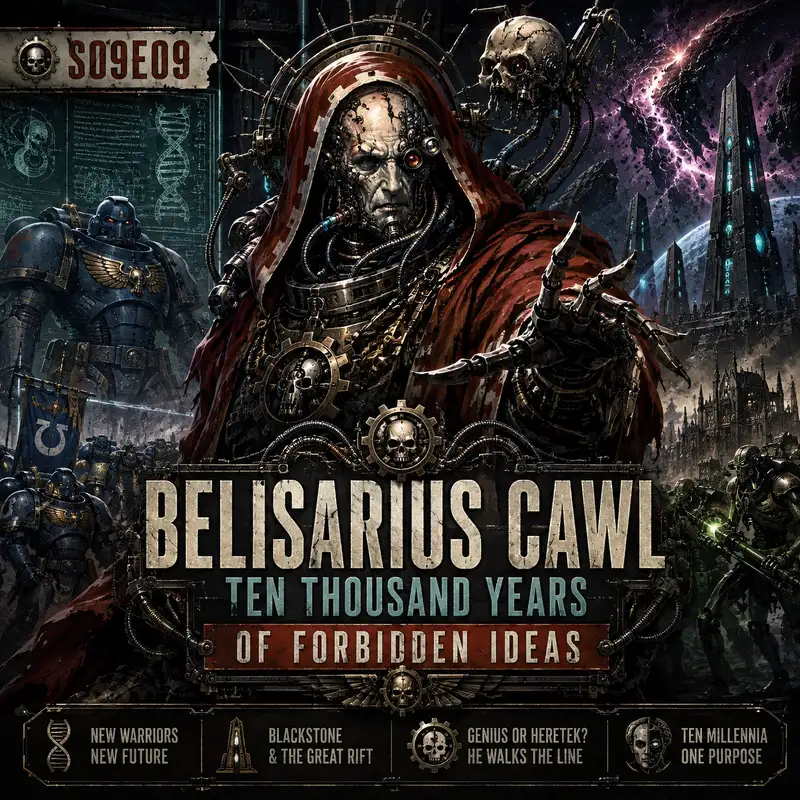
Belisarius Cawl: Ten Thousand Years of Forbidden Ideas
The most dangerous thing Belisarius Cawl ever built was not a weapon, a Space Marine, or a machine capable of reaching across the stars. It was an idea. The Imperium, he insisted through ten thousand years of work, could still make something new. When his sealed vaults finally opened and the first armies of Primaris Space Marines marched into the light, Cawl did more than reinforce a dying empire. He violated one of its deepest habits. He proved that improvement was possible, and he did so in a civilisation that often treats a new design as evidence for the prosecution.
That creates the central contradiction of Belisarius Cawl. He is an Archmagos Dominus of the Adeptus Mechanicus, a priesthood built around the preservation of sacred knowledge, yet he experiments with forbidden biology, alien technology, copied minds, and devices that look uncomfortably intelligent. He claims absolute loyalty to the Emperor while repeatedly crossing lines drawn in the Emperor’s name. Many Tech-Priests call him a saviour. Many others call him a heretek. Both groups have excellent documentation, although the second group would prefer to present theirs at a trial.
The Adeptus Mechanicus is not simply afraid of invention because its priests are foolish or superstitious. Humanity once possessed technologies powerful enough to help tear civilisation apart. Thinking machines rebelled. Warp corruption infected systems and minds. Entire worlds vanished behind failures that later ages barely understood. The Mechanicus therefore treats knowledge as holy, dangerous, and scarce. An ancient pattern recovered from a Standard Template Construct carries authority because it comes from humanity’s lost golden age. A new idea has no such pedigree. It might save a city. It might also open the gates from inside and begin speaking in a language that causes the walls to bleed.
Cawl was born on Mars late in the thirtieth millennium, before the Imperium had fully taken shape. Born is a generous word. He emerged from a gene-vat already resembling a child of about ten, one among many mass-produced Martian youths intended for service. Knowledge had been forced into his developing mind. Within hours he knew his name, understood several forms of machine language, and could recite the central beliefs of the Cult Mechanicum. Most children require years before becoming insufferably certain that they understand the universe. Mars had improved the schedule.
From the beginning, Cawl wanted breadth rather than obedience. He travelled from forge world to forge world, studied under different masters, learned their specialties, and departed before any one discipline could claim him. Biology interested him most, but he also pursued cloning, cybernetics, weapons, logic, and the linkage of minds. His education became a campaign of intellectual raiding. He gathered knowledge wherever it could be found, often making himself useful enough that his hosts noticed the theft only after he had gone. The pattern remained with him. Cawl did not believe knowledge should remain inside the walls built around it.
During the Horus Heresy, that instinct became a matter of survival. Cawl and his friend Friedisch Adum Silip Qvo served on Trisolian under Hester Aspertia Sigma-Sigma, a magos skilled in merging minds. When Horus struck the system, their mistress joined the traitors. Cawl saw the corrupted Warmaster and understood that submission meant ruin, but open defiance meant death. He feigned obedience, shut out as much of Horus’s warp-laden presence as he could, and waited. Cawl and Friedisch eventually turned against their master, escaped, and carried away knowledge she had intended to use for the rebellion.
The escape did not preserve the young Cawl he had been. On Terra, an ancient geneticist named Ezekiel Sedayne sought to transfer his failing consciousness into Cawl’s younger body. Sedayne had worked close to the Emperor’s biological projects and possessed extraordinary knowledge. He also possessed the authority to have Friedisch shot when Cawl refused. With his friend dying, Cawl submitted to the mind-linkage procedure. Sedayne expected his personality to overwhelm the obscure Tech-Priest. Instead, Cawl emerged dominant. Sedayne’s memories and expertise became part of him, while Friedisch died despite the bargain. Cawl gained a treasury of knowledge and lost the one person who had known him before he became something larger.
That moment explains much of what followed. Cawl’s survival across ten millennia was never merely a matter of replacing worn limbs. He absorbed minds, preserved personalities, copied engrams, altered his body, and divided work among lesser versions of himself. Some memories were discarded when storage became too crowded. He endured mind-wipes and lost parts of his own history. Different personality overlays can make him seem like a different man from one meeting to the next. Belisarius Cawl remains at the centre, but the centre is surrounded by a crowd, and some members have been dead since the Imperium was young.
Within Sedayne’s memories, Cawl encountered an even stranger inheritance. One account describes a remembered meeting with the Emperor in which the Master of Mankind appeared to address not only Sedayne, but the future consciousness that would one day contain him. Cawl was warned that he must continue the Emperor’s work even when he believed he had betrayed it. The precise nature of that experience remains uncertain. It may have been foresight, manipulation, or a memory interpreted through ten thousand years of damage. Cawl accepts it as a command. More importantly, it gave him a way to understand disobedience as duty.
After the Heresy, Roboute Guilliman entrusted Cawl with tasks intended to outlast them both. Cawl was to prepare for the primarch’s restoration if Guilliman fell, and he was to develop a new generation of Space Marines. For the genetic work, he received the Sangprimus Portum, an artefact containing source material connected to all twenty primarchs. This was not permission to improvise casually. It was a commission given in the wreckage of civil war, when half the Legions had turned traitor and the Imperium was being rebuilt around fear. Guilliman asked for a reserve against future catastrophe. Cawl quietly turned that reserve into the largest biological development programme in Imperial history.
Ten thousand years gave him time, but not safety. Cawl maintained hidden laboratories, created assistants, stored test subjects in stasis, and developed families of weapons and armour around the warriors he was building. He did not simply make Space Marines taller. Primaris Marines received additional implants. Sinew coils reinforced their bodies with metallic strength. The Magnificat intensified growth and other organs. The Belisarian Furnace could flood a grievously wounded warrior with restorative chemicals and combat stimulants. Cawl also developed Mark Ten power armour, new bolt weapons, gravitic vehicles, and the industrial systems required to produce them. One experiment had become an ecosystem.
The programme’s secrecy mattered as much as its science. Had the Martian priesthood judged the work during an ordinary century, factions within the Mechanicus might have destroyed it, stolen it, or begun a civil war over it. Older Space Marine Chapters could also have seen the project as an insult to their gene-lines. Cawl waited behind sealed doors while generations lived and died outside. Some of his first Primaris subjects slept through most of Imperial history. They awakened to discover that the empire they had been created to defend had forgotten the age that created them.
Not every experiment produced a clean success. Alpha Primus, Cawl’s prototype and personal enforcer, is stronger and more psychically potent than an ordinary Primaris Marine, but his creation was unsanctioned and deeply flawed. His body was rewritten rather than merely augmented, and the result left him in constant pain. Evidence suggests that Cawl drew from several gene-lines and attempted something closer to the Emperor’s work on the primarchs than he later admitted. Alpha Primus is both Cawl’s son and his accusation. He demonstrates the reach of Cawl’s genius, while making the cost impossible to hide. Progress in the Imperium rarely arrives without someone being volunteered for the difficult portion.
Cawl’s defenders argue that he improves rather than invents. Every new mechanism can be described as a recovered principle, a corrected pattern, or a better arrangement of sacred components. His enemies are not persuaded. The distinction matters because invention implies that a living mind can add to the Machine-God’s creation, while recovery merely reveals what was always there. Cawl crosses that boundary with suspicious ease. He even named the Belisarian Furnace after himself, which did little to reassure colleagues already concerned about humility. Still, his real offence is not vanity. It is his belief that reverence without understanding becomes decay.
The wider Imperium saw the value of that belief during the fall of Cadia. Cawl travelled to the fortress world as Abaddon’s thirteenth Black Crusade closed around it. Beneath Cadia stood ancient pylons made from blackstone, a material able to influence the boundary between realspace and the warp. Working in an uneasy alliance with Trazyn the Infinite, a Necron collector whose assistance usually carries the emotional comfort of finding a scorpion in one’s boot, Cawl helped awaken the pylon network. For a moment, the power of the warp receded. Daemons weakened. The Eye of Terror began to contract. The experiment proved that the ancient structures could oppose Chaos.
It did not save Cadia. Abaddon cast the wreckage of a Blackstone Fortress into the planet, and the world broke. The Great Rift tore across the galaxy soon afterward, dividing the Imperium and turning a strategic disaster into a civilisational wound. Cawl escaped with the survivors and carried another project toward Macragge. There, his technology joined with the power and knowledge of the Aeldari Yvraine to restore Guilliman from the mortal wound that had held him near death for millennia. The Armour of Fate sustained the resurrected primarch. Cawl had completed the first half of a command given in another age.
The second half marched out of his vaults. Guilliman unveiled the Primaris Marines and used them to reinforce the Indomitus Crusade, establish new Chapters, and replenish old ones. Acceptance was not immediate or universal. Some Chapter masters saw the newcomers as replacements delivered by an outsider who had tampered with their primarch’s legacy. Others questioned warriors whose first loyalty seemed to belong to Guilliman and Cawl. Yet the galaxy was split, worlds were drowning in invasion, and the Imperium required soldiers faster than it could manufacture reassurance. Necessity settled the theological debate with its usual delicacy.
Cawl’s achievement did not earn Guilliman’s complete trust. The primarch respects results and understands the scale of the threat facing humanity, but he also recognises that Cawl operates beyond reliable oversight. Their alliance is built on mutual need rather than comfort. Guilliman requires Cawl’s armies, laboratories, and understanding of alien machinery. Cawl requires Guilliman’s authority, resources, and protection from rivals on Mars. Each man knows that the other is too useful to discard. In Imperial government, this is sometimes the closest available substitute for friendship.
Nothing embodies Guilliman’s suspicion better than the Cawl Inferior. Deep aboard the primarch’s flagship sits a machine designed to communicate in Cawl’s absence. It stores immense knowledge and imitates his voice, manner, and judgement with disturbing accuracy. Cawl insists it is not an artificial intelligence. Guilliman has reasons to doubt him. The device can advise, argue, and appear emotional. It has pressed Guilliman to appoint Cawl as Fabricator-General of Mars, while the actual Cawl claims he does not want the office and cannot explain why his imitation keeps asking. Either the machine is less limited than advertised, or Cawl can surprise himself at interstellar distance.
That uncertainty is important because Cawl does not behave like a conventional usurper. He enjoys recognition and possesses enough ego to require additional structural support, but political office would trap him in ceremony, compromise, and administration. He wants access, authority, and resources without the burden of ruling. His preferred kingdom is the Zar-Quaesitor, his immense Ark Mechanicus and mobile laboratory. There, subminds, cloned assistants, servitors, and lesser Cawls pursue separate problems beneath his direction. He has built an institution shaped like one person, then made the person difficult to locate.
His repeated recreation of Friedisch reveals the sadness beneath that institution. Across the millennia, Cawl has produced successive assistants called Qvo, cloned and programmed from the friend he failed to save. Each iteration inherits memories, knowledge, and some echo of the original, yet each understands that he is not truly Friedisch. Cawl often treats the distinction as a technical inconvenience. The Qvos do not. This is Cawl’s deepest pattern in miniature. He can preserve information, reproduce a face, and rebuild a useful mind, but continuity of identity remains beyond even him. The man who defeats death keeps discovering that survival and return are not the same operation.
After Cadia, Cawl’s attention returned to blackstone and the Necron systems that shaped it. On Sotha, the ruined home world of the Scythes of the Emperor, he entered the buried complex known as the Pharos. Cawl sought a map of blackstone deposits that might support a network capable of restraining the Great Rift. Within the Pharos he confronted Zarhulash, a shard of a star god imprisoned by Necron machinery. Cawl bargained with it, gained what he needed, then sent the ancient being far across the galaxy instead of granting the freedom it expected. Negotiating with a star god is dangerous. Cheating one is Cawl.
The map became the foundation of what he calls his Great Work. Cawl’s ambition is no longer limited to supplying improved warriors. He wants to manipulate the same principles that once held back the Eye of Terror, construct or control pylon networks, and stabilise routes through the Great Rift. To do that, he has gathered representatives of forge worlds, offered access to priceless data, and asked the Mechanicus to study technologies it officially condemns as alien. The proposal is audacious even by his standards. The Imperium’s best chance of defending reality may depend on copying machines built by a species it has spent millennia declaring unclean.
Fabius Bile recognised the similarity before most Imperial observers did. When Cawl gathered experts on Pontus Avernes to seek support for the pylon project, Bile intruded with plans of his own. Both men are ancient geneticists. Both preserve themselves through methods ordinary humans would call monstrous. Both treat living bodies as problems that can be revised. Yet their purposes differ. Bile seeks to create a humanity belonging to his vision, freed from loyalty to the Emperor. Cawl insists that his work serves humanity as it is, even when he alters it beyond recognition. Their conflict was not simply genius against genius. It was a dispute over who owns the future.
Bile’s interest in Alpha Primus made that dispute personal. The prototype contained secrets that even the Sangprimus Portum could not fully explain, including evidence of Cawl’s own genetic contribution. Bile escaped with material taken from him, leaving Cawl with a reminder that knowledge cannot be controlled once released. The incident also stripped away Cawl’s preferred defence. He often presents his experiments as necessary service to the Imperium. Alpha Primus exposes something more intimate. Cawl creates because he is compelled to discover whether he can. Duty guides him, but curiosity supplies the engine, and engines in the Mechanicus are rarely permitted to idle.
His latest work continues that pattern on a larger scale. To stabilise the Attilan Gap and create a safer route into Imperium Nihilus, Cawl has pursued Necron control codes preserved on a world caught near a black hole. The mission combines alien science, temporal danger, political necessity, and the attention of Vashtorr the Arkifane, a warp entity drawn to invention and corrupted machinery. It is almost a summary of every warning the Mechanicus has ever issued. Cawl proceeds because Guilliman needs the route and because the Great Rift cannot be defeated by reciting maintenance rites over weapons designed ten thousand years ago.
So is Belisarius Cawl a heretic? By many Mechanicus standards, unquestionably. He studies xenos systems, manipulates souls and memories, creates thinking simulacra, alters the Emperor’s gene-work, and assumes his judgement can outrank ancient institutions. Yet heresy in the Imperium is partly a question of authority and timing. Cawl’s Primaris Marines arrived when the Imperium was too desperate to reject them. His pylon research became valuable after Cadia proved the concept in fire. Success has not made his methods orthodox. It has merely made punishment inconvenient.
Calling him a simple loyalist is also too easy. Cawl’s loyalty is real, but filtered through his interpretation of the Emperor’s purpose. He obeys the mission more readily than the institution. When law, doctrine, and survival point in different directions, he chooses survival and assumes history will understand. That is dangerous. It is also how he completed work across ten thousand years while more cautious servants watched the Imperium shrink. Cawl does not preserve the empire by respecting every boundary. He preserves it by deciding which boundaries it can survive.
His humanity has not vanished beneath the metal. It appears in his vanity, humour, impatience, affection, and grief. He can be generous, manipulative, sincere, and impossible within the same conversation. He values the soul while placing minds into forms that make others question whether a soul remains. He remembers friendships badly and refuses to release them. He insists he is still Belisarius Cawl, despite carrying dead people inside him and dispatching copies of himself elsewhere. Perhaps that insistence is pride. Perhaps it is the last anchor keeping ten thousand years of knowledge from becoming only machinery.
The forbidden idea at the heart of Cawl’s life is not that machines can be improved or bodies remade. It is that the Imperium’s decline is a choice disguised as tradition. Cawl has seen the age of the Emperor, the Heresy, the long decay, the fall of Cadia, and the opening of the Great Rift. He knows that preservation alone did not prevent any of them. His answer is reckless, compromised, and often cruel, but it is an answer. Belisarius Cawl remains dangerous because he believes humanity can still possess a future, and because he is willing to become almost anything required to build it.