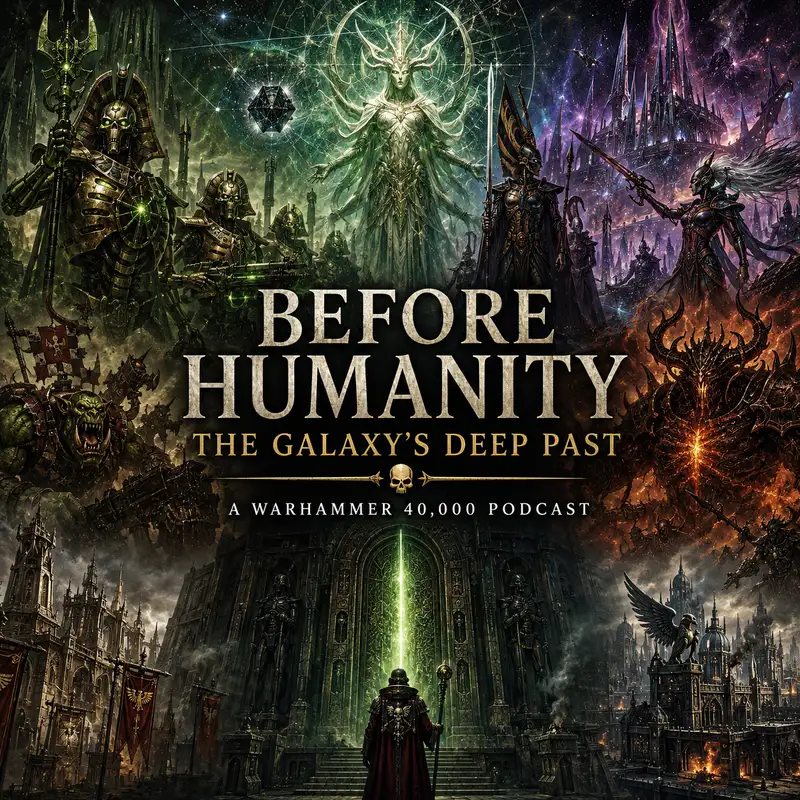
Before Humanity: The Galaxy’s Deep Past
The oldest human cities in the galaxy are young enough to be mistaken for temporary camps beside what lies beneath them. An Imperial colony may raise cathedrals, fortifications, and monuments declaring eternal ownership of a world, only to discover that the bedrock contains doors built before the first human ancestor looked upward. When those doors open, the figures emerging from the dark do not regard themselves as invaders. They regard the people above as trespassers who have become unusually confident.
That is the first truth of the galaxy’s deep past. Humanity arrived late.
The Imperium measures history in millennia. Its oldest institutions have endured for roughly ten thousand years, which is quite long by human standards and barely a pause to some of the beings still active in the forty-first millennium. The events that shaped the galaxy began tens of millions of years earlier. By the time humanity appeared, the stars had already witnessed empires, engineered species, living gods, wars fought through other dimensions, and at least one catastrophe large enough to damage the nature of reality.
The surviving record is not a reliable chronicle. Much of it comes from Necron nobles whose memories have decayed, been altered, or been arranged to flatter their dynasties. Other fragments survive as Aeldari myth, where history, religion, and symbolic drama are often inseparable. Human scholars possess ruins, forbidden translations, and a regrettable tendency to execute one another before comparing notes. Accounts differ because almost everyone who could have written a neutral history died approximately sixty million years ago.
Even the name most often given to the great conflict, the War in Heaven, is deceptive. It suggests one campaign with a beginning, a decisive middle, and a clean end. The truth appears to have been a succession of wars, rebellions, creations, and disasters spread across immense periods of time. Whole species may have risen and vanished between phases. What remains is less a complete history than the outline left by an explosion.
Before the Necrons, before the Aeldari empires, and long before humanity, there were the Old Ones.
No one can say with confidence whether the Old Ones were a single species, an alliance, or a name later cultures gave to several related powers. They were ancient even by the standards of the galaxy’s oldest survivors. They understood biology as an instrument, psychic power as a science, and the structure of space as something that could be engineered rather than merely crossed.
Their greatest monument was the Webway, a vast network of passages existing between the material universe and the Warp. Through it, the Old Ones could move between distant regions without relying upon ordinary travel through either realm. Armies, travellers, and knowledge could cross interstellar distances while avoiding many of the dangers that would later make Warp travel an occupational argument for staying home.
The Old Ones also appear to have guided, altered, or created life across the galaxy. Their motives remain uncertain. They may have been gardeners, imperial planners, scientists, strategists, or all four at different times. Later species remembered them as creators and teachers, but gratitude is not the same as evidence. A civilisation capable of designing intelligent life may cultivate worlds out of generosity. It may also be preparing strategic depth.
Whatever their intentions, the Old Ones possessed what another ancient people desperately wanted. They had longevity, mastery of the immaterial realm, and freedom from many of the limits imposed by ordinary flesh.
That other people were the Necrontyr.
The Necrontyr arose beneath a hostile star. Their lives were short, disease was common, and death shaped their culture from the beginning. Their cities and dynasties were built in the presence of mortality, not as an abstract future but as a daily certainty. Tombs, memorials, and the authority of the dead became central to their civilisation.
They were not primitive victims awaiting rescue. The Necrontyr developed extraordinary science, crossed the stars, and established powerful dynasties. Their technology could challenge the achievements of almost any later civilisation. Yet every triumph remained bounded by the same insult. They could conquer worlds, manipulate matter, and calculate the motion of suns, but they could not escape the weakness of their own bodies.
The Old Ones could.
The Necrontyr sought the secret of immortality, or at least relief from the condition that defined them. The Old Ones refused, or perhaps could not provide what was demanded. The surviving accounts rarely pause to consider whether immortality can be handed from one species to another like a diplomatic gift. The Necrontyr saw only arrogance. Their rulers also faced bitter divisions among the dynasties, and an external enemy offered a convenient method of restoring unity. Declaring war to resolve domestic instability was not their most original invention.
The first struggle went badly for them.
The Old Ones could use the Webway to appear where they were needed, withdraw before retaliation, and sustain a war across distances that crippled conventional strategy. Their psychic mastery gave them options the Necrontyr could not easily answer. The Necrontyr possessed formidable weapons and determination. The Old Ones possessed control of the routes, the initiative, and the ability to choose when battle occurred. Determination is admirable, but it is not a substitute for operational mobility.
Defeat did not cure the Necrontyr of resentment. It deepened it.
Then they found the C’tan.
The C’tan were not gods in the same manner as the powers of the Warp. They were entities of the material universe, vast intelligences associated with the energy of stars. In their natural state, they were almost impossible for ordinary beings to perceive or communicate with. Necrontyr science gave them bodies of necrodermis, living metal shaped into forms through which these star-born beings could act directly.
The Necrontyr believed they had given form to allies. In practice, they had invited cosmic predators into the room and provided them with ceremonial robes.
Among the C’tan were beings later remembered as the Deceiver, the Nightbringer, and the Void Dragon. Their names are translations and titles, not comfortable explanations. They offered the Necrontyr what the Old Ones had denied them. Immortality. Strength. Unity. Revenge.
The offer was accepted by Szarekh, the last of the Silent Kings.
Whether Szarekh acted from desperation, ambition, genuine concern for his people, or some combination cannot be settled. The available accounts suggest that he understood the bargain as a path to survival and victory. The C’tan understood it as a harvest.
The process was called biotransference.
Across the Necrontyr domains, immense furnaces consumed bodies and transferred minds into forms of living metal. Illuminor Szeras is remembered as the architect who made the process possible. The nobility retained complex personalities, memory, and ambition. Warriors preserved enough awareness to obey and fight. The mass of the population received far less. Artisans, labourers, families, and ordinary citizens became ranks of near-mindless Necron Warriors.
The social order of the dynasties survived the death of the species with remarkable efficiency. The powerful remained individuals. Everyone else became equipment.
The C’tan consumed the souls released during the transformation. What emerged from the furnaces could endure across ages, repair damaged bodies, and march without fatigue. The Necrontyr had escaped disease, ageing, and death. They had also ceased to exist as a living people.
Immortality had been delivered exactly as promised, which is often the most dangerous kind of bargain.
Szarekh discovered that the command protocols embedded within the Necrons gave him absolute control. He also discovered that his people were bound to the C’tan and that regret is of limited practical value once an entire civilisation has been fed into a furnace. The Necrons went back to war, not as the bitter mortal dynasties that had been defeated, but as legions that could rise after being shot apart and obey without fear.
This phase of the War in Heaven changed the balance.
The Necrons brought weapons capable of stripping matter apart and technologies that treated ordinary physical law as a suggestion. The C’tan could reshape battlefields, consume life, and wield energies that made fleets and fortresses seem temporary. The Old Ones still possessed the Webway and immense psychic power, but they now faced enemies who did not tire, did not age, and could replace tactical caution with repeated annihilation.
The surviving stories describe suns extinguished, systems ruined, and weapons whose effects continued long after those who fired them were gone. Some of that language may be mythic exaggeration. Some of it may be the inadequate vocabulary of later civilisations trying to describe engineering they no longer understand. The ruins scattered across the galaxy suggest that understatement would be equally unwise.
Pressed toward destruction, the Old Ones answered as they always had. They shaped life.
Among the warrior races associated with the Old Ones were the ancestors of the Aeldari and the Krork. The exact degree of deliberate creation remains obscured by myth, but both were suited to a war in which conventional armies were no longer enough.
The Aeldari possessed powerful psychic potential, speed, intelligence, and a deep connection to the Warp. Their oldest legends of gods, heroes, and cosmic conflict may preserve memories of this age, though memory expressed through religion does not behave like a military archive. Figures such as Khaine, Vaul, and Cegorach may represent divine beings, historical forces, symbolic truths, or several of these at once.
The Krork were made for a different requirement. They were immensely powerful warriors supported by a biological system able to spread, survive, and continue fighting under conditions that would erase more delicate species. Their distant descendants are the Orks. The decline or transformation from Krork to Ork is not clearly recorded, but the inheritance remains obvious. Orks do not merely survive war. Their entire biology treats war as a favourable climate.
Other peoples also fought beside the Old Ones, many now reduced to names in broken records or traces in Aeldari legend. This was not a war between two neat alliances. It became an ecosystem of created soldiers, enslaved dynasties, star gods, psychic weapons, and species trying to survive the strategies of their makers.
The Old Ones had turned the Warp into a strategic advantage. The War in Heaven helped turn it into a catastrophe.
The Warp reflects emotion and psychic activity. As suffering spread across the galaxy, and as increasingly powerful psychic species entered the conflict, the immaterial realm grew more turbulent. Passages that had once been comparatively stable became dangerous. Predatory entities found new opportunities. Some accounts place the Enslavers, creatures capable of using psychic minds as gateways and hosts, among the disasters that overwhelmed the final defences of the Old Ones.
The precise sequence remains disputed. The important point is that the war escaped the control of those fighting it. The Old Ones had cultivated psychic life to oppose enemies rooted in the material universe. The resulting violence poisoned the medium from which that power came. They had found a weapon capable of reaching beyond physical law and then discovered that the weapon had wildlife.
The Old Ones fell.
Whether they were completely exterminated, scattered beyond recovery, or survived in some diminished and hidden form is unknown. Their empire vanished. The Webway remained, damaged but immense. Their servant and successor races endured. Their enemies stood among the wreckage.
The C’tan might have expected eternal dominion. Szarekh had other intentions.
The Silent King could not strike while the star gods were at full strength. He waited until the Old Ones were defeated and the C’tan had been weakened by war and by conflict among themselves. Then the Necrons turned upon their masters.
This was not a rebellion fought with ordinary weapons. The Necrons focused energies capable of breaking beings that had once fed upon stars. Most of the C’tan could not be killed outright, or their destruction was judged too dangerous. Instead, they were shattered into fragments. Those shards were imprisoned within devices such as tesseract labyrinths and eventually used as weapons by the very people they had enslaved.
It was revenge on a scale only the Necrons could manage. They overthrew their gods, broke them into useful pieces, and placed them in storage.
Victory carried a cost. The Necrons had spent themselves fighting the Old Ones and then the C’tan. The Aeldari and other surviving creations of the Old Ones remained powerful. Szarekh understood that his people might win another war only by destroying what remained of them.
So he chose patience.
The Silent King ordered the Necron dynasties into the Great Sleep. Across countless worlds and hidden tomb complexes, the legions descended beneath the surface. Their cities sealed. Their machines slowed. They would wait while their enemies aged, divided, and died.
For roughly sixty million years, they slept.
Before leaving, Szarekh destroyed the command protocols that had given him absolute control and released the Necrons from compulsory obedience. It was an act of liberation performed after the people capable of enjoying freedom had largely been erased. He then departed into exile beyond the galaxy, carrying a burden no throne could dignify.
The Aeldari inherited the age that followed.
For millions of years, their civilisation spread across the galaxy. They mastered the Webway, shaped worlds, developed technologies that later species would call miraculous, and grew so secure that danger became remote. The descendants of a warrior race created for an ancient emergency became the rulers of an empire with no serious rival.
That empire would eventually destroy itself in the Fall, birthing Slaanesh and tearing open the Eye of Terror. That disaster belongs to a later age, but its roots lie in the victory after the War in Heaven. The Aeldari inherited a galaxy without the powers that had once restrained them. Their triumph lasted so long that history became mythology and supremacy became normal.
The Orks also endured. Whatever grandeur the Krork possessed was diminished or transformed, but the fundamental design proved brutally successful. Civilisations collapsed. Orks remained. Their technology, culture, and instinctive drive toward conflict are not random comic accidents. They are the surviving machinery of an ancient war, stripped of its original command structure and still functioning enthusiastically.
The Necrons remained beneath worlds that changed names thousands of times. Continents shifted above their tombs. Species evolved, migrated, and vanished. Aeldari travellers sometimes found and destroyed sleeping complexes, but countless others survived. When humans eventually colonised those worlds, they built cities over machines they could neither detect nor understand.
The C’tan survived as shards. The Webway survived as a broken road system through impossible space. The Warp remained dangerous. The Aeldari carried the memory of the Old Ones. The Orks carried the biology of their final armies. Almost every major power of the later galaxy inherited something from that first catastrophe.
Humanity inherited the consequences without understanding the cause.
This changes how the forty-first millennium should be seen. The Imperium is not the owner of an ancient galaxy defending its rightful borders against newcomers. It is a young and violent state occupying ruins it usually cannot identify. A Necron lord reclaiming a tomb world may be monstrous, but the claim can be older than human evolution. An Aeldari force protecting a maiden world may appear without warning because its interest in that world predates every Imperial chart. An Ork invasion may be another movement in a war machine set in motion before Terra had a name.
None of this makes the ancient powers noble. Age is not virtue. The Old Ones engineered species for war. The Necrontyr chose conquest and accepted a bargain that destroyed their own people. The C’tan treated civilisations as food. The Aeldari inherited supremacy and eventually turned abundance into ruin. The galaxy’s elders are not wise parents watching disappointing children. They are survivors, weapons, prisoners, and heirs to crimes so old that even the perpetrators remember them incorrectly.
The deep past matters because it explains why the galaxy seems built for catastrophe. Its hidden roads were made by a vanished power. Its oldest armies were designed rather than recruited. Its gods can be predators, psychic reflections, or fragments chained inside machines. Its great species did not develop in isolation. They were shaped by one another through war.
Humanity did not create this condition, though it has contributed with impressive energy. The Imperium’s wars, the rise of Chaos, and the opening of the Great Rift belong to later history. Beneath them lies an older pattern. Civilisations seek mastery, turn living beings into instruments, mistake power for control, and discover that victory has prepared the next disaster.
The War in Heaven ended, but it was never truly resolved. The Old Ones vanished without repairing what they had broken. The Necrons escaped their masters without regaining their souls. The Aeldari won the future and used it to create a god that hunts them. The Krork survived by becoming something their makers might no longer recognise. The C’tan were defeated and remain dangerous in captivity.
That is the galaxy before humanity. Not an empty wilderness waiting for explorers, and not a peaceful golden age spoiled by younger races. It was already a battlefield layered with graves, sealed arsenals, abandoned roads, and unfinished vengeance.
Above a sleeping tomb, an Imperial priest may declare that a world has belonged to humanity since time immemorial. Far below, machines older than his species are counting down toward dawn.
Humanity did not enter an empty galaxy. It arrived late, armed, and already standing on the battlefield.