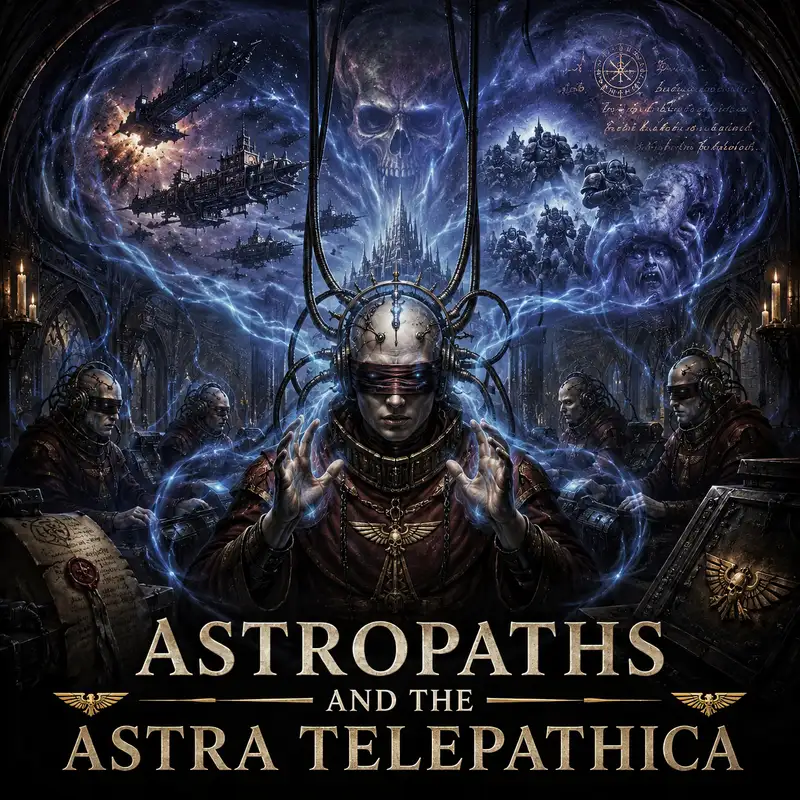
Astropaths and the Astra Telepathica
An Imperial commander can watch an enemy fleet burning toward his world and still have no reliable way to warn the next star system. His vox can reach orbit. His couriers can carry sealed orders aboard a ship. Neither is fast enough. For a message to cross the interstellar dark before the enemy does, it must be placed in the mind of a blinded psyker, hurled through the Warp, and caught by another mind that may be hundreds or thousands of light-years away. The Imperium calls this communication. A more honest description would be controlled haunting.
That single fact explains much of how the Imperium survives, and much of why it functions so badly. The Imperium of Man is not one connected state in the modern sense. It is a scattered empire of worlds separated by distances that ordinary signals cannot cross within a useful lifetime. Ships can move faster than light only by entering the Warp, where time, distance, and causality become negotiable. Messages face the same problem. Without astropaths, Terra could issue decrees, but most of the galaxy would learn of them generations too late. Crusades would sail without updated orders. Governors would rule without oversight. Distress calls would arrive as archaeology.
An astropath is not simply a powerful human radio. Astropaths are sanctioned psykers trained to send and receive thoughts through the Warp. They do not guide ships. That task belongs to Navigators, whose mutant sight allows them to perceive the psychic beacon of the Astronomican and steer through the immaterium. Astropaths carry information. Navigators carry vessels. The Astronomican provides a point of reference. The three functions are related because all depend upon psychic contact with the Warp, but they are not interchangeable. Confusing them is rather like confusing a map, a messenger, and the person driving the staff car. Imperial bureaucracy has executed people for smaller errors.
The organisation responsible for finding, judging, training, and controlling Imperial psykers is the Adeptus Astra Telepathica. Its name suggests a specialist communications service. Its actual reach is far wider. It administers the great psychic tithe demanded from Imperial worlds. It operates the Black Ships that gather psykers. It maintains the institutions that test and sanction those who can be used. It supplies astropaths to fleets, fortresses, sector capitals, military headquarters, and distant colonies. It also ensures that those considered too dangerous do not return home. The Astra Telepathica is therefore part school, part intelligence service, part transport network, part priesthood, and part machinery for processing human beings into state resources.
Every Imperial world is expected to identify its psykers. The method varies. On one planet, local officials may maintain registries and conduct examinations. On another, frightened villagers may drag a child to a shrine after the child dreams of a murder before it happens. Some psykers reveal themselves through visions, voices, impossible accidents, or uncontrolled manifestations. Others hide for years. The fear surrounding them is not entirely superstition. An untrained psyker can attract entities from the Warp, become possessed, tear open a breach in reality, or simply lose control in a crowded room. Yet fear also creates denunciation, cruelty, and convenient accusations. In the Imperium, a genuine danger and an excuse for persecution are often permitted to share the same uniform.
Those captured or surrendered are held until the arrival of a Black Ship. These vessels are among the most dreaded sights in Imperial space. Their holds are designed to contain psychic prisoners, their corridors protected by wards and dampening systems, and their crews trained for work that can become catastrophic without warning. The Sisters of Silence, whose null presence suppresses psychic power, have long been associated with this duty, although the exact composition of Black Ship crews has varied across eras and regions. For the psykers aboard, the voyage is a passage into uncertainty. They are cut off from families, names, and previous lives. Few know whether they are being taken to service, execution, sacrifice, or something for which the Administratum has not yet invented a reassuring term.
On Terra and at other centres of the Astra Telepathica, the captives are tested. Strength alone is not enough. A useful Imperial psyker must possess control, discipline, resilience, and some chance of resisting corruption. The most dangerous may be destroyed. Some are selected for training as sanctioned psykers and later serve in armies, institutions, or the retinues of powerful officials. Some are chosen for the Adeptus Astronomica, whose choirs sustain the Astronomican. Others are consumed by the psychic demands surrounding the Golden Throne and the Emperor’s continued existence. A smaller number possess the qualities required for astropathic service. Survival has brought them to the threshold of a new life, although the Imperium’s definition of survival is unusually flexible.
The Scholastica Psykana trains those selected for sanctioned service. For an astropath, training is not merely learning to project a thought. The student must learn to distinguish an ordinary dream from an alien touch, to build mental barriers, to recognise emotional contamination, and to transmit meaning without allowing the Warp to reshape it completely. Discipline is ritualised because ritual gives the mind a structure it can cling to. Repetition, prayer, mnemonic forms, symbolic languages, and psychic exercises all serve practical purposes, even when the people performing them no longer understand every original reason. The Adeptus Mechanicus preserves machines through liturgy. The Astra Telepathica preserves minds in much the same fashion, except the equipment can scream.
The defining transformation is soul-binding. Astropaths are brought into psychic contact with the Emperor, traditionally within the Imperial Palace on Terra. The exact experience is beyond ordinary description, and surviving accounts are filtered through religious awe, trauma, and institutional secrecy. What is clear is that the process brands the astropath’s soul with a measure of the Emperor’s psychic presence. This strengthens resistance to the predators of the Warp and makes long-range telepathy more survivable. The price is severe. Many die. Many lose their physical sight as their eyes are burned out or ruined by the experience. Those who live often perceive the world through psychic senses that do not resemble ordinary vision. The Imperium has taken their eyes and given them a safer way to look into hell.
That safety is relative. An astropath does not hear a distant message as a clean voice speaking across an empty room. The Warp is formed by emotion, thought, memory, and the pressure of sentient life. Meaning travels through it as image, sensation, symbol, instinct, and dream. A warning about an approaching fleet might arrive as iron teeth closing around a blue sun. A request for reinforcements might be felt as a fortress drowning beneath black water. Names, coordinates, and numbers can be transmitted, but they are vulnerable to distortion. Skilled astropaths learn shared symbolic systems and methods of psychic encoding. The receiver must interpret what arrives, compare it with expected patterns, and decide which details are literal. This is communication performed by trained professionals who must also be part cryptographer, part mystic, and part survivor of repeated nightmares.
For important traffic, astropaths work in choirs. A choir combines several minds under the direction of a senior astropath, increasing range, clarity, and endurance. Great naval bases, sector capitals, major warships, and command centres may maintain dedicated choirs in protected chambers. The architecture is often cathedral-like, because the Imperium cannot build a secure workplace without making it suitable for a funeral. Choirs provide redundancy. One astropath may detect a pattern another misses. Several receivers can compare impressions. A powerful sender can be supported by others who absorb strain or reinforce the signal. The arrangement also spreads the danger. When a transmission carries psychic contamination, the entire choir can suffer.
Major voidships often carry their own astropathic sanctums. A battleship may support a choir, while a smaller vessel may depend upon one exhausted specialist and a locked door covered in wards. Rogue Traders, inquisitors, Space Marine strike forces, merchant houses, and pilgrim fleets all value astropaths because distance without communication turns authority into guesswork. The death of a ship’s Navigator can leave it unable to cross the Warp safely. The death of its astropath creates a different isolation. The ship may still travel, but it cannot call ahead, request aid, report discoveries, or learn that the destination has fallen. It becomes a sealed fragment of the Imperium carrying orders that may already be obsolete. For crews used to delayed news, that silence is still frightening. They know how much of their safety depends upon someone sitting alone in a chamber and dreaming in a direction.
A message begins with preparation. The sender must know the intended destination, the receiving choir, or at least the psychic direction in which the signal should be cast. Conventional ciphers and authentication phrases may be included because telepathy does not abolish espionage. The content is reduced to a form the astropath can hold and project. Urgent military traffic may be transmitted in compressed bursts, with essential facts repeated through different symbols. The astropath enters a trance, reaches into the Warp, and releases the construct. At the far end, another astropath senses the disturbance and draws it into a comprehensible shape. Between those two moments lies a medium populated by storms, predators, echoes, and the emotional debris of an entire species.
Distance matters, but not in a simple way. A nearby system may be unreachable during a violent warp disturbance, while a distant choir may receive a clear signal under favourable conditions. Messages can arrive late, fragmented, or out of sequence. A warning may precede the event that caused it. Another may emerge decades after it has any value. Astropaths use relays because repeated transmission can carry information across enormous distances more reliably than a single leap. Each relay, however, introduces another interpretation and another chance of error. By the time an order crosses several sectors, it may have been translated, authenticated, summarised, retransmitted, and partially reconstructed. The final recipient may possess the Emperor’s seal and only half of the Emperor’s sentence.
This uncertainty shapes Imperial warfare. A crusade commander may request reinforcements and receive them after the campaign has ended. A governor may report rebellion, then suppress it, then be executed when the original report reaches a superior who mistakes the crisis for a current event. Fleet admirals often act on incomplete information because waiting for confirmation can be more dangerous than being wrong. Astropathic messages can coordinate strategic movement, but they rarely provide the continuous command link expected by a tightly integrated modern military. Imperial commanders are therefore granted enormous discretion. Success depends upon doctrine, local judgment, and the willingness to explain later why the order that finally arrived would have produced a disaster.
Distress calls reveal the system at its most desperate. When a world faces invasion, its astropaths may transmit until exhaustion, psychic injury, or death. The message is often less a report than a beacon of fear wrapped around a few critical facts. Nearby choirs may detect it faintly. Merchant captains may carry copies onward. Sector authorities may compare several broken transmissions and realise that a threat is moving across multiple systems. This is how invasions become known beyond the worlds already burning. It is also how rumours become strategy. A garbled image of claws, hunger, and a dead moon might indicate Tyranids, daemonic assault, or one astropath having a particularly bad morning. Context decides whether fleets move.
The same limitations that complicate war also shape Imperial government. Terra cannot supervise every world in real time. Sector and subsector authorities must make decisions without immediate guidance. Planetary governors possess wide practical autonomy as long as they pay the tithe, suppress rebellion, and maintain loyalty. The Imperium’s feudal character is not merely ideological. It is technological and geographic. Astropathic communication allows the centre to exert influence across the galaxy, but not continuous control. Orders travel. So do petitions, tax records, accusations, appointments, and demands for troops. They arrive with delays and gaps that local rulers exploit. The Imperium is held together by messages that are just reliable enough to prevent complete fragmentation and just unreliable enough to make fragmentation a permanent condition.
Astropathic communication is also a security problem. The Warp is not private. Enemy psykers may sense transmissions, intercept fragments, or trace psychic activity. Chaos can exploit dreams, symbols, and emotional weaknesses. A message may carry false imagery or a concealed psychic attack. Receivers use wards, ritual protections, verification codes, trusted relays, and multiple interpretations to reduce the risk. Sensitive commands may still travel by courier because a sealed physical record can be slower but harder to alter without evidence. The most important orders often use both methods. An astropathic message gives speed. A shipborne copy gives detail and confirmation. The system assumes that one channel may fail, which is a rare example of the Imperium learning from experience without first building a shrine to the failure.
The astropaths themselves live in an uneasy social position. They are essential servants of the state, sanctioned by the Emperor’s authority, and treated with a degree of reverence. They are also mutants whose presence unsettles ordinary humans. Many spend their lives in sealed chambers, aboard ships, or within fortified relay stations. Their work brings repeated exposure to alien thoughts, mass terror, dying worlds, and the pressure of the Warp. Burnout is common. So are physical decline, psychological damage, and sudden death. Some astropaths become respected masters with remarkable control. Others are reduced by service until they can barely separate their own memories from the messages they have carried. The Imperium honours sacrifice most efficiently when it does not have to watch it happen.
It would be easy to describe the Astra Telepathica only as another cruel Imperial institution, and cruelty is built into its operation. Children and adults are seized. Prisoners vanish into Black Ships. Survivors are remade without meaningful consent. Countless psykers are expended. Yet the danger the institution confronts is real. An uncontrolled psychic population would not produce freedom. It would produce possessions, warp breaches, cults, and disasters large enough to consume worlds. The Astra Telepathica protects humanity by using methods that deny much of the humanity of the people it protects. That contradiction is not an accidental flaw. It is the institution’s foundation.
Its officials would argue that there is no alternative at Imperial scale. Every psyker represents risk, but also possibility. A telepath can warn a system. A sanctioned battle psyker can break an enemy assault. A trained seer can detect threats before conventional intelligence. A soul-bound astropath can connect isolated worlds to a civilisation they may never physically visit. The system takes dangerous individuals, sorts them according to utility, and places them where their gifts serve the state. That logic is brutally coherent. It is also the logic of a machine that measures a human life according to whether it can be converted into communication, navigation, warfare, illumination, or fuel.
The opening of the Great Rift exposed how dependent the Imperium had become on this fragile machinery. When the Cicatrix Maledictum tore across the galaxy, warp storms disrupted travel, obscured the Astronomican, and shattered astropathic contact across vast regions. Worlds on the far side of the rift entered the long darkness often called the Noctis Aeterna. Some heard nothing from neighbouring systems. Others received only screams, visions, or messages that could not be dated. The Imperium Nihilus did not cease to exist in one instant. It became a collection of isolated struggles, each forced to decide what loyalty meant when Terra could no longer answer.
In those regions, an astropathic signal could become more valuable than a fleet. A single coherent transmission might prove that another human world still survived. A choir might carry a warning around a storm that no ship could cross. The arrival of a message could restore a chain of command, reveal a safe route, or summon forces months too late but not entirely useless. Astropaths became living evidence that the Imperium remained connected, however faintly. Their work did not overcome the Great Rift. It created brief bridges across it, built from exhausted minds and symbols dragged through darkness.
This is why the Adeptus Astra Telepathica cannot be understood merely as the Imperium’s communications department. It is one of the institutions that converts psychic danger into Imperial continuity. The Black Ships gather the raw human cost. The Scholastica Psykana imposes discipline. Soul-binding makes a few survivors capable of enduring what waits in the Warp. Astropathic choirs then spend those lives message by message, holding together fleets, governments, and wars that would otherwise collapse into silence.
The Imperium communicates across the stars because astropaths accept, or are forced to accept, a burden no machine can reliably carry. Their messages are imperfect. Their visions are dangerous. Their institution is merciless. Yet without them, the Imperium would not be a galactic empire at all. It would be a million frightened worlds, each staring into the night and wondering whether anyone else was still alive. The astropath’s gift is not certainty. It is the chance that somewhere beyond the storm, another human mind is listening.