Astra Militarum: Regiments, Officers, and the Human War Machine
The order is to hold until relieved. No one in the trench knows when relief is coming, whether the artillery still has ammunition, or whether the shapes moving through the smoke are enemy infantry, machines, or something that should not exist outside a nightmare. The soldiers are cold, hungry, and very mortal. Their officer has a cracked vox set, a half-empty pistol, and a map that was inaccurate before the bombardment rearranged the landscape.
They hold anyway.
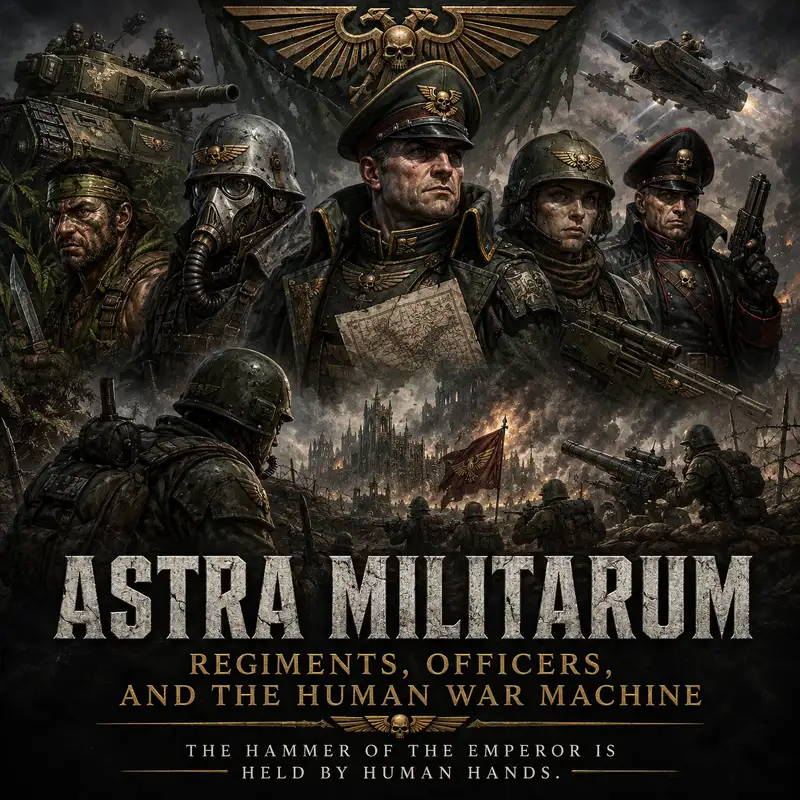
This is the central fact of the Astra Militarum. The Imperium is defended not only by gene-forged warriors, ancient machines, and saints wrapped in fire, but by human beings carrying mass-produced rifles into wars that frequently defy reason. They are called the Astra Militarum in formal Imperial language and the Imperial Guard almost everywhere else. They are not one army in the modern sense. They are thousands upon thousands of military cultures, gathered from worlds that may share little beyond loyalty to the Emperor and a regrettable appointment with the same enemy.
The question is not simply how ordinary humans survive such wars. Many do not. The more revealing question is how the Imperium turns the populations of wildly different planets into a military instrument capable of fighting across the galaxy. The answer lies in three things. Regiments give soldiers identity. Officers turn that identity into action. The Imperial bureaucracy supplies scale, usually with several signatures, a missing cargo manifest, and the calm assumption that any problem can be solved by requisitioning more people.
Most Imperial worlds owe a tithe to the greater Imperium. That obligation can include raw materials, food, manufactured goods, specialist labor, and soldiers. A planetary governor may be ordered to raise one regiment or many, depending on the world, the threat, and the appetite of distant officials who will never hear the guns. The recruits may come from a planetary defence force, from volunteer formations, from conscription, from hereditary warrior castes, from noble households, or from entire communities whose lives have always pointed toward military service.
A planetary defence force is meant to protect its own world. The Astra Militarum is meant to leave it. Once a regiment is accepted, inspected, blessed, numbered, and loaded aboard transport ships, its soldiers enter a much larger system. They may fight several sectors away from home. They may spend years in transit and longer in campaigns. Some return. Many never do. Veterans may be granted settlement rights on conquered worlds, meaning that one planet’s military traditions can take root beneath another planet’s sky.
The regiment is therefore more than an administrative formation. It is a travelling fragment of home.
A regiment carries accents, prayers, food customs, rivalries, songs, funeral rites, standards, and ideas about what courage looks like. Its soldiers may have grown up under the same poisoned rain, inside the same hive towers, across the same frozen plains, or beneath the same predatory jungle canopy. They understand one another in ways that an off-world commander may not. That shared culture can produce extraordinary cohesion. It can also produce feuds, stubbornness, and the firm conviction that every other regiment has been trained incorrectly.
The word regiment sounds precise, but precision is not the Imperium’s strongest habit. One regiment may contain a few thousand soldiers. Another may be vastly larger. Titles, ranks, and internal structures vary from world to world. A formation called a company on one planet might resemble a battalion somewhere else. The Departmento Munitorum records these differences, standardises what it can, and then sends everyone to war under paperwork suggesting that the matter has been settled.
What truly defines a regiment is not its exact size. It is its origin, its command, and its military purpose.
Some worlds produce disciplined generalists. Others provide specialists shaped by their environment. A frozen world may raise troops accustomed to bitter cold. A hive world may produce soldiers comfortable in ruins, tunnels, and densely packed cities. A world of open plains may send cavalry or mobile infantry. A heavily industrialised planet may supply armoured regiments. A death world may produce survivors who regard a hostile battlefield as a modest improvement over home.
Cadia became the most influential example of the first kind. For thousands of years, it stood near the gateway through which the forces of Chaos repeatedly assaulted the Imperium. Cadian society was organised around defence. Military training was not a strange interruption to civilian life. It was woven into the culture from childhood. Cadian Shock Troops became known for discipline, flexible combined-arms warfare, and the ability to build a functioning defence under pressure.
Cadia itself was destroyed during the thirteenth Black Crusade, but Cadian military culture did not vanish with the planet. Regiments were already scattered across the Imperium. Survivors continued to fight. New formations adopted Cadian equipment, methods, and identity. Cadia became both a lost home and a standard others tried to imitate. Its soldiers proved that a regiment can outlive the ground that gave it a name.
Catachan produced something very different. Its jungles are so lethal that survival itself is a form of military preparation. Catachan Jungle Fighters are skilled in ambush, fieldcraft, close combat, and operating in terrain that swallows conventional formations. Their culture values toughness, initiative, and practical experience. A Catachan soldier may respect an officer who shares danger and understands the ground. Rank alone is less persuasive, particularly when the person wearing it appears unfamiliar with either danger or ground.
This can make Catachan formations difficult for rigid outsiders to command. It also makes them exceptionally effective when given missions that reward independence. The Imperium does not always enjoy soldiers who think for themselves. It does, however, enjoy the results when those soldiers return from a jungle in which everyone else disappeared.
The Death Korps of Krieg represent another path. Krieg’s regiments are shaped by a culture of collective guilt and redemption born from their world’s catastrophic civil war. They are associated with siege warfare, attrition, trench systems, artillery, and an almost unnerving acceptance of sacrifice. Their gas masks and greatcoats are practical equipment, but they also erase individuality. A line of Krieg soldiers looks less like a gathering of separate people and more like a single idea advancing through smoke.
It is tempting to describe them as mindless. That misses the point. The Death Korps are trained, organised, and capable. Their tragedy is that their culture teaches them to measure human life against duty in a way that leaves very little room for self-preservation. Even commissars, normally assigned to prevent soldiers from fleeing, may find themselves restraining Krieg troops from spending lives too freely. In most armies, the political officer urges the troops forward. With Krieg, the difficulty may be persuading them that the minefield will still be there after the artillery has fired.
Other regiments widen the picture. The Armageddon Steel Legion fights from armoured transports across poisoned industrial wastes. Attilan Rough Riders preserve a mounted warrior culture while carrying explosive hunting lances capable of threatening machines far larger than their horses. Mordian troops turn relentless drill and formal discipline into battlefield steadiness. Tallarn forces are masters of mobility, concealment, and war across harsh deserts. The Imperium does not erase these differences because it cannot, and because those differences are useful.
A sensible high command assigns each regiment where its strengths matter. Catachans scout through lethal vegetation. Armoured formations break open a front. Siege troops reduce fortifications. Infantry holds ground. Artillery reaches beyond the horizon. Cavalry and reconnaissance units exploit gaps. The Astra Militarum’s variety allows it to answer almost any military problem somewhere in its vast order of battle.
The difficulty is getting the correct answer to the correct planet.
Regimental specialisation creates dependence. At the strategic level, the Guard fights through combined arms, joining infantry, tanks, artillery, engineers, reconnaissance, air support, and logistics. At the regimental level, many formations are much narrower. An infantry regiment may have little heavy armour of its own. An armoured regiment may need other units to protect its vehicles in broken terrain. Artillery is devastating only if someone finds the target, communicates its position, and prevents the enemy from reaching the guns.
This is partly practical and partly political. After the Horus Heresy, Imperial military power was divided so that no single commander would easily control the complete machinery of conquest. The Imperial Navy moves armies between stars and fights in space. The Astra Militarum wages the ground war. Air power, transport, armour, and infantry may belong to separate commands. Cooperation is essential, but complete independence is discouraged. The system is inefficient by design because the Imperium fears another rebellion almost as much as it fears losing the current war.
That brings the officers into the story.
A regiment’s officers are usually products of the same world as their soldiers. They understand its customs, doctrine, and assumptions. Some are professional soldiers raised through academies. Some are nobles for whom command is a hereditary privilege. Some rise from the ranks because everyone above them has died, occasionally during the same afternoon. The Guard can reward competence with remarkable speed when casualties have created an urgent vacancy.
The familiar chain may run from squad leaders through platoon and company officers to a regimental commander, often called a colonel, though titles differ. Above the regiment stand generals, lord generals, and other senior commanders responsible for coordinating whole campaigns. The names are less important than the function. Every level must translate a broad intention into a specific act performed by tired people under fire.
A senior commander may order a city taken. A regimental officer must decide which companies advance, where the artillery fires, when reserves move, and how long the assault can continue. A platoon officer must cross the final distance between the map and the mud. That officer has to point toward an actual doorway, trench, ridge, or ruined hab block and make the order understandable to the soldiers who must reach it.
This is why command squads matter. An officer is rarely just a lone figure waving a sword at the enemy, although Imperial art is extremely fond of that moment. Around the officer may be a vox operator maintaining communications, a medic preserving experienced personnel, a standard bearer carrying the regiment’s visible identity, and veterans providing security and advice. Together they create a small centre of control amid confusion.
The vox is especially important. The Guard’s strength depends on coordination. Scouts identify movement. Forward observers report targets. Officers issue orders. Artillery batteries calculate fire. Tank commanders adjust routes. Infantry receives warnings. A broken communication net can reduce a combined force to isolated groups fighting separate battles. A functioning one can make thousands of humans act with the speed and purpose of a single organism.
Imperial officers are often portrayed as either brilliant heroes or foolish aristocrats. Both exist, but most are somewhere between. They are people operating inside a system that gives them enormous responsibilities, incomplete information, inherited doctrine, political pressure, and subordinates whose lives can disappear in minutes. Some officers conserve their troops, learn from mistakes, and inspire trust. Others mistake casualties for proof of determination. The bureaucracy may promote either, provided the reports are written persuasively.
The best officers understand that human soldiers are not ammunition, even when high command treats them that way. They know when to demand endurance and when to withdraw. They recognise that discipline without trust becomes brittle. They also know that kindness without authority may collapse at the first sight of a charging monstrosity. Command in the Astra Militarum is a constant negotiation between what the mission requires, what the troops can endure, and what the officer is willing to spend.
Beside this chain of command stands another figure in a black coat.
A commissar is not simply another regimental officer. Commissars come from the Officio Prefectus and are often educated through the Schola Progenium. Their duty is political, moral, and disciplinary. They watch for cowardice, disloyalty, corruption, defeatism, and failure of command. They represent an authority beyond the regiment, which means they can challenge officers as well as soldiers.
The summary version is that commissars shoot people who retreat. That does happen. It is not the whole institution. A commissar is meant to preserve the fighting spirit and loyalty of the formation. Execution is one tool, and a spectacularly final one. Effective commissars also use example, rhetoric, religious faith, personal courage, and a careful understanding of their regiment’s culture. Fear can force a person forward once. Respect can keep an entire unit functioning through a campaign.
The famous commissars are remembered precisely because they understood this distinction. Ibram Gaunt combined commissarial authority with direct regimental command, an exceptional arrangement that demanded both military skill and political judgment. Ciaphas Cain cultivated a heroic reputation while privately possessing a much sharper instinct for survival than Imperial propaganda usually admits. Sebastian Yarrick inspired soldiers because he shared their war and became part of its mythology. None of them can be reduced to a pistol behind the line.
Commissars also reveal a fundamental Imperial anxiety. The Imperium needs regiments to possess strong identities because identity creates cohesion. It fears those same identities because loyalty to a home world, commander, or comrades might compete with loyalty to the Emperor. The regimental officer speaks from within the culture. The commissar watches it from outside. When the relationship works, each corrects the other. When it fails, the enemy may become the second most dangerous presence on the battlefield.
Even excellent leadership cannot fight without supply. Behind every charge stands the Departmento Munitorum, the immense logistical apparatus responsible for raising, equipping, assigning, transporting, and sustaining the Guard. It manages weapons, uniforms, rations, fuel, ammunition, replacement parts, medical stores, animals, vehicles, and the movement of personnel on a scale no individual mind could follow.
The Munitorum is easy to mock because its errors can be absurd. A force may receive equipment poorly suited to its environment. Supplies may arrive late, be misdirected, or exist only on a clerk’s ledger. A regiment can survive the enemy and still be defeated by a missing fuel convoy. Yet the same bureaucracy also moves armies across interstellar distances, sustains sieges lasting years, replaces losses from worlds most soldiers have never heard of, and keeps ancient vehicle patterns operating under conditions their designers may never have imagined.
Standard equipment helps. The lasgun is not celebrated because it is the most powerful weapon in the galaxy. It is celebrated because it is reliable, comparatively simple, and supportable in enormous quantities. The Leman Russ battle tank is not elegant, but elegance is of limited value when a vehicle must be manufactured on many worlds, repaired by exhausted crews, and kept moving through ash, mud, ice, or corrosive dust. Imperial equipment survives because it is rugged, widespread, and understood through a mixture of engineering, ritual, and repeated use.
The Guard’s real weapon is not the lasgun, the tank, or the artillery piece. It is the sequence that joins them.
A reconnaissance patrol locates the enemy. A vox message reaches command. An officer identifies the threat and requests fire. Artillery forces the enemy into cover. Infantry fixes it in place. Engineers clear an obstacle. Tanks strike the weakened position. Fresh troops move forward to hold what has been taken. Supply vehicles follow with ammunition and fuel. Medics collect the wounded. Clerks record losses. Priests declare the survival of anyone involved to be evidence of faith.
When the sequence works, the Astra Militarum can crush forces that would destroy any one regiment alone. When it fails, infantry advances without support, tanks enter ground they cannot cross, artillery fires on obsolete coordinates, and headquarters learns of the disaster after receiving a request for replacement forms.
This human war machine is therefore both immense and fragile. It can absorb losses on a scale that would end lesser powers, but it depends on countless individual acts of competence. A loader must place the next shell. A driver must keep the engine running. A signaler must hear the message through static. A junior officer must recognise that the map is wrong. A soldier must stand when every instinct says to run.
Regiments make that possible by giving the soldier a smaller world inside the Imperium. The empire may be too vast to imagine, but the regiment has a name, a standard, familiar faces, and remembered dead. Soldiers may fight for the Emperor, but they also fight because the person beside them is from the same street, hive level, village, clan, or training cadre. They fight because their officer stayed in the trench. They fight because retreat would abandon the wounded. They fight because everyone they trust is watching.
The Imperium often speaks of Guardsmen as numbers. Its greatest victories occur when commanders remember that numbers still feel fear, exhaustion, loyalty, shame, and hope. Its worst defeats often begin when someone at a distant table decides that a regiment is merely a line on a chart and therefore cannot be tired, surrounded, or almost out of ammunition.
The Astra Militarum endures because it is not truly one army. It is a coalition of human worlds forced into common purpose, held together by discipline, logistics, faith, fear, and habit. Its regiments preserve the differences that make soldiers effective. Its officers turn those differences into coordinated force. Its bureaucracy provides the scale to keep replacing what war consumes.
That is the human war machine. It is inefficient, brutal, courageous, wasteful, adaptable, and far more powerful than the individual people inside it. Yet every order still has to be understood. Every weapon still has to be carried. Every line still has to be held by someone who can die.
The Imperium calls the Astra Militarum the Hammer of the Emperor, but every time that hammer falls, a human hand is still wrapped around the handle.