Astra Militarum: Ordinary Humans Against Everything
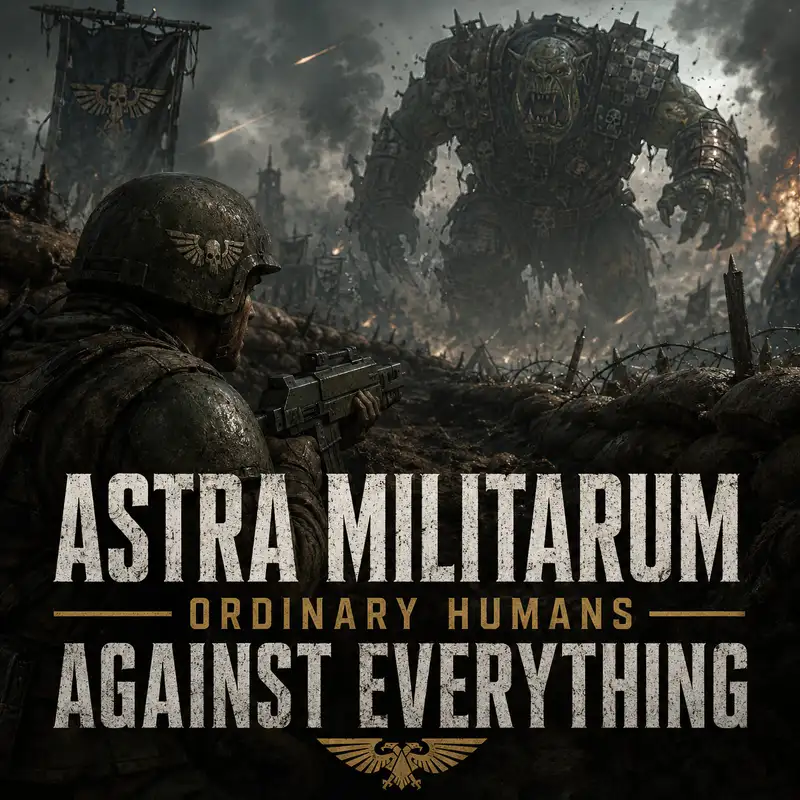
A Guardsman stands in a trench with a rifle that looks painfully small. Beyond the parapet, something is moving through the smoke. It may be an Ork large enough to tear a man apart with its hands. It may be a Tyranid creature bred for the single purpose of crossing this field and feeding. It may be a traitor in power armour, carrying the strength and hatred of ten thousand years. The Guardsman has no gene-enhanced muscles, no ancient war plate, no personal force field, and no reasonable expectation that the enemy will agree to die politely. He has a flak vest, a lasgun, a few orders, and several thousand other frightened human beings standing beside him.
That is the Astra Militarum.
The name is High Gothic, the formal language of Imperial power. Most people simply call it the Imperial Guard. It is not the Imperium’s most glamorous military force, nor its most celebrated. Space Marines receive the statues. Titans shake the ground. Imperial Knights stride through battle like feudal castles that have developed strong opinions about artillery.
The Guard does the ordinary work.
It occupies trenches, escorts convoys, clears cities, guards bridges, digs gun pits, patrols roads, assaults fortifications, and holds ground after the heroes have gone elsewhere. Across the Imperium, it fights wars too numerous to name and too distant for Terra to notice. Many of those wars are decided without a Space Marine ever appearing.
The central question is obvious. How can ordinary humans survive in a galaxy where nearly everything trying to kill them is stronger, faster, older, stranger, or more heavily armed?
The honest answer is that many of them do not survive.
The more important answer is that the Astra Militarum was never designed around the survival of one soldier. It is designed around the endurance of armies.
The Imperium contains an immense variety of worlds. Hive worlds stack billions of people inside continent-sized cities. Agri worlds feed distant populations they will never see. Feral worlds preserve cultures that may barely understand the stars. Forge worlds cover landscapes in industry. Death worlds produce life forms that regard human settlement as a temporary inconvenience.
Most Imperial worlds owe tithes to the greater empire, and one of the most valuable tithes is human. Governors raise troops, equip them according to local custom and available resources, and surrender entire regiments to Imperial service. Those soldiers leave their home world and may never return. They are transported across the Warp to fight enemies they may never have heard of, under skies they may not recognise, for strategic purposes that no one intends to explain to them.
The distinction between a planetary defence force and the Astra Militarum matters. Local forces are raised to defend their own world. Guard regiments are taken beyond it and placed at the service of the wider Imperium. A governor may know every mountain and supply depot on his planet. Once his soldiers are shipped away, that local knowledge is replaced by orders from authorities whose maps may have been copied from maps that were already wrong.
This arrangement also reflects an old Imperial fear. During the Horus Heresy, vast armies and fleets followed rebel commanders against the Emperor. In the aftermath, Imperial military power was divided. The Guard fights on land, while the Imperial Navy controls most interstellar transport and warships. The separation makes rebellion more difficult because a general cannot easily take both an army and the fleet needed to carry it between worlds. It also means that cooperation between services is not merely useful. It is the difference between reinforcement and isolation.
The system is cumbersome by design. The Imperium would rather endure inefficiency than make betrayal convenient.
This is one reason the Guard is so diverse. There is no single Guardsman.
A Cadian is trained within a military culture shaped by millennia of warfare near the Eye of Terror. A Catachan grows up on a jungle death world where the local wildlife has already provided a thorough introduction to close combat. A soldier of the Death Korps of Krieg emerges from a society defined by guilt, sacrifice, and relentless obedience. Tallarn regiments specialise in mobile war across hostile deserts. Valhallans are associated with endurance in punishing cold and with the brutal mathematics of massed warfare.
These are not merely different uniforms placed on the same soldier. Each world produces habits, strengths, prejudices, doctrines, and expectations. Some regiments excel at siege warfare. Others fight from armoured columns, conduct airborne assaults, scout through terrain that would kill an outsider, or maintain parade-ground discipline under fire.
The Imperium rarely wastes time making them culturally compatible.
Regiments from different worlds may be combined inside a larger army, sometimes with impressive results and sometimes with the predictable enthusiasm of people who have just discovered that their allies consider them undisciplined savages. Imperial commanders are expected to turn this variety into military power. The Departmento Munitorum is expected to feed, equip, transport, and replace them. Expected is doing considerable work in that sentence.
The Munitorum is one of the great administrative engines of the Imperium. It can gather soldiers from thousands of planets, move them across interstellar distances, and sustain campaigns lasting generations. That achievement is extraordinary. It can also send cold-weather uniforms to a desert front or deliver ammunition for weapons a regiment does not possess. Both facts are true, and the army must survive between them.
The Guardsman’s basic equipment reflects the scale of the institution. The lasgun is rugged, simple to maintain, and powered by rechargeable energy cells. Against an armoured giant, it can seem inadequate. Against most ordinary bodies, it remains a lethal military rifle. Its great virtue is not that it is the most destructive weapon in the galaxy. Its great virtue is that it can be issued in uncounted millions, supplied across impossible distances, and placed in the hands of soldiers who can be trained to use it.
A single lasgun may not frighten a Carnifex.
A firing line supported by heavy weapons, tanks, mines, and artillery presents a more persuasive argument.
That is the first secret of the Astra Militarum. The individual soldier is only one part of a combined system. Infantry finds and fixes the enemy. Heavy weapon teams engage strongpoints and vehicles. Engineers cut obstacles and build defences. Reconnaissance units locate threats before they reach the main force. Artillery destroys positions beyond sight. Aircraft and the Imperial Navy strike from above. Tanks provide mobile firepower and protection.
The Leman Russ battle tank embodies the Guard’s approach. It is not elegant. It is a slab-sided machine built to function in mud, ash, snow, dust, and ruins. Its main gun can break fortifications, destroy enemy armour, and remind nearby infantry that subtlety is not always a military requirement.
Behind it stand heavier vehicles, including the vast Baneblade and its relatives, machines whose practical answer to most tactical problems is to bring a larger cannon.
The Guard’s artillery is even more important. Many enemies are terrifying at close range. The Astra Militarum therefore prefers, when circumstances and ammunition permit, to kill them from several kilometres away. Basilisk batteries, field guns, mortars, rockets, and siege weapons can turn a defended line into a landscape of craters before the infantry advances.
This is not cowardice. It is professional judgment.
The Guard does not defeat monsters by pretending its soldiers are monsters too. It defeats them by concentrating force. A Guardsman cannot wrestle an Ork. A company can pin an Ork mob in place while tanks crush its flank. A platoon cannot outfight a host of Tyranids in hand-to-hand combat. It can channel them through wire and mines into pre-sighted killing zones. Infantry cannot match a traitor Space Marine in speed or strength. It can identify his position, hold him for a few necessary moments, and bring down enough fire to make his advantages irrelevant.
Of course, the enemy is allowed to object.
Orks thrive on battle and can absorb punishment that would break a human assault. Tyranid organisms adapt, swarm, burrow, fly, and keep coming after the first defensive plan has failed. Necron warriors can rise after apparently fatal damage. Aeldari strike with speed and precision before lumbering Imperial formations can react. The T’au bring coordinated firepower and technology that can expose every weakness in an outdated command structure. Chaos attacks not only the body, but loyalty, memory, hope, and the reliability of reality itself.
Against such enemies, discipline matters as much as weaponry.
The Imperial Guard’s command structure is built around orders. Officers direct movement and fire, maintain the plan, and keep units functioning amid noise and confusion. Good officers understand that courage is not a permanent condition. It is something soldiers borrow from training, comrades, habit, and confidence in leadership.
Bad officers are also plentiful.
The Imperium is a feudal and authoritarian civilisation. Rank may reflect competence, inheritance, political favour, wealth, or the simple fact that every better candidate has already been killed. Some commanders husband their troops carefully. Others spend lives to protect reputations. The scale of the Guard allows brilliance to exist beside criminal stupidity, often within the same campaign.
Commissars stand partly outside the ordinary regimental hierarchy. They are political officers responsible for morale, discipline, and loyalty to the Imperium. Their black coats and severe reputation are not decorative. A commissar may rally a broken line, confront a corrupt commander, expose treachery, or execute someone whose failure threatens the army.
The stereotype is a fanatic shooting soldiers for the slightest hesitation. Such figures certainly exist. Yet a commissar who kills indiscriminately soon discovers that terror is a limited resource, particularly when the enemy is more frightening than he is. The most effective commissars understand their troops. They know when to threaten, when to inspire, when to lead from the front, and when a regiment will follow only someone willing to share its danger.
The Guard is held together by coercion, faith, comradeship, pride, habit, and the knowledge that retreat may merely expose someone else’s home world.
That last motive is easy to overlook. Imperial propaganda speaks constantly of duty to the Emperor. Many Guardsmen believe it sincerely. Others fight for their regiment, their squad, their family, or the person beside them. Some fight because military service is the only life they know. Some are afraid of punishment. Some hate the enemy. Some want to live long enough to become veterans and acquire the rare privilege of knowing which regulations can be ignored.
They are ordinary humans, which means their courage is rarely pure.
That makes it more meaningful, not less.
A Space Marine is created for war through genetic alteration, indoctrination, surgery, and relentless training. A Guardsman may have been a factory worker, a farmer, a hive ganger, a noble’s child, or a professional soldier before the tithe claimed them. Even those raised in military cultures remain human in familiar ways. They get tired. They become hungry. They misunderstand orders. They carry charms. They write letters that may arrive decades late. They fear the dark, especially after learning that the dark occasionally has teeth.
They also adapt.
Veteran Guard units learn the habits of enemies that once seemed incomprehensible. They recognise the sound of incoming fire, the signs of an ambush, the moment an officer’s plan has ceased to correspond with the battlefield. They trade information, modify equipment, develop superstitions that are sometimes nonsense and sometimes fieldcraft wearing a religious coat.
This adaptability is one of humanity’s oldest weapons. The Imperium itself is rigid, suspicious, and resistant to change. The soldiers inside it cannot afford to be. A regiment that survives long enough becomes a record of practical lessons written in scars.
Cadia became the most famous expression of this military culture. The planet stood near the Eye of Terror, guarding the principal route by which the forces of Chaos could strike into the wider Imperium. Its society was organised around defence. Cadians trained from childhood, and their regiments became a standard against which many others were measured.
During the thirteenth Black Crusade, Cadia faced Abaddon the Despoiler’s greatest assault. The campaign involved armies, fleets, daemons, traitor legions, fortresses, and weapons capable of wounding a world. Cadian soldiers fought inside a catastrophe too large for individual courage to control.
Cadia fell.
That point should not be softened. The world was broken, its defences overwhelmed, and the disaster helped tear open the Great Rift across the galaxy. Imperial slogans insist that the planet broke before the Guard did. Like most effective propaganda, the phrase simplifies a much harder truth.
Cadians did break. Units collapsed. People fled. Commanders failed. Soldiers died frightened and confused. Others continued fighting when resistance no longer offered victory, only time. The significance of Cadia is not that every defender became an unshakable statue. It is that enough human beings kept performing their duty amid the destruction of everything that had given that duty meaning.
The surviving Cadians carried their identity off-world. Their home was gone, but their regiments remained. New recruits could join them. Traditions could continue. Cadia became less a planet than a military memory, preserved wherever its soldiers formed ranks.
That is how the Astra Militarum survives defeats that would erase a smaller force. It is not one army gathered in one place. It is a process repeated across the Imperium. Worlds raise regiments. Regiments enter wars. Survivors become veterans. Veterans train replacements. Destroyed units are rebuilt, merged, or remembered. A victory on one world may depend on troops whose own world vanished centuries earlier.
The cost is staggering, and the Imperium often treats that cost as proof of virtue.
Human life is the Guard’s greatest resource and its most abused one. Imperial commanders can spend soldiers because there are always more worlds, more tithes, and more names to enter into records. Entire regiments may be sacrificed to gain time, test an enemy line, or correct a planning failure made far from the front. The language of duty can conceal waste. Heroism can be used to excuse commanders who should never have required it.
Yet it would be a mistake to see the Guard only as helpless victims fed into a machine.
The soldiers possess loyalties and cultures of their own. Regiments remember victories that the wider Imperium has forgotten. They preserve songs, grudges, rituals, slang, and ways of fighting. They may despise allied formations, distrust outsiders, and ignore orders they consider suicidal. Some commanders become beloved because they protect their people. Others discover that an accident involving a live grenade can be surprisingly difficult to investigate during an artillery barrage.
The Guard is an Imperial institution, but it is also millions of small human communities carried from battlefield to battlefield.
Its victories are rarely clean. A Guard army may save a world and leave its cities shattered. It may defeat an invasion only to face purges, famine, or political reprisals. It may fight beside forces whose methods are nearly as frightening as the enemy’s. It may be ordered to destroy civilians exposed to corruption, abandon allies who cannot be evacuated, or hold a line solely because someone of higher rank needs time to escape.
The ordinary soldier does not control the Imperium’s morality. The soldier carries it.
This is why the Astra Militarum captures the central contradiction of humanity in Warhammer forty thousand. It is both courageous and cruel, indispensable and disposable. It protects human civilisation while serving a regime that consumes human beings on an industrial scale. Its soldiers can be genuine heroes without making the Imperium heroic.
They matter because the galaxy is not defended only by demigods.
Space Marines are devastating shock troops, but they are too few to garrison every world or fight every campaign. The Sisters of Battle bring faith and elite discipline, but they do not replace mass armies. Titans can break fortresses, but they cannot search every ruin, guard every road, or occupy every trench. Even the greatest weapon needs someone to hold the ground after it fires.
That someone is usually a Guardsman.
The Astra Militarum survives against everything because it refuses the terms of an individual contest. It does not ask whether one human is stronger than an Ork, faster than an Aeldari warrior, more durable than a Necron, or more terrifying than a daemon. The answers would be discouraging.
It asks whether enough soldiers can hold long enough for the guns to fire.
Whether the tanks can reach the flank.
Whether the engineers can close the breach.
Whether the next regiment can arrive before the current one disappears.
Sometimes the answer is no. Worlds fall. Armies vanish. Names are lost in archives that no one will open.
Sometimes the line holds.
When it does, it is rarely because fear was absent. It holds because frightened people loaded one more power cell, passed one more order, dragged one more wounded comrade into cover, and remained at their post while something impossible came toward them through the smoke.
The Guardsman is not impressive because he belongs in that battle.
He is impressive because he does not, and stands there anyway.