Asdrubael Vect: Tyrant of the Dark City
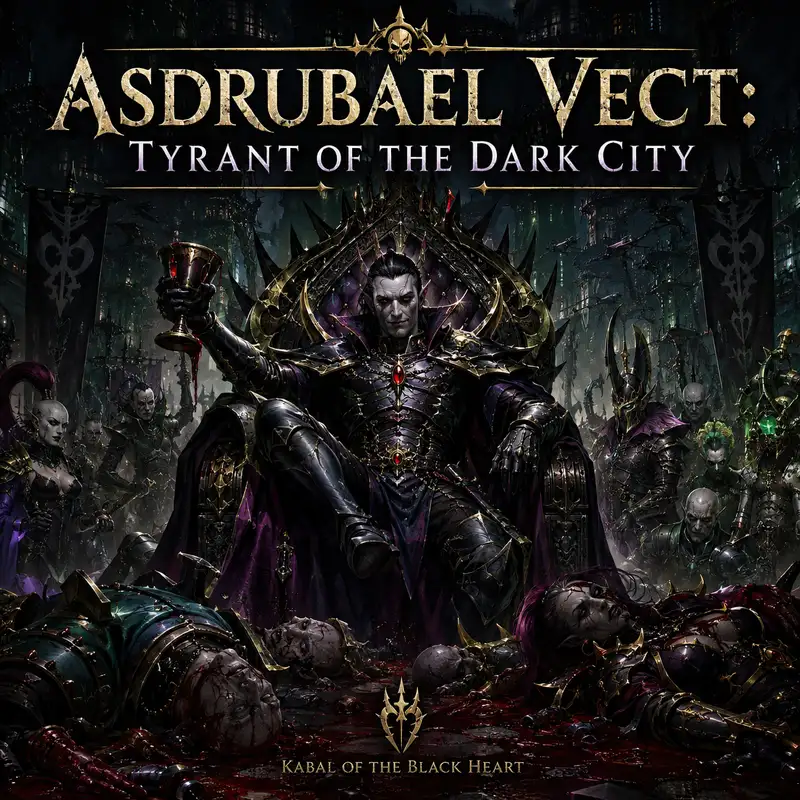
The corpse of Asdrubael Vect lay at the center of a funeral attended by people who had spent centuries imagining his death. Archons came in jeweled armor. Wych leaders came hungry for spectacle. Haemonculi came because death, in Commorragh, is often less a conclusion than a scheduling inconvenience. Above them moved the Harlequins of the Veiled Path, preparing a final performance for the tyrant of the Dark City. Every guest understood the opportunity. Vect was gone. His throne was empty. The knives could finally come out, though in fairness most of them had never been put away.
Then the performance became a massacre. The assembled lords of Commorragh were cut down, their blood spilling across the arena in quantities suitable for both ritual and political reform. At the height of the slaughter, Vect returned. Reborn in a perfected body and surrounded by the ruin of his enemies, he declared himself a living Dark Muse. His funeral had not ended his reign. It had refreshed it. Even by the standards of the Drukhari, this was considered rather theatrical.
That scene captures the central problem of Asdrubael Vect. How does anyone rule a city where betrayal is a social skill, assassination is an accepted career path, and the most influential citizens can have themselves rebuilt after death? Strength alone cannot explain it. Commorragh contains warriors faster than Vect, killers more famous than Vect, and flesh sculptors who can turn mortality into a technical dispute. Vect survives because he does not merely occupy the top of Drukhari society. He shaped that society so that its rivalries feed his power.
Commorragh is called a city because language eventually gives up. It is a vast collection of districts, ports, fortresses, estates, and conquered sub realms connected through the Webway. Some portions are separated by distances that would span star systems in realspace, yet a portal can place them beside one another. Black spires rise beneath stolen suns. Raiders return through hidden gates with captives chained in their holds. Entire neighborhoods can be sealed away, shifted into darkness, or abandoned to things that sensible civilizations would have destroyed rather than given an address.
The Drukhari who inhabit this place are descendants of the ancient Aeldari empire that destroyed itself in the Fall. The birth of Slaanesh consumed much of their civilization and left the survivors beneath a constant spiritual hunger. The Drukhari stave off that draining pressure through the suffering of others. Pain restores what Slaanesh leaches from them. Their raids are therefore not only piracy, entertainment, or military policy. They are part of the mechanism by which their society survives. Cruelty in Commorragh is appetite, currency, status, and medicine, all administered without the burden of professional ethics.
This does not excuse the Drukhari. It explains why their civilization rewards exactly the qualities that make stable government nearly impossible. Mercy creates weakness. Trust creates evidence. Open loyalty announces where an enemy should strike. Every Archon must appear dangerous, remain useful, and watch subordinates who are learning the same lessons. A ruler who tried to end this cycle would threaten the survival system of the city and invite immediate revolt. Vect did something far more effective. He made himself the master of the cycle.
The earliest parts of his life remain wrapped in claims, legends, and deliberate uncertainty. Vect has presented himself as ancient enough to remember the Fall, although any statement made by Vect should be handled with the care normally reserved for unstable explosives. The more consistent tradition describes him as a slave, low born and without the protection of the old aristocracy. Whether every detail is true matters less than the political meaning. Vect built his identity around the idea that birth granted no permanent right to rule, because anything inherited could be taken.
Before his ascendancy, ancient noble houses dominated much of Commorragh. Their authority rested on lineage, territory, private armies, and the assumption that the old order would continue because it always had. Vect challenged that assumption by building the Kabal of the Black Heart. A kabal was not simply a family or court. It was a military cartel, raiding organization, political machine, and protection racket. Membership depended less on ancestry than on usefulness, ambition, and the ability to remain alive during internal meetings.
This was a revolutionary structure by Commorrite standards, though revolution is perhaps too generous a word for replacing hereditary predators with professionally managed predators. Vect offered warriors advancement through service. He offered lesser lords access to raids, wealth, and protection. He offered enemies the opportunity to become examples. The Black Heart grew because it gave ambitious Drukhari a path upward while ensuring that the path passed through Vect. He did not abolish hierarchy. He made hierarchy answer to him.
His rise reached its decisive point through an operation of astonishing scale. Vect intensified attacks on Imperial territory near the Desaderian Gulf, striking shipping and outposts until the Imperium could no longer ignore the threat. The raids enriched the Black Heart, but plunder was not the main objective. Vect wanted retaliation. He understood that Commorragh's old nobles were too entrenched to be removed by a straightforward civil war. So he arranged for a less subtle institution to enter the debate.
The trap centered on the Forgehammer, a strike cruiser of the Salamanders Space Marine Chapter. Vect's forces crippled the vessel and dragged it into Commorragh as a prize. One of the ruling nobles claimed the captured ship, apparently unaware that a Salamanders Librarian aboard it was transmitting a psychic distress signal. The signal reached the Imperium. Soon the Salamanders came for their brothers, accompanied by forces from the Howling Griffons and the Silver Skulls. Vect had placed a beacon inside his enemy's palace and invited Space Marines to follow it home.
The resulting assault tore through the Dark City. Imperial warships forced their way into a realm outsiders were not supposed to find. Drop pods struck amid the spires. Space Marines fought through aircraft, warriors, beasts, and the layered defenses of Commorragh. The attackers suffered heavily, but they did not need to conquer the city. They only needed to smash the noble houses concentrated around the stolen cruiser. By the time the surviving Space Marines withdrew with the Forgehammer, much of the old aristocratic order had been annihilated.
Vect emerged from the destruction with his greatest rivals dead and his own power intact. More importantly, he allowed the truth of his role to become known. A lesser conspirator would have hidden the evidence. Vect displayed it. The message was not merely that he had defeated the nobles. It was that he could turn an alien empire into a weapon, guide that weapon into Commorragh, and stand clear while it struck. From that point onward, every rival had to consider not only Vect's armies, but every enemy he might persuade, provoke, or misdirect.
Once established, Vect expanded his control across the scattered realms linked to Commorragh. Portals were exposed, forced open, and transformed into great gates guarded by his forces. Independent enclaves were conquered, absorbed, or made dependent. Control of passage meant control of raiding routes, trade, captives, and escape. The Kabal of the Black Heart became powerful not simply because it possessed warriors, but because it stood astride the roads through which other warriors gained wealth.
Control of those routes made Vect's supremacy self financing. A successful raider might despise him and still pay for passage through a gate held by the Black Heart. A lesser kabal might hate his taxes and depend on his patrols to keep a more dangerous neighbor away. Every captive brought home strengthened the raider, but a portion of that strength flowed toward Vect. He did not need universal affection. He needed enough of Commorragh's daily business to pass through hands that answered to him.
This is one reason Vect's authority is difficult to measure. He does not govern Commorragh as an Imperial planetary lord governs a world. There is no tidy chain of command descending through obedient departments, which is fortunate because Commorrite civil servants would probably poison the stationery. Kabals retain their armies. Wych Cults control arenas and supply elite killers. Haemonculus Covens guard their laboratories and biological secrets. Mandrakes occupy a shadow realm that does not respect ordinary boundaries. Vect rules by controlling the relationships among these powers.
He permits competition because competition keeps every faction sharp and divided. He encourages conflict because ambitious Archons who are fighting one another are not combining against him. A rising lord may receive access to a valuable gate, a military alliance, or a chance to raid rich territory. The same lord may discover that a rival received information about the raid, that the promised reinforcements were delayed, or that the route home now ends above a hostile arena. Vect's favor is useful. It is never safe.
Fear is the visible part of this system, but information is the stronger foundation. Vect collects debts, secrets, hostages, and patterns of behavior. He uses agents, proxies, and substitutes. Stories even speak of a double known as the Geldling, a being used to stand in for him when an appearance may become fatal. Whether every reported deception is genuine is almost beside the point. Once enemies believe that any Vect might be a decoy, assassination becomes harder. Once they believe a disaster may be his design, panic begins doing his work for him.
Vect also understands that terror must be witnessed. Punishment in Commorragh is rarely private when a public display can frighten ten rivals at once. A defeated Archon may be reduced to a living ornament, rebuilt into a servant, or left alive long enough to explain the error. The details change because repetition dulls the audience. The purpose does not. Vect turns vengeance into political communication, and the Dark City has never suffered from a shortage of attentive listeners.
This reputation creates a trap for his opponents. If an Archon challenges Vect openly and fails, the punishment must be spectacular enough to educate the city. If an Archon plots secretly, Vect may already know. If an Archon refuses to plot, subordinates may interpret caution as weakness. Every possible choice carries danger, and Vect usually controls which danger arrives first. He does not need to prevent conspiracy. He needs conspirators to distrust one another more than they hate him.
That does not make Vect omniscient or invulnerable. Commorragh has suffered upheavals that escaped even his control, and rivals have come close enough to force a response. One major crisis grew around Archon Yllithian and a conspiracy involving the resurrection of El'Uriaq, the ancient tyrant of Shaa-dom. Their struggle unfolded amid a dysjunction, a catastrophic breakdown in the Webway's structure that allowed districts, shadows, and daemonic forces to bleed into one another. The city began to tear itself apart while its rulers continued their civil war, which was very Commorragh of them.
Vect answered the rebellion with a weapon that revealed the scale of his ruthlessness. The conspirators sheltered within a fortress thought nearly impossible to break. Rather than spend armies against its defenses, Vect drew upon the stolen suns that illuminated the Dark City. Their energy was focused upon the stronghold until fortress, defenders, and surrounding horrors were consumed. He did not merely defeat the rebellion. He demonstrated that the environment of Commorragh itself could become an execution device.
The act also exposed the limit of any claim that Vect protects the Dark City. He protects the version of Commorragh that keeps him supreme. Districts, populations, and ancient structures are assets, not sacred trusts. He will preserve them when useful, sacrifice them when necessary, and destroy them when their loss teaches the proper lesson. His rule creates a kind of stability, but it is the stability of a blade held against the throat. The hand may be steady. The arrangement remains unhealthy.
The greatest recent threat came with the rise of Yvraine, prophet of the Aeldari death god Ynnead. Her awakening sent a psychic shock through Commorragh and helped trigger another vast dysjunction. Khaine's Gate, a heavily sealed barrier deep within the city, failed. Daemons poured through. Portals buckled, districts collapsed, and the carefully separated dangers of the Webway began moving into one another. For a people who had spent millennia avoiding the direct touch of Chaos, the result was not merely invasion. It was the return of the disaster their entire civilization had been built to evade.
Vect withdrew while others fought, a choice that looked like abandonment and may partly have been exactly that. Yet he had long prepared refuges and fallback positions beyond the most vulnerable districts. While rivals lost armies trying to hold their domains, the Black Heart established fortified enclaves and offered protection at a price. Even catastrophe became a market. When Vect returned to the struggle, he called in old debts, gathered the Incubi, and launched the counterattack after the city's defenders had been worn close to exhaustion.
The daemonic breach could not simply be closed. Vect's forces drove the invaders toward compromised regions, then severed those sub realms from the rest of Commorragh. Entire districts were sacrificed to contain the spread. More breaches continued to open, and the war did not truly end, but the heart of the Dark City survived. So did Vect. His timing reinforced the same political truth that had defined his rise. Let rivals absorb the first impact. Arrive when survival depends on your intervention. Then charge everyone for being saved.
Not long afterward, Mandrakes serving an unknown master apparently succeeded where generations of Archons had failed. They killed Vect and destroyed the vessels containing fragments of his essence, preventing the usual restoration by Haemonculi. Commorragh fell quiet as its rulers considered a future without him. Some prepared claims. Some withdrew. Some likely practiced expressions of dignified grief while making very undignified calculations. The tyrant was dead, and the city briefly discovered that uncertainty could be more frightening than oppression.
Then came the Great Wake. Harlequins arranged the funeral, rivals gathered, and the slaughter began. Their deaths provided the means for Vect's return. Loyalists were restored. Enemies who rose again did so in forms shaped to mock and enslave them. By declaring himself a living Dark Muse, Vect elevated his rule beyond ordinary politics. The Dark Muses are legendary figures admired by the Drukhari as embodiments of their cruel virtues. Vect was no longer presenting himself only as the strongest Archon. He was presenting himself as an ideal to be revered.
Whether his death was entirely planned, partly exploited, or transformed into victory after the fact remains uncertain. That uncertainty serves him. If the assassination was staged, then he lured his enemies into a perfect purge. If it was genuine, then he turned successful murder into a coronation. Either interpretation warns the same audience. Killing Vect may only move the conflict onto ground he has already prepared.
His achievement is therefore larger than personal survival. Vect understands the incentives of the Drukhari better than anyone who tries to rule them through simple obedience. They need raids to sustain themselves. They crave sensation, status, and mastery. Their institutions encourage private armies and lethal ambition. Vect does not ask them to become different people. He gives their appetites direction, rewards them when they strengthen his system, and ensures that rebellion usually benefits one of their rivals before it benefits them.
This is why describing him as merely the most evil man in an evil city misses the point. Commorragh contains cruelty without administration, vanity without patience, and genius without restraint. Vect combines all three with political discipline. He can wait centuries for a plan to mature. He can lose territory without losing the larger contest. He can allow an enemy to rise because a visible enemy attracts other enemies. In a civilization addicted to immediate sensation, patience may be his most dangerous weapon.
He is also not a king in the ordinary sense. Many Drukhari beyond his immediate reach pursue their own wars, bargains, and obsessions. Wych leaders such as Lelith Hesperax possess fame that Vect cannot simply manufacture. Haemonculi command knowledge he cannot fully replace. Figures such as Lady Malys can survive his hostility through foresight and skill. His dominion is real, but it is not the calm possession claimed by Imperial maps. It is a permanent contest in which he has written most of the rules and reserved the right to change them.
The cost of that dominion is paid by everyone beneath him. Captives suffer so the Drukhari can endure. Lesser Drukhari fight for scraps of protection. Kabals rise and vanish according to calculations they may never understand. Whole districts can be abandoned to daemons or burned beneath stolen suns. Vect's order does not reduce the violence of Commorragh. It concentrates the benefits. The city survives, but survival and victory are not the same thing, especially when the survivor owns the arena.
Asdrubael Vect remains tyrant of the Dark City because he solved a problem that seemed impossible. He made a society of betrayers dependent on controlled betrayal. He turned invasion, rebellion, catastrophe, and even his own death into instruments of rule. No one in Commorragh trusts him, and nearly everyone must account for him. That is the foundation of his power. The image that defines him is not a throne beneath black spires. It is a funeral floor covered in the blood of rivals, while the dead tyrant opens his eyes.