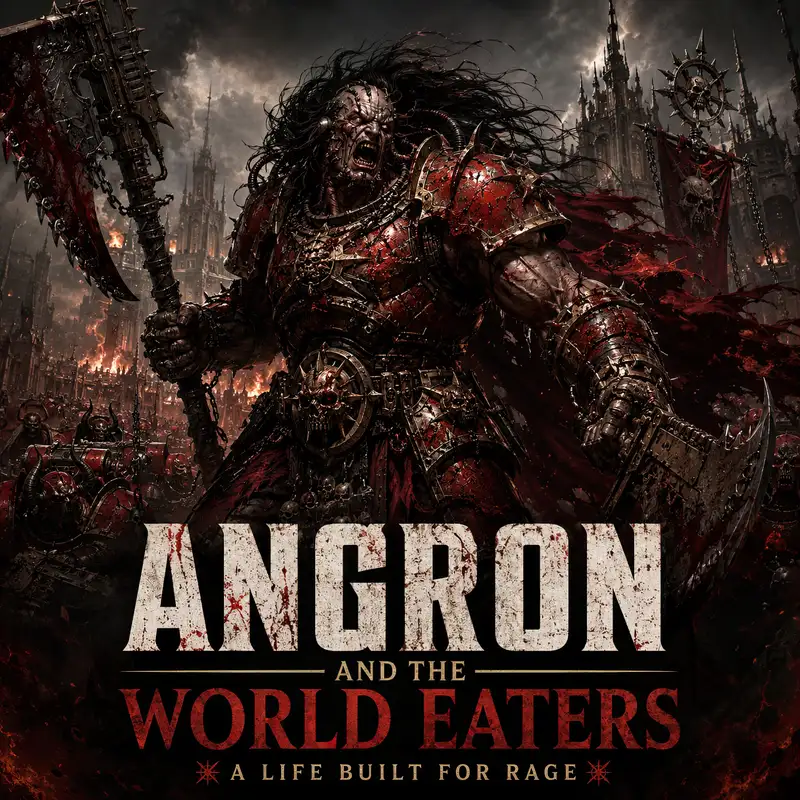
Angron and the World Eaters: A Life Built for Rage
The last army Angron ever chose for himself waited in the mountains of Nuceria with no expectation of victory. They were escaped gladiators, wounded slaves, and exhausted rebels surrounded by the forces of the world’s ruling elite. Angron knew they would die. That was not the same as saying they had lost. They had broken their chains, burned the cities of their masters, and reached the final morning still standing beside one another. Then golden light swallowed Angron. One instant he was among his brothers and sisters. The next he stood aboard an Imperial warship while the people he had sworn never to abandon were slaughtered below.
That moment explains more about Angron than all the mountains of skulls that followed. He is remembered as rage given flesh, the most violently direct of the Emperor’s sons, and eventually the immortal champion of the Blood God. Yet Angron was not simply born angry. His life was constructed around pain by a succession of masters, each of whom discovered that a wounded demigod could still be useful. The High Riders of Nuceria made him a gladiator. The Emperor made him a general. Horus made him a weapon of rebellion. Lorgar made him a daemon. Khorne made certain the process would never end.
Like the other primarchs, Angron was scattered across the galaxy while still an infant. He came to rest on Nuceria, a wealthy human world whose civilisation concealed a brutal appetite for blood sport. Its aristocratic rulers, remembered as the High Riders, forced slaves to fight in public arenas. The surviving accounts of Angron’s earliest days are incomplete, but they agree on the essential point. He was found wounded, captured, and sold into the pits before he had any chance to understand what he was. Other primarchs awoke among kings, tribes, scholars, or warriors who eventually recognised their greatness. Angron awoke as property.
The child who entered the arenas was already immensely strong, but strength was not the quality that first defined him. Later accounts suggest that Angron could feel the suffering of those around him with extraordinary intensity. He sometimes eased the pain and terror of other slaves by taking part of it into himself. In the pits, he resisted killing when he could, even when mercy placed him in greater danger. He found a father figure in the veteran gladiator Oenomaus and a family among the slaves who shared his chains. This is the first great contradiction in Angron’s story. The primarch who would become a symbol of mindless slaughter may once have possessed an unusual gift for compassion.
Compassion was not useful to the masters of Nuceria. When Angron refused to become the killer they wanted, they implanted the devices called the Butcher’s Nails. The name sounds crude because the effect was crude, but the technology was not. The Nails burrowed into the brain and nervous system, creating relentless pain while suppressing the ability to experience peace or pleasure. Rage and violence brought temporary relief. The victim did not merely become more aggressive. The victim learned, at the level of the body itself, that hurting others was the only reliable way to stop hurting. In one of his first uncontrolled frenzies, Angron killed Oenomaus, the man he loved as a father. The masters had not merely forced him to murder. They had made his own mind betray him.
The Nails did not erase Angron at once. They left enough of him to understand what had been taken, which was considerably worse. He continued to build loyalty among the gladiators, and eventually he led them in revolt. They called themselves the Eaters of Cities. They escaped the arenas, destroyed the holdings of their oppressors, and fought a running war against forces they could not hope to defeat forever. Angron was no elegant statesman and no patient strategist, but among the rebels he possessed something he would never truly share with his Legion. He belonged. They had suffered together. Their loyalty was not engineered from his genetic material or assigned by Imperial decree. It had been earned in chains.
When the Emperor arrived over Nuceria, he found a son who had not conquered his world. By the standards of the Great Crusade, this made Angron an uncomfortable exception. The Emperor offered him command and a place in the expanding Imperium. Angron refused. He did not ask to be rescued alone, and he did not regard survival as more important than loyalty. He intended to die with the Eaters of Cities in their final battle. The Emperor removed him anyway, teleporting Angron to safety while leaving the rebels below. Whether the Emperor believed the battle hopeless, considered intervention politically inconvenient, or simply judged the recovery of a primarch more important than the lives of the rebels remains uncertain. The result is not uncertain. Angron looked upon the Emperor and saw another High Rider.
Later examination revealed that the Butcher’s Nails had replaced and damaged vital portions of Angron’s brain. Removing them would almost certainly kill him. The Emperor therefore retained a compromised son because a compromised primarch could still conquer worlds. It was a practical judgment, and the Imperium was very fond of practical judgments whose moral cost would be paid by someone else. Angron was not healed. He was given armour, a fleet, and an army of sons who had been waiting their entire lives to meet him. Then he was told, in effect, to continue fighting.
That army had once been the War Hounds, the Twelfth Legion of the Legiones Astartes. Even before Angron, they were known for direct assaults, ferocious close combat, and a willingness to accept casualties that would make more cautious commanders reconsider the afternoon’s schedule. They were brutal, but they were not yet broken. Their aggression existed inside a military culture built around discipline, unit loyalty, and shared hardship. The War Hounds expected their primarch to give their nature purpose. Instead, Angron saw them as replacements for the companions the Emperor had allowed to die.
His first encounters with the Legion were violent and contemptuous. He killed warriors who approached him and rejected the role of father they desperately wanted him to accept. Kharn, then a captain of the Legion, eventually reached him where others had failed. Their bond was never gentle, but Kharn became the closest thing Angron had to an interpreter and equerry. Angron renamed the Legion the World Eaters in memory of the rebel army of Nuceria. The name was intended to preserve the dead. The tragedy was that the living Legion could never become those dead companions, no matter how much blood it shed in imitation.
The World Eaters responded to rejection by trying harder to resemble the father who rejected them. Their Apothecaries and Techmarines reverse-engineered a version of the Butcher’s Nails suitable for Space Marines. Many Legionaries accepted the implants willingly, believing shared pain would create the bond Angron refused to give them. Some resisted. Others suffered catastrophic effects. The Legion’s psykers were especially vulnerable because the Nails and psychic power interacted with lethal instability. Yet the process continued. Angron’s torment became doctrine, and doctrine has a way of making voluntary choices feel compulsory. The Legion did not cure its primarch. It copied his wound into thousands of brains.
The results were effective in the narrowest possible sense. The World Eaters became terrifying assault troops. They closed with enemies at speed, broke defensive lines through physical shock, and pursued victory with almost no concern for their own survival. Their chainaxes and gladiatorial traditions made the battlefield resemble an arena expanded to continental scale. Angron imposed impossible timetables and punished failure with decimation. Worlds were brought into compliance, although sometimes there was not much left to comply. The Imperium objected to the excesses, but it also continued assigning targets. A weapon that produces horrifying results is still producing results, which is the sort of sentence around which empires build entire departments.
Leman Russ eventually confronted Angron in the clash later remembered as the Night of the Wolf. Russ wanted to show that rage without discipline was not strength. The Space Wolves manoeuvred into positions from which they could have killed Angron even as he fought Russ personally. Angron’s World Eaters, focused on defeating the enemy immediately before them, failed to recognise the danger to their primarch. Russ believed the lesson obvious. Angron believed he had won because Russ withdrew and because more Space Wolves lay dead. Both judgments contained a piece of truth, but Angron missed the point Russ had tried to make. His sons would kill for him. They did not know how to preserve him, and he did not care whether they could.
That indifference made Angron easy for Horus to use when the Warmaster turned against the Emperor. Angron did not require a complicated theological argument. He already hated the Imperium’s master and regarded the Great Crusade as slavery conducted beneath brighter banners. Horus offered him the chance to strike back. Even then, the World Eaters were not united in betrayal. Loyalist elements remained within the Legion and were marked for death at Isstvan Three alongside loyalists from the other rebel Legions. When Angron descended to the surface to kill them personally, World Eaters who had refused treason charged their own primarch. They could not defeat him. Their resistance still matters. The Nails narrowed choice, but they did not eliminate it.
As the Horus Heresy widened, Angron became less a commander than a catastrophe pointed in a useful direction. Horus valued him for the same reason the Emperor had. Angron could destroy almost anything placed before him, provided no one expected restraint, occupation policy, or a particularly detailed after-action report. He fought across Isstvan and the campaigns that followed, while the Legion around him slid toward the worship of Khorne. This was not a sudden conversion in which every World Eater knelt and signed the appropriate infernal paperwork. It was a convergence. The Nails rewarded rage. The Legion’s culture glorified close slaughter. The Heresy removed the last restraints. Khorne was waiting at the end of a road they were already travelling.
Lorgar understood that Angron was dying. The Nails were not merely painful. They were destroying what remained of his body and mind. During the Shadow Crusade against Ultramar, Lorgar fought beside Angron and claimed to seek his salvation. The two brothers were an unlikely pair. Lorgar believed in gods, destiny, and the transforming power of faith. Angron believed mainly in chains, betrayal, and the temporary silence that followed violence. Yet Lorgar showed him a degree of attention that few brothers had offered. He listened. He recognised the pain. Then, with the serene confidence of a man who has discovered religion and intends to share it at weapon point, he decided what salvation would mean.
The Shadow Crusade devastated the realm of the Ultramarines and eventually carried Angron back to Nuceria. The world had preserved its own version of his history. Its ruling class remembered the slave revolt in ways convenient to the descendants of those who had crushed it. Angron returned not as a liberator but as the head of a conquering army, bringing the violence of the arena back to the civilisation that had created it. During the slaughter, Lorgar completed a ritual fed by death on an immense scale. Angron was transformed into a Daemon Prince of Khorne.
It is tempting to call this the moment Angron finally fell, but that makes the process sound too clean. He had been falling for most of his life, and many hands had pushed. More importantly, daemonhood did not free him from the Nails. It made their logic eternal. His ruined mortal body could no longer die from their damage, but the pain, rage, and machinery became part of his immortal form. Lorgar saved Angron’s existence by destroying the possibility that he might ever become anything else. The slave who had once chosen death beside his family was denied even death. Khorne did not break his chains. Khorne made the chains sacred.
The transformation also completed the ruin of the World Eaters as a coherent Legion. Their primarch was now a warp-born engine of destruction whose presence drove violence around him. Kharn and the Legion’s remaining officers could still direct forces, maintain ships, and conduct campaigns, but command increasingly meant arranging circumstances in which the killing moved approximately toward the enemy. Even reaching Terra required outside force. Perturabo, primarch of the Iron Warriors, had to beat Angron into submission and drag the World Eaters back into Horus’s strategy. It was an impressive demonstration of Traitor unity, in the sense that several brothers were still capable of pointing weapons at one another until cooperation occurred.
At the Siege of Terra, Angron became the ultimate expression of what every master had wanted from him. He was a living siege weapon. He hurled himself against the defences of the Imperial Palace, regenerated from destruction, and led a tide in which the distinction between army and massacre had almost disappeared. At the Eternity Gate he faced Sanguinius, another primarch whose sons carried a terrible inherited rage. The contrast was merciless. Sanguinius acknowledged the darkness within his bloodline and struggled to master it. Angron had been denied that struggle until surrender to rage became the only relief he knew. Sanguinius defeated and banished him, tearing at the very mechanisms that had defined his torment. For a moment, the Red Angel fell before the Great Angel. It was a victory, not a cure.
After Horus was defeated, the World Eaters retreated into the Eye of Terror with the other Traitor Legions. Whatever remained of their unity continued to decay. The Battle of Skalathrax finally shattered much of the Legion into warbands when Kharn turned on warriors who had abandoned the fight to seek shelter from the killing cold. Since then, the World Eaters have existed as scattered companies, hosts, and brotherhoods bound less by central command than by the Nails, the worship of Khorne, and the recurring gravitational pull of Angron’s presence. They still possess veterans, officers, ships, and fragments of old identity. They are not mindless. That makes their condition darker, not lighter. Enough remains to remember what was lost.
Angron himself has returned again and again. During the First War for Armageddon, he led a vast daemonic invasion before the Grey Knights banished him at terrible cost. In the age of the Great Rift, he has manifested with renewed power, and even destruction can delay him only temporarily. Current accounts describe a fixed cycle in which banishment is followed by his return after eight weeks, eight days, and eight hours. The number is devotional. The consequence is practical. There is no final battlefield victory over Angron, only the purchase of time, usually paid for in entire armies.
That does not make Angron innocent. The Nails explain his violence, but explanation is not absolution. He understood suffering intimately and still chose to reproduce it in his sons. He hated the Emperor for treating people as tools, then treated the World Eaters as extensions of his own wound. He despised slavery, yet demanded obedience through terror. He knew what it meant to lose a family and built a Legion in which brotherhood was steadily sacrificed to pain. Other World Eaters resisted him, remained loyal, refused the Nails, or attempted to preserve discipline. Their existence proves that Angron’s path was shaped by coercion without being entirely empty of choice.
The World Eaters share that responsibility. They were not merely infected by their primarch. They pursued him. They accepted mutilation to earn affection he would not give, and then made mutilation the price of belonging. Their tragedy is not that they loved Angron too little. It is that they loved the image of their father more than they valued what remained of themselves. Every implant was an attempt to cross the distance between son and primarch. Every implant widened it.
A life built for rage was built piece by piece. Nuceria taught Angron that pain was entertainment. The Nails taught him that violence was relief. The Emperor taught him that loyalty could be discarded for utility. The Great Crusade taught him that destruction became honourable when issued as an order. Horus gave his hatred a target. Lorgar transformed torment into immortality. Khorne removed the last possibility of silence.
Beneath all of that remains the image of a young giant in a dark cave, taking the pain of frightened slaves into himself so they could sleep. That figure did not vanish because he had always been false. He was cut apart, rewired, betrayed, and finally buried beneath ten thousand years of rewarded fury. Angron became the Red Angel because every power that claimed ownership of him preferred the weapon to the man. Now he returns whenever he is banished, the Nails still biting, the rage still offering its brief and terrible relief, and the last slave of Nuceria still unable to die beside the family he chose.