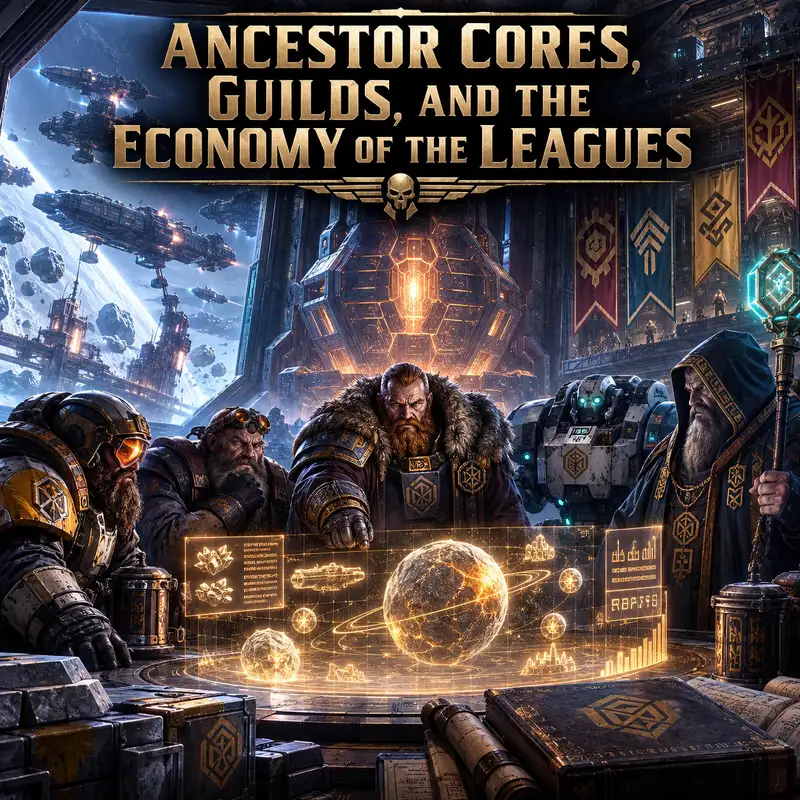
Ancestor Cores, Guilds, and the Economy of the Leagues
A Kin prospecting vessel can look at a lifeless moon and see a future Hold, reactor fuel, and rare metals enough to sustain generations. It can look at an inhabited world and see much the same thing. The difference will enter the calculations. It simply may not change the answer. For the Leagues of Votann, wealth is not an ornament piled in a vault. It is survival measured in ore, energy, knowledge, labour, and secure routes through a murderous galaxy. Every claim supports a Hold, every Hold a Kindred, and every Kindred stands beneath an Ancestor Core. The economy of the Leagues begins there, with a civilisation that treats extraction as duty and accounting as a form of memory.
The central question is not whether the Kin are miners, merchants, or industrialists. They are plainly all three. The better question is why acquisition carries such moral weight for them. Other powers seize worlds for glory, faith, expansion, or simple appetite. The Kin usually present a colder justification. A resource exists. Their people need it. Their ancestors preserved the means to use it. Therefore, leaving it idle can seem less like restraint and more like waste. That logic creates an economy that is competitive without being individualistic, communal without being centrally uniform, and deeply practical while resting upon something close to religious devotion. They maintain a chain of obligation between the living, the manufactured, and the ancient intelligences that made their society possible.
At the smallest political scale stands the Kindred. Nearly every Kin belongs to one, and a Kindred can range from a small extended community to a population numbering in the millions. Its members share bonds of origin, tradition, and mutual responsibility, often tracing their beginnings to the same genetic crucibles. They live and work within a Hold, although that word covers almost anything the Kin have decided to fortify and inhabit. A Hold may be a tunnel complex, a factory settlement, an asteroid station, a voidborne fortress, or an industrial domain spread across a planet. It is home, workplace, arsenal, and storehouse at once.
Several Kindreds may bind themselves into a League. A League is not a single empire with one throne and one central treasury. It is an alliance held together by oaths, bargains, shared defence, trade, and the authority of custom. Kindreds retain a considerable measure of autonomy, but gain access to wider markets, military aid, specialist expertise, and routes linking distant Holds. Some Leagues are enormous and ancient. Others are recent, diminished, scattered, or highly specialised. Their strength depends on reliable agreements as much as warriors. A League survives because its Kindreds believe that an obligation entered into must be honoured, even when honouring it becomes expensive.
At the centre of that web are the Votann, the Ancestor Cores from which the Leagues take their name. These are ancient, sentient supercogitators, self-organising masses of data-stacks and quantum systems created in humanity’s forgotten past. Within them lie scientific knowledge, military theory, genealogical records, philosophical traditions, technological designs, and Standard Template Construct data that the Imperium has lost or reduced to sacred fragments. A Votann is archive, adviser, industrial inheritance, and ancestral presence combined. Its Fanes provide the means by which selected Kin, especially the Grimnyr, seek its guidance. Outsiders might call such a machine an artificial intelligence. The Kin would regard that description as both dangerously incomplete and an excellent reason to end the conversation.
The Ancestor Cores do not make the Leagues a simple machine dictatorship. The surviving lore does not suggest that a Votann personally assigns every worker, prices every shipment, or approves every drilling charge. Kindreds govern themselves, Hearthspakes debate, Guilds compete, and commanders make decisions in the field. Yet the Votann shape the limits within which all of those choices occur. They preserve the cloneskeins from which biological Kin are created. They produce Ironkin and determine many of the forms best suited to the needs of society. They retain the designs that keep forges running and voidships moving. They answer questions no living council could solve alone. Even when silent, they define what the Kin know, what they can build, and what they fear losing.
That silence is becoming more common. The Votann were not designed for tens of thousands of years of ceaseless operation. The Kin continue to offer them knowledge, experience, and resources, adding layer upon layer to already burdened data-stacks. Their answers can be slow. Their personalities have developed peculiarities. Their processes can become inconsistent. No loyal Kin is eager to describe an Ancestor Core as failing, because civilisations generally prefer not to announce that their gods require maintenance. The Leagues must preserve systems that may be impossible to replace, secure resources to support them, and plan while the wisest voice in the Hold may take generations to reply. Efficiency becomes sacred partly because waste is annoying, and partly because the margin for error is shrinking.
The Kin themselves are products of this managed inheritance. Biological Kin emerge from crucibles shaped by stable genetic templates called cloneskeins. These templates can provide adaptations suited to crushing gravity, hostile atmospheres, radiation, heightened perception, rapid reactions, or the limited psychic abilities needed by the Grimnyr. Ironkin are created as fully accepted members of the same society, their cerebral units joined to bodies suited for labour, exploration, craft, or war. This allows a Kindred to develop a population fitted to the environments and tasks it expects to face. It is not merely workforce planning. It is civilisation designing its own descendants around anticipated need, with all the confidence and danger that sentence deserves.
Yet the Kin are not presented as disposable tools locked forever into assigned functions. Ironkin and biological Kin are treated as equals, and individuals can develop interests beyond the roles for which they were first suited. Kin society values competence, contribution, memory, and loyalty more than the distinction between flesh and machine. That matters economically. Labour is not divided between a privileged biological citizenry and an expendable mechanical class. A damaged Ironkin body is not simply discarded as replaceable equipment. Skill and personhood reside in the individual, and the community has reason to preserve both. The result is a society capable of extreme industrial calculation without fully reducing its own people to numbers, although anyone outside the Kindred may find that reassurance arrives with several important qualifications.
A typical resource venture begins far from the furnaces. Hernkyn pioneers and other prospectors range beyond established space, surveying systems, mapping routes, and identifying useful deposits. Their discoveries may attract a Kindred, a Guild, or an entire League. Specialists calculate the likely yield, the dangers of extraction, the transport cost, the political complications, and the forces required to secure the claim. If the prize is worth the expenditure, an Oathband or Kinhost may follow. The soldiers are not separate from the economic mission. They are part of it. Their task is to seize, defend, and hold the material on which future production depends. In Kin practice, the distance between a mining expedition and a military campaign can be measured with a very short ruler.
The Guilds turn those ventures into a functioning interstellar system. A Guild brings together Kin who practise the same trade across the boundaries of Kindred and League. Salvagers, miners, builders, fabricators, scientists, transport specialists, ration makers, and countless other professions can organise through Guild structures. Guilds establish standards, certify competence, preserve specialised knowledge, provide contacts, and collect tithes. Membership is voluntary in principle. Freelancers exist. So does the mutual suspicion between freelancers and Guildkin, each convinced that the other has confused independence with disrepute, or regulation with fossilisation. This is one of the more familiar parts of Kin society. Even beneath black holes and ancient machine minds, professionals remain professionally irritated by one another.
The Guilds are important because they cross the political map. A Kindred ties people together through origin, kinship, and shared home. A League ties Kindreds together through alliance. A Guild ties workers and experts together through practice. Those networks overlap without becoming identical. A mining Guild can connect distant Holds that answer to different councils. A construction Guild can carry methods from one League to another. A salvage Guild can turn the wreckage of war into the foundation of the next settlement. Knowledge travels with contracts, accreditations, apprentices, and reputations. The Leagues possess no single central ministry directing the whole economy, but they do possess institutions capable of making compatible work possible across vast distances. That is less dramatic than a conquering fleet, and more useful once the fleet needs fuel.
Officially, Guilds are commercial bodies rather than governments. In practice, economic power has never shown much enthusiasm for remaining outside politics. Guildmasters often sit upon the Hearthspake, the governing council of a Kindred, alongside military leaders and the Grimnyr. There they represent civilian interests, technical expertise, and control over essential work. A Hearthspake must balance the needs of defence, production, tradition, and the Ancestor Core. It decides which claims deserve support, which risks are acceptable, and which debts must be honoured. The arrangement is neither a free market floating above society nor a command economy issuing orders from one centre. It is negotiated power inside a community where everyone understands that a failed shipment can become a failed life-support system.
Competition remains fierce. Guilds seek profitable claims, prestigious contracts, rare materials, and influence within the Holds they serve. Rival Guildmasters may sponsor competing expeditions into the same region, each determined to secure a resource before the other. This competition can drive innovation and speed, but it can also turn survey work into armed confrontation. Other species living on the desired world may discover that they have entered a commercial dispute without being invited to the meeting. The Kin can bargain, trade, or cooperate when the numbers favour it. They can also decide that an existing civilisation has placed itself inconveniently between a Guild and a deposit. Their economy is disciplined, but discipline is not the same thing as mercy.
No Guild illustrates this better than the Cthonian Mining Guilds. Their Kin work in environments so violent that even other members of the Leagues consider them extreme. They cut into rad-soaked regions, unstable asteroids, crushing depths, and other places where the geology appears actively offended by visitors. Many Cthonians use heavy augmentation and cybernetic modification to survive the work. Their equipment is designed to break stone, penetrate armour, and continue operating when sensible machinery would request reassignment. In war, Cthonian Beserks carry plasma axes and concussion mauls derived from industrial tools. This is not a case of peaceful workers suddenly improvising weapons. It is a reminder that Kin extraction technology often begins with enough force to make the distinction academic.
Behind the miners stand the Brôkhyr, master artisans, engineers, and forge-workers who administer the central forges of a Hold. They work from ancient patterns preserved through the Votann, including technologies related to Standard Template Constructs, but they are not bound to imitate the past without change. Refinement is itself a form of respect. A Brôkhyr honours the Ancestors by making a proven design more reliable, more precise, or better adapted to present conditions. Science Guilds push further, testing experimental systems and judging whether new technologies are ready for wider production. The Leagues therefore combine preservation with controlled innovation. They do not worship ignorance. They treat knowledge as inheritance, and inheritance carries an obligation to keep the machinery working.
Production among the Kin begins with access to designs that other human societies would kill to recover. Their weapons, armour, vehicles, and industrial systems often resemble human technology because both descend from ancient sources, but the Kin have retained more complete knowledge and manufacture to higher standards. That advantage does not make production effortless. Rare materials must still be located. Forges require energy. Skilled workers require training. Ships require maintenance. Routes require protection. Each finished device represents an entire chain of survey, claim, extraction, transport, fabrication, inspection, and distribution. The finished device may look effortless. The tithe, manifest, and repair schedule offer a less romantic explanation.
Trade allows the Leagues to obtain what they cannot efficiently produce or reach alone. They bargain among Kindreds, across League boundaries, and sometimes with alien powers. The Seran-Tok Mercantile Leagues, for example, have profited through trade with the T’au Empire. Kin pragmatism can overcome isolation when both sides see advantage. Yet trade has limits. The true nature of the Votann is guarded with extraordinary care, and the technological inheritance contained within an Ancestor Core is not simply another commodity. The Kin may exchange finished goods, expertise, passage, intelligence, or access to resources. They do not casually sell the foundation of their identity. A merchant culture can be open for business while keeping the vault behind the counter very firmly closed.
Trying to label this system with a single modern economic term misses what holds it together. Guilds compete, contracts matter, accreditation has value, and trade can enrich a League. At the same time, the Kindred is a deeply communal body whose members are expected to support one another, defend shared Holds, and preserve resources for future generations. Production serves collective survival even when ambitious Guildmasters struggle over who will control it. The phrase that captures Kin thinking is simple. Luck has. Need keeps. Toil earns. Fortune may place a resource within reach. Genuine need justifies holding it. Labour establishes the right to benefit from it. The saying is not a complete legal code, but it explains why the Kin respect both possession and effort.
It also explains why outsiders often experience Kin commerce as a threat. From within the Hold, acquisition can appear responsible and even moral. The resource will sustain families, create new Kin, maintain the Ancestor Core, and strengthen the League against enemies that would gladly destroy it. From the surface of the world being dismantled, the same process looks rather different. Kin calculations place less value on a foreign civilisation than on their own future. They are not mindless consumers like the Tyranids, because they understand negotiation, restraint, and long-term management. They are not indiscriminate destroyers. They are selective, deliberate, and capable of explaining exactly why your planet has become an acceptable loss. This may not improve the experience.
Grudges add another layer to the economy because the Kin do not separate material obligations from moral ones as neatly as outsiders might prefer. A stolen claim, a broken oath, a destroyed shipment, or an attack upon a Hold can become more than a temporary loss. It becomes a debt recorded within communal memory. The response may be military, commercial, or both. A League that fails to answer such an injury risks teaching rivals that its agreements and possessions can be violated without consequence. Vengeance therefore protects reputation as well as honour. The Kin do not maintain grudges because they are incapable of calculation. They maintain them because their calculations include precedent, trust, and the cost of appearing unable to collect.
All of these institutions feed back toward the Ancestor Cores. The Votann preserve the knowledge that enables production. Their designs create the tools that recover resources. Those resources maintain the Holds, forges, crucibles, and data systems surrounding the Votann. The Kin add new experience and information to the ancient stores, hoping to expand the wisdom available to their descendants. It is a closed cycle, and it is aging. Each generation depends on systems it can operate but may not be able to replace. Each addition of knowledge enriches the Core while burdening it further. The Kin economy is therefore not only a machine for growth. It is an immense maintenance effort directed at keeping the past alive long enough to guarantee a future.
The loss of a Votann would mean more than the death of a ruler. It could mean the destruction of genealogical inheritance, industrial designs, strategic memory, cultural identity, and the processes by which new Kin are created. The fate of a League and the fate of its Ancestor Core are bound together so tightly that Kin may defend one until no defenders remain. Recent accounts even describe an isolated Votann driven into madness by the destruction of its people, a terrible inversion of the usual relationship. The ancestors require the living, just as the living require the ancestors. Once that is understood, the apparent hunger of the Leagues becomes less mysterious. They are accumulating against extinction.
That does not excuse what they do to others, and it should not reduce them to caricatures of greed. The economy of the Leagues is built from several truths held at once. Resources are finite. Kin are obligated to one another. Knowledge is sacred but useful. Competition sharpens skill but can become destructive. Labour creates claims. Oaths create trust. Violence protects both. Above everything waits the Ancestor Core, containing wonders no treasury could price and weaknesses no loyal council wishes to admit. The Guilds, Holds, Kindreds, and Leagues exist to turn that inheritance into continued life. Their commerce is ancestry made material.
Deep within a Hold, furnaces burn around a Fane older than any living Kin. Guildmasters argue over yields. Brôkhyr inspect machines whose first patterns predate the Imperium. Prospectors prepare to cross the dark in search of the next claim, while the Ancestor Core considers a question asked decades before. Somewhere inside its burdened systems lies an answer assembled from thousands of years of memory. Outside, ships depart before the reply arrives, because need will not wait. That is the economy of the Leagues of Votann: not wealth for its own sake, but a civilisation mining the galaxy to keep its ancestors thinking, its people working, and its future from going dark.