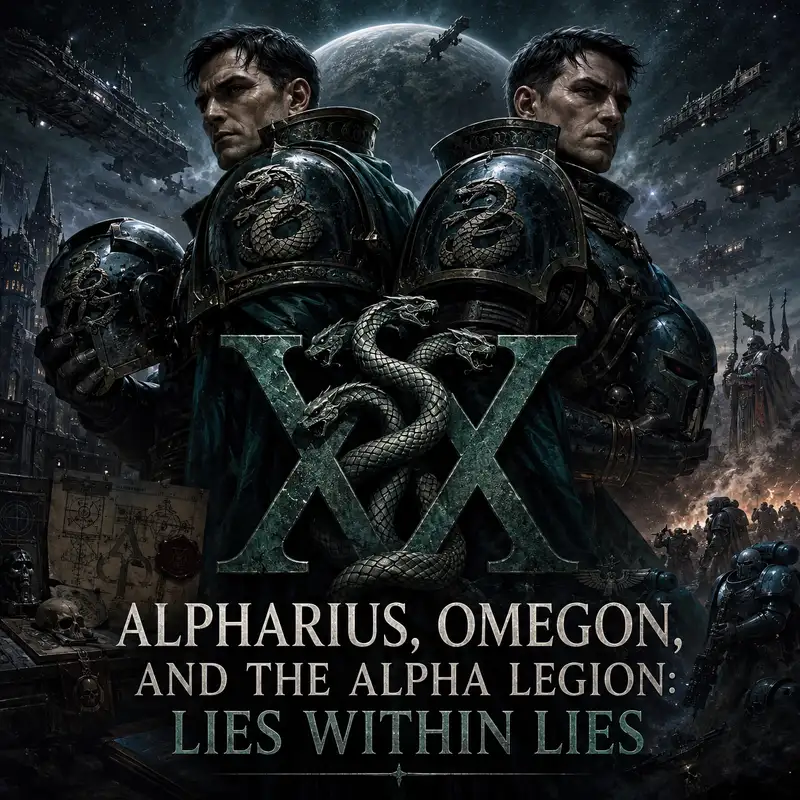
Alpharius, Omegon, and the Alpha Legion: Lies Within Lies
Rogal Dorn knew the warrior beneath his blade was a primarch. What he could not know was whether killing him had answered any question at all. Around Pluto, at the edge of the Solar System, the Alpha Legion had turned codes, uniforms, memories, and loyalties into weapons. Their attack had penetrated defenses that were supposed to be secure. Their agents had worn trusted faces. Their plans seemed to point in several directions at once. At the center of it stood Alpharius, or the man calling himself Alpharius, speaking as though there was still time for explanation. Dorn gave him none. The duel ended with one of the Emperor’s sons dead, and somewhere far away his twin understood that half of their shared existence had been cut away. It should have been a moment of clarity. With the Alpha Legion, clarity was usually the first casualty.
Alpharius and Omegon are remembered as the primarchs of the twentieth legion, but even that simple statement hides a problem. Most legions had one father. The Alpha Legion had two, identical in appearance and apparently linked by something deeper than ordinary brotherhood. One was presented to the Imperium as Alpharius. The other remained concealed as Omegon. They exchanged names, armour, roles, and public identities. Their legionaries copied them, sometimes through surgery, sometimes through discipline, and sometimes merely by standing in the right light while everyone else was already confused. “I am Alpharius” was not simply a boast or a password. It was a declaration that the individual no longer mattered as much as the pattern.
The official story once seemed straightforward. Alpharius was the last primarch discovered during the Great Crusade, the youngest brother welcomed by Horus after a confrontation in which the hidden legion tested the Warmaster’s fleet. Later accounts made the story far less comfortable. One version, told by Alpharius himself, claims that he was actually the first primarch found, discovered on Terra and raised in secrecy by the Emperor and Malcador. In that account, the primarch known publicly as Alpharius was often Omegon, the twin recovered much later. The problem is that the narrator openly tells us that deception is part of the tale. The account may contain truth. It may contain a carefully arranged version of truth. It may even be true in every detail and still be designed to mislead. That is the Alpha Legion’s preferred form of honesty.
The twins were smaller than most of their brothers, while many Alpha Legion Space Marines were unusually tall. This made impersonation possible in a way that would have been rather difficult for someone attempting to pass as Vulkan. Armour concealed proportions. Helmets concealed faces. Altered features and practiced mannerisms did the rest. Yet the disguise was more than physical. Alpharius and Omegon trained their legion to think in cells, layers, and redundancies. Orders could be distributed without every warrior understanding the complete design. Human operatives worked beside Space Marines as essential parts of the plan rather than disposable scenery. A clerk, dockworker, courier, planetary official, or frightened refugee might carry more strategic value than a squad of armoured giants.
This was the Alpha Legion’s great military insight. Armies do not fight only with guns. They fight with information, confidence, timing, and the belief that the person beside them is who he claims to be. Break those things, and a fortress can begin collapsing before the first shot. The legion infiltrated command structures, cultivated local factions, created false rebellions, encouraged real ones, intercepted communications, and planted agents years before they were needed. When the final assault came, it often looked effortless because most of the work had already happened in rooms without windows. Other legions broke gates. The Alpha Legion preferred to arrange matters so that someone inside opened the gate, shot the commander, and submitted a report blaming the entire affair on an unrelated department.
There was brilliance in this method, and there was vanity. Alpharius did not merely want victory. He often wanted a victory that proved the superiority of his way of war. A direct attack could take a city. A layered operation could demonstrate that the city had never truly belonged to its defenders. That distinction mattered to him. Some of his brothers regarded the Alpha Legion’s methods as needlessly elaborate, a maze built so the architect could admire it. They were not entirely wrong. Complexity creates options, but it also creates points of failure. A plan with three hidden contingencies is clever. A plan with thirty hidden contingencies may be a religious experience for the staff officers and a catastrophe for everyone else.
Before the Horus Heresy, the Alpha Legion’s secrecy served the Great Crusade. That is important. They were not born as obvious traitors waiting for a suitable villainous banner. They conquered worlds for the Emperor. They fought human tyrants, alien powers, and rebellious systems. Their methods could be ruthless, but ruthlessness was hardly a distinguishing feature among the legions. The deeper issue was that Alpharius and Omegon had been taught to value hidden purpose over visible allegiance. They believed that the person who understood the whole board might be justified in moving every piece without explanation. That belief is dangerous in any empire. In an empire led by demigods, it becomes expensive on a planetary scale.
The decision that defined them came through the Cabal, an alliance of ancient alien powers and human agents who claimed to understand the future of the war against Chaos. Through a vision known as the Acuity, the twins were shown two possible outcomes. If the Emperor’s forces defeated Horus, humanity would survive, but the Imperium would decay across millennia, feeding Chaos through endless suffering, repression, war, and spiritual stagnation. If Horus won, his triumph would consume humanity in a shorter and more violent catastrophe. Humanity would die, but Chaos would supposedly burn itself out with its greatest source of nourishment gone. The Cabal asked the primarchs to betray the Emperor in order to destroy the greater enemy.
It was a monstrous calculation, presented as cold necessity. The lives of uncounted human beings were reduced to fuel in an equation. The Cabal assumed that the future could be read clearly enough to justify extinction. Alpharius and Omegon, trained to trust secret knowledge and hidden strategy, were perhaps uniquely vulnerable to that argument. They did not need to love Horus. They did not need to embrace the Chaos gods. They only needed to believe that apparent treason could serve a deeper loyalty. The Alpha Legion had always lived by the idea that the visible mission might conceal the real one. The Cabal offered them the largest concealed mission imaginable.
Whether both twins accepted that mission in the same way is uncertain. Later events suggest disagreement, divided loyalties, or separate strategies, but the surviving evidence refuses to settle the matter. One twin may have followed the Cabal’s plan while the other tried to preserve the Emperor’s cause. They may have cooperated while pursuing different end states. They may have abandoned the Cabal and continued their own war. Some actions that appear loyal may have been designed to strengthen Horus indirectly. Some actions that appear traitorous may have been intended to limit the damage. The problem is not simply that the records are incomplete. The Alpha Legion deliberately created records that could support several explanations at once.
When Horus rebelled, the twentieth legion stood with him openly enough to be counted among the traitors. Alpha Legion warriors took part in the war against the loyalists. They deceived, sabotaged, and killed in support of the Warmaster’s campaign. Whatever private interpretation the twins carried, their legion helped tear the Imperium apart. This matters because intent can become a convenient hiding place. A commander may claim that every atrocity served a nobler objective, but the dead remain dead. The Alpha Legion’s possible loyalty to the Emperor’s ultimate purpose does not erase the consequences of its actions against the Emperor’s armies.
Their participation in the Drop Site Massacre placed them among the legions that completed the trap at Isstvan Five. Loyalist forces descended believing reinforcements were behind them. Instead, the second wave turned its weapons on the survivors. The Alpha Legion’s role suited its character perfectly. The betrayal was military deception on a grand scale, an entire battle built around false identification and misplaced trust. The legion did not invent Horus’s treachery, but it understood the mechanics of treachery better than almost anyone present. The massacre proved that the Alpha Legion’s methods could break more than a fortress. They could break the assumptions holding brotherhood together.
The legion also struck at the Raven Guard during Corvus Corax’s desperate attempt to rebuild after Isstvan. Corax had received access to ancient genetic knowledge that might allow him to replace his shattered legion at extraordinary speed. Alpha Legion infiltrators entered the project, stole its secrets, and corrupted the process. The result was not a clean military defeat. It was worse. Hope itself became contaminated. Corax’s new warriors suffered terrible mutations, and the Raven Guard’s recovery was crippled. Perhaps the Alpha Legion had additional motives. Perhaps what it handed to Horus was incomplete or altered. Those possibilities do not change what happened to Corax and his sons. A secret war still leaves visible wounds.
Yet there were moments when the Alpha Legion seemed to work against the traitor cause. Orders were delayed. Information moved in strange directions. Operations produced results that did not always benefit Horus. Agents claiming loyalty to the Emperor appeared within networks that were supposedly committed to rebellion. The legion’s decentralized structure made this possible. A cell could believe it served Alpharius while unknowingly carrying out Omegon’s design. Another could receive two contradictory missions and assume the contradiction was deliberate. Some may have remained loyal. Some may have fallen to Chaos. Some may have believed they were preserving a plan no living commander still understood.
This is where the Alpha Legion’s strength became its curse. Compartmentalization protects a conspiracy because no single captured operative can reveal everything. It also prevents the conspiracy from knowing whether it still has a coherent purpose. When orders pass through false identities, dead drops, memory alteration, and agents who have been given different versions of the truth, loyalty becomes almost impossible to measure. A legionary may betray the Imperium while believing he is saving it. Another may serve Chaos while believing he is only pretending. A third may know exactly what he is doing and encourage the first two to keep arguing. The hydra survives decapitation, but it may not agree with itself about where to walk.
The campaign at Pluto brought that contradiction home. The Alpha Legion penetrated the outer defenses of the Solar System and demonstrated that Terra’s approaches were not as secure as the Imperial Fists believed. Alpharius confronted Rogal Dorn during the fighting. What he intended remains disputed. He may have been attacking in earnest. He may have been exposing weaknesses so Dorn could correct them before Horus arrived. He may have been attempting to deliver intelligence. He may simply have believed that Dorn would recognize the elegance of the lesson. If so, Alpharius misunderstood his brother completely.
Dorn had no patience for a lesson delivered through dead defenders and breached fortifications. He did not admire the Alpha Legion’s complexity. He saw an enemy inside the gates. Alpharius tried to speak during their confrontation, but words had become another weapon, and Dorn had no reason to trust them. The primarch of the Imperial Fists killed him. The death was real. The psychic shock felt by Omegon makes the identity of the fallen twin far more certain than most Alpha Legion stories. The man who died at Pluto was Alpharius, even if the name had been worn by both brothers at other times.
For Omegon, the death was both personal loss and strategic transformation. He was no longer one of two hidden primarchs sharing a public identity. He was the survivor, and the role of Alpharius now belonged to him alone. In some accounts, he acknowledged the death by taking the name again. The exchange that had once protected the twins became a kind of inheritance. Every future appearance of Alpharius could now be Omegon, an impostor, a legionary, or a deliberate echo of a dead man. The Alpha Legion had made identity flexible enough to survive death, but not clear enough to provide certainty.
What happened to Omegon after the Heresy remains unresolved. A later tale claims that Roboute Guilliman killed Alpharius on the world of Eskrador. The account is deeply suspect, and even Imperial records do not confirm it cleanly. If the primarch killed there was real, he would almost certainly have been Omegon using his brother’s name. If the story was fabricated, then Omegon may have survived far longer. The Alpha Legion’s own traditions encourage the possibility that every death is a substitution and every survivor a disguise. This should not be taken as proof that Omegon lives. It is proof only that the legion successfully destroyed the conditions needed for proof.
After the Heresy, the Alpha Legion did not become a single unified force in the same manner as some traitor legions. It fractured into warbands, cells, networks, and hidden commands. Some groups embraced Chaos openly. Others acted as renegades without obvious devotion to the gods. Still others claimed to serve the Emperor through methods no Imperial authority would recognize as loyalty. Ten thousand years of isolation, corruption, false orders, and competing traditions make any universal explanation impossible. The modern Alpha Legion is not one secret plan. It is many plans, some connected, some inherited, some invented, and some probably maintained because no one wishes to admit that the original objective was lost several thousand years ago.
That fragmentation does not make them harmless. Their methods are well suited to survival. A legion built around a single fortress can be destroyed when the fortress falls. A legion built around a single leader can collapse when the leader dies. The Alpha Legion distributed itself across hidden bases, mortal cults, false identities, encoded doctrines, and autonomous warbands. Its enemies can win battles without knowing whether the battle mattered. They can kill a commander and discover that he was a decoy. They can uncover a conspiracy and learn that exposing it was part of another conspiracy. The practical effect is exhausting, which may itself be considered a strategic success.
Alpharius and Omegon were not merely liars. They were primarchs who believed that truth should be controlled, rationed, and weaponized. Their tragedy was not that they deceived others. Many of the Emperor’s sons did that. Their tragedy was that deception became the only language they trusted. A secret could justify disobedience. A hidden objective could excuse betrayal. A superior understanding of the future could excuse the sacrifice of those denied any voice in the decision. Once that habit took hold, there was no point at which they could simply step into the light and explain themselves. Explanation requires trust, and they had spent their lives proving that trust was a vulnerability.
Were they loyalists within the traitor host? There is evidence that at least some of their actions served the Imperium, and it is possible that one twin remained more loyal than the other. Were they true traitors? Their armies fought beside Horus, their agents crippled loyalist forces, and their choices helped create the catastrophe they claimed to be controlling. Were they servants of Chaos? Some of their descendants certainly became so, but the twins’ original motives appear to have been more complicated than worship. The most honest answer is that they tried to place themselves beyond ordinary categories of loyalty and treason. They believed they could betray the Imperium without betraying its ultimate survival.
That belief failed. The Cabal’s promised future did not unfold as intended. Horus was defeated, the Emperor was enthroned, and the Imperium entered the long nightmare the twins had been shown. If they joined Horus to prevent that future, they failed. If they secretly worked to preserve the Emperor, their assistance was so concealed and contradictory that it could not prevent ruin. If they attempted both strategies at once, they achieved the rare military distinction of helping create the disaster from opposing directions.
The Alpha Legion remains compelling because its uncertainty is not an empty trick. The lies reveal character. Alpharius and Omegon wanted control in a universe too vast, chaotic, and human to be controlled. They turned identity into a weapon, but lost any stable identity of their own. They sought the hidden truth behind the war, then discovered that possessing a secret vision did not make them wise enough to judge it. They built a legion that could survive the death of its leaders, yet made it impossible for that legion to know what those leaders truly wanted.
At Pluto, Dorn ended one life with absolute certainty. Everything around that death remained uncertain. The surviving twin inherited a name that had already belonged to both of them, and the legion carried that name into ten thousand years of conflicting wars. Each head of the hydra could claim to serve the original purpose. Each could accuse the others of misunderstanding it. Somewhere beneath the aliases, coded orders, false histories, and carefully planted contradictions, there may once have been a final truth. The Alpha Legion’s greatest victory was ensuring that no one, perhaps not even the Alpha Legion, could ever be certain what it was.