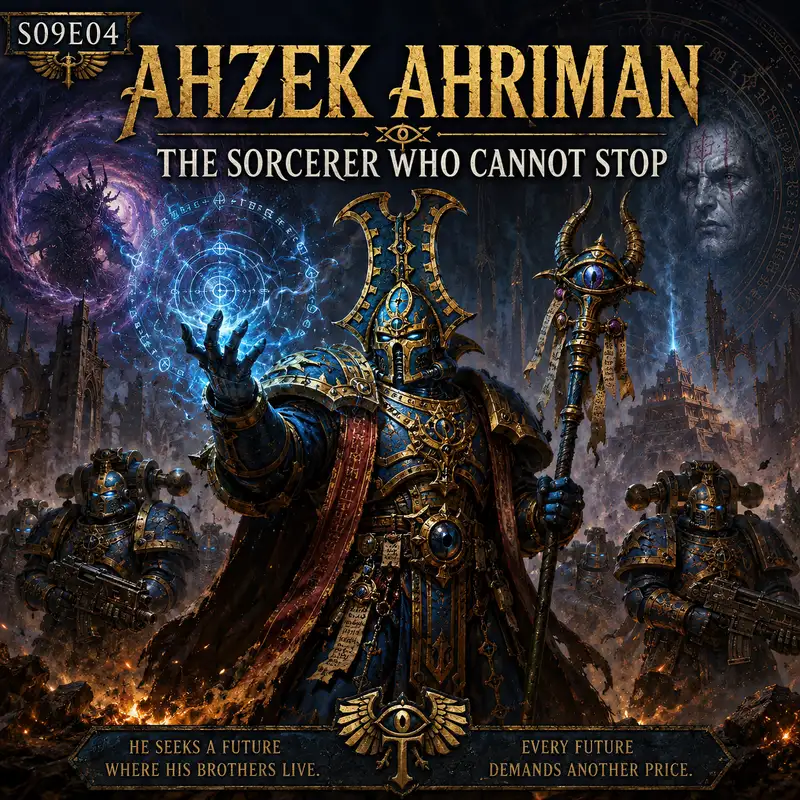
Ahzek Ahriman: The Sorcerer Who Cannot Stop
The spell ended without thunder. Across the Planet of the Sorcerers, warriors of the Thousand Sons stood motionless in their armour, their voices gone, their flesh gone, and their souls bound inside sealed plates of ceramite. Fine ash whispered from broken joints. Ahzek Ahriman had tried to save his Legion from mutation. In one terrible sense, he had succeeded. The flesh-change could no longer consume men who no longer possessed flesh. Behind the silence stood a sorcerer powerful enough to alter an entire Legion, intelligent enough to understand what he had done, and proud enough to believe that the damage could still be repaired.
That belief is the key to Ahriman. He is not merely a Chaos sorcerer hunting forbidden books because forbidden books are fashionable among Chaos sorcerers. He is a physician who cannot admit that his treatment killed the patient, a commander who keeps spending lives to recover the lives already lost, and a prophet who mistakes the ability to see possibilities for the right to control them. For nearly ten thousand years, every failure has given him another reason to continue. Every sacrifice has made stopping more difficult. Ahriman cannot stop because the moment he does, his quest ceases to be redemption and becomes what everyone else already knows it to be.
Long before the blue armour, the horned helm, and the armies of dust, Ahriman was a son of Terra. He and his twin brother, Ohrmuzd, were among the early recruits of the fifteenth Legion, before the Legion had been reunited with its primarch. The transformation into a Space Marine was only the beginning of their danger. Psychic power emerged throughout the Legion, and with it came the flesh-change, a curse of uncontrolled mutation that could twist a warrior beyond recognition. Ohrmuzd eventually succumbed. Ahzek survived, carrying both his brother’s memory and the fear that the same fate waited inside his own blood.
Then the Legion found Magnus the Red on Prospero. Magnus appeared to accomplish what Imperial science and Legion discipline had failed to do. He halted the flesh-change and gave his sons a home shaped around learning, psychic mastery, and the recovery of lost knowledge. Prospero became a place where libraries mattered as much as arsenals, where scholars wore power armour, and where the dangerous could be treated as something to understand rather than simply something to burn. It was an attractive philosophy, particularly if one had watched fear and ignorance fail to save a brother. It also contained the seed of nearly every disaster that followed.
Ahriman rose because he embodied the best qualities of the Thousand Sons. He was disciplined, patient, intellectually fearless, and exceptionally gifted. He became the Legion’s first and last Chief Librarian, commanded its First Fellowship, and stood among Magnus’s most trusted sons. As a leader of the Corvidae, he studied possible futures and tried to guide events toward the least ruinous path. He did not think of psychic power as wild magic. To him it was a field of knowledge with principles, techniques, and consequences. The universe might be dangerous, but danger could be mapped. Given enough information, the correct answer could always be found.
Prospero’s learning was organised into psychic cults, each teaching a different way to approach the Warp. The Corvidae studied probability and foresight, and Ahriman became their foremost master. The Legion also relied upon tutelaries, spirit companions that appeared helpful, obedient, and familiar. Later events revealed how badly the Thousand Sons had misunderstood the beings answering them from the Warp. That failure matters because it was not caused by a lack of intelligence. It was caused by confidence. They had names for what they encountered, systems for using it, and centuries of successful experience. Those things felt very much like proof, right up until they did not.
That conviction met the Imperium at the Council of Nikaea. The Emperor forbade the Space Marine Legions from using their Librarians, and the Thousand Sons heard the judgment as a condemnation of everything they had built. Ahriman also learned that Othere Wyrdmake, a Space Wolf Rune Priest with whom he had shared knowledge, would speak against the Legion’s practices. The distinction between a sanctioned rune and forbidden sorcery proved remarkably dependent on who was holding the staff. Ahriman left Nikaea angry, wounded, and even more certain that fear of knowledge was the true enemy.
By then, Ahriman had begun to suspect that Magnus’s victory over the flesh-change concealed a price. The primarch had dealt with powers he did not fully explain to his sons, and the Warp was not the neutral ocean of energy they preferred to imagine. Yet Ahriman did not abandon Magnus’s philosophy. He concluded that the answer was greater understanding, tighter discipline, and fewer secrets. This response sounds reasonable until one notices that every warning was being converted into an argument for continuing the same work more carefully. The possibility that some knowledge should not be used remained outside the system.
Magnus soon used forbidden sorcery to warn the Emperor that Horus had rebelled. The warning was true, but the means of delivering it shattered the Emperor’s secret work beneath the Imperial Palace and opened the way for daemons. The punishment sent toward Prospero became an invasion, and the Space Wolves descended upon a world that Magnus had left dangerously unprepared. Ahriman fought amid the burning of Tizca as libraries collapsed, scholars died, and the future he had once tried to read became a storm of contradictory possibilities. The Thousand Sons escaped destruction only when Magnus carried the survivors into the Warp.
In the years after the Heresy, their refuge was the Planet of the Sorcerers, a daemon world where landscape, time, and flesh obeyed uncertain laws. There the old curse returned with greater violence. The flesh-change spread through the surviving Legion, proving that Magnus’s cure had never been as complete as his sons believed. Mutation was no longer a distant memory. It was happening in front of Ahriman, brother after brother becoming something unrecognisable. He had already lost Ohrmuzd once. Now he faced the same loss on the scale of an entire Legion, and Magnus offered no solution that Ahriman could accept.
So Ahriman gathered a cabal and created the Rubric. It was an act of extraordinary sorcerous invention, intended to reach every surviving Thousand Son and fix his form against mutation. The ritual was not performed casually, and its architects understood that failure could be catastrophic. Their mistake was believing that understanding the danger meant they controlled it. The spell moved through the Legion. The strongest sorcerers survived with their powers magnified and their bodies preserved. Most of their brothers were reduced to dust, their spirits trapped inside their armour, obedient to the commands of those who remained alive.
The decision was not a solitary impulse performed in a moment of panic. Ahriman persuaded other powerful sorcerers to join him, assembled the lore required, and accepted opposition from brothers who feared what the ritual might do. He had time to consider the scale of the gamble. That makes the Rubric more tragic, not less. Ahriman was not ignorant of risk. He simply believed that refusing to act was the greater danger, and once he framed the choice that way, almost any intervention could be justified. The Legion was dying. A dangerous cure still looked like a cure.
The Rubric Marines still marched. They raised bolters, guarded halls, and advanced through enemy fire with the implacable rhythm of machines. Yet whatever remained inside them was fragmented, distant, and difficult to reach. A name might stir a response. Battle might awaken an echo of old instinct. None of that restored the men they had been. Ahriman had prevented mutation by replacing it with a different prison. Magnus saw the result as an unforgivable act of pride and banished Ahriman and the surviving members of his cabal from the Planet of the Sorcerers.
Exile might have ended another man. For Ahriman, it became a period between attempts. He wandered through the Eye of Terror, stripped of his old authority and confronted by the hatred of his own brothers. At times he tried to turn away from sorcery and from the identity that had destroyed so much. Yet turning away could not free the Rubric Marines, restore Prospero, or bring back Ohrmuzd. Withdrawal offered no cure, only the admission that there would never be one. Ahriman returned to power because power remained the only language in which he believed a solution could be written.
He seized control of followers, Rubric Marines, ships, and sorcerers, eventually forming the force known as the Prodigal Sons. Some served because they believed he could save the Legion. Others wanted access to his knowledge, protection, status, or a share of whatever he uncovered. Ahriman could inspire loyalty, but he also treated loyalty as a resource. Allies became components in rituals. Worlds became repositories to be opened. Enemies became sources of information. When a choice lay between preserving lives and advancing the quest, the quest usually survived.
This is where the sympathetic image of Ahriman begins to darken. His purpose is not trivial. He does care about the Thousand Sons, and his guilt is real. He does not seek sensation like a devotee of Slaanesh or slaughter for its own sake like a champion of Khorne. He wants to undo a catastrophe. The difficulty is that he grants himself unlimited authority to decide what that goal is worth. A million strangers may die because he is trying to save warriors who died ten thousand years earlier. In his accounting, the intention remains noble and the bodies become an unfortunate administrative detail.
Ahriman searched for fragments of Magnus’s knowledge, including the Athenaeum of Kallimakus, an artefact tied to the lost Book of Magnus and the primarch’s hidden thoughts. He fought the Inquisition, Space Marines, rival sorcerers, daemons, and his own Legion. He crossed time, memory, and the shifting geography of the Warp. Each victory exposed another missing piece. Each missing piece justified another campaign. This is the machinery of his obsession. Knowledge never completes the puzzle. It expands the border of what he does not know.
Eventually, Ahriman returned to the worlds that had shaped the Thousand Sons and attempted another great working, meant to reverse the Rubric rather than merely understand it. The plan demanded power on a scale that would have discouraged anyone with a healthier relationship to warning signs. It failed to restore the Legion. Yet one Rubric Marine, Helio Isidorus, displayed signs that something of the man endured within the dust. For Ahriman, that fragment of possibility mattered more than the larger failure. One response meant the Rubric was not absolute. If it was not absolute, it could be broken. If it could be broken, stopping would be betrayal.
The Aeldari Black Library became another focus of his search. Hidden within the Webway, it contains knowledge of Chaos guarded by beings who understand very well what happens when powerful sorcerers are allowed unrestricted access to powerful sorcery. Ahriman has assaulted its approaches, fought Harlequins, broken paths through the Webway, and pursued maps and secrets that might lead him closer. To the Aeldari, he is not a grieving scholar asking for assistance. He is a walking demonstration of why certain doors have guardians.
During the upheavals surrounding the opening of the Great Rift, Ahriman confronted Yvraine, the emissary of the Aeldari god of the dead. She demonstrated that the souls within several Rubric Marines could be restored to living bodies. For a moment, Ahriman saw his impossible goal achieved before his eyes. Then those restored warriors were hurled from the Webway and lost. The encounter was cruelty, strategy, and revelation at once. It proved that the Rubric could be reversed, or at least that a power existed which could reproduce the result. A wiser man might have reconsidered his methods. Ahriman received confirmation that he had been right to continue.
He also turned toward the Necrons, whose command of time offered a different route to salvation. If the Rubric could not be undone in the present, perhaps the past could be rewritten. Ahriman sought the device known as the Key of Infinity, hoping to overwrite the mistake at its source. By then the consequences of his second great working had produced another threat, the Pyrodomon, a fire consuming sorcerers and Rubric Marines alike. His attempt to repair one curse had generated another. The situation was therefore entirely clear. He required an even greater intervention.
That pattern makes Ahriman one of the most fitting servants of Tzeentch, whether he accepts the description or not. Tzeentch is the Chaos god of change, ambition, sorcery, hope, and schemes that breed further schemes. Ahriman often behaves as though he is using the powers of Chaos without belonging to them. He does not need to kneel in simple worship. His refusal to accept a final answer is devotion expressed as method. He changes plans, allies, identities, and even the shape of causality, always moving toward a future that recedes as he approaches.
It would be too easy to say that Tzeentch simply controls every choice Ahriman makes. That interpretation removes the most disturbing part of the character. Ahriman chooses. He studies, calculates, persuades, threatens, and sacrifices. His decisions arise from recognisable motives, including grief, responsibility, love for his brothers, fear of mutation, and faith in reason. Chaos does not replace those motives. It bends them until virtue and corruption become difficult to separate. Tzeentch’s finest trap is not a chain around Ahriman’s will. It is a path Ahriman keeps selecting because every step appears to be his own.
His gift of foresight deepens the irony. Ahriman can perceive possible futures, but possibility is not certainty. The more futures he sees, the more he tries to force events toward the one he prefers. Every intervention creates new branches, hidden costs, and opportunities for manipulation. A less powerful man would eventually encounter a locked door. Ahriman can burn the door, rewrite the lock, travel backward to prevent its construction, or sacrifice the city around it. His power does not free him from consequences. It merely lets him reach consequences that would be inaccessible to ordinary people.
He is therefore dangerous in a way that differs from a berserker or a daemon prince. Ahriman can be calm, courteous, and entirely convinced that he is acting for the greater good of his Legion. He can offer genuine mercy when mercy does not obstruct the plan. He can value an ally and still spend that ally’s life at the necessary moment. His evil is not the absence of conscience. It is the repeated decision that conscience must wait until the work is finished. Since the work is never finished, conscience remains permanently postponed.
The question is whether Ahriman truly wants to save the Thousand Sons as they were, or whether he needs to prove that he was capable of saving them. The two desires may once have been identical. After millennia of manipulation and sacrifice, they are not so easily separated. Restoring his brothers would be an act of love. Demonstrating that the Rubric was a correctable error would vindicate his entire view of the universe. It would prove that knowledge was sufficient, that will could master fate, and that Ahzek Ahriman had never encountered a limit he was morally required to accept.
Stopping would cost him more than the quest. It would force him to admit that some losses cannot be reversed, that intelligence does not confer permission, and that responsibility may require living with failure rather than feeding others into it. It would also strip away the identity he has built since Prospero. Without the cure, he is not the saviour of the Thousand Sons in exile. He is the architect of the Rubric, followed by the hollow armour of the men he condemned. That truth is unbearable, so he transforms it into a temporary condition.
Ahriman can always identify one more archive, one more prophecy, one more captured seer, one more Aeldari path, one more Necron device, or one more ritual whose risks are acceptable because the alternative is surrender. He has become a master of turning guilt into momentum. The dead justify the next sacrifice, and the next sacrifice increases the debt owed to the dead. It is a perfect closed system, powered by hope and sealed against repentance. Even his remorse serves the engine.
That is why Ahzek Ahriman cannot stop. He is not compelled only by a god, a curse, or an external prophecy. He is compelled by the conviction that persistence is the same thing as responsibility. Somewhere ahead, he believes, there remains a version of the future in which the dust rises, takes human form, and speaks with the voices of his brothers. Behind him march the Rubric Marines, silent witnesses to every attempt. Ahriman keeps leading them toward salvation, and with every step, more dust gathers at his feet.