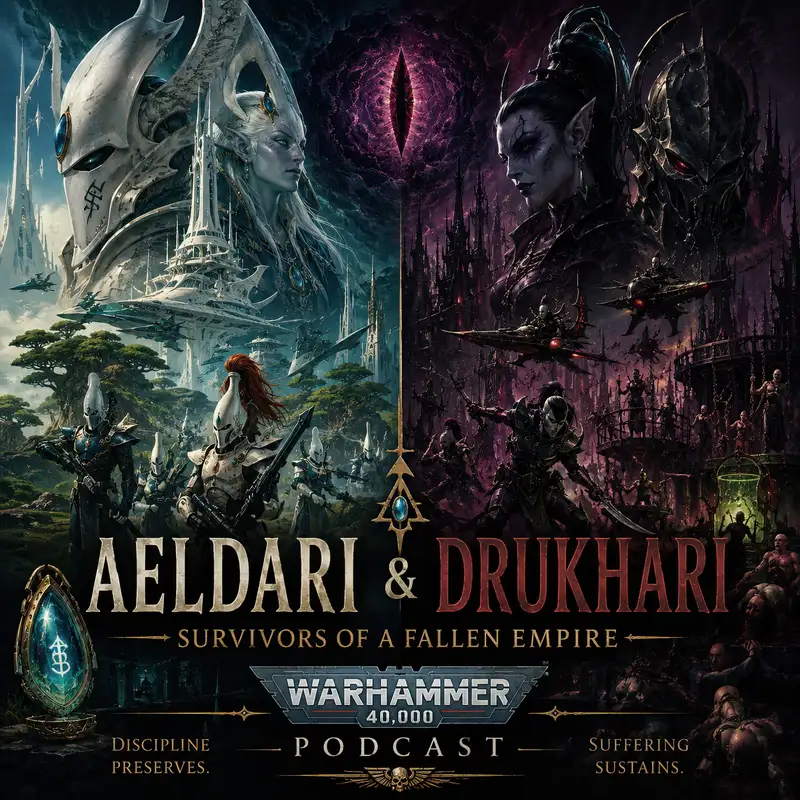
Aeldari and Drukhari: Survivors of a Fallen Empire
An Aeldari dies twice if their companions fail them.
The first death is the ending of the body. The second comes when the soul slips into the warp and falls into the hunger waiting there. For the inhabitants of a craftworld, a small gem worn against the body may prevent that final loss. For the inhabitants of Commorragh, survival follows another path. They draw strength from the terror and suffering of others, feeding a wound in the soul that never truly closes.
Both peoples descend from the same civilisation. Both remember the same catastrophe. Both are hunted by the same god.
They simply chose opposite answers to the question of how to endure.
To human eyes, the craftworld Aeldari and the Drukhari can appear to be separate alien species. Their armour, customs, weapons, and ways of war seem designed by different civilisations. One arrives in silence, guided by seers and protected by the souls of the dead. The other tears open the night in blades of black metal, taking prisoners before vanishing into passages no Imperial fleet can reliably follow.
The distinction is real, but it is not biological. In the broadest sense, both are Aeldari. The word describes the ancient people whose empire once dominated much of the galaxy. The craftworlders call themselves the Asuryani. The Drukhari are their kin from the hidden city of Commorragh. There are other branches as well, including Exodites, Corsairs, Harlequins, and the followers of Ynnead. The family survived. It did not remain on speaking terms.
Long before humanity built its Imperium, the Aeldari possessed a civilisation of staggering power. Their empire was supported by psychic mastery, automated abundance, and access to the Webway, a network of hidden routes passing between the material universe and the warp. Travel that would demand a dangerous voyage through the immaterium could instead be made through these enclosed passages.
The Aeldari had defeated or outlasted their great rivals. Material need had largely ceased to govern their lives. Machines performed labour. Their lifespans were immense. Their minds and emotions were far more intense than those of humans, and their psychic presence gave every act a deeper echo in the warp.
This combination should have created paradise. It created leisure without restraint.
The decline did not begin with a single emperor issuing a foolish command. It was slower and more intimate. A civilisation that had exhausted ordinary experience began searching for stronger sensation. Pleasure became obsession. Art became cruelty. Curiosity became violation. Entire communities surrendered themselves to cults devoted to excess, while those who warned of disaster were dismissed as joyless, frightened, or embarrassingly unfashionable.
The old empire did not collapse because its people lacked intelligence. It collapsed because intelligence is quite capable of explaining why one more indulgence is perfectly reasonable.
Every Aeldari emotion left an imprint in the warp. Across generations, the psychic pressure of their excess gathered into something conscious. When that presence was finally born, the result was not merely a new enemy. It was Slaanesh, the Chaos God of excess, obsession, sensation, and consuming desire.
The birth scream tore across reality. Most of the Aeldari population died in an instant as their souls were devoured. The heart of their empire was swallowed by the immense warp storm humanity would call the Eye of Terror. Worlds of impossible beauty became the Crone Worlds, haunted remains lying inside the wound created by their destruction. Most of the Aeldari gods were consumed. Khaine, their god of war, was shattered. Cegorach, the Laughing God, escaped into the Webway. The old order ended with remarkable efficiency.
The disaster also changed human history. The warp storms that had isolated human worlds during the Age of Strife began to recede after Slaanesh’s birth. As the Aeldari empire died, the Emperor of Mankind launched the Great Crusade into a galaxy suddenly open to travel. Humanity remembers that age as a beginning. For the Aeldari, it was the silence after the scream. One empire rose through the space cleared by another empire’s death, though neither species has ever been especially eager to discuss the inheritance.
The survivors were not a random sample.
Some had recognised the danger and fled aboard immense craftworlds, trading vessels that became wandering nations. Others had abandoned the empire even earlier, settling harsh frontier worlds and embracing austere lives close to the land. These became the Exodites. Still others were already deep within the Webway, living in ports, enclaves, and hidden cities beyond the centre of the disaster.
Those Webway survivors included the ancestors of the Drukhari.
The difference between the craftworld Aeldari and the Drukhari therefore began before the Fall. The craftworlders were largely those who had rejected the culture consuming the empire. The ancestors of the Drukhari were often those who had escaped the physical destruction without rejecting the assumptions that caused it. One group concluded that appetite must be controlled. The other concluded that appetite must be fed more carefully.
Neither choice ended Slaanesh’s claim upon them.
For the craftworld Aeldari, survival became a discipline. Their answer is called the Path. An Aeldari devotes themselves completely to a role or calling, learning its skills, emotions, and obligations within a controlled structure. There are paths for artists, healers, builders, seers, diplomats, and countless other pursuits. The Path of the Warrior allows an Aeldari to enter the violent part of their nature without letting it govern every part of life.
This is not simple repression. The craftworlders do not attempt to feel nothing. An Aeldari may immerse themselves in a discipline with an intensity few humans could sustain. The crucial act is leaving it. Once a path has taught what it must teach, the individual is expected to step away before mastery becomes captivity.
Sometimes they cannot.
A warrior trapped upon the Path becomes an Exarch, a permanent servant of one aspect of Khaine. A seer may travel so far along the Path of the Seer that no ordinary life remains possible. The system that saves craftworld society therefore carries its own quiet tragedy. Its greatest masters are often those who have lost the ability to become anything else.
The Path protects the living mind. The spirit stone protects the soul at death.
A craftworld Aeldari normally carries one of these psycho-reactive gems upon the body. When the wearer dies, the stone captures the departing soul before Slaanesh can claim it. The stone must then be recovered. This explains why the Aeldari may risk warriors, vehicles, and elaborate plans to retrieve what an Imperial commander mistakes for a piece of jewellery.
Obtaining new stones carries its own danger. Many are recovered from the Crone Worlds, inside the region consumed by the Fall. Aeldari expeditions must therefore return to the graveyard of their civilisation and enter territory saturated by Chaos to gather the means of protecting future souls. The object that offers salvation is found where salvation failed. Few customs express the burden of Aeldari survival more clearly.
The recovered spirit is placed within the craftworld’s Infinity Circuit, a psychic network running through the vessel’s living structure. There the dead remain present within the community, not quite alive, not entirely gone. They advise seers, add their strength to the craftworld, and continue as part of a civilisation in which ancestry is more than memory.
In desperate wars, those spirits may be summoned into wraithbone bodies. Wraithguard, Wraithlords, and other constructs go to battle with the dead guiding their movements. Craftworlders often regard this as a grave necessity rather than a convenient reserve force. To wake the dead for war is to disturb souls that have already paid enough.
Craftworld Iyanden learned how thin that distinction can become. After catastrophic losses, it came to rely heavily upon its ghost warriors. Its armies can resemble funeral processions that have decided to return fire.
The craftworlds themselves are not a single government. Each is a separate nation with its own character, traditions, grudges, and strategic fears. Ulthwé watches the threat of Chaos from near the Eye of Terror. Biel-Tan has long carried a militant dream of Aeldari restoration. Saim-Hann values clan, honour, and speed. Iyanden bears the weight of terrible losses. They may cooperate, but they may also disagree over prophecy, policy, or which lesser species is currently ruining a plan designed six centuries ago.
Their warfare reflects their situation. The craftworld Aeldari cannot afford long campaigns of attrition. They strike with speed, specialisation, and careful timing. Aspect Warriors train for distinct battlefield roles. Guardians defend the craftworld when the need is dire. Grav vehicles and jetbikes provide exceptional mobility. Seers attempt to shape the battle before it begins by reading possible futures.
This foresight is powerful, but it is not omniscience. The future branches. Visions mislead. Preventing one disaster may create another. Aeldari intervention often looks treacherous to outsiders because the craftworlders may assist an Imperial force in one war and destroy it in the next. From their perspective, the two actions may serve the same future.
Their calculations are not humane. A craftworld council may accept the deaths of millions of humans to save a much smaller number of Aeldari. This is not necessarily because they enjoy human suffering. It is because they regard their own people as the remnants of a civilisation that cannot be replaced, while humanity appears numerous, violent, and distressingly committed to colonising every world it sees.
The craftworlders learned restraint, but not humility.
The Drukhari learned a different lesson.
Commorragh lies within the Webway, though calling it a city gives entirely the wrong sense of scale. It is a sprawling collection of realms, districts, fortresses, ports, arenas, and stolen territories linked across impossible spaces. Suns have been captured to illuminate portions of it. Rival domains may be separated by distances that do not behave properly. Its geography is political, unstable, and occasionally weaponised.
The Dark City survived the Fall because the Webway shielded its inhabitants from the immediate catastrophe. It did not protect them completely from Slaanesh. The Drukhari feel their souls being slowly drained. Without relief, they wither in body and spirit.
Unlike their craftworld kin, the Drukhari do not normally rely upon spirit stones or an Infinity Circuit. They also suppress the open use of psychic powers within Commorragh. Their ancestors were among the most psychically gifted beings in the galaxy, but uncontrolled psychic activity can attract the attention of the warp and threaten the Webway itself. The craftworlders trained their gifts under discipline. The Drukhari largely turned away from them and developed other forms of mastery, including poison, fleshcraft, speed, and political murder. Commorragh has many laws in practice, even when it pretends otherwise. Avoiding a daemonic breach is among the more sensible ones.
They discovered that the agony of other beings could restore them.
Pain, terror, humiliation, and despair generate an emotional force the Drukhari can absorb. The older and more depleted the Drukhari, the greater the need. What began as a means of survival became the foundation of culture, economy, entertainment, medicine, and power.
This does not excuse their cruelty. It explains why their cruelty is organised.
The Drukhari do not simply hurt others because they are villains with unusually sharp furniture. Their society rewards those who can acquire victims, stage suffering, and demonstrate dominance. A lord who cannot provide slaves and spectacle appears weak. A citizen without protection may become part of someone else’s restoration. Kindness is dangerous because it creates obligation without fear. Trust is dangerous because betrayal is one of the city’s most reliable forms of social mobility.
Commorragh is governed through competing institutions. Kabals control warriors, territory, and raiding fleets. Wych Cults transform combat and suffering into public spectacle. Haemonculus Covens practice fleshcraft so advanced that death can become a temporary inconvenience for those wealthy or useful enough to arrange a return.
The supreme ruler, Asdrubael Vect, has maintained power not by creating order in the ordinary sense, but by ensuring that every rival understands how quickly disorder can be directed against them. Commorragh is not stable because its people obey the law. It is stable because the most dangerous survivor is usually prepared for the conspiracy before the conspirators have selected a meeting room.
The Haemonculi reveal the darkest logic of Drukhari survival. They reshape bodies, manufacture living weapons, and can restore fallen patrons from scraps of flesh, provided a suitable arrangement was made beforehand. The wealthy may return from murder, dismemberment, or battlefield death. The poor receive a more traditional level of medical service.
This ability does not make the Drukhari fearless. A destroyed body can be rebuilt. A soul consumed by Slaanesh cannot. Political enemies may interfere with resurrection. A captured fragment may become leverage. Immortality in Commorragh is less a guarantee than a contract written by someone who collects organs.
Their raids into realspace are often misunderstood as invasions. The Drukhari usually do not want territory. They want prisoners, sensation, wealth, and prestige. Webway portals allow their forces to appear with little warning. Fast skimmers cut through defenders. Toxins and specialised weapons disable rather than merely kill. The raiders strike population centres, military posts, pilgrim routes, or isolated worlds, then withdraw before a conventional response can trap them.
A Drukhari raid is not conquest. It is harvesting conducted at combat speed.
This purpose shapes their military behaviour. They may abandon a tactically favourable position once enough captives have been taken. They may prolong an attack because fear has value. They may spare witnesses so that the next target panics sooner. Imperial commanders expecting an enemy to seize ground can find themselves defending bridges and fortresses while the Drukhari remove the civilian population from somewhere less impressive.
The craftworld Aeldari regard their dark kin with horror, but also with recognition. The Drukhari preserve much of the old empire’s arrogance, appetite, and casual domination. They are a living accusation. They show what the craftworlders might have become had the refugees carried their old civilisation intact into exile.
The Drukhari, in turn, often regard the craftworlders as frightened ascetics who have wrapped themselves in rules and surrendered the intensity that makes life worth living. To them, the Path is a cage. Spirit stones are another form of bondage. The craftworlders deny themselves power and pleasure, then call the denial wisdom.
There is truth in both accusations, which is why the hatred runs so deep.
The craftworlders have made discipline into identity. Their restraint can become rigidity, pride, and a belief that only they understand the future. The Drukhari have made predation into survival. Their freedom is governed by addiction, fear, and the endless need for fresh victims. One people carries a prison within the self. The other builds a prison around everyone else.
Their relationship is not a simple war between good Aeldari and evil Aeldari. Craftworld forces and Drukhari raiders can fight one another with extraordinary bitterness, yet temporary alliances are possible when extinction threatens them both. Harlequins move between their societies as servants of the Laughing God. Corsairs recruit from multiple traditions. Individuals defect, flee, or change allegiance.
The rise of the Ynnari made those boundaries even less secure. Followers of Ynnead, the emerging Aeldari god of the dead, have drawn craftworlders, Drukhari, Harlequins, and others into a shared cause. They believe the power of death may offer a way to defeat Slaanesh rather than merely delay the inevitable.
That promise remains uncertain. It is also dangerous to every ruler whose authority depends upon the old divisions. A Drukhari who no longer needs suffering threatens the economy of Commorragh. A craftworlder willing to abandon established protections threatens traditions built over ten thousand years. Hope can be revolutionary, especially in a civilisation organised around managing despair.
For all their differences, neither people has escaped the Fall. The craftworld Aeldari sail through the galaxy inside remnants, guarding dwindling populations and consulting futures that rarely offer victory without sacrifice. The Drukhari hide in the Webway, appearing immortal while feeding constantly to prevent their souls from being drained away.
Both remain brilliant. Both remain dangerous. Both still carry the pride of a species that once believed the galaxy belonged to it. Their weapons are elegant because their civilisation never forgot beauty. Their wars are merciless because beauty did not save them.
The craftworlders survive by limiting desire, preserving the dead, and treating every life as irreplaceable. The Drukhari survive by indulging desire, creating fresh suffering, and making other lives expendable. One answer demands discipline. The other demands victims.
That is why these two branches of the Aeldari endure as more than mirrored factions. They are the two clearest verdicts on the same catastrophe. The craftworlders looked upon the ruins of their empire and decided that they must never again become what destroyed it. The Drukhari looked upon those same ruins and decided that destruction was acceptable, provided someone else paid the price.
One carries the dead so they will not be consumed. The other creates the dead so that it will not be consumed.