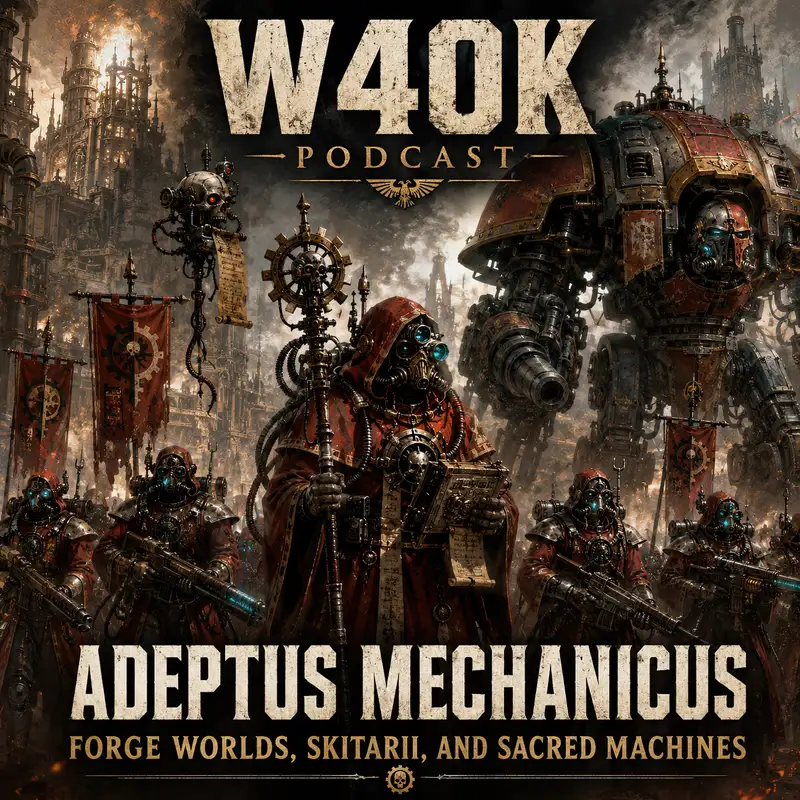
Adeptus Mechanicus: Forge Worlds, Skitarii, and Sacred Machines
Before a forge world goes to war, it prays.
Incense drifts through assembly halls large enough to swallow cities. Hooded priests chant over reactor cores. Servo-skulls carry strips of sanctified parchment between banks of machinery. Far below, workers feed ore into furnaces that have burned for thousands of years. Then the gates open, and the Skitarii march out beneath banners of red and black. Behind them, something vast begins to move. A god-engine takes its first step, and the floor shakes hard enough to make every prayer sound sensible.
This is the central contradiction of the Adeptus Mechanicus. It is the great technological power of the Imperium, yet it distrusts invention. It commands factories capable of building starships, plasma weapons, and machines taller than cathedrals, yet it treats maintenance as liturgy and technical knowledge as sacred revelation. Its armies are made from human beings who have replaced much of their humanity, while its most revered machines are spoken to as though they possess souls.
The Mechanicus does not merely worship machines. It has built an entire civilisation around the belief that knowledge is holy, ignorance is dangerous, and technology must be controlled because humanity has already proved what happens when it is not.
That belief began on Mars long before the Imperium existed.
During the long collapse remembered as the Age of Strife, Mars became a world of poisoned deserts, ruined industrial zones, and sealed enclaves struggling to preserve what remained of human science. The planet had once been a centre of advanced technology. By the time order began to return, much of that technology was broken, fragmented, or incomprehensible.
The survivors did not preserve knowledge in universities open to everyone. They preserved it through cults, guarded archives, hereditary offices, and ritual. A maintenance sequence might survive as a prayer because the prayer could be memorised after the original engineering theory had been lost. A warning label might become a taboo. A start-up procedure could become a rite performed in exactly the same order because deviation had once caused an explosion, and no one still living understood why.
Over generations, practical survival became theology.
The priests of Mars taught that all knowledge existed as part of the divine Machine God. The Omnissiah was the physical manifestation of that divinity, and the Motive Force was the animating power moving through all mechanisms. Many among the Martian priesthood would later identify the Emperor as the Omnissiah, though the precise meaning of that claim has never been as simple or as universally accepted as Imperial sermons prefer to suggest.
When the Emperor came to Mars at the dawn of the Great Crusade, he did not simply absorb the planet as another conquered territory. He needed its shipyards, weapons, engineers, and industrial knowledge. Mars needed access to the wider human galaxy and protection from the enemies gathering beyond its red deserts.
The result was an alliance remembered as the Treaty of Mars.
The Martian Mechanicum retained its own priesthood, laws, military forces, and religious identity. In return, it armed the Emperor’s armies and helped construct the fleets of the Great Crusade. Humanity’s new empire was built by two powers joined together. One ruled from Terra. The other ruled from Mars and kept the keys to the engines.
The arrangement worked because both sides needed it. It also created a problem that has never disappeared. The Imperium depends upon the Mechanicus, but it does not entirely control it. The Mechanicus serves the Imperium, but it also serves its own god, its own hierarchy, and its own understanding of humanity’s destiny.
The Horus Heresy tore that alliance apart. The Mechanicum divided, and Mars became a battlefield between loyalists and those who embraced forbidden knowledge, daemon-bound machines, and the service of the Warmaster. The traitors would become associated with the Dark Mechanicum. The loyal priesthood survived, but it emerged from the civil war altered. The Adeptus Mechanicus became the great technical institution of the Imperium, more tightly bound to Imperial government than before, yet still distinct enough to remain a realm within a realm.
Its power rests upon the forge worlds.
A forge world is a planetary factory, monastery, archive, fortress, and political state combined. Continents disappear beneath refineries. Oceans are drained or poisoned. Mountains are hollowed out for mines. The atmosphere becomes a permanent industrial haze lit from below by furnaces.
Every forge world has its own traditions, rivalries, and specialities. Mars remains the spiritual centre. Ryza is famed for plasma technology. Lucius descends through layers of industry beneath its surface. Metalica is defined by machinery and relentless production. Stygies Eight carries a reputation for dangerous curiosity, particularly where alien technology is concerned.
These worlds are united by creed, but they are not identical. A tech-priest from one forge world may consider the practices of another inefficient, impure, or suspiciously close to heresy. Since the Mechanicus is an institution dedicated to preserving knowledge, its members spend a remarkable amount of effort hiding knowledge from one another.
That secrecy is not merely vanity. Knowledge is political power.
A forge world that alone knows how to manufacture a particular reactor component can bargain with governors, admirals, and generals. A magos who controls access to an ancient data archive can command obedience from rivals. A priesthood that maintains a planet’s life-support systems does not need to explain why its requests should be treated seriously. The implication is already circulating through the ventilation ducts.
The most valuable discoveries are fragments of Standard Template Construct technology.
Before humanity’s collapse, Standard Template Construct systems helped human colonies build what they needed from available resources. In the forty-first millennium, the surviving knowledge is scattered. Sometimes a discovery is a complete pattern. More often it is a damaged design, a partial database, or a manufacturing method preserved without its original context.
To the Mechanicus, such a fragment is not merely useful. It is sacred evidence that the knowledge of the ancients can be recovered.
Explorator fleets cross the galaxy in search of it. They enter dead systems, alien ruins, and worlds abandoned before the Imperium was born. Some return with relics capable of changing a war. Others return with nothing. Some do not return at all, which is treated as unfortunate but not necessarily discouraging. Martian doctrine has never allowed mortality to interfere excessively with archival work.
This search explains why the Mechanicus appears both curious and conservative.
Its priests are not forbidden from discovering technology. They are encouraged to recover it. The danger lies in claiming to have invented something new.
Innovation suggests that human reason can create knowledge outside the sacred inheritance of the past. That idea threatens theology, hierarchy, and safety at the same time. The ancient human civilisation that produced wonders also produced machine intelligences and weapons that helped destroy it. Memories of the Men of Iron and the horrors of unrestricted artificial intelligence survive only in fragments, but the fear is deeply embedded.
From the Mechanicus point of view, caution is not cowardice. It is the lesson of a civilisation that nearly died from its own brilliance.
The problem is that preservation without understanding can become stagnation. A ritual may protect a machine because it encodes a correct procedure. It may also survive long after its purpose has been forgotten. Priests can spend centuries arguing over whether a component should be blessed before or after installation while an army waits for ammunition.
Even then, the ritual is not necessarily pointless.
A litany may function as a checklist. Sacred oils may be industrial lubricants. The prescribed striking of a casing may dislodge a damaged contact. Anyone who has attempted to repair an old machine by tapping it in the correct place should resist feeling too superior.
The Mechanicus adds another layer through its belief in machine spirits.
Some Imperial machines clearly possess complex control systems, adaptive behaviour, or limited intelligences. A Land Raider can respond to threats after its crew is incapacitated. A Titan has a presence powerful enough to influence the mind of its princeps. Other devices are treated as though they possess personalities when the evidence may be no more than mechanical unreliability and human habit.
The setting does not provide one simple answer. Machine spirits may describe many different things, from basic software to ancient semi-aware systems, from religious interpretation to something genuinely numinous. The Mechanicus sees no need to separate these possibilities. The spirit exists. It must be respected. The machine works better when properly honoured. Debate may continue after the reactor stops trying to kill everyone.
The tech-priests who maintain these systems gradually remake themselves to match their faith.
To the Cult Mechanicus, the human body is temporary, unreliable, and burdened by weakness. Flesh decays. Memory fails. Emotion distracts. Steel can be replaced, data can be copied, and sensory organs can be improved.
A newly inducted priest may still appear mostly human. A senior magos may be a towering arrangement of metal limbs, cables, weapon mounts, memory cores, and life-support systems, with only a few organic remnants concealed within. Some retain recognisable personalities and emotions. Others suppress them behind logic engines and coded speech.
They communicate through spoken language when required, but also through binharic cant and the noosphere, a data environment through which information can pass between augmented minds and machines. To an unmodified human, a forge world may seem full of silence broken by chanting. To a tech-priest, it is crowded with signals, access requests, targeting data, doctrinal commands, warnings, prayers, and arguments moving at machine speed.
The Skitarii fight inside that world.
They are often mistaken for robots. They are not. They are human soldiers transformed through augmentation, conditioning, chemical control, and surgical modification. Their bodies may be fitted with mechanical limbs, enhanced senses, internal power systems, radiation shielding, or weapons interfaces. Their commanders can feed orders directly into their minds and alter the way they perceive the battlefield.
Some Skitarii retain names, memories, and strong individual identities. Others are reduced almost entirely to function. Practices vary by forge world, commander, and military need. This variation matters because the Mechanicus is not trying to create one ideal soldier. It is creating tools suited to particular tasks.
Skitarii Rangers operate as scouts, trackers, and long-range marksmen. They can cross poisoned landscapes and continue hunting targets where ordinary troops would require sealed vehicles. Skitarii Vanguard serve as aggressive assault troops, carrying weapons and power systems that expose them to levels of radiation lethal to normal humans. Their own bodies become hazardous. They advance through enemy positions wrapped in invisible contamination, a tactical method that is effective, terrifying, and unlikely to improve relations with nearby civilian authorities.
On the battlefield, Skitarii cohorts can appear unnervingly precise. Their movements are coordinated through streams of data. A tech-priest commander can impose doctrina imperatives that sharpen one set of abilities while reducing another. Individual judgment may be suppressed in favour of mathematical obedience. The result is not mindless. It is directed.
That distinction separates Skitarii from servitors.
Servitors are organic beings whose minds have been removed, reduced, or overwritten so that their bodies can perform limited functions. Some are created from vat-grown biological material. Others are made from condemned criminals or unfortunate human beings caught inside systems that regard identity as an inefficient luxury. They carry ammunition, operate weapons, maintain machinery, and perform labour throughout the Imperium.
The Skitarii are soldiers. Servitors are equipment made from flesh.
The fact that both can stand in the same formation tells us something essential about the Mechanicus view of humanity. The human form is not sacred. Purpose is sacred.
Yet Skitarii are not merely disposable infantry. They are the protective edge of the forge worlds. They secure excavation sites, escort Explorator missions, defend data vaults, and recover technology under fire. When a magos identifies a relic inside an enemy fortress, the Skitarii are the ones ordered to bring it back intact while everything around it is rendered less historically significant.
They also march beside the sacred machines of the Cult Mechanicus.
There are ancient Kastelan robots governed through doctrinal programming, tracked Onager Dunecrawlers built for heavy fire support, and Ironstrider engines kept in motion through principles so poorly preserved that shutting them down can be considered an unacceptable risk.
Above them all stand the Titans.
A Titan is not simply a large vehicle. It is a fusion of fortress, weapon, shrine, and predatory intelligence. Titan Legions are associated with forge worlds and the Collegia Titanica, and each engine carries centuries of honour, memory, and ritual. Their crews do not merely drive them. They enter into communion with them.
The princeps is the central mind of a Titan. Through a mind impulse unit, the princeps connects directly with the god-engine’s systems and machine spirit. In smaller Titans, the princeps may command from a cockpit. In larger engines, long service can leave the princeps permanently sustained within an amniotic tank, more at home inside the Titan than inside a human body.
A Titan’s machine spirit can be wrathful, proud, and eager to destroy. The princeps must command it without being consumed by it. When control holds, the result is one of the most powerful land weapons in the Imperium. When control fails, the distinction between pilot and machine begins to disappear.
A Warlord Titan walking to battle makes Mechanicus theology difficult to dismiss as metaphor. Its guns shatter fortifications, its void shields turn aside artillery, and its footsteps crush streets into rubble. Bells toll from armour plates decorated like cathedral walls while priests chant beside enough ammunition to erase a city district.
To ordinary Imperial soldiers, such an engine is a weapon and a miracle. To the Mechanicus, it is also a living inheritance. Losing one is not measured only in military terms. It is the destruction of knowledge, memory, and sacred continuity.
This explains one of the darkest features of Mechanicus warfare. Human lives can be replaced more easily than ancient machines.
A commander may sacrifice thousands of Skitarii to recover a damaged relic. A forge world may strip an entire region of resources to restore one irreplaceable engine. An Imperial general may see madness in such priorities, right up until the restored engine wins the campaign.
The Mechanicus survives because its beliefs are often both terrible and practical.
Its monopoly on technology gives it enormous leverage, but it also carries a genuine burden. The Imperium spans a million worlds filled with machines built in different eras, under different conditions, from plans no one fully understands. Starships must cross the void. Life-support systems must continue functioning. Lasguns need power cells. Armoured regiments need engines. Hive cities need pumps, filters, and generators.
Without the Mechanicus, the Imperium does not merely lose its most advanced weapons. It stops breathing.
That dependence creates constant tension. Planetary governors resent Martian demands. Imperial commanders complain about delays and ritual. Inquisitors watch for heresy. Tech-priests guard their independence and pursue goals that may have little to do with the immediate needs of local authorities.
The Mechanicus also contains its own internal struggles. Some priests believe knowledge must be preserved exactly. Others experiment while insisting they are merely recovering forgotten principles. Xenarites study alien technology despite the danger of contamination and accusation.
Belisarius Cawl is the most famous example of how disruptive a tech-priest can become while remaining on the loyal side of the line. His work on new weapons, armour, and the Primaris Space Marines proves that the Mechanicus can innovate. It also explains why many priests regard innovation as a threat. Cawl has not ended the argument. He has made it louder.
This is why the Adeptus Mechanicus cannot be reduced to superstition.
Its rituals preserve procedures. Its secrecy protects monopolies. Its caution reflects historical trauma. Its cruelty follows from a belief that flesh is temporary and function is sacred. Its faith gives meaning to a civilisation living among the ruins of achievements it can maintain but rarely equal.
The forge worlds are the physical expression of that belief. They turn planets into engines because production is devotion. The Skitarii are its military expression. They surrender pieces of themselves so that purpose can replace weakness. The sacred machines are its promise. They suggest that memory, power, and perhaps even identity can endure after flesh has failed.
There is nobility in that promise. There is also horror.
A tech-priest may save a city by restoring a reactor no one else can understand. The same priest may condemn ten thousand workers because the correct component must be delivered before the next sacred cycle. A Skitarii soldier may fight with courage, loyalty, and fragments of remembered humanity. The command network may still spend that soldier’s life as casually as ammunition. A Titan may defend an entire world. Its princeps may never again experience life outside the machine.
The Mechanicus protects humanity by teaching that humanity, in its natural form, is not enough.
That is the answer hidden inside the furnaces of every forge world. The Adeptus Mechanicus is powerful not because it understands all technology, but because it controls the surviving islands of understanding in an age of darkness. It turns maintenance into ritual so knowledge can outlive comprehension. It turns soldiers into instruments so flesh can survive impossible wars. It turns ancient engines into objects of worship because some machines truly are older, stronger, and more enduring than the people who serve them.
On a forge world, the night is never dark. Furnace light glows through the poisoned sky. Skitarii columns move across iron plains while data passes invisibly above them. Deep inside a cathedral of machinery, a priest places one metal hand upon an ancient control panel and recites words spoken by generations whose names have been erased.
The machine awakens.
Whether it responds to code, prayer, memory, or something that deserves to be called a spirit no longer matters. The doors open, the war engines advance, and humanity survives one more day by trusting the part of itself that has already become machine.