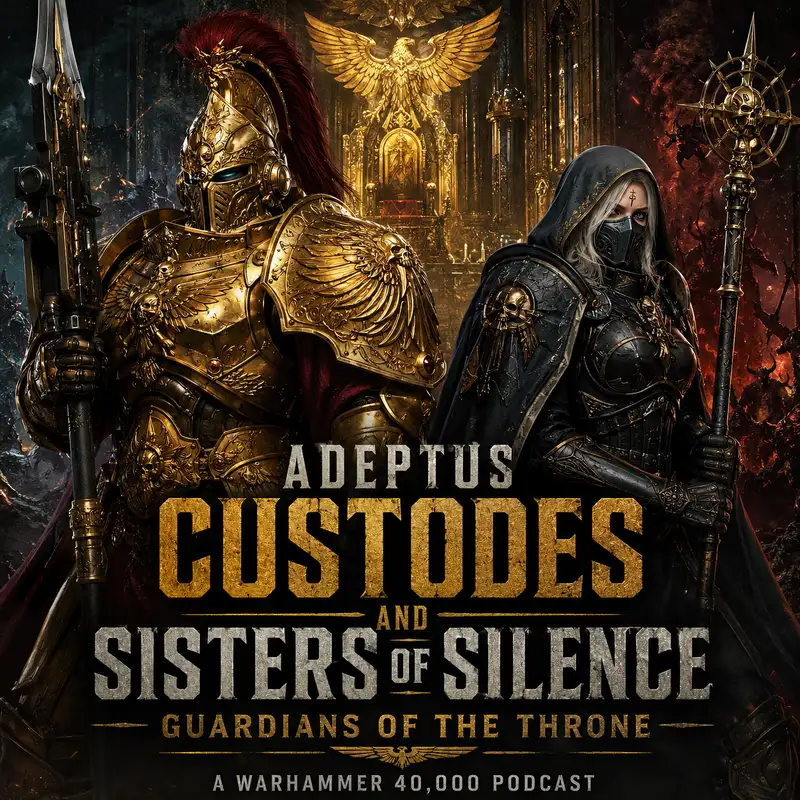
Adeptus Custodes and Sisters of Silence: Guardians of the Throne
The first warning was a pressure behind the eyes. Then came the screams of astropaths and the sense that the sky above Terra had become a wound. Cadia had fallen. The Great Rift was opening across the galaxy, and near the Lion’s Gate of the Imperial Palace, daemons of Khorne forced themselves into reality. They did not arrive by landing craft. They came through the weakness between worlds, already inside the most heavily defended place in the Imperium. Against them stood warriors in gold, each crafted to be stronger, faster, and more lethal than almost any other human being. Beside them moved women in dark armour whose presence made the Warp recoil. One force was impossible to overlook. The other was difficult to endure. Together, they were the Talons of the Emperor.
That image explains the purpose of the Adeptus Custodes and the Sisters of Silence better than any parade on Terra. They are often described as the guardians of the Throne, but that phrase can sound deceptively simple. The Imperial Palace is not merely a building, and the Golden Throne is not merely a chair. The Palace is a continent-sized fortress, the administrative heart of a galactic empire, and the final defensive shell around the Emperor’s broken body. The Throne is a life-support system, psychic engine, seal, and sacred object all at once. Protecting it means defending walls, secrets, institutions, and reality itself. No single kind of warrior can do all of that.
The Custodians are the visible half of the answer. They existed before the Imperium had become the Imperium, when Terra was still divided among tyrants, techno-barbarians, gene-forged armies, and rulers who had survived the Age of Strife by becoming very difficult people to remove. The Emperor created the Custodians as personal companions and protectors during those wars. They were not simply elite infantry assigned to stand near him. They were made for proximity to power. A Custodian could guard a doorway, command a campaign, evaluate a diplomat, study an enemy civilisation, or advise the Emperor directly. Their loyalty was personal, absolute, and focused upon the Master of Mankind rather than upon any ministry, senator, priesthood, or later interpretation of Imperial law.
This is one reason the Custodes should not be understood as unusually expensive Space Marines. Both are towering, altered warriors in advanced armour, and from a safe distance the distinction may appear academic. It becomes less academic when one of them reaches you. Space Marines are created through an organised system of implants, gene-seed, indoctrination, and Chapter tradition. Custodians are fashioned individually. Candidates are taken very young and remade through a process of genetic, alchemical, psychological, and intellectual transformation that is tailored to each person. The work may take decades. The result is not a soldier produced from a pattern, but a singular weapon whose body and mind have been rebuilt together.
Their armour reflects that difference. Auramite plate is among the finest personal protection the Imperium can still manufacture, adjusted to its wearer and maintained like a relic. Their guardian spears combine blade and firearm in a weapon that demands strength, precision, and excellent confidence in one’s ability to manage recoil while removing someone’s head. Yet the equipment is not what makes them terrifying. Their true advantage is the union of speed, perception, judgement, and control.
A squad of Space Marines fights as a unit trained to create overlapping fields of support. Custodians can do that, but their cooperation often appears more fluid. Each warrior reads the battlefield independently, understands the intentions of the others, and acts without requiring constant orders. To an observer, their formation may look loose, even individualistic. Then every enemy position collapses at once. It is less like watching a shield wall advance and more like watching several master swordsmen conduct the same execution from different directions.
The name the Ten Thousand is ancient, though their actual strength has risen and fallen through war and losses that cannot be replaced quickly. They are led by the Captain-General and organised into Shield Hosts, shield companies, and specialised formations. Some stand within the innermost sanctums as Companions, close to the Golden Throne. Others guard the Palace, patrol the Solar System, escort individuals or relics judged essential to the Emperor’s will, and hunt dangers before those dangers reach Terra. For a force associated with standing still, the Custodes devote considerable effort to ensuring that a threat never reaches the door.
They also test that door themselves. In the Blood Games, Custodians attempt to penetrate the Palace’s defences using the methods of assassins, infiltrators, and invaders. A security system that has never failed may be perfect, or it may simply be untested. The Custodes prefer to discover the distinction before a daemon or traitor does. Imperial bureaucracy produces reports claiming that everything is secure. The Blood Games produce evidence.
Even a Custodian eventually slows, though an ordinary warrior might never notice it. When a Custodian judges that their reactions are no longer flawless, that warrior may surrender the armour and depart Terra as one of the Eyes of the Emperor. These agents gather intelligence and watch for threats. The Custodes do not define protection as remaining within sight of the Throne. They define it as preserving the Emperor, wherever the danger begins.
Yet physical perfection is not enough in Warhammer forty thousand, because physical reality is only part of the battlefield. A fortress wall can stop an army. It cannot reliably stop a thought. Armour can turn a blade. It may not turn a curse, a possession, or a hole opening into the Warp. The Emperor therefore required another kind of guardian, one defined not by overwhelming presence but by absence.
The Sisters of Silence should not be confused with the Adepta Sororitas. They are not warrior-nuns of the Ecclesiarchy, but an older order built around psychic blanks, sometimes called nulls or pariahs. Most human beings possess a reflection in the Warp, however faint. Psykers possess a much brighter connection, which allows them to draw power from that dimension and also gives the things living there a convenient way to notice them. A blank has no normal psychic presence. Near one, Warp-born power weakens. Psykers may lose concentration or suffer intense pain. Daemons find their connection to reality disrupted. Ordinary humans often experience instinctive discomfort, nausea, anger, or fear without understanding why.
That reaction has shaped the lives of blanks throughout human history. A child with the pariah trait may be rejected before anyone knows the reason. Neighbours feel uneasy. Family members become cold or hostile. In an Imperium governed by superstition, this often ends with isolation, violence, or a quiet disappearance into an institution that knows the value of rare human anomalies. The Sisters of Silence take those whom society instinctively despises and turn their condition into discipline.
During the Great Crusade, the Emperor formalised them as the Anathema Psykana. Jenetia Krole, one of the most formidable blanks known to Imperial history, became their Knight-Commander. She gathered others of her kind and forged them into an order of investigators, witch hunters, guards, and battlefield warriors. They accompanied the Great Tithe that collected psykers for Imperial service, sacrifice, or containment. They hunted rogue psychic threats. They fought enemies whose sorcery could break conventional armies. Their silence was both vow and method, a deliberate identity built by people who had learned that their mere presence disturbed everyone around them.
The Sisters communicate through gesture, coded signs, posture, and disciplined coordination. Their lack of speech does not make them passive. Some carry boltguns, others flamers or greatblades, and all train to close with enemies that conventional troops struggle even to approach. They remain physically human. What makes them extraordinary is the way their null presence changes the conditions of the fight.
A powerful psyker facing ordinary troops controls the terms of engagement. Distance, cover, and morale may mean very little when thoughts can be burned from the mind or bodies torn apart by force drawn from another dimension. Bring a Sister of Silence close enough, and the contest changes. The psychic storm weakens. Illusions flicker. Daemons become less certain. Powers that seemed divine are reduced toward something that can be reached by a blade. This does not make the Sisters invincible. A sufficiently large daemon can still crush a human body, and a bolter round remains admirably indifferent to metaphysics. The null field creates opportunity. Someone must still exploit it.
That is where the Custodes enter. A Sister strips away the enemy’s unnatural advantage. A Custodian attacks with speed and force few opponents can survive. The Sisters deny the Warp. The Custodes dominate the material battlefield. One talon pins the threat in reality. The other tears it apart. Their partnership is not decorative symbolism. It is a military solution to the fact that the Emperor’s enemies exist in more than one realm.
The clearest demonstration came beneath the Imperial Palace during the Horus Heresy. The Emperor had built a secret human route into the webway, an ancient network outside ordinary space. His intention appears to have been to free humanity from dependence upon Warp travel and perhaps from the growing danger of psychic exposure. Magnus the Red shattered the wards protecting that project when he attempted to warn the Emperor of Horus’s betrayal. His warning was sincere. Its delivery was catastrophic.
Daemons flooded toward the breach beneath Terra. Custodians, Sisters of Silence, and loyal forces of the Mechanicum fought in tunnels, ruins, and impossible spaces to keep the enemy from reaching the Palace. The war continued for years. The Custodes could destroy daemons in close combat, but the enemy seemed endless. The Sisters weakened the creatures and smothered psychic assaults, but they were mortal and painfully few. Every loss mattered. Every retreat brought the Warp closer to the heart of the Imperium.
The fighting reduced the Ten Thousand with a severity no conventional campaign had achieved. It also consumed many of the Sisters who had been gathered during the Great Crusade. The Emperor eventually entered the battle himself, but even his intervention could not restore the ruined project. The Imperial forces withdrew. The gateway had to be sealed, and the Emperor was bound increasingly to the Golden Throne to hold disaster at bay. The guardians had fought with almost unmatched skill and courage. They had still lost the future they were meant to protect.
That failure shaped both orders. During the Siege of Terra, the remaining Custodians and Sisters fought while the Palace became a continent of trenches, broken walls, and burning monuments. Jenetia Krole moved through the slaughter with a null presence so intense that people struggled to notice or remember her. She killed traitors at the height of the siege and was eventually slain in the chaos, her death almost swallowed by the very absence that had defined her life. It was a fittingly cruel end for the leader of an order the Imperium needed desperately and could barely bear to acknowledge.
When Horus was defeated and the Emperor was placed upon the Golden Throne, the Custodes regarded the outcome not as victory but as failure. Their master had commanded armies, shaped history, and spoken with them directly. Now he was immobile, wounded beyond mortal recovery, and sustained by machinery that no living technician fully understood. The Custodians remained at his side, but their duty changed from protecting an active ruler to interpreting the will of one who rarely communicated in any simple fashion.
For much of the next ten thousand years, the Custodes appeared to withdraw from the wider Imperium. That appearance was only partly true. They guarded the Palace, conducted Blood Games, watched the approaches to Terra, sent agents outward, and undertook missions hidden from almost every Imperial archive. They did not become a conventional crusading army, because they did not regard themselves as one. The Imperium could lose worlds, fleets, and entire sectors without automatically drawing their intervention. Their responsibility was the Emperor. Humanity benefited when the two interests aligned, which was often, but not always in the way Imperial citizens might hope.
This distinction gives the Custodes an unusual place in Imperial politics. They are not servants of the High Lords. Their authority descends directly from the Emperor, and by their oldest understanding, no lesser law can bind them. They may cooperate with inquisitors, generals, priests, or primarchs, but cooperation is not obedience. The Custodes have watched institutions rise, decay, and declare themselves eternal. They remember, through records and living tradition, an Imperium that did not worship the Emperor as a god. Standing near the centre of Imperial religion has not necessarily made them enthusiastic participants in it.
The Sisters of Silence suffered a different fate. Their numbers had been devastated, their founder was dead, and the Imperium that emerged from the Heresy increasingly feared what it did not understand. The Sisterhood fragmented. Some remained connected to the Black Ships and the collection of psykers. Others formed isolated cadres, convents, and hidden watch stations. Many Imperial officials treated them as unpleasant tools to be used at a distance. This was administratively convenient and strategically foolish, a combination the Imperium has refined across many millennia.
Their decline was also a consequence of their nature. Institutions are built through human relationships, patronage, memory, and trust. Blanks make those relationships difficult simply by entering the room. People forget them, resent them, or find reasons to assign them elsewhere. A Space Marine may inspire terror and still be worshipped as an angel. A Sister of Silence can save a city and leave its survivors wishing she had never arrived. Heroic recruitment posters were unlikely to solve the problem.
The opening of the Great Rift made such neglect impossible to sustain. When daemons assaulted Terra near the Lion’s Gate, the Custodes fought in full view of the Throneworld, and the Sisters again stood beside them. Roboute Guilliman’s return accelerated the restoration of the Sisterhood. He issued the Dispensatus Anathema, directing the scattered Sisters to be found and gathered into renewed service. An order that had almost become rumour returned as a vital arm of Imperial war.
The Custodes also moved outward in far greater strength. The logic was unavoidable. Terra could no longer be protected by waiting for the galaxy’s disasters to reach the Solar System. Shield Hosts carried the Emperor’s authority beyond the Palace. Custodians accompanied crusades, delivered commands, hunted emerging threats, and intervened where failure might eventually endanger the Throne. Some Imperial commanders welcomed their arrival as divine confirmation. Others recognised that a golden warrior carrying the Emperor’s direct authority can make a routine command dispute rather brief.
In the Era Indomitus, the Talons of the Emperor are therefore both restored and changed. They still defend Terra, but their battlefield may be a shrine world, a void station, a plague ship, or a planet where psychic corruption has begun to spread. The Sisters are not merely assistants attached to more important warriors. They possess their own traditions, commanders, and methods. The Custodes are not simply larger front-line troops. Each force addresses a different category of danger, and each becomes more effective when the other is present.
Their relationship also reveals the contradiction at the heart of the Imperium. Humanity depends upon psykers. Astropaths carry messages through the Warp. Navigators guide ships between stars. The Astronomican itself is a psychic beacon sustained at terrible cost. Yet psychic power is also one of humanity’s greatest vulnerabilities. The Imperium survives by using the same force that continually threatens to destroy it. The Sisters of Silence embody the emergency brake, except the emergency has lasted ten thousand years.
The Custodes embody a different contradiction. They are presented as the peak of human martial achievement, but their existence is proof that the Emperor trusted no ordinary system to protect him. They are philosophers and guardians created by a ruler who claimed to reject superstition, yet they now stand at the centre of the largest religion in human history. They possess authority beyond almost every Imperial institution, but they cannot simply repair the empire those institutions have damaged. They were made to serve the Emperor’s will, and the Emperor no longer explains that will in terms anyone can easily debate.
This makes them magnificent, but not uncomplicated heroes. A Custodian may save a world because its survival protects Terra. The same Custodian may abandon another world because it does not. A Sister of Silence may rescue thousands from daemonic possession and be hated by the people she saved. Both orders operate according to duties older than the current shape of the Imperium. Their loyalty is admirable precisely because it is so complete, and frightening for the same reason.
So what does it truly mean to guard the Throne? It means more than standing beside a door with a spear. It means testing the locks, watching the stars, hunting conspirators, killing witches, suppressing daemons, judging allies, and deciding which distant war may become tomorrow’s attack on Terra. It means defending the Emperor’s body, the machinery that sustains him, the psychic systems that depend upon him, and the political order built around his continued existence. It also means carrying the memory of failure every hour of every day.
The Custodian and the Silent Sister are opposites only in appearance. One is a declaration of power, clad in gold and impossible to ignore. The other is an absence, a human shape around which souls instinctively draw back. The Custodian defeats what can be touched. The Sister forces the untouchable to become vulnerable. Together they close the gap between the material world and the Warp, because that gap is where the Emperor’s most dangerous enemies have always entered.
The Emperor once made the Talons to protect a future he intended to build. Ten thousand years later, they protect the ruins of that intention. Gold stands at one side of the gate, silence at the other, and neither will move while humanity still breathes behind them.