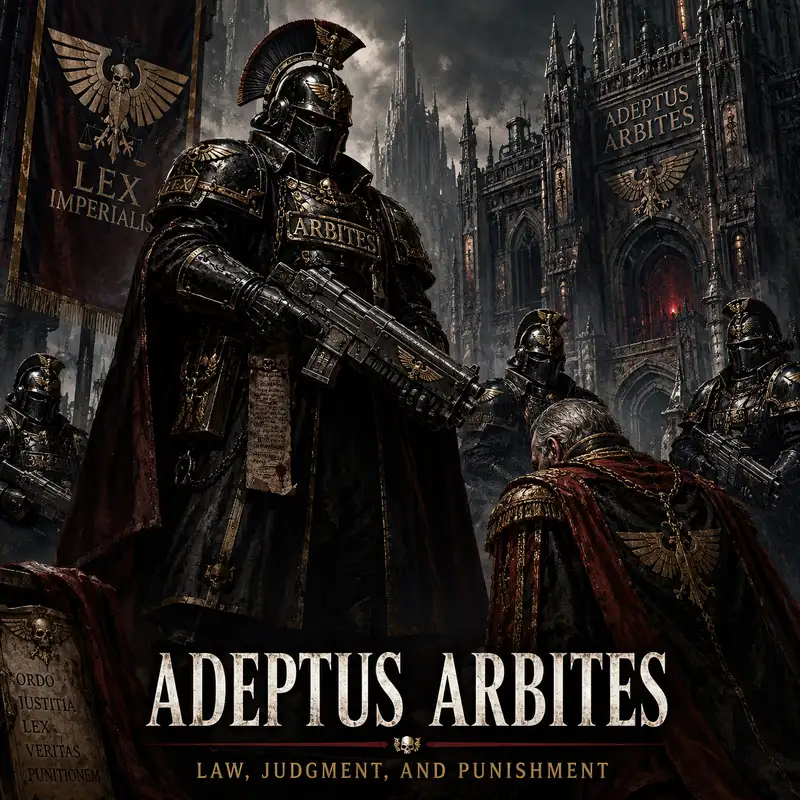
Adeptus Arbites: Law, Judgment, and Punishment
A planetary governor may command armies, own continents, and condemn millions with a gesture. Yet the moment the tithe ships depart half-empty, another authority enters the palace. Black carapace armour. Eagle-crested helmets. Combat shotguns carried with the calm of people who have already read the sentence. The governor has spent a lifetime believing himself to be the law. The Adeptus Arbites have come to remind him that he is merely subject to it.
That distinction explains nearly everything about the Arbites. They are often described as the police of the Imperium, but that comparison is useful only until it becomes misleading. They do not patrol every market, investigate every murder, or rescue every citizen in distress. Those duties usually belong to local enforcers, watchmen, militia, guild security, noble retainers, or whatever passes for civil authority on a particular world. The Arbites enforce the law that stands above those systems. Their concern is not whether a planet is pleasant, humane, or even competently governed. Their concern is whether it remains obedient to Terra.
The Imperium could not function in any other way. Its worlds are separated by dangerous voyages, unreliable messages, and cultures that may have developed in isolation for thousands of years. One planet may settle disputes through hereditary courts. Another may allow industrial clans to police their own workers. A third may consider trial by combat a perfectly respectable administrative procedure. The Imperium rarely objects to local custom. It asks for loyalty, worship of the Emperor, soldiers, resources, control of psykers, and obedience to Imperial decree. How a governor obtains these things is usually the governor’s problem. Failure to provide them becomes the Arbites’ problem.
One of the most sensitive obligations concerns psykers. Imperial law requires the untrained and unsanctioned to be identified, confined, and handed to the institutions that gather them for the Black Ships. The Arbites may assist in raids, guard holding sites, and compel local authorities to surrender their human tithe. They are not always told what awaits those prisoners. Their duty ends with compliance. To an Arbitrator, a governor who hides a dangerous psyker is not showing compassion. He is concealing a breach in the wall between reality and the warp.
This is why a local police officer and an Arbitrator can look similar while serving very different masters. On Necromunda, for example, the Palanite Enforcers preserve the authority of the ruling House Helmawr. They suppress gangs, riots, and disorder according to the needs of the planetary regime. The Adeptus Arbites answer to a higher chain of command. A Palanite officer may arrest someone for threatening the governor’s peace. An Arbitrator may arrest the governor.
The law they enforce is the Lex Imperialis, the immense body of Imperial law gathered through ten thousand years of decrees, judgments, precedents, and interpretations. Its foundations are attributed to the Emperor, while later rulers and institutions have added layer upon layer of commands. The result is not a neat legal code carried in a convenient pocket volume. It is a civilisation-sized archive. Judges may spend their lives studying one portion of it, assisted by scribes who search through rulings issued by authorities dead for millennia.
Contradictions are inevitable. One decree may demand immediate punishment. Another precedent may require an inquiry. A later ruling may clarify both, except that its authority is disputed because the seal was damaged during a civil war seven thousand years earlier. Imperial justice is therefore exacting, absolute, and occasionally delayed until everyone involved has become an ancestor. This does not prevent punishment. It merely changes who receives it.
At the center of the institution stands the Hall of Judgement on Terra, repository of the greatest collection of Imperial law and seat of the Grand Provost Marshal. From there, authority descends through marshals, judges, proctors, and the countless precincts scattered across the Emperor’s realm. No single official can truly master the whole legal tradition. The system survives because the Arbites are trained to treat its authority as unquestionable even when its meaning requires years of armed scholarship.
The institution reaches back to the age of the Great Crusade, when newly compliant worlds required officials capable of handling matters beyond local jurisdiction. The principle was simple. A conquered world could retain much of its own government, but it could not decide what obedience to the Imperium meant. That question belonged to the Imperium itself. The Arbites became the enduring presence of that claim, long after the conquest fleets had moved on and the banners of compliance had faded into ceremonial relics.
Many Arbitrators are drawn from the Schola Progenium, where the orphaned children of Imperial servants are shaped for lives of duty. The qualities desired are not subtle. Discipline. Force of will. Physical courage. Resistance to bribery, fear, and local loyalty. An Arbitrator posted to a distant world is expected to stand apart from its politics and customs. Friendship with the powerful can become corruption. Sympathy for the accused can become weakness. Doubt can become dereliction.
This produces officers who are often severe even by Imperial standards. They are taught that law is not a negotiation and that mercy may endanger entire worlds. In a setting where a hidden cult can open the way to daemonic invasion, where one unsanctioned psyker can become a doorway for catastrophe, and where rebellion can interrupt the supply of armies fighting several systems away, that belief is not entirely irrational. It is merely broad enough to justify almost anything.
The physical symbol of Arbites authority is the precinct-fortress, sometimes called a courthouse, although the word suggests a gentler building than the one intended. A precinct-fortress is courthouse, barracks, prison, armoury, archive, communications station, vehicle depot, and siege position combined. Its walls are designed to resist the very population over which it watches. Its cells can hold political prisoners, dangerous criminals, rogue psykers, and anyone unfortunate enough to have become relevant to an Imperial investigation.
On a major hive world, a precinct may contain enough personnel and equipment to fight a small war. On a remote or sparsely populated planet, the Arbites presence may be a handful of officers surrounded by millions of people whose language they barely understand. In either case, the precinct is deliberately separate from local authority. Its weapons point outward. Its records travel upward. Its gates remind the governor that there is a fortress on the planet which does not belong to him.
That independence becomes decisive when a world begins to rebel. The pattern often starts quietly. A tithe shipment is late. Recruitment figures no longer match population records. An astropath disappears. A labour strike becomes an armed movement. Local enforcers report that everything is under control, usually while deleting the evidence that it is not. Arbites investigators compare ledgers, question officials, intercept communications, and watch the ruling class for signs of treason, corruption, or panic.
Their jurisdiction can also follow crime beyond a planet’s streets. Smuggling, piracy, forbidden commerce, and the movement of fugitives turn ports and voidcraft into legal battlefields. Cargo seals are checked, manifests compared, crews questioned, and holds searched for contraband that local officials were paid not to notice. A crate of untaxed luxury goods may be corruption. A crate containing xenos technology may be a threat to the entire system. The Arbites are trained to recognize that the difference is often hidden beneath the same false paperwork.
If the problem can be contained, the Arbites make arrests. If the governor remains loyal but weak, they may force his administration to act. If the governor is the problem, they can move against him directly. The warrant may be served in a council chamber, at a landing field, or through a fortified door breached by explosive charge. Rank provides no immunity. Wealth provides no innocence. A noble house that has ruled for centuries can discover that ancestry is simply a longer list of people available for punishment.
Exaction Squads represent the most focused expression of this authority. They are formed from experienced Arbitrators and sent after targets whose capture matters to the Imperium. Their task is not ordinary patrol work. They hunt fugitives, secure dangerous prisoners, break protected conspiracies, and enter places where local forces are compromised or inadequate. They may include scouts, communications specialists, medics, marksmen, shield-bearing Subductors, and handlers directing cyber-mastiffs through the smoke.
The preference is often to take the designated quarry alive. A dead suspect cannot be interrogated, tried, displayed, transported, or compelled to name accomplices. This does not make the operation merciful. The target’s guards, associates, employees, relatives, and unfortunate neighbors may receive far less careful treatment. Imperial law values the prisoner because the prisoner is useful. Everyone else is advised not to stand between the Arbites and an active warrant.
Their equipment reflects the need to control crowds, breach strongholds, and survive close-range violence. Combat shotguns are a signature weapon, reliable in corridors and hab blocks where a long rifle is more burden than advantage. Shock mauls and suppression shields allow Arbites formations to batter through riots or hold narrow approaches. Grenade launchers, web weapons, heavy guns, and specialist ammunition provide answers to resistance of increasing seriousness. Cyber-mastiffs track fugitives and pull them down with iron jaws. The Imperium has achieved many wonders. It has also perfected the arrest dog.
The armour matters as much as the weapons. An Arbitrator in sealed carapace plate is not dressed to reassure the public. The broad visor, heavy boots, and severe heraldry turn the officer into an emblem rather than an individual. That is intentional. The accused is not meant to see a tired human being who might hesitate. The accused is meant to see the law approaching.
Judgment within the Arbites is similarly personal and impersonal at once. Judges interpret the Lex Imperialis, issue warrants, hear cases, and pronounce sentences, but they are not detached magistrates in the modern sense. Senior officers may combine legal and operational authority. The same institution that investigates the crime can seize the accused, examine the evidence, determine guilt, and carry out the punishment. The Imperium considers this efficiency. The condemned may prefer a different term, though the opportunity to submit amendments is limited.
Trials can be elaborate when the political stakes are high. Records are examined, witnesses interrogated, seals authenticated, and precedent invoked. Yet the purpose is not to defend individual rights against the state. The purpose is to determine how the state has been injured, who is responsible, and what response will preserve its authority. A subject may be innocent of local wrongdoing and still guilty under Imperial law. A subject may be guilty of terrible local crimes and escape Arbites attention because those crimes do not threaten Imperial interests.
That last point is essential. The Arbites are not guardians of universal justice. A governor may exploit workers, tolerate slavery, destroy rival families, and maintain a private reign of terror without provoking intervention, provided the world remains productive and loyal. The Imperium does not require good government. It requires functioning government. The suffering of ordinary people becomes an Imperial concern when it reduces output, fuels rebellion, conceals heresy, disrupts recruitment, or interferes with the tithe.
This creates one of the darkest contradictions in the institution. The Arbites may be the only force capable of removing a corrupt ruler, yet corruption alone may not be enough to move them. They may save a city from a cult, then restore the same brutal social order that allowed the cult to recruit followers. They may protect workers from traffickers because stolen labour damages production, not because the workers possess rights. They may break a criminal cartel because it trades with xenos, while ignoring another cartel whose crimes remain properly domestic.
Punishment is therefore both practical and theatrical. Execution removes a traitor. Imprisonment preserves a source of information. Penal labour converts guilt into output. Confiscation enriches the state and ruins a disloyal house. Collective punishment warns every family, guild, and district that rebellion carries a cost beyond the individual. The Arbites do not merely dispose of offenders. They create examples.
The severity is not accidental excess. It is part of Imperial communication. Most citizens will never read the Lex Imperialis, meet a High Lord, or see Terra. They understand authority through rituals and consequences. A public sentence, a sealed transport, a noble dragged from his palace, or a precinct gate opening to release shielded Arbitrators tells the population that the distant Imperium is still present. Law becomes visible when it breaks someone.
There are limits to Arbites power, although the written law may be less eager to admit them. An Inquisitor carries extraordinary authority and may ignore, command, or appropriate an investigation. The Adeptus Mechanicus guards its own legal privileges. The Ecclesiarchy possesses immense political influence. Space Marine Chapters are unlikely to be impressed by a local warrant, especially when backed by several companies of transhuman warriors and an orbital fleet. Imperial government is a structure of overlapping jurisdictions supported by armed institutions, each confident that the Emperor intended the paperwork to favor them.
A skilled judge therefore needs more than knowledge of law. Political judgment matters. Evidence must be strong enough to survive interference. Allies may be required among the Administratum, the Astra Telepathica, the Navy, or the Inquisition. An arrest that is legally correct but operationally impossible remains a fine piece of calligraphy. Arbites authority is formidable because it is backed by force, but even the law must sometimes wait for a larger gun.
When open rebellion comes, subtlety ends. The precinct-fortress seals its gates. Astropathic warnings are sent if communication remains possible. Arbites units secure ports, tithe depots, prisons, administrative centers, and routes needed by loyal forces. Suspected leaders are detained or executed. Crowds are dispersed with shields, shock weapons, gas, shotguns, and heavier fire if required. The officers may be hopelessly outnumbered, but retreat would abandon the legal claim that the world still belongs to the Emperor.
This is where the Arbites can become genuinely heroic, though never comfortably so. A precinct may hold for days or months against traitor militia, cultists, corrupted enforcers, or a population driven into revolt. Its defenders know that relief may never come. Warp storms may swallow the distress signal. The nearest Imperial force may be years away. The governor they tried to arrest may already control the planet. Still, the Arbitrators remain at their posts because duty has been trained into them more deeply than hope.
Their last stand can preserve records, keep a starport open, protect imprisoned witnesses, or delay rebels long enough for loyal forces to organize. In such moments, the brutal officer who once crushed a strike may die defending civilians from something far worse. The contradiction is not a flaw in the story. It is the story. The same discipline that makes the Arbites instruments of oppression can make them almost impossible to corrupt or frighten when the darkness finally reveals itself.
This is why reducing them to thugs misses something important. Many Arbitrators sincerely believe that order is the narrow wall between human survival and extinction. The galaxy gives them evidence. Worlds do fall because warnings were ignored. Cults do hide behind respectable institutions. Governors do divert tithes, sell weapons to enemies, conceal rogue psykers, and murder investigators. Rebellion is not always liberation. Sometimes it is the first stage of a Chaos sacrifice.
Yet accepting that danger does not make every Arbites action just. The institution begins with the assumption that the Imperium must endure, then defines justice as whatever protects that endurance. Once survival becomes the highest law, cruelty can always present itself as necessity. The Arbites are not asked whether the system deserves preservation. They are trained to punish the question.
Their relationship with ordinary citizens is therefore built on distance and fear. An Arbitrator may investigate carefully, resist bribery, and place duty above personal gain. Those are virtues. They exist inside an institution that measures people primarily by obedience and usefulness. The honest Arbites officer is not necessarily kinder than the corrupt local enforcer. Honesty may simply make the sentence more certain.
The title of Judge captures this tension. It suggests wisdom, deliberation, and moral authority. In the Imperium, it also carries a shotgun. Judgment is not complete until it can be imposed. Law without force is a disputed archive. Force without law is mere rebellion. The Adeptus Arbites join the two and call the result the Emperor’s peace.
That peace is not the absence of violence. It is the concentration of lawful violence in Imperial hands. A riot may be forgiven if it ends quickly and production resumes. A governor may be tolerated if his cruelty remains useful. A criminal may be ignored until his profits affect the tithe. Then the calculation changes, the warrants are sealed, and the precinct gates open.
The governor in the palace may protest that his people obey him, that his ancestors built the cities, that his private armies control the streets, and that no outsider understands the world as he does. None of this answers the only question that brought the Arbites to his door. Did he meet his obligations to the Imperium?
If the answer is yes, he may continue ruling a world of misery under the Emperor’s distant gaze. If the answer is no, his throne becomes evidence, his household becomes suspect, and his authority ends at the muzzle of a combat shotgun. The Arbites do not promise that justice will be merciful, fair, or even timely. They promise only that the Imperium will remember the debt, pronounce the judgment, and send someone to collect.