Abaddon the Despoiler: Heir to the Warmaster
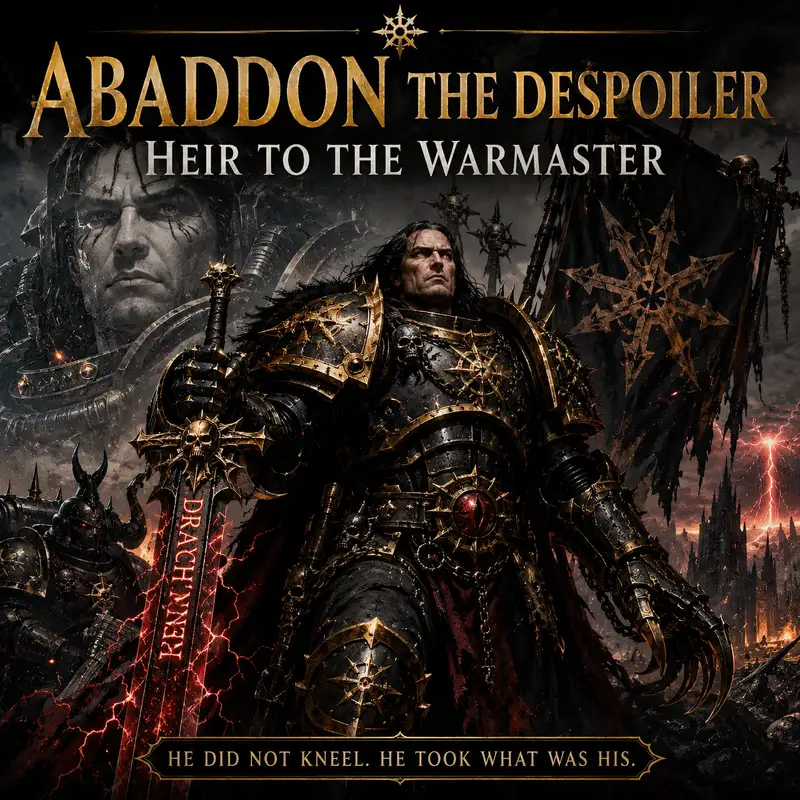
The most important moment in Abaddon’s rise did not come when he inherited Horus’s weapon, claimed the title of Warmaster, or led a fleet out of the Eye of Terror. It came when he stood before a copy of his dead gene-father and refused to kneel. The clone looked like Horus, fought like Horus, and carried the authority of memory. Abaddon killed it with the Talon that Horus had once worn. In that act, he announced the contradiction that would define him. He would continue the Warmaster’s war, but he would not remain the Warmaster’s son.
That is the central problem in understanding Abaddon the Despoiler. He is often described as the heir to Horus, and the title is accurate, but only in the most dangerous sense. He did not inherit a functioning empire, a united army, or a clear plan. He inherited defeat. He inherited the contempt of rival traitor legions, the ruins of a broken brotherhood, and a war that had already consumed nearly everyone who began it. His achievement was not simply taking Horus’s place. It was turning Horus’s failure into the foundation of a new kind of power.
Before he became the Despoiler, he was Ezekyle Abaddon of the Luna Wolves. He came from Cthonia, the harsh world from which Horus drew many of his legionaries. Cthonian culture valued strength, loyalty, reputation, and the ability to settle political disagreements with blunt instruments. Abaddon adapted well. He rose to become First Captain of the Luna Wolves, commander of the black-armoured Justaerin Terminators, and a member of the Mournival, the four-man council intended to advise Horus and challenge his thinking.
Even before the rebellion, Abaddon was widely treated as the most obvious embodiment of Horus’s Legion. His size, features, and temperament encouraged rumours that his connection to the primarch was unusually direct, though the surviving accounts do not settle every claim made about his origins. The perception mattered more than the genetics. Abaddon looked and acted like the Legion’s idea of itself: aggressive, loyal, confident, and convinced that hesitation was usually a problem best solved by advancing through it.
Abaddon was no detached philosopher in power armour. He was direct, proud, quick to anger, and convinced that the Legions had earned the right to shape the future they were conquering. He loved Horus with the fierce loyalty of a warrior who had found both a father and a commander. During the Great Crusade, that loyalty appeared admirable. Horus was brilliant, charismatic, and victorious. Following him seemed less like submission than common sense. The trouble with following a great man is that the habit can survive after the greatness has begun to rot.
When Horus was wounded on Davin, Abaddon helped carry him to the Serpent Lodge, where the Warmaster’s supposed healing became the gateway to corruption. Abaddon did not understand the full design at work. Few did. What mattered was that he accepted secrecy, ritual, and the advice of men like Erebus because he feared losing Horus. His loyalty made him useful. The road to damnation was not opened by cowardice. It was opened by devotion that refused to question the object of its devotion.
Once Horus rebelled, Abaddon followed without hesitation. He fought at Isstvan, hunted loyalists from his own Legion, and became one of the rebellion’s most relentless commanders. The Mournival, once a brotherhood built to preserve honest counsel, collapsed into murder and civil war. Abaddon’s former comrades became enemies because they placed principle above obedience. From his perspective, they had betrayed Horus. From theirs, Abaddon had mistaken loyalty to one man for loyalty to everything the Legion had once claimed to defend.
The Horus Heresy taught Abaddon how quickly noble language could become camouflage. The rebellion spoke of freedom from distant rulers, the rights of warriors, and the Emperor’s broken promises. It also burned worlds, butchered civilians, and handed armies to powers that regarded human souls as fuel. Abaddon did not recoil from those crimes. He committed and commanded them. Yet he also began to see that Chaos was not merely a weapon placed in Horus’s hand. It was a claimant to the hand, the arm, and eventually the mind holding it.
By the Siege of Terra, Horus was becoming less a general and more a vessel. The Warmaster who had once coordinated vast expeditionary fleets now spent long periods withdrawn, swollen with the power of the gods and increasingly distant from the practical conduct of the war. Abaddon watched the traitor coalition fray. Primarchs pursued obsessions. Legions followed private hungers. Command became a contest between divine prophecy, wounded pride, and whoever could still persuade the ammunition crews to report for duty.
Abaddon responded by trying to fight a soldier’s war inside a supernatural catastrophe. His assault beneath the Saturnine defences was bold, carefully assembled, and disastrous. Loyalist forces had anticipated the attack. The underground spearhead emerged into a killing ground, and elite Sons of Horus died in numbers their Legion could not easily replace. Abaddon survived only narrowly. The experience did not teach him humility in any gentle sense. It taught him that courage, elite troops, and a glorious objective are poor substitutes for sound intelligence when the enemy has prepared the reception.
Saturnine also exposed the growing distance between Abaddon and Horus. Abaddon still fought for the rebellion, but he increasingly despised what his father had become. Horus had accepted immeasurable power, and that power had consumed his freedom. To Abaddon, the Warmaster’s failure was not merely that he lost. It was that he surrendered the very independence the rebellion claimed to defend. Horus had challenged one master and ended with four far less reasonable ones.
When Horus died aboard the Vengeful Spirit, the rebellion lost the one figure capable of giving it even the appearance of unity. The Sons of Horus withdrew from Terra, carrying defeat into the void. Abaddon did not seize command immediately and declare that everything was proceeding according to plan. Even the traitor legions would have struggled to maintain a straight face. He ordered retreat, preserved what he could, and entered the Eye of Terror with the survivors.
Inside the Eye, time, geography, and loyalty became unreliable. The traitor legions turned on one another in the wars that followed. The Sons of Horus suffered especially. Their allies blamed them for the defeat at Terra. Their fortress was destroyed. Their numbers dwindled. Worst of all, the Emperor’s Children stole Horus’s corpse and allowed Fabius Bile to use it in his experiments. The Legion that had once stood first among the Emperor’s armies became a hunted remnant guarding the memory of a dead failure.
Abaddon disappeared from the centre of this collapse. Accounts describe him wandering within the Eye, searching, enduring, and refusing the immediate scramble for power. This absence matters. Horus had been appointed Warmaster by the Emperor before the Heresy began. Abaddon would receive no such legitimate commission. He could not rely on rank, bloodline, or ceremony. If he returned, he would have to build authority among warriors who recognised only strength, success, and the prospect of future plunder.
The theft and cloning of Horus finally drew him back. A group of legionaries found Abaddon aboard the recovered Vengeful Spirit, and he gathered a coalition to strike at Fabius Bile’s works. At the centre of the confrontation stood the clone of Horus, a body carrying the face, strength, and fragments of memory associated with the dead primarch. For the surviving Sons of Horus, it offered a terrible temptation. Their father had returned, or at least something close enough to make grief dangerous.
Abaddon’s answer was the Talon of Horus. He took up the weapon of his gene-father and used it against the gene-father’s image. The symbolism was almost painfully efficient. He claimed the military inheritance while rejecting the cult of the man. The old Legion had spent years praying to a corpse and dying for a name. Abaddon would not rebuild that shrine. He would take what remained useful, destroy what demanded worship, and force the survivors to look forward.
The Black Legion emerged from that decision. Its armour was black, but it was not simply the old First Company expanded to legion size. Nor was it merely the Sons of Horus with a less embarrassing name. Abaddon opened his ranks to warriors from across the traitor legions and, in later ages, to renegades from loyalist chapters. Former identity mattered less than present loyalty. The Black Legion would be a coalition bound by the Long War, not a family bound by one primarch’s gene-seed.
That change was Abaddon’s most important political innovation. The original traitor legions had become prisons built from memory. The World Eaters were chained to rage. The Emperor’s Children pursued sensation. The Death Guard endured beneath Mortarion and Nurgle. The Thousand Sons inhabited their own labyrinth of sorcery and regret. Even legions that retained more coherence carried ten thousand years of grievance. Abaddon offered another identity. A warrior could enter the Black Legion without pretending his old loyalties had ended well.
Unlike a primarch, Abaddon could not command obedience through awe alone. His authority had to be demonstrated, negotiated, rewarded, and defended. He offered warbands a banner larger than their private grudges, access to fleets and armouries, and a cause that could survive the death of any one champion. That made the Black Legion unusually adaptable. Its members did not have to share a bloodline or a god. They had to accept Abaddon’s command and contribute to the war.
Building that coalition required more than battlefield strength. Abaddon had to defeat rivals, bargain with warlords, tolerate specialists he disliked, and make examples of those who mistook negotiation for weakness. His rise was contested, particularly by figures such as the Death Guard warlord Thagus Daravek. Abaddon became Warmaster not because the gods issued a tidy certificate, but because enough champions accepted that following him offered better prospects than opposing him. Chaos remains chaos, so the agreement was reviewed frequently and with weapons present.
His relationship with the Chaos Gods is therefore central to his claim that he surpassed Horus. Abaddon accepts their marks, uses their daemons, bargains for their favour, and commands warriors devoted to each of them. He is not untainted. He is one of the greatest servants of Chaos in the setting, however he chooses to describe the arrangement. Yet he has resisted becoming a daemon prince and insists upon remaining his own master. He wants the gods as patrons, not owners.
Whether that independence is real remains uncertain. The gods of Chaos are not known for respecting contractual boundaries. They reward ambition because ambition creates motion, conflict, sacrifice, and ruin. Abaddon believes he can accept their power without repeating Horus’s surrender. Perhaps his long survival proves that he has succeeded. Perhaps his certainty is simply the most sophisticated chain they have ever placed around a mortal will. In the Eye of Terror, a leash does not become freedom merely because its wearer selected the colour.
What is clear is that Abaddon learned from Horus’s defeat. Horus attempted to win the Imperium through one enormous rebellion, driving directly toward Terra before his coalition dissolved. Abaddon adopted the Long War. He could strike, withdraw, recruit, gather relics, weaken defences, and return centuries later. Time inside the Eye did not pass as it did in realspace, while the Imperium aged beneath bureaucracy, superstition, and permanent emergency. Abaddon did not need every campaign to end at the Imperial Palace. He needed each campaign to leave the enemy less able to survive the next.
His first Black Crusade established the pattern. Abaddon broke out of the Eye, fought the Imperium’s defenders, and faced Sigismund, the ancient first High Marshal of the Black Templars. Their duel nearly killed Abaddon, but Sigismund fell. The victory mattered beyond the death of one legendary warrior. It announced that the veterans of the Heresy were returning under new leadership. During that crusade, Abaddon also claimed Drach’nyen, the daemon sword whose name means the End of Empires.
The weapons he carries tell his story. The Talon of Horus is inherited authority, torn from the wreckage of the old rebellion. Drach’nyen is chosen purpose, a weapon claimed during Abaddon’s own war. One binds him to Horus. The other points beyond Horus. Together they make him look like a successor, but they also reveal the terms of succession. Abaddon does not preserve the past. He strips it for weapons.
For much of Imperial history, the Black Crusades were remembered as repeated attacks that failed to reach Terra. That judgment was comforting and incomplete. The crusades had different objectives. Some gathered artefacts, destroyed enemies, tested routes, secured alliances, or weakened the systems surrounding the Eye of Terror. Not every operation succeeded exactly as intended, and Chaos commanders are no more immune to failure than anyone else. Abaddon’s strength lay in turning partial victories, recovered weapons, and surviving forces into preparation for another campaign.
The twelfth Black Crusade, remembered as the Gothic War, demonstrated how far his power had grown. Abaddon assembled a fleet on a scale unseen since the Heresy, devastated the Gothic Sector, and fought for control of ancient Blackstone Fortresses. He did not conquer the sector completely, but he emerged with two of those impossible weapons. An Imperial chronicler could record that the sector survived. Abaddon could record that he now possessed assets capable of changing the next war. Both statements were true, which is often how disasters receive respectable paperwork.
Cadia stood at the centre of that next war. The fortress world guarded the most stable passage between the Eye of Terror and the wider Imperium. It was not merely a planet covered in fortifications. It was the lock on the traitor legions’ prison. Abaddon had tested the Cadian Gate repeatedly, learning how the Imperium reinforced it, how its fleets responded, and how its defenders absorbed punishment. Cadia’s continued survival became proof of Imperial strength. That also made it the perfect target.
During the thirteenth Black Crusade, Abaddon committed the greatest alliance of Chaos forces since the Siege of Terra. The struggle for Cadia was not effortless. Imperial defenders, saints, Space Marines, soldiers, and allies inflicted severe losses. Plans failed. Subordinates quarrelled. Abaddon was wounded and forced from the battlefield. Yet he did not allow battlefield frustration to become strategic defeat. When the surviving Blackstone Fortress could no longer deliver the victory he wanted from orbit, he hurled it into Cadia.
The fortress world broke. Its defenders had not simply collapsed, and their resistance became legend, but the strategic barrier was destroyed. The loss of Cadia and its ancient pylons helped unleash the Great Rift, tearing the galaxy apart and isolating vast regions of the Imperium. Abaddon had not reached Terra. He had done something more immediately useful. He had changed the map on which every future Imperial war would be fought.
This was the clearest proof that the Long War was not merely an excuse for endless raiding. Abaddon had spent ages gathering forces, weapons, knowledge, and opportunities. At Cadia, those accumulated efforts produced a result Horus never achieved. The Imperium survived, and Roboute Guilliman returned to lead its defence, so Abaddon did not win the final victory. He did, however, transform a decaying empire into a divided one. For a commander who measures time in millennia, that is not a minor accomplishment.
None of this makes Abaddon a misunderstood liberator. His war is sustained by enslavement, sacrifice, corruption, and mass murder. He opposes the tyranny of the Imperium while building a hierarchy held together by terror and personal dominance. He condemns Horus for becoming a slave to the gods while accepting gifts purchased with the souls of others. His intelligence makes him more dangerous, not more virtuous. A disciplined atrocity remains an atrocity.
His claim to independence also contains a deep irony. Abaddon defines himself through refusal. He refuses to kneel to Horus’s memory. He refuses daemonhood. He refuses to abandon the rebellion. He refuses to accept that the Imperium’s survival proves the Emperor was right. Yet every refusal keeps him attached to the war that created him. He may have escaped Horus’s shadow as a commander, but he has never escaped Horus’s choice.
So is Abaddon truly the heir to the Warmaster? Yes, because he inherited the Long War, the Vengeful Spirit, the Talon, and the task of uniting forces that naturally prefer treachery to administration. No, because he built his legitimacy by declaring Horus a failure. He did not become great by imitating his father. He became great by studying where Horus broke, then reorganising the rebellion around that fracture.
Horus was given the title of Warmaster at the height of Imperial triumph. Abaddon claimed it among ruins. Horus commanded brothers who still remembered unity. Abaddon commands exiles who remember betrayal. Horus tried to seize the galaxy in one incandescent act of rebellion. Abaddon has spent ten thousand years teaching the galaxy that a war can be lost in stages long before the final fortress falls.
That is why the image of Abaddon remains so powerful. He stands in black armour beneath the Eye of Terror, wearing the weapon of a father he repudiated and carrying a sword named for the death of empires. He is Horus’s heir because he continues the war. He is more than Horus’s heir because he understands that inheritance is not reverence. It is deciding which parts of the dead will be carried forward, and which must be destroyed before they can command the living.