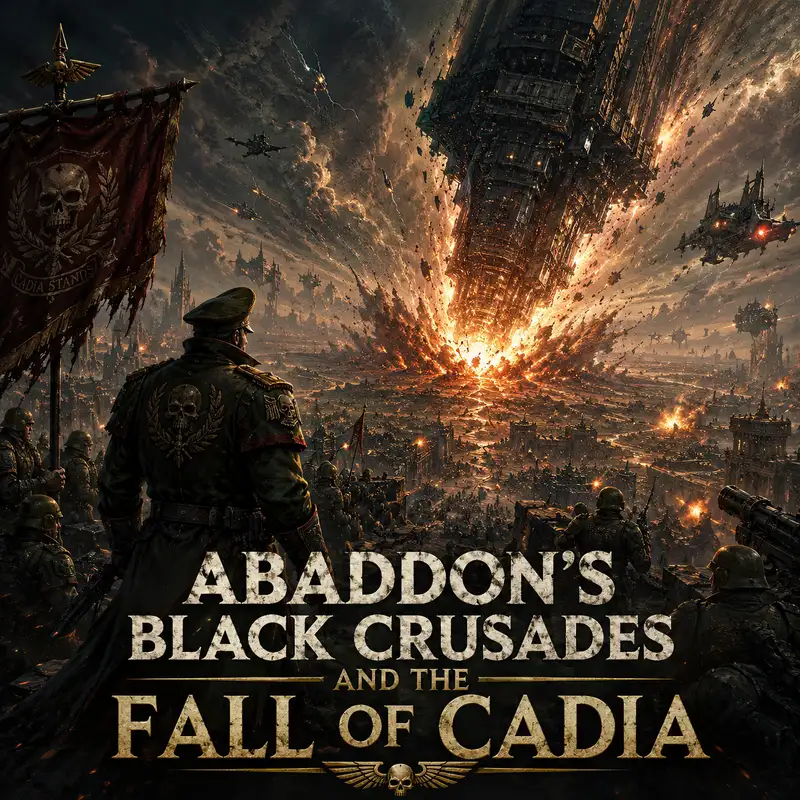
Abaddon’s Black Crusades and the Fall of Cadia
Cadia did not fall because its defenders forgot how to fight. It fell because Abaddon the Despoiler decided that a fortress he could not conquer would serve just as well as a grave. When the final assault stalled and the ancient pylons beneath the world began to awaken, Abaddon sent the broken remains of a Blackstone Fortress plunging into the planet. Continents split. The pylon network failed. The fortress world that had guarded the mouth of the Eye of Terror for thousands of years came apart beneath soldiers who were still firing. The planet broke before the Cadians did. That was the thirteenth Black Crusade, but to understand why it succeeded, we have to ask what the first twelve had actually been for.
Imperial histories often treated those earlier crusades as a comforting pattern. Abaddon emerged from the Eye of Terror. Worlds burned. The Imperium gathered its strength, drove the invaders back, and declared victory. Then he returned, apparently having learned nothing except how to make the casualty report longer. This version turned the greatest warlord of the Traitor Legions into a persistent nuisance rather than a patient enemy. The opposite version is also too simple. Abaddon was not an all-knowing architect whose every defeat unfolded exactly as intended. His fleets were destroyed, rivals betrayed him, and opportunities were lost. The Black Crusades were not thirteen attempts at the same objective. They were stages in a war that changed its methods while keeping its purpose.
Before he was Warmaster of the Black Legion, Ezekyle Abaddon was First Captain of the Sons of Horus. He had mastered the spear-tip assault, the direct strike that tore the command from an enemy army. He fought beside Horus during the Heresy, reached Terra, and watched the greatest rebellion in human history collapse after his primarch’s death. Abaddon did not emerge believing Horus had been misunderstood. He emerged believing Horus had failed.
The traitors fled into the Eye of Terror, where defeat became civil war. The Legions fought over territory, slaves, weapons, and pride. The Sons of Horus were especially hated because they bore the name of the commander who had lost. Their enemies stole Horus’s body, their allies abandoned them, and their power collapsed. Abaddon withdrew, then returned to destroy what remained of Horus’s legacy and build something new.
The Black Legion was not simply the Sons of Horus painted another colour. It welcomed warriors from many Traitor Legions and renegade Chapters, provided they accepted Abaddon’s authority and the Long War. Black and gold replaced sea green. The change was part mourning, part rejection, and part political declaration. Loyalty would rest on a shared war against the Imperium rather than descent from one primarch. Abaddon united warriors who agreed on almost nothing, which may be his most impressive achievement. Chaos can turn men into monsters with some regularity. Getting those monsters to attend the same campaign briefing is harder.
Abaddon accepted the favour of all four Chaos Gods, but resisted surrendering himself completely to any one of them. He remained a mortal warlord rather than ascending into daemonhood. A daemon prince possesses immense power, but is more tightly bound to the Warp and to a patron’s will. Abaddon intended to conquer the material galaxy in flesh and armour. He believed he could take gifts from the gods without becoming a piece in their game. Whether anyone can bargain with Chaos and remain independent is doubtful, but this refusal shaped his strategy. He built power from warbands, fleets, cults, weapons, routes, and obligations. Those are less dramatic than prophecy, but generally more useful when invading a galaxy.
The Eye of Terror was a vast wound in reality where the Warp pressed close. Escaping it in force was difficult because stable routes were limited, and the most important passed through the Cadian Gate. Cadia stood beside that passage like a mailed fist at the throat of Chaos. Across its surface rose ancient blackstone pylons created long before humanity reached the stars. The Imperium did not understand them, but knew they suppressed the Warp and helped restrain the Eye. It built fortresses around machines it could not explain and entrusted entire sectors to their continued operation. This was ordinary Imperial procedure. The unusual part was that it worked for thousands of years.
The First Black Crusade announced that the traitors had survived. Sigismund, first High Marshal of the Black Templars and one of the greatest swordsmen of the Heresy, had waited for their return. Centuries had passed when he met Abaddon, yet Sigismund wounded the new Warmaster almost beyond recovery. Abaddon killed him, but the duel was no easy triumph. Sigismund’s body was returned to the Imperium with a message carved into his black sword. We are returned.
The crusade also carried Abaddon to Uralan, where he claimed the daemon blade Drach’nyen beneath the Tower of Silence. By the campaign’s end, he had slain the Imperium’s greatest surviving champion of the Heresy, acquired one of the galaxy’s most dangerous weapons, and proved the Eye was not a prison. Judged as an attempt to conquer Terra, the crusade failed. Judged by what Abaddon actually gained, it was a beginning.
The crusades that followed varied greatly. Some were invasions across whole regions. Others concealed narrow objectives inside raids, cult uprisings, and daemonic incursions. Abaddon destroyed sacred sites, broke military formations, secured gene-seed, summoned ancient daemons, punished rivals, tested Imperial responses, and opened routes for other Chaos fleets. The records are incomplete and contradictory. Imperial archives emphasise worlds saved. Chaos accounts describe every pile of corpses as a revelation of cosmic destiny. Neither makes ideal material for a calm staff study.
A pattern nevertheless emerges. Across the millennia, Abaddon’s forces struck at worlds and structures connected to blackstone, especially monoliths that restrained the Warp. Later Imperial analysis described this effort as the Crimson Path. The aim was not merely to march through the Cadian Gate. It was to damage the barriers that made the gate necessary. Abaddon was not only battering the door. He was cutting through the walls around it.
This explains why many Imperial victories proved temporary. When a Chaos fleet withdrew, commanders judged the campaign by territory held, enemy ships destroyed, and cities preserved. Those measures were reasonable and incomplete. Abaddon sometimes left without the world but with a relic, prisoner, navigational secret, new ally, or the destruction of a target the Imperium had not recognised as important. The Imperium counted the ground it still possessed. Abaddon counted the tools he could use next time.
Still, every loss was not proof of genius. Chaos was not a reliable army but a coalition of ancient grudges armed with battleships. Daemon primarchs pursued their own obsessions. Legion commanders resented one another. The gods offered contradictory visions and rewards. Abaddon’s plans had to survive both the Imperium and his allies. He repeatedly improvised, threatened, bargained, and sacrificed forces he could not replace. His achievement was not perfect foresight. It was strategic persistence under conditions that made persistence nearly impossible.
The Twelfth Black Crusade revealed how far that persistence had carried him. Known to the Imperium as the Gothic War, it engulfed the Gothic Sector for more than two decades. Warp storms isolated the region while Abaddon’s fleets struck naval bases, routes, and inhabited worlds. He deployed the Planet Killer and sought six ancient Blackstone Fortresses that the Imperium had converted into defensive stations. Imperial and Aeldari forces eventually turned the war against him. In the conventional sense, Abaddon was driven off. Yet four fortresses were destroyed, and two disappeared into the Warp under his control. The Imperium held the sector. Abaddon left carrying its most important weapons.
Blackstone can affect the boundary between realspace and the Warp. Under different conditions, it can suppress empyric energy or magnify it. The pylons on Cadia held the Warp back. The captured fortresses could focus power on a destructive scale. One would become the Will of Eternity, a mobile strategic weapon whose full capabilities neither side completely understood. Abaddon did not need complete understanding. He needed it to work long enough to break something.
By the closing years of the forty-first millennium, Abaddon was ready to launch the Thirteenth Black Crusade. This was not one fleet aimed at one planet. It was a vast offensive across the Cadian Gate, combining Traitor Legions, renegade Space Marines, daemonic hosts, cult armies, Titans, and warships. Cadia remained the centre because its destruction would remove both the fortress guarding the route and the pylons restraining the Eye. Abaddon’s allies wanted plunder, vengeance, sacrifice, or divine favour. He needed them to want those things in roughly the same direction.
Cadia’s commander was Ursarkar E. Creed. He rose during the opening disasters after the Volscani Cataphracts turned traitor at Tyrok Fields and slaughtered much of the high command. Creed crushed the rebellion and became Lord Castellan. He possessed no supernatural gifts. His strength was disciplined use of reserves, an instinct for enemy intent, and a willingness to prepare for the attack behind the attack. When the first waves appeared to recede, Creed did not believe the war was over. An enemy such as Abaddon did not spend fleets merely to make noise, unless the noise covered something worse.
Cadia had been shaped by permanent mobilisation. Its fortress cities, called kasrs, were strongholds as much as population centres. Cadian youths trained before entering full service, and regiments left the world to fight across the Imperium. Their doctrine emphasised discipline, combined arms, and the expectation that any position might become decisive. The culture was harsh, but not empty propaganda. Cadians had stared into the Eye for generations and repeatedly fought what came out. On many Imperial worlds, readiness was an emergency measure. On Cadia, it was closer to climate.
The final invasion battered the planet from orbit and across its surface. Kasrs were isolated, relieved, and surrounded again. Armour fought through wreckage. Artillery fired until its barrels failed. Daemons appeared where reality thinned, while traitor warbands pursued private rivalries inside Abaddon’s campaign. Space Marines, Sisters of Battle, Imperial Navy formations, Mechanicus forces, and Guard regiments reinforced the Cadians. The fortress-monastery Phalanx attacked the Will of Eternity and crippled it, but the ancient station remained a mass of weaponised blackstone hanging above the world.
On the ground, the defence became personal. Saint Celestine arrived with the Sisters of Our Martyred Lady and turned a collapsing front into a rallying point. Inquisitor Katarinya Greyfax fought beside allies she regarded with deep suspicion, which for an inquisitor is a form of emotional balance. Creed directed armies while Jarran Kell guarded him. When Abaddon struck the command structure, Kell sacrificed himself to delay the Warmaster and let Creed escape. Abaddon had not come merely to watch from orbit. He intended to kill Cadia’s leaders, reach the pylon fields, and ensure the ancient machines never barred his path again.
Beneath the surface, Belisarius Cawl attempted to reactivate the pylons. He received help from Trazyn the Infinite, a Necron overlord whose usual interests involved removing important people and objects from history and placing them in his collection. Trazyn did not aid humanity from affection. A galaxy consumed by the Warp would be bad for preservation, and even an immortal curator has standards. He opened parts of his collection and released warriors taken from other ages, producing reinforcements no Imperial quartermaster had requested and none could properly explain.
Cawl and Trazyn brought the pylons to life. The pressure of the Warp receded. Daemons weakened or vanished. Psychic powers failed. The supernatural fire surrounding Celestine diminished, and the Living Saint became painfully mortal. Even the Eye of Terror appeared to contract as the pylon field asserted itself. For a brief moment, the machinery beneath Cadia threatened to reverse the purpose of the crusade.
The activation revealed something important about Abaddon. Much of his coalition depended on the Warp, but the core of the Black Legion remained beings of flesh, gene-forged muscle, armour, and hatred. They could fight when daemons vanished and sorcerers faltered. Abaddon’s refusal to become a daemon prince gave him freedom where more corrupted champions were crippled. Yet the pylons were closing the route to the Warp, and remaining risked trapping his forces in realspace. Victory could still be taken from him.
Celestine fought Abaddon despite losing much of her divine strength. Greyfax and the Cadians pressed the counterattack. Creed entered the struggle and was grievously wounded. Abaddon was hurt badly enough to withdraw, and the Black Legion began leaving the pylon fields. The defenders had stopped the immediate assault, activated the pylons, and forced the Warmaster from the field. Had the battle ended there, Cadia might have survived.
Abaddon refused to let the battle end there.
From the Vengeful Spirit, he turned the crippled Will of Eternity into a projectile. The fortress was one of the greatest prizes he had taken during the Gothic War, an irreplaceable weapon gathered through centuries of preparation. He spent it in a single act. If Cadia could not be captured, its strategic function could still be destroyed. If the pylons could not be held, they could be buried beneath a dead world. There was spite in the choice, but also cold economy. Abaddon sacrificed a weapon to remove a barrier.
The broken fortress descended through Cadia’s sky like a falling continent. Its impact tore the crust and shattered the pylon network. Tectonic failure spread across the surface. Cities collapsed, and the Warp surged into the wounds. Evacuation orders went out, though no plan could remove more than a fraction of those still fighting below. Creed remained behind with the Cadian Eighth to cover the withdrawal. Ships escaped carrying soldiers, civilians, and whatever relics could be saved. Behind them, the world came apart.
Cadia’s destruction became a critical catalyst for the opening of the Great Rift. With its pylons gone and other blackstone sites already damaged during Abaddon’s campaigns, warp storms spread and joined across the galaxy. The Cicatrix Maledictum divided the Imperium. On one side, worlds could still see the Astronomican and maintain some connection to Terra. On the other lay Imperium Nihilus, where navigation, communication, and reinforcement became uncertain or impossible. Abaddon had not merely opened a route from the Eye. He had changed the strategic geography of the galaxy.
Was this a complete victory for Chaos? Not quite. Abaddon lost armies, ships, allies, and one of his greatest weapons. Survivors escaped and continued fighting. Cadian regiments retained their discipline, traditions, and name, turning a dead planet into a living military identity. Imperial bastions in the wider region continued to resist. The defenders denied Abaddon a clean conquest and forced him to purchase destruction at a terrible price.
None of that changes the strategic result. Cadia’s purpose had been to bar the gate and anchor the machinery restraining the Eye. After the crusade, the planet was gone, the pylons were broken, and the galaxy was split. In war, a costly victory remains a victory when the enemy’s position becomes permanently worse. The Cadians won battles on the surface, in the tunnels, and in orbit. Abaddon won the campaign by ensuring there would be no surface left to defend.
The Black Crusades are best understood neither as twelve failures followed by one success nor as a flawless plan executed without error. They were campaigns in which Abaddon accumulated power, tested defences, removed obstacles, recruited allies, acquired weapons, and learned how the Imperium responded. Some objectives were planned far in advance. Others were opportunities seized from chaos in both senses of the word. His strength was not that he never lost. It was that his losses did not end the war, while each Imperial victory consumed resources the Imperium could barely replace.
Horus had tried to destroy the Imperium with one overwhelming rebellion and one decisive assault on Terra. Abaddon chose the Long War. He attacked the edges, routes, symbols, and hidden structures that allowed the Imperium to function. He allowed generations of Imperial commanders to believe survival was the same as recovery. By the time the full pattern became visible, Cadia was already beneath a falling fortress.
Abaddon remains a contradiction. He despises Horus for becoming a pawn, yet carries the Talon of Horus. He claims independence from the gods, yet bears their blessings and wields a daemon as a sword. He presents himself as master of the Long War, though every victory draws the material galaxy closer to powers he believes he can control. He is not a mindless servant of Chaos, and that makes him more dangerous. It does not make him free.
Cadia remains a contradiction as well. The world is dead, yet its name is spoken on battlefields across the Imperium. Its surviving soldiers carry its doctrine and memory. They insist that Cadia stands, and in the sense that matters to soldiers, it does. Its people were not erased. Its regiments did not surrender. Its example outlived its continents.
But memory is not a pylon. Courage cannot close the Great Rift. The defenders denied Abaddon the victory he wanted, and Abaddon accepted the ruin that gave him the galaxy he needed. Cadia stands in regimental colours, memorial stones, and the voices of survivors. Across the sky, the wound opened by the Black Crusades still burns.