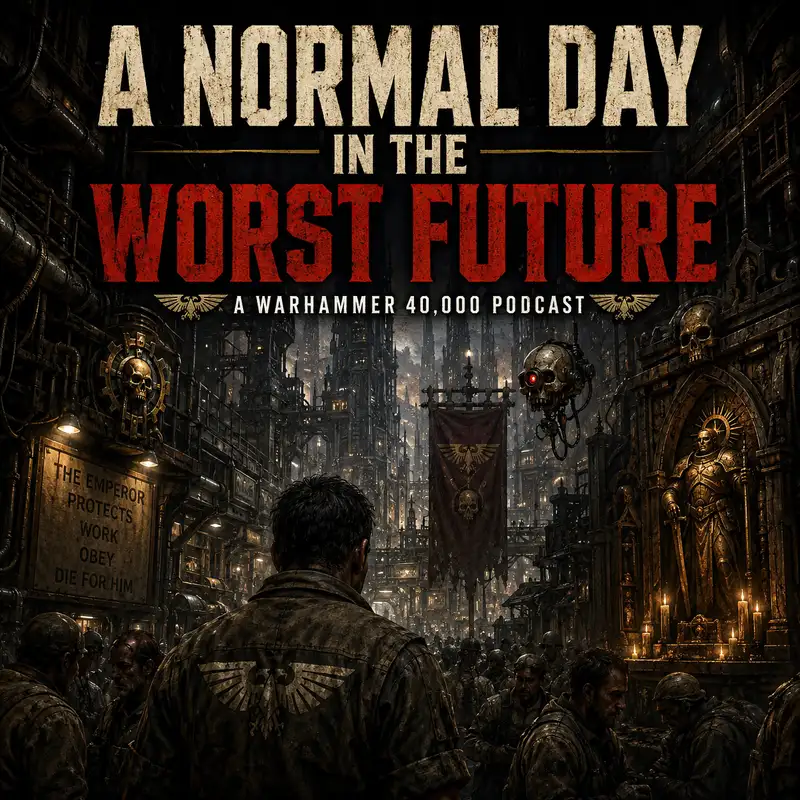
A Normal Day in the Worst Future
The day begins with a bell, although no one in the hab-block has ever seen it. The sound rolls through iron walls, rattles loose dust from overhead pipes, and tells several thousand people that the next work shift has begun. There is no sunrise this far inside the hive. Morning is whatever the authorities say it is.
One of those people wakes in a room shared with family members, storage lockers, devotional images, and the persistent vibration of machinery. They are not a Space Marine, an Inquisitor, a famous general, or a secret heir to anything. They will probably never see an alien. They may live their entire life without hearing a bolter fired. In the stories of Warhammer forty thousand, they are almost invisible.
They are also the person the entire Imperium is built upon.
Ask what a normal day looks like in the worst future imaginable, and the honest answer is that there is no single normal day. The Imperium stretches across a million worlds, divided by distance, unreliable communication, and the hazards of the warp. One planet may possess towering cities and ancient machines. Another may be a feudal kingdom whose people know the Emperor only as a distant god. A third may be a planet-wide factory where the air is an industrial by-product.
The Imperium does not create uniformity so much as demand obedience. Local customs may survive. Languages, clothing, food, architecture, and even the details of religious practice can vary enormously. What matters is that the world pays its tithe, acknowledges Imperial authority, worships the Emperor in an acceptable form, and does not attract the wrong sort of attention.
For a useful picture of ordinary life, imagine a worker in a hive city. This is not every Imperial citizen, but it is a common human experience. Hive cities are immense structures built upward and downward across centuries. Their upper levels hold palaces and government chambers. Their lower regions descend through factories, hab districts, abandoned infrastructure, criminal territories, and places where official maps become hopeful suggestions.
Our worker lives somewhere in the crowded middle. High enough that the walls are maintained, low enough that no one pretends the air is fresh.
Their first act of the day may be prayer. A small shrine to the Emperor stands near the door, perhaps beside the image of a local saint, a regiment raised from the district, or an ancestor who died in Imperial service. The prayer is partly faith, partly habit, and partly proof of respectability. In the Imperium, these three things often share the same room.
The Imperial Creed is not identical everywhere. The Emperor may be depicted as a golden ruler, a sun god, a warrior ancestor, or a divine protector whose sacrifice preserves humanity. The Ecclesiarchy tolerates considerable variation as long as the central message remains clear. The Emperor is divine. Humanity is besieged. Duty is sacred. Doubt is dangerous.
This religion is an instrument of control, but it is not merely a fraud imposed upon people who should know better. The warp is real. Daemons exist. Human minds can become doors through which terrible things enter reality. Miracles appear often enough that complete disbelief would be as foolish as unquestioning certainty. An Imperial citizen lives in a universe where superstition can be oppressive, comforting, and occasionally correct.
Breakfast depends on the world and the worker’s status. It may be grain, fungus, algae, preserved protein, ration paste, or something described as meat because the alternative would require additional paperwork. Water is likely recycled. So is almost everything else. In the harshest hives, even human remains may be processed into the food supply, although corpse-starch is not the universal Imperial menu. The Imperium has many cuisines. Most of them improve with ignorance.
The worker leaves the hab and joins the flow of bodies moving toward the manufactorum. The journey may involve crowded lifts, rail cars, moving platforms, or several kilometres on foot through corridors that have not seen natural light in generations. Loudspeakers broadcast prayers, production notices, warnings about sedition, and reports of victories too distant for anyone present to verify.
Statues watch from alcoves. Servo-skulls drift between cables. Servitors perform repetitive tasks with machine-like patience because most of their humanity has been surgically removed. Some were criminals. Some were condemned debtors. Some were simply selected by systems that do not feel obliged to explain themselves. To the worker, they are not shocking. They are part of the furniture of civilisation.
The manufactorum may produce ammunition, engine components, uniforms, food containers, weapon parts, or a single small fitting used inside a larger machine assembled on another continent. The worker may not know the final purpose of what they make. Specialisation protects production, preserves secrets, and ensures that few people understand enough of the process to change it.
Before the machinery starts, a supervisor or tech-priest may perform a ritual. Oils are applied. Incense is burned. Approved words are spoken. Controls are activated in the correct sequence. To a modern observer, this can look like superstition wrapped around engineering. Sometimes it is. Sometimes the ritual is the only surviving procedure that reliably keeps an ancient machine operating. In the Imperium, the difference between prayer and maintenance is often whether the machine starts afterward.
The shift is long. Its exact length matters less than the principle behind it. Most of the worker’s waking life belongs to the factory. Production quotas are measured carefully. Fatigue is not. A machine has a sacred maintenance schedule. The people feeding it may be replaced.
Accidents happen. A hand is crushed. A lung is damaged by fumes. A worker disappears into moving machinery, and the line pauses just long enough to remove what would interfere with production. Better facilities may offer augmetics, medical care, or compensation. Worse ones offer a vacancy.
During a meal break, the worker hears rumours. A transport ship has arrived in orbit. A new levy is coming. A saint’s relic will pass through the district. There has been fighting in the lower levels. Someone saw a mutant near a water station. Someone else says the mutant was merely an injured labourer, but this is not the sort of distinction that improves with public discussion.
Reliable information is rare. The Imperium’s communication systems are stretched across interstellar distances and filtered through military commands, religious authorities, noble houses, censors, and bureaucracies. A war may be old before news of it arrives. A victory may be announced while the victorious planet is already burning. An error copied into the records can become official truth if it survives long enough.
Most citizens know almost nothing about the galaxy as a whole. They may have heard of Space Marines as angels of the Emperor, but never expect to see one. They may know that aliens exist without knowing what they look like, and understand Chaos only as forbidden corruption. This ignorance comes partly from distance and partly from policy. Knowledge can be dangerous in Warhammer forty thousand. Unfortunately, ignorance is not especially safe either.
The worker returns to the line among friends, relatives, rivals, and people whose families have served the same concern for generations. There are jokes whispered beyond the supervisors’ hearing, courtships, grudges, celebrations, and acts of generosity. Someone saves part of a ration for a child. Someone covers a station while a friend visits a sick parent. Someone has stolen a tool and will spend the rest of the shift insisting it was requisitioned.
This ordinary humanity is essential. Imperial citizens build lives inside systems that treat them as numbers. They form families beneath propaganda screens and sing local songs in buildings designed to manufacture artillery shells. They create normality because people have always created normality, even where normality is a very poor bargain.
After work, the worker may visit a market, a shrine, a drinking house, or a communal room. They may watch a local contest, gamble, listen to music, or simply return home before the next shift bell. The Imperium does not prohibit pleasure as a universal rule. It regulates, taxes, moralises, and occasionally weaponises it, which is a more administratively satisfying arrangement.
The local enforcers patrol the district. They are usually not members of the Adeptus Arbites. The Arbites defend Imperial law and the authority of the wider Imperium. Ordinary policing is commonly handled by planetary forces, guild guards, noble retainers, or institutions with names that sound reassuring until they arrive at the door.
Justice depends heavily on status. A worker who steals rations may be beaten, imprisoned, conscripted, or converted into a servitor. A noble who steals an entire district may be praised for restructuring its assets. The Imperium possesses vast legal systems, but equality before the law is not one of their most dependable products.
Above the worker, sometimes literally, lives another version of normal life. In the upper hive, noble families breathe cleaner air, eat food grown under real light, wear imported fabrics, and conduct political struggles that can destroy thousands of people below them. Their children receive education, patronage, and the assumption that the future belongs to them. Some nobles are capable administrators. Some sincerely believe their privilege is a sacred responsibility. Some are ornamental disasters with private armies.
Below the worker lies the underhive. There, power failures, toxic leaks, collapsing structures, gangs, mutants, scavengers, and forgotten machines shape daily life. Official authority weakens. Local power belongs to whoever controls water, weapons, medicine, or access to safer levels. The underhive is not simply a basement full of criminals. It is a society formed from abandonment.
It is also fertile ground for rebellion and cults. A Chaos preacher can offer meaning to people whose suffering has been declared useful. A Genestealer Cult can offer belonging, family, and a promised day of liberation to workers ignored by everyone above them. The promises are lies, or at least truths with catastrophic omissions, but they do not begin by sounding like madness. They begin by identifying a real wound.
The hive worker’s day is only one possibility.
On an agri world, normal life may mean operating enormous harvesters beneath chemical clouds or tending engineered crops across continents. Some agri worlds are green and fertile. Others are industrial food engines whose soil, weather, and population have been reorganised around export quotas. The pastoral life exists, but it may come with a production target large enough to feed a star system.
On a forge world, menials labour among furnaces, assembly lines, data vaults, and engines they are forbidden to understand. Pollution may make unaugmented life difficult. Workers can be modified to suit their task, because adapting the person is often easier than changing the machine.
Aboard an Imperial voidship, a citizen may be born, work, marry, and die without ever setting foot on a planet. Entire communities live in lower decks, maintaining systems whose designers are forgotten. Occupations pass through families. The captain may be as distant as a planetary monarch, and most crew members see only bulkheads.
On a feudal world, life may resemble an age of castles, villages, mounted warriors, and hand tools. The population may know little of technology beyond sacred objects held by priests or rulers. An Imperial tithe ship can seem like a visitation from heaven, particularly when it takes soldiers, food, or both.
On a civilised world, life may look disturbingly familiar. There can be apartments, offices, shops, vehicles, courts, hospitals, restaurants, universities, and professional careers. Not every street is covered in chains and skulls. People can have comfortable homes and routine concerns while still living beneath an authoritarian state, a mandatory faith, inherited privilege, and obligations to distant wars.
There are also shrine worlds crowded with pilgrims, fortress worlds built around military service, mining worlds carved hollow for resources, death worlds where survival is a profession, and paradise worlds maintained for those wealthy enough to enjoy someone else’s labour. On isolated planets, the Imperium may exist only as a tax collector, a religious symbol, and a fleet that appears once in a generation.
For many, the day ends much as it began. The worker returns to the hab. They eat, pray, talk with family, repair clothing, and sleep while machinery hums through the walls. They may be tired without being hopeless, and may take pride in their work. If someone has been taught from birth that every shell made in the factory protects humanity, that belief can carry genuine dignity.
The Imperium survives partly because billions of ordinary people choose duty, loyalty, courage, and sacrifice within it. They are not all mindless victims. Many love their homes, honour their regiments, trust their priests, and fear the enemies beyond Imperial borders for very good reasons. Orks do raid worlds. Tyranids do consume populations. Drukhari do take captives. Chaos does corrupt. The danger is real.
The tragedy is that the Imperium uses real danger to justify nearly every cruelty, including cruelties that make it weaker.
Then, one day, the routine changes.
The shift bell sounds at the wrong hour. Transit lines stop. Blast doors close. A proclamation orders all citizens to remain calm, which is how many Imperial disasters introduce themselves. The cause might be a riot, a plague, a tithe inspection, an uprising, an orbital attack, or a bureaucratic mistake with unusually energetic consequences.
Perhaps the Administratum has ordered the raising of new Astra Militarum regiments. The worker’s district must provide bodies. Some citizens volunteer out of faith, ambition, poverty, or a desire to escape the hive. Others are selected. Training may be thorough or hurried. The regiment may become a proud military formation with strong traditions and capable officers. It may also be sent to a war zone whose name the recruits cannot pronounce.
Perhaps a child in the district begins to hear thoughts that were never spoken. Psychic ability is both valuable and terrifying. Authorities will investigate. The individual may be taken for assessment and eventual collection by the Black Ships. Some psykers are trained for Imperial service. Some become astropaths or sanctioned battlefield psykers. Some are judged too dangerous. The family is expected to regard surrender as duty, because private grief has never been allowed to interfere with strategic requirements.
Perhaps the disturbance begins in the lower levels. Workers seize a power station. A familiar foreman speaks of liberation. Symbols appear on walls. The movement may be a genuine revolt against brutal conditions, a Genestealer Cult preparing its ascension, a Chaos sect answering voices from the warp, or all three causes tangled together by fear and opportunism.
Perhaps the sky itself becomes relevant. Enemy ships enter the system. Sirens sound. Defence batteries fire from towers whose purpose the worker has never understood. The manufactorum changes production schedules. Local enforcers become military police. The planetary defence force mobilises. Rumours spread faster than official announcements.
For the ordinary citizen, the appearance of a Space Marine is not necessarily reassuring. Space Marines arrive when a situation has already exceeded the capacity of ordinary institutions. Seeing one is rather like seeing a surgical instrument the size of a tank. It may save your life. Its presence is not evidence that your day is improving.
If the enemy reaches the hive, the worker’s knowledge of the war will remain painfully local. They will know which corridor is blocked, which shelter still has water, and which neighbour did not return. They may never know the enemy commander’s name, the strategic importance of the planet, or whether the battle is considered a victory elsewhere.
Evacuation will be limited. Priority goes to military assets, senior officials, essential specialists, sacred relics, and anyone whose family prepared for this possibility several generations ago. Most citizens will shelter, labour, fight, flee downward, or die where the Imperium requires them to remain.
Yet even during invasion, the machinery of routine may continue. Factories operate under bombardment. Priests hold services in transit tunnels. Rations are distributed. Clerks record losses. Someone stamps a form authorising ammunition for soldiers already dead. The Imperial response is vast, sincere, and frequently delayed by procedure.
This is the point at which ordinary life in Warhammer forty thousand reveals its true shape. The normal day is not separate from the wars, crusades, and catastrophes. It feeds them. The hive worker makes the ammunition. The agri worker supplies the rations. The voidship crew carries the army. The clerk records the tithe. The parent gives up a child. The preacher gives suffering a sacred meaning.
Most citizens never stand on the front line, but the front line reaches backward through every factory, field, shrine, transport deck, and hab unit in the Imperium.
And still, the day is not made only of oppression. A parent tells a story to a child. A medic treats a stranger. Workers pull someone from wreckage before the next collapse. Soldiers hold a corridor so civilians can escape. People share food they cannot spare. Faith gives courage as well as obedience. Communities survive because ordinary humans remain capable of decency inside institutions that rarely reward it.
That is why a normal day matters. Warhammer forty thousand is filled with demigods, monsters, and battles large enough to scar planets, but scale alone does not make the setting frightening. The deeper horror is that the galaxy’s impossible violence rests upon familiar things. A job. A family. A rent payment. A ration queue. A supervisor. A prayer said because everyone says it, and then said again because tonight it might be needed.
The worst future is not worst because every minute contains a daemon or an artillery barrage. It is worst because most days do not. Most days are survivable. They contain enough friendship, duty, habit, and hope to keep people going. The system needs only for each person to surrender a little more of life to the machine, generation after generation.
Somewhere deep inside a hive, the bombardment stops. Dust settles through the hab corridor. The dead are counted, the missing are reassigned, and the production quota is revised.
Then the bell sounds.
The survivors rise, because morning is whatever the Imperium says it is.